Category: Business News

  • How Indian CAs and Accountants Can Practice in Dubai

    How Indian CAs and Accountants Can Practice in Dubai

    Imagine being a talented CA who hails from India. You are practising well, your clients trust you 100%, and you have a strong career going on for yourself. But as you see new opportunities coming towards you, you start looking at the bigger picture and start thinking. Maybe you want to cater to global clients, grow your services or establish an international presence.  

    That’s where Dubai, UAE, enters the frame. Being one of the top business hubs of the world, it gives a plethora of opportunities to individuals who work in finance, including talented CAs from India. That’s why, in this blog, we will be talking about business setup for Indian CAs in Dubai. 

    For those who do not know, Indian CAs have an important role to play in the entrepreneurial world of the UAE. The financial knowledge that they bring, their international outlook, and expertise in the Indian as well as the UAE markets really benefit businesses. No matter if it’s about making sure there’s compliance, figuring out complicated regulations, or creating opportunities that are new, CAs from India are dependable partners when it comes to the growth of the company. 

    Alright! Now that we’ve established that, let’s dive in deeper to understand the business setup for Indian CAs in Dubai. 

    Why Dubai Appeals to Indian CAs? 

    Dubai is one of the top business hubs of the world. That’s why it appeals to small and medium enterprises, startups, MNCs, and global investors. That said, once companies expand, so does their requirement for expert financial services. These include accounting, compliance with VAT, bookkeeping, reporting of finances, CT advisory, management of payroll, and auditing.  

    A few major benefits for Indian CAs are: 

    • Increasing need for tax and accounting knowledge 
    • Access to a client base that is diverse and international  
    • Prime location that links Asian, European & African markets 
    • Regulations that are business-friendly  
    • Advanced financial ecosystem 
    • Chances to work with law firms, consultants, etc.  

    Thanks to these factors, business setup for Indian CAs in Dubai is an appealing choice for expert professionals who want to grow outside of the Indian market. 

    Is It Possible for Indian CAs to Practice in Dubai? 

    Of course. Indian CAs can give accounting as well as consultancy services lawfully in Dubai, as long as they secure the crucial company licenses and approvals.  

    Based on the provided services, professionals might set up:  

    • Consultancy firms for accounting 
    • Practices with respect to financial advisory 
    • Companies that provide bookkeeping services 
    • Firms that provide tax consultancy 
    • Businesses that provide corporate finance advice 

    To function lawfully, professionals need to finish the needed process for CA firm registration in Dubai and secure permission from the concerned authorities.  

    Explained: Available Business Structures for Indian CAs 

    Before you begin your operations, you need to choose the correct structure of your business, as it’s necessary. Some of the most typical options are: 

    UAE Mainland  

    A company in the UAE Mainland lets accounting professionals cater to their clients across the United Arab Emirates. There are no geographical restrictions. To add, a Mainland setup is perfect for those firms that want to directly work with companies that are local, corporations that are huge, and government entities.  

    UAE Free Zone  

    Some Free Zones in the United Arab Emirates provide professional licenses that suit accounting as well as consultancy activities. Free Zones such as DWTC, IFZA, and DMCC come with simplified processes for registration. Often, these get a preference from the business owners who want an affordable market entry.  

    Remember, going with the correct structure is an extremely important step when it comes to Business setup for Indian CAs in Dubai. The reason? It has a direct impact on the operational flexibility as well as the growth of your business. 

    Licenses Needed to Launch Your Accounting Practice 

    Securing the right license is crucial before you start providing professional services. Based on the activities, you might need an accounting consultancy license in Dubai that allows services like: 

    • Bookkeeping 
    • Reporting of the finances 
    • Tax consultancy 
    • Consulting for compliance 
    • Management accounting 
    • Advisory for business 

    Remember, the exact requirements related to licensing might differ depending on what jurisdiction you go with and the nature of the services being provided.  

    What Are the Steps for CA Firm Registration in Dubai? 

    We are sure that by now, you might be thinking about the CA firm registration in Dubai process. To put it simply, it usually includes the following steps: 

    Step 1. Finalise Your Business Activities 

    Start by establishing what services will be provided by your firm, like reporting of finances, bookkeeping, consultation regarding taxes, etc. When you clearly highlight your activities, it aids in establishing the requirements for approval & licensing. 

    Step 2. Pick a Business Jurisdiction 

    Select whether you wish for your firm to be established in the Mainland or a UAE Free Zone, depending on the market you’re targeting as well as your operational requirements. Remember, every jurisdiction comes with specific advantages, regulations, and opportunities for business.  

    Step 3. Secure Your Unique Business Name 

    Pick a trade name that is unique and in compliance with the naming guidelines of the United Arab Emirates. To add, the name should be a reflection of your professional services. After it is approved, that name will get reserved for the process of your company registration.  

    Step 4. Get Initial Approvals 

    Turn in the needed paperwork as well as applications (for initial approval) to the concerned authorities. This step is a confirmation that the business activities you proposed meet regulatory needs.  

    Step 5. Submit Your License Application 

    Make sure you’re applying for your accounting consultancy license in Dubai that’s appropriate and is in line with the services you plan to provide. Securing the right license is crucial if you wish to operate your accounting practice lawfully. 

    Step 6. Finish Registering Your Company 

    Make sure you have finalised all the formalities related to the incorporation, such as submission of paperwork and approvals from the government. This finishes the process of accounting firm company formation & establishes your business officially.  

    Step 7. Open a Corporate Bank Account 

    After the registration of your company, you need to set up your business bank account with a bank that is based in the United Arab Emirates. This lets you take care of the transactions related to your business, payments, as well as operations related to finances with efficiency.  

    If you want a seamless experience when it comes to business setup for Indian CAs in Dubai and begin legally serving your clients, make sure you follow these steps. 

    What Are the Services Provided by Indian CAs in Dubai? 

    Accounting experts can offer a variety of services post getting the needed approvals, such as: 

    • Accounting & bookkeeping 
    • CT advisory 
    • Preparation of the financial statement 
    • Processing of the payroll 
    • Value Added Tax registration & compliance 
    • Assessment of the internal controls  
    • Valuation of the business  
    • Consulting for finances 
    • Advisory on risk management 
    • CFO services 

    The flexibility offered by the United Arab Emirates’ market makes it simpler for you to start an accounting business in Dubai and serve businesses in a variety of industries. 

    Top 4 Advantages of Establishing an Accounting Firm in Dubai 

    Here are several benefits of going for a professional accounting practice set up in Dubai: 

    Growing Market Access 

    Many new businesses get set up in the United Arab Emirates annually. This makes a constant demand for services related to accounting.  

    Global Client Exposure 

    The international business environment of Dubai lets firms collaborate with clients from across nations & industries.  

    Opportunities for Business Expansion 

    It’s possible for professionals to grow their operations by providing consulting solutions as well as financial services that are specialised. 

    Solid Regulatory Framework 

    The evolving financial regulations of the United Arab Emirates make opportunities for expert professionals who are able to help companies stay compliant.  

    These benefits have made a significant contribution to the growing demand for the services related to accounting firm setup in Dubai among professionals from India.  

    Challenges One Should Consider 

    Yes, there are substantial opportunities. However, as a professional, you need to be aware of the challenges, too. These are: 

    • Licensing & compliance needs 
    • Competition in the market 
    • Strategies for client acquisition 
    • Knowing the tax regulations of the UAE 
    • Ensuring professional certifications as well as standards 

    Cost of Establishing an Accounting Firm in Dubai 

    Although the cost lies between AED 12,900* to AED 30,000*, the entire price of an accounting firm setup in Dubai is based on certain factors, such as: 

    • Jurisdiction of your business 
    • Licensing needs 
    • Allocation of the visas 
    • Office space needs 
    • Fee for the government 
    • Professional service costs 

    Since requirements differ, getting personalised assistance could be a great idea before you execute your accounting firm company formation process.  

    Set Up Your Accounting Firm in Dubai with Shuraa India! 

    Establishing your professional UAE accounting practice includes several regulatory, licensing, and paperwork requirements. Which is why it can seem like a hassle if you are doing it on your own. Don’t worry! That’s where Shuraa India comes into the picture. We make the process simple by helping you right from registration to banking assistance. 

    Over the past few decades, we have enabled thousands of Indian business owners to realise their UAE business dream, and you could be next. With us, you don’t get overpromised claims or complicated solutions. Our team of experts understands your unique requirements and helps you with what’s best for your business.  

    So, no matter if you want support with your CA firm registration in Dubai, want to get your accounting consultancy license in Dubai, or wish to start an accounting business in Dubai, all you need to do is contact us, and we will take care of the rest.  

    FAQs 

    1. How to Register a CA Firm in Dubai?  

    To do it, you need to follow the necessary steps that enable you to register your firm.  

    2. Is an Indian CA Valid in Dubai?  

    Of course! Their international outlook, knowledge related to finances, and command of the Indian as well as the UAE markets are really advantageous for businesses.  

    3. What Are the Best Business Setup Consultants for Indian CAs in Dubai? 

    If you’re an Indian CA looking for reliable consultants to set up your firm in Dubai, Shuraa India is one of the leading names that you can trust. 

    4. Cost of Company Formation for Indian Chartered Accountants in Dubai? 

    Although the price falls between AED 12,900* to AED 30,000*, there are several factors that influence the entire costing such as jurisdiction of your business and licensing needs, etc. 

    5. Is Dubai Good for Accountants?  

    Totally! The city offers a good environment for the growth and success of accounting firms. 
  • UBO Registration UAE: What Indian Business Owners Must Know

    UBO Registration UAE: What Indian Business Owners Must Know

    The United Arab Emirates has turned out to be a preferable business hub for business owners from India (who want to expand internationally). And why should we blame them? Whether it is policies that are tax-friendly or business setup options that are easy, the UAE provides a lot of opportunities for growth to anyone who dares to dream loudly. 

    That said, with global business activity rising, the government in the United Arab Emirates has also done its bit to strengthen the regulations related to corporate transparency. And this is exactly why we’d be talking about one of the major requirements for compliance, i.e., UBO registration in the UAE. 

    If you have your very own UAE company or are managing one, it is extremely important for you to understand the regulations related to the Ultimate Beneficial Owner (UBO). This is because if you fail to comply, it can result in legal complexities, penalties & disruptions when it comes to your operations. That’s why, in this blog, we will tell you all that you need to know regarding UBO registration in the UAE, such as why it is important, what you require, the eligibility, and the process for compliance. 

    What Do You Mean by UBO Registration in the UAE? 

    UBO, or Ultimate Beneficial Owner, refers to the natural person who directly or indirectly owns, controls, or has significant influence over a company, usually through 25% or more ownership or voting rights. Under UAE regulations, companies are required to identify and maintain records of their UBOs to enhance corporate transparency and help prevent financial crimes such as money laundering and terrorism financing. 

    The process via which the ownership details are submitted to the concerned authorities is referred to as UBO registration in the UAE. For those who do not know, the regulation is applicable to the majority of the companies in the Mainland, entities in the Free Zone & other licensed companies that operate in the United Arab Emirates. 

    The goal? Enhancing accountability & making the United Arab Emirates aligned with the global standards for anti-money laundering. 

    Explained: The Reason Behind the UBO Regulation Being Introduced 

    The UBO rules were introduced by the UAE as a part of its attempts to fortify its economic ecosystem and improve global trust. The aim of the authorities is to make a business atmosphere that is transparent, where the identification of the actual owners behind companies becomes easy. 

    The following are supported by these regulations: 

    • Money laundering prevention 
    • Financial fraud reduction 
    • Better compliance for AML that’s a must for India-UAE companies to follow 
    • Investor confidence that’s stronger 
    • Improved credibility for international business 

    For Indian business owners who are functioning in the United Arab Emirates, compliance is not just optional. Keeping precise records when it comes to ownership is an extremely important legal responsibility now. 

    Who Needs to Register for UBO in the UAE? 

    A lot of companies that are based in the UAE have to adhere to the UBO rules. This involves: 

    • Companies in the Mainland 
    • Companies in the Free Zone 
    • Entities that are commercial 
    • Businesses that operate in the UAE that are foreign owned 

    If you happen to be the beneficial owner of a UAE company, you might need to submit your information as part of the registration process of the Ultimate Beneficial Owner. 

    What Information Do You Need for UBO Registration?  

    As a business, for you to finish the process of registration, you generally need to give:  

    • Complete name of the individual who’ll be the beneficial owner 
    • Details related to the passport 
    • The nationality 
    • Residential address  
    • Percentage of ownership 
    • Control nature in the business 
    • Details related to the visa or the Emirates ID (if applicable) 

    Authorities might also ask for corporate paperwork that is supportive in nature, copies of the license, as well as shareholder structures.  

    That’s why ensuring your records are up to date is equally important. If there are any changes in terms of ownership or structure of control, usually, they must be reported within the timeframe that is prescribed.  

    Why is It Important for Indian Business Owners to Maintain UBO Compliance? 

    Indian entrepreneurs often go for company formation in Dubai & other emirates to expand internationally, plan their taxes, and access markets. That said, if you ignore compliance needs, you’d be putting yourself at serious risk.  

    Listed below are the reasons why you need to go for UBO registration in the UAE:  

    1. To Steer Clear of Penalties

    If you aren’t compliant, it might lead to huge fines, company operation restrictions, or challenges when it comes to renewing your trade license. 

    2. To Keep Up Banking Relationships

    UAE banks carry out tight due diligence checks. If you, as a business, have proper UBO records, it can help you keep up financial credibility as well as banking operations that are smooth.  

    3. To Encourage Corporate Transparency 

    Having ownership disclosures that are strong means contributing to the UAE’s corporate transparency. This increases trustworthiness when it comes to investors, financial institutions, as well as authorities. 

    4. Boost Your International Image

    As a company, if you comply with the international standards for ownership disclosure & AML, you could be seen as more dependable and credible.  

    What is the Procedure for UBO Registration? 

    The process for UBO registration in the UAE generally includes the following steps: 

    Step 1: Determine Your Ultimate Beneficial Owners 

    Figure out those people who will be owning or controlling the business directly or indirectly, such as investors, shareholders, or people who have a lot of power to make decisions for the business when it comes to the business.  

    Step 2: Make Sure Your Supporting Documents are Ready 

    Have the identification paperwork, records related to the ownership, and information regarding the shareholders in place. It is important to ensure that all the paperwork is updated, accurate, and in line with the legal structure of the company ahead of submission.  

    Step 3: Make the Information Submission to Authorities 

    Make sure you are filing the needed details with the concerned authority of the Free Zone or the relevant licensing authority of the UAE Mainland within the timeline that has been prescribed.  

    Step 4: Ensure Your Records are Updated  

    Companies need to make sure that information related to ownership remains precise and up to date. If there are any changes in the structure of control or shareholding, they should be promptly reported to the concerned authority.  

    Remember, finishing UBO registration in the UAE in a correct manner helps companies steer clear of needless delays as well as challenges related to compliance. 

    What Are Some Typical Challenges Companies Face? 

    A lot of Indian business owners come across challenges like: 

    • Complicated structures for ownership  
    • Difficulty in figuring out indirect ownership 
    • Incomplete paperwork 
    • Submissions that are delayed 
    • Insufficient knowledge when it comes to regulatory updates 

    That’s why it becomes important to take professional advice, as it can make the entire process simple and minimise the risks related to compliance in a significant manner.  

    How Can Expert Business Setup Consultants in the UAE Be Helpful? 

    Expert business setup consultants can help businesses: 

    • Understand regulatory requirements 
    • Identify beneficial owners accurately 
    • Prepare the required documentation 
    • Ensure timely submissions and filings 
    • Stay compliant with changing regulations 

    For Indian business owners who are not familiar with the compliance processes of the UAE, professional assistance is time-saving, error-reducing, and helps streamline the operations of the business.  

    Make Your UAE UBO Registration Easy in Shuraa India! 

    Knowing the regulations related to compliance in the United Arab Emirates can seem complex, particularly for business owners from India who are taking care of cross-border company operations. From figuring out the ultimate beneficial owners to making sure you are ready with precise paperwork, even a single, tiny mistake can result in penalties or needless delays. 

    At Shuraa India, our experts simplify the entire UBO registration process for UAE businesses. From understanding legal requirements and organising ownership records to preparing documents and ensuring timely submissions, we help you stay fully compliant with ease. 

    No matter if you have a business in the Mainland or a company in the Free Zone, our expert consultants offer comprehensive support, helping you remain compliant and concentrate on the growth of your business.  

    FAQs 

    1. Who is Eligible for UBO Registration in the UAE?

    Any person who is owning 25% or above shares or voting rights in a business (directly/ indirectly), or can significantly exercise control concerning the decisions related to the business, is usually regarded as qualified when it comes to UBO. 

    2. What Does UBO Stand for?

    The person who ultimately has either direct or indirect ownership or control over a business is referred to as the UBO (also known as Ultimate Beneficial Owner) 

    3. Is It Mandatory to Go for UBO Registration in the UAE?

    Of course! Most of the UAE Mainland companies and even Free Zone businesses need to adhere to the UBO regulations.  

    4. Can a CEO Be a Beneficial Owner? 

    Totally! It is possible for a CEO to be considered as a beneficial owner provided they are owning the business (25% or more, whether directly or indirectly) or exercising control that is significant when it comes to the business’ operations or decision-making.  

    5. What Are the Documents Required for Beneficial Ownership? 

    The paperwork needed for beneficial ownership typically involves copies of the passport, Emirates ID, or copies of the visa (if applied), details of the shareholder, ownership records of the company, copies of the trade license, and supporting corporate paperwork that shows the structure of the ownership. 

  • Is Dubai better than Singapore for Indian startups?

    Is Dubai better than Singapore for Indian startups?

    A Bengaluru-based startup founder recently shared something interesting during a startup networking event in Dubai. His startup grew significantly within one year after launch. His client base included people from the UAE, Europe, and Southeast Asia. Payments were arriving in USD, and expansion opportunities were opening up across global markets.

    So, he started exploring a location for his business expansion plans. When he researched which country would help in maximising his profits through tax savings and a better client base, two names came to the top of his list. These two names were Dubai and Singapore. 

    And honestly, this is exactly where many Indian entrepreneurs find themselves today. A few years ago, international business expansion was something only large corporations thought about. Now, even early-stage founders, agencies, SaaS startups, e-commerce brands, consultants, and digital businesses are comparing global business hubs before scaling. 

    Choosing between Dubai and Singapore as your next business destination can appear difficult. Both attract founders from across the world. Both offer strong business environments. But the better choice depends entirely on what kind of startup you are building and how you want to scale it. 

    In this blog, we will break down the complete Dubai vs Singapore business setup comparison for Indian startups in 2026. 

    Dubai vs Singapore for Startups: Quick Comparison 

    Before diving into details, here’s a quick overview of how both destinations compare for Indian entrepreneurs. 

    Factor  Dubai  Singapore 
    Business Setup Time  Fast  Fast 
    Corporate Tax  9% (0% in many free zone cases)  17% with exemptions 
    Personal Income Tax  0%  Progressive tax rates 
    Foreign Ownership  100% ownership available  100% ownership available 
    Market Access  Middle East, Africa, Europe  Asia-Pacific (APAC) 
    Ease of Setup  Very flexible and founder-friendly  More compliance-oriented 
    Investor Ecosystem  Growing rapidly  Highly mature 
    Best For  Trading, consulting, e-commerce, logistics, agencies  SaaS, fintech, AI, VC-backed startups 
    Operational Costs  Moderate  Higher 
    Lifestyle for Indian Founders  Familiar and highly connected to India  Structured and premium 

    Both destinations are highly business-friendly. The difference lies in what your startup prioritises more i.e., operational flexibility or long-term institutional positioning. 

    Why Indian Startups Are Comparing Dubai and Singapore? 

    Over the last few years, Indian startups have become far more global in their thinking. Indian entrepreneurs are no longer limiting themselves to one market. Modern startups often work with international clients, remote teams, global payment systems, and overseas investors from day one. 

    Because of this, founders are now looking for jurisdictions that offer: 

    • Better tax efficiency 
    • Easier international banking 
    • Faster company setup 
    • Global business credibility 
    • Access to new markets 
    • Better founder lifestyle and mobility 

    Dubai and Singapore have become two of the most preferred options because both offer strong infrastructure, international connectivity, and startup-friendly environments. 

    Dubai has become extremely attractive for founders who want faster setup, lower taxes, easier residency options, and direct access to the Middle East and Africa. Singapore, on the other hand, continues to attract startups looking for strong investor credibility, advanced financial systems, and deeper access to Southeast Asian markets. 

    This is why the startup in Dubai vs Singapore debate has become much bigger in 2026 than ever before. 

    Dubai vs Singapore Business Setup Process 

    When founders decide to expand internationally, one of the first concerns is how quickly and smoothly the company can actually be established. In this area, both Dubai and Singapore perform very well compared to most global jurisdictions. However, Dubai often feels more flexible and founder-friendly for Indian entrepreneurs, especially during the early stages. 

    Setting Up a Business in Dubai 

    Dubai has become one of the easiest places in the world to start a business. The process is fast, digital, and designed to attract foreign entrepreneurs. Indian founders can choose between Mainland company setup, Free zone company setup, and Offshore structures. 

    Free zones are especially popular among startups because they offer: 

    • 100% foreign ownership 
    • Easy licensing 
    • Simplified compliance 
    • Flexible office solutions 
    • International business operations 

    Many startups in consulting, e-commerce, digital marketing, IT services, trading, and logistics prefer Dubai free zones because setup can often be completed within a few days. 

    Another major advantage is that founders can also apply for UAE residency through their business setup. This makes it easier for founders to live in Dubai and operate globally. 

    Dubai’s business ecosystem is designed for speed. Founders usually spend less time dealing with paperwork and more time focusing on growth. 

    Popular UAE Free Zones for Startups: 

    Setting Up a Business in Singapore 

    Singapore also offers a fast and digital incorporation process. The country is known for its highly organised regulatory system and strong legal framework. However, the setup process can be slightly more structured for foreign entrepreneurs.  

    In many cases, foreign founders need: 

    • A local nominee director 
    • Additional compliance documentation 
    • Banking approvals 
    • Corporate service providers for setup support 

    Singapore works exceptionally well for startups planning long-term regional expansion across Asia-Pacific markets. 

    The ecosystem is especially strong for SaaS startups, Fintech companies, AI businesses, Venture capital-backed startups, and Deep tech ventures. While incorporation is efficient, operational compliance can feel more detailed compared to Dubai. 

    Dubai vs Singapore Tax Benefits for Startups 

    Tax is one of the biggest reasons founders compare these two destinations. 

    Here’s a simplified overview: 

    Tax Factor  Dubai  Singapore 
    Personal Income Tax  0%  Up to 22% 
    Corporate Tax  9%  17% 
    VAT/GST  5% VAT  9% GST 
    Capital Gains Tax  Generally favourable  No capital gains tax 
    Profit Repatriation  Allowed  Allowed 

    For founders generating international revenue, Dubai’s tax environment can significantly improve cash flow efficiency. 

    However, Indian entrepreneurs should also remember that FEMA regulations, tax residency rules, DTAA provisions, and RBI compliance still matter when operating internationally. 

    Many startups rush into overseas incorporation without understanding tax residency and compliance requirements properly. Speaking with Shuraa India experts before expanding internationally can help avoid costly restructuring later. 

    Cost of Running a Startup in Dubai vs Singapore 

    Startup Costs in Dubai 

    Dubai is often more cost-efficient than Singapore for many early-stage businesses. Operational flexibility is one of the biggest reasons behind this. 

    Founders can choose from virtual office solutions, shared workspaces, flexible visa packages, and different free zone pricing options. 

    That said, Dubai is still a premium international business destination. Costs can increase depending on: 

    But overall, many startups find Dubai easier to manage financially during the growth stage. 

    Startup Costs in Singapore 

    Singapore is known for higher operational costs. Businesses often spend more on: 

    • Office rentals 
    • Salaries 
    • Corporate compliance 
    • Professional services 
    • Living expenses 

    However, many founders see this as a tradeoff for stability, strong infrastructure, and investor confidence. For funded startups targeting global markets, the higher costs are often considered part of building a premium international presence. 

    Dubai vs Singapore for Startup Funding and Investors 

    Dubai’s Growing Startup Ecosystem 

    Dubai’s startup ecosystem has grown rapidly over the last few years. The UAE government has invested heavily in: 

    • Innovation programs 
    • AI initiatives 
    • Tech infrastructure 
    • Startup accelerators 
    • Investor ecosystems 

    Dubai is becoming increasingly attractive for startups in Fintech, Web3, E-commerce, LogisticsReal Estate Tech, and AI services. The city is also attracting global founders because of its business-friendly policies and international connectivity. 

    For many Indian entrepreneurs, Dubai offers a practical combination of growth opportunities, tax efficiency, and global expansion potential. 

    Singapore’s Strong VC Ecosystem 

    Singapore remains one of Asia’s strongest hubs for venture capital and startup funding. The country has built deep investor confidence over decades. 

    Many international investors prefer Singapore structures because of strong corporate governance, legal transparency, IP protection, and financial system stability. 

    This makes Singapore particularly attractive for startups planning: 

    • Institutional fundraising 
    • International acquisitions 
    • Large-scale APAC expansion 
    • Enterprise technology growth 

    For startups heavily dependent on venture capital, Singapore often has an edge in fundraising maturity. 

    Market Access: Dubai vs Singapore 

    Dubai’s Global Position 

    Dubai sits between Asia, Europe, and Africa, making it a major international business gateway. 

    Startups operating from Dubai can easily serve: 

    • GCC countries 
    • Middle East markets 
    • Africa 
    • Europe 
    • South Asia 

    This is especially valuable for businesses in trading, logistics, export-import, consulting, and international services. For Indian entrepreneurs, the UAE also offers geographical proximity and easier travel connectivity. 

    Singapore’s APAC Advantage 

    Singapore is often used as a regional headquarters for Asia-Pacific operations. It offers excellent access to: 

    • Indonesia 
    • Malaysia 
    • Vietnam 
    • Thailand 
    • Philippines 
    • Broader ASEAN markets 

    Many global technology companies use Singapore as their APAC headquarters because of its regulatory stability and advanced financial infrastructure. This makes Singapore highly attractive for startups planning deep expansion into Southeast Asia. 

    Lifestyle, Residency and Founder Experience 

    Lifestyle may not seem like a business factor initially, but for founders building long-term companies, it matters more than people expect. 

    Dubai has become highly attractive for Indian founders because of: 

    • Golden Visa opportunities 
    • Political Stability 
    • Strong Indian business community 
    • Luxury lifestyle 
    • Modern infrastructure 
    • International networking environment 
    • Easier relocation flexibility 

    Many entrepreneurs also feel culturally comfortable in Dubai because of its large Indian population and familiar business ecosystem. 

    Singapore offers a different kind of appeal. It is known for: 

    • Political stability 
    • Clean urban environment 
    • Strong public systems 
    • High-quality education 
    • Efficient public transport 
    • Family-friendly living 

    Both cities offer high safety standards and world-class infrastructure. The right choice depends more on the lifestyle and expansion environment a founder personally prefers. 

    Startup in Dubai vs Singapore: Which One Should You Choose? 

    After comparing every major factor, the final answer depends on your startup goals. 

    Choose Dubai For – 

    • Faster and simpler setup 
    • Tax efficiency 
    • Access to Middle East markets 
    • Lower operational friction 
    • Global lifestyle flexibility 
    • Easier business scalability 
    • Strong international connectivity 

    Dubai works extremely well for founders in building profitable, globally operating businesses. 

    Choose Singapore For – 

    • Strong investor ecosystem 
    • APAC expansion 
    • Institutional credibility 
    • Deep tech ecosystem 
    • Long-term fundraising opportunities 
    • Strong IP and regulatory frameworks 

    Singapore is often preferred by startups focused heavily on venture-backed scaling. 

    Note:  

    Every startup has its own operational needs, and a single ecosystem doesn’t work for all. Some businesses prioritise profitability and operational ease. Others look for funding and institutional credibility. 

    Here’s where each destination usually performs better. 

    Business Type  Better Fit 
    E-commerce Business  Dubai 
    Trading & Export Companies  Dubai 
    Consulting & Agencies  Dubai 
    Logistics & Supply Chain  Dubai 
    SaaS Startup  Singapore 
    AI & Deep Tech  Singapore 
    VC-Funded Startup  Singapore 
    MENA Expansion Business  Dubai 
    APAC Expansion Business  Singapore 
    Freelancers & Solopreneurs  Dubai 

    For many Indian SMEs and service-based startups, Dubai often becomes the more practical choice because of operational flexibility and easier international scaling. 

    Can Indian Startups Use Both Dubai and Singapore? 

    Yes, and many growing businesses have already done this. Some startups operate with: 

    • UAE entity for operations and tax efficiency 
    • Singapore structure for fundraising or APAC presence 
    • India operations for talent and development 

    Hybrid structures are becoming increasingly common among globally scaling Indian startups. The right structure depends on your revenue model, founder residency, investor plans, client geography, and expansion goals. 

    Professional guidance becomes extremely important here because international structures must comply with Indian regulations, FEMA guidelines, and taxation rules. 

    Which is better for Indian Startups – Dubai vs Singapore? 

    The Dubai vs Singapore for startups debate does not have one universal answer. Both are world-class business destinations. Both offer major advantages. And both continue attracting ambitious Indian founders in 2026. 

    Singapore offers structure, investor confidence, and strong APAC positioning. Dubai offers speed, flexibility, tax efficiency, and global expansion advantages that are difficult to ignore. 

    Statistically, Dubai is more preferred launchpad for Indian founders because it combines international business access with founder-friendly operations. The UAE government’s focus on innovation, foreign investment, and entrepreneurship has made the country one of the most attractive destinations for modern startups. 

    If your goal is to build a globally connected business with operational flexibility and strong growth potential, Dubai offers a highly compelling environment to scale. 

    How Shuraa India Can Help You Set Up a Business? 

    Choosing the right country is only the first step. The real challenge is choosing the right jurisdiction, license, business activity, and the right setup structure. 

    At Shuraa India, we help Indian entrepreneurs simplify the entire Dubai business setup process. From company formation, free zone setup, mainland licensing, visas, banking assistance, and compliance guidance, our team supports you throughout the process. 

    If you are planning to expand your startup internationally, this is the right time to explore how Dubai can support your business growth. 

    Get in touch with Shuraa India today and build your Dubai business with expert guidance. 

    Frequently Asked Questions 

    1. Is Dubai better than Singapore for Indian startups?

    Dubai is often considered better for Indian startups looking for faster setup, lower taxes, easier scalability, and access to Middle Eastern markets. Singapore is usually preferred by startups focused heavily on venture capital funding and APAC expansion. 

    2. Which is cheaper for startups: Dubai or Singapore?

    In most cases, operational costs in Dubai are lower than in Singapore, especially for early-stage businesses and SMEs. Singapore generally has higher office, staffing, and living costs. 

    3. Is Dubai good for SaaS startups?

    Yes, Dubai is becoming increasingly attractive for SaaS startups, especially those targeting MENA markets. However, startups seeking aggressive VC funding and APAC-focused expansion may also consider Singapore. 

    4. Can Indian entrepreneurs fully own a company in Dubai?

    Yes. Many UAE free zones and mainland structures allow 100% foreign ownership for Indian entrepreneurs. 

    5. Which country offers lower taxes: Dubai or Singapore?

    Dubai offers 0% personal income tax and competitive corporate tax rates, making it one of the most tax-friendly business destinations globally. 

    6. Is Singapore better for startup funding?

    Singapore has a highly mature investor ecosystem and is often preferred for venture capital-backed startups, fintech businesses, and deep-tech companies. 

    7. Can Indian startups operate in both Dubai and Singapore? 

    Yes. Many startups use hybrid business structures depending on their operational, tax, fundraising, and market expansion goals. 

  • JAFZA vs DAFZA Free Zone: Which Is Better for Indian Exporters?

    JAFZA vs DAFZA Free Zone: Which Is Better for Indian Exporters?

    International business expansion isn’t a faraway dream for Indian business owners, especially when the United Arab Emirates offers some Free Zones that are the most strategic across the globe. However, when it’s about choosing from two key players like JAFZA and DAFZA, the final decision often comes after a thorough JAFZA vs DAFZA comparison.  

    That’s why, in this blog, we are going to talk about all the things Indian exporters should know, from cost to location benefits, suitability of business, and logistics, for you to decide better and with confidence.  

    That said, no matter if you’re looking for a DAFZA setup or want a JAFZA Free Zone company, Shuraa India is with you every step of the way. From assisting you in figuring out the correct Free Zone to taking care of the paperwork, setup, and licensing. We make the procedure easy for you by providing holistic support. 

    Explained: JAFZA & DAFZA Free Zones  

    What’s JAFZA? 

    One of the biggest and most established UAE Free Zones, the Jebel Ali Free Zone (JAFZA) is located near the world-renowned Jebel Ali Port. This acts as a major hub when it comes to trade, manufacturing, as well as logistics.  

    For those who do not know, a Jebel Ali Free Zone company is particularly advantageous for exporters who deal with goods in bulk. This is because it has direct access to shipping routes that are international.  

    What’s DAFZA? 

    Strategically situated near the Dubai Airport Freezone Authority, Dubai International Free Zone (DAFZA) is recognised for its premium-quality infrastructure and connectivity that’s seamless. It’s perfect for businesses that deal with products that are high-value and time-sensitive.  

    To add, companies that depend on quick international distribution and air cargo systems that are efficient often prefer a DAFZA setup 

    JAFZA vs DAFZA Comparison: What are the Major Differences? 

    Selecting between these options calls for an in-depth look at how different they are across business factors that are critical. Let’s understand one by one.  

    1. Logistics and Location  

    JAFZA allows access to sea routes quite directly, which makes large shipments very cost- ffective. Whereas the airport proximity offered by DAFZA makes sure that there’s rapid delivery across global markets.  

    This is a central distinction when we talk about the JAFZA vs DAFZA comparison. 

    2. Activities for Business  

    Jebel Ali Port Free Zone supports a wide industry range. This includes manufacturing, trading, as well as logistics. However, the Dubai Airport Free Zone Authority is inclined towards sectors such as aviation, electronics, IT, and professional services.  

    3. Price and Setup 

    In general, JAFZA is more cost-effective, especially for businesses that need industrial space and warehouses. On the other hand, a DAFZA setup is more premium, offering quicker processing and an infrastructure that’s high-end. Here’s the starting price for both: 

    • JAFZA: Starts from *AED 50,000  
    • DAFZA: Starts from *AED 40,000  

    4. Infrastructure 

    From offices that are smart and facilities that are tech-enabled in DAFZA to industrial land as well as logistics parks present in JAFZA, both zones serve distinct operational requirements.  

    This, here, is yet another major factor when we talk about JAFZA vs DAFZA comparison. 

    5. Connectivity for Exporters  

    Both JAFZA and DAFZA come with powerful connectivity to India. JAFZA links via key sea routes, whereas DAFZA allows for air cargo movement that’s quick. This makes both a great option when we talk about a UAE Free Zone for exporters in India. 

    JAFZA vs DAFZA Comparison

    Bird’s Eye View of the JAFZA vs DAFZA Comparison 

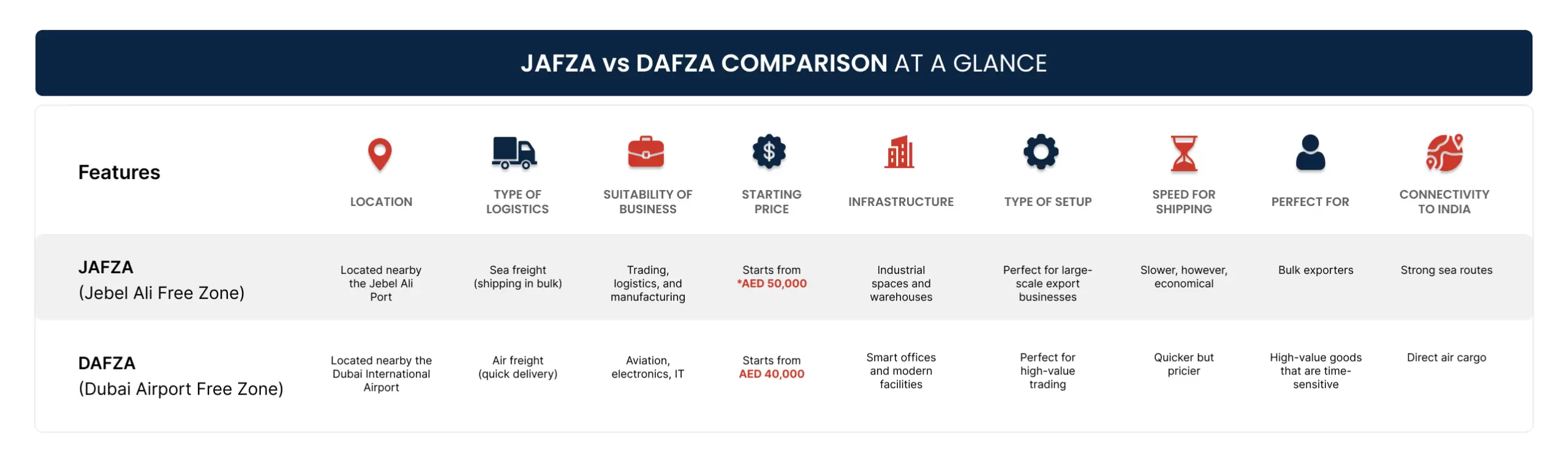
    To make the decision-making process easier for you, have a look at a quick comparison between both of these Free Zones: 

    Features  JAFZA (Jebel Ali Free Zone)  DAFZA (Dubai Airport Free Zone) 
    Location  Located nearby the Jebel Ali Port  Located nearby the Dubai International Airport 
    Type of Logistics  Sea freight (shipping in bulk)  Air freight (quick delivery) 
    Suitability of Business  Trading, logistics, and manufacturing  Aviation, electronics, IT 
    Starting Price  Starts from *AED 50,000  Starts from *AED 40,000 
    Infrastructure  Industrial spaces and warehouses  Offices that are smart, facilities that are modern 
    Type of Setup  Perfect for export businesses that are large-scaled  Perfect for trading that is of high value 
    Speed for Shipping  Slower, however, economical  Quicker but pricier 
    Perfect For  Bulk exporters  High-value goods that are sensitive to time 
    Connectivity to India  Sea routes that are strong  Air cargo that is direct 

    Rest assured, the aforementioned perfectly reveals the essence of the JAFZA vs DAFZA comparison for quick evaluation. 

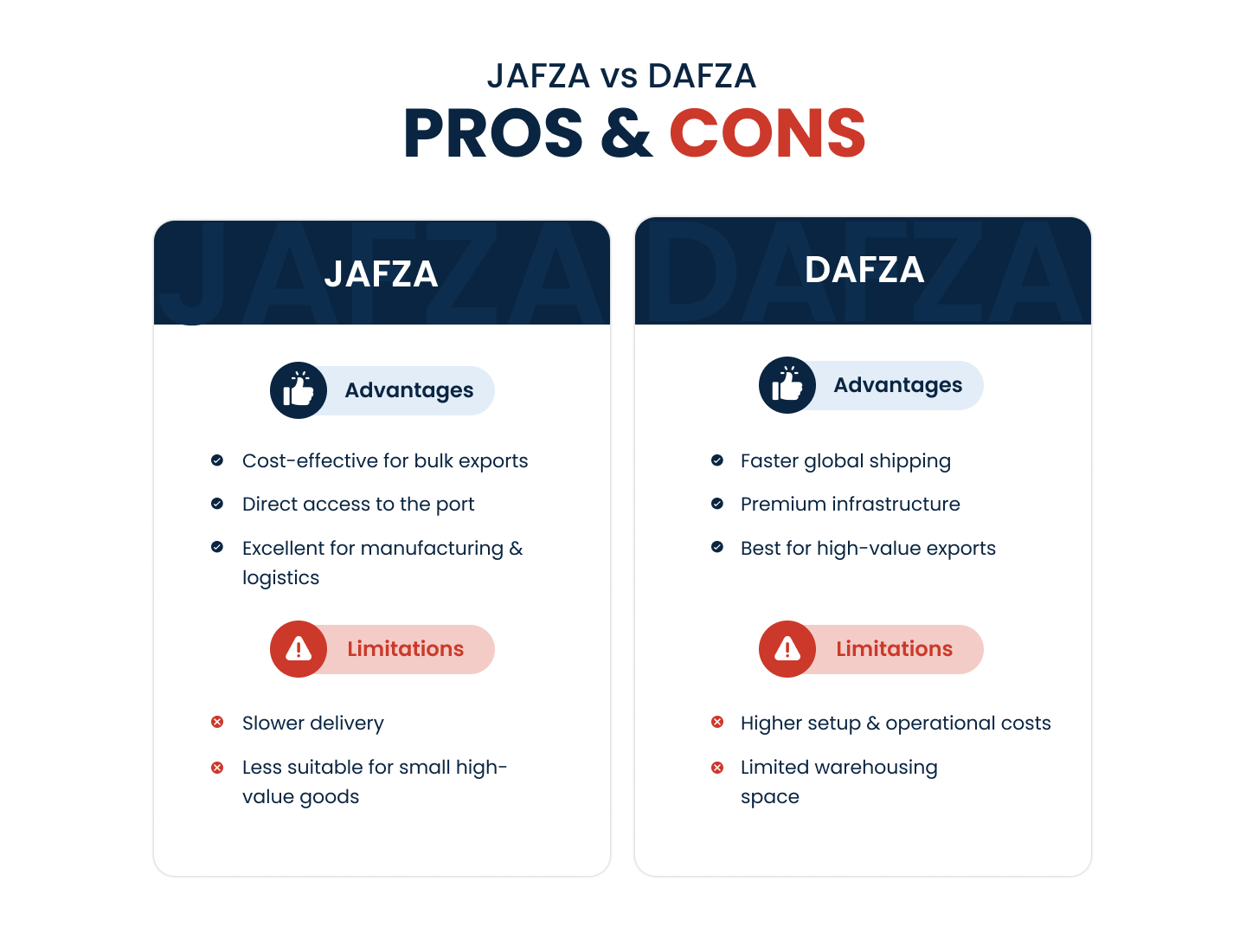
    JAFZA vs DAFZA Comparison: Pros and Cons Explained 

    Listed below are some of the benefits and limitations of both the Free Zones:  

    Advantages of JAFZA 

    • Cost-effective when it comes to bulk exports 
    • Helps you with direct access to the port 
    • Excellent when it comes to manufacturing as well as logistics 

    Limitations of JAFZA 

    • The delivery is slower when you compare it with air freight 
    • It is not quite suitable for goods that are small and of high value 

    Advantages of DAFZA 

    • Global shipping that’s faster 
    • Infrastructure is premium  
    • Excellent for exports that are of high value  

    Limitations of DAFZA 

    • Set-up as well as operational expenses are higher 
    • Warehousing space is limited 

    JAFZA vs DAFZA Comparison: Pros and Cons Explained

    JAFZA or DAFZA: Which One is Better for Indian Exporters? 

    We know that by this point, you might be wondering which of the two Free Zones is better when it comes to Indian exporters. To put it simply, there isn’t a universal answer to this question.  

    • If your company is focusing on exports that are of large-scale, efficiency in terms of costs, and warehousing, JAFZA could be a better option.  
    • If you prioritise speed, a reach that’s global, and handling of premium-quality products, DAFZA could be an excellent option.  

    Ultimately, selecting the correct UAE Free Zone Business Setup for Indian exporters is based on your business goal and logistics strategy alignment.  

    Want to Set Up Your Business? Do It with Shuraa India! 

    If you are an Indian exporter who’s trying to figure out the Free Zone setup in the UAE, there are chances that you might feel confused regarding the process. And honestly, without proper guidance, the process could appear complex, too. That’s why Shuraa India makes everything simple and efficient for you. 

    We help you assess the options, handle paperwork, and launch your UAE business without any hassles. Our legacy? Over decades of experience and having helped thousands of entrepreneurs successfully launch their UAE business 

    So, no matter if you want to go ahead with a DAFZA setup or feel like choosing a Jebel Ali Free Zone company, our experts can make it possible for you. All you have to do is book your free consultation today!  

    FAQs 

    1. Which Free Zone is More Expensive? DAFZA or JAFZA?

    A DAFZA setup typically has higher prices because of its top-class infrastructure and it being in the proximity to the Dubai airport.  

    2. Can Indian Business Owners Completely Own Their Business in These Zones?

    Of course. JAFZA and DAFZA permit 100% foreign ownership. This makes these Free Zones appealing for Indian Exporters who want to expand internationally. 

    3. JAFZA or DAFZA: Which is Best When It Comes to Warehousing & Logistics?

    JAFZA, because of its huge industrial spaces and access to the Jebel Ali Port, is more suited when it comes to warehousing and logistics.  

    4. Which is the Biggest Free Zone in the UAE?

    The United Arab Emirates’ very first Free Zone, Jebel Ali Free Zone Authority in Dubai, is the largest Free Zone.  

    5. Is DAFZA a Designated Zone? 

    Of course. DAFZA is recognised as a designated zone under the VAT regulations of the United Arab Emirates.  

  • Top 10 Mistakes Indians Make When Setting Up a Business in Dubai

    Top 10 Mistakes Indians Make When Setting Up a Business in Dubai

    Dubai continues to attract Indian entrepreneurs and investors for one simple reason: it rewards well-planned business decisions. With major tax advantages, strong infrastructure, access to global markets, modern banking systems, and a business-friendly environment, Dubai has become one of the most preferred destinations for business setup outside India. 

    But there is another side to the story that many first-time founders discover only after they have spent money. 

    A low-cost license that does not suit the business model, a Free Zone setup that limits future plans, delays in opening a corporate bank account, tax assumptions based on old information, poor cost planning, weak documentation, or choosing the wrong advisor can turn a promising move into an expensive lesson. 

    The businesses that succeed in Dubai usually begin with the clarity of what they want to sell, where they want to sell it, and which setup truly supports long-term growth. 

    This guide explains the top mistakes Indian entrepreneurs make during Dubai business setup, why they happen, and how to avoid them. If you are planning Dubai company formation, Free Zone setup, mainland business registration, or remote company setup from India, this article will help you make informed decisions before you invest. 

    Why Dubai Business Setup Is Popular Among Indian Entrepreneurs? 

    Dubai remains one of the strongest international expansion destinations for Indian business owners. It offers commercial advantages that are practical for running a business. It is geographically close to India and well-connected to the markets of Europe, Africa, and Asia. Dubai has fast administrative systems compared with many global markets. 

    For businesses in trading, e-commerce, consulting, logistics, technology, professional services, food, healthcare, and manufacturing support, Dubai can become both an operating base and a growth market. 

    Key Reasons Indians Choose Dubai for Company Formation 

    Advantage  Why It Matters 
    Strategic Location  Access to GCC, Africa, Europe, and Asia 
    Strong Infrastructure  Ports, airports, logistics, telecom, transport 
    Business-Friendly Policies  Multiple setup options and clear regulations 
    Global Banking Access  Useful for cross-border trade and international payments 
    Large Expat Market  Diverse customer base and talent pool 
    Tax Efficiency  No personal income tax and business taxes subject to applicable rules 

    However, these advantages work best when you choose the right setup for your business. 

    Top 10 Mistakes Indians Make When Setting Up a Business in Dubai 

    1. Choosing the Wrong Jurisdiction: Mainland vs Free Zone vs Offshore

    One of the biggest reasons businesses face limitations later is choosing a setup based only on cost or speed. Dubai offers multiple jurisdictions, and each serves different commercial needs. The right choice depends on your target customers, business operations, hiring plans, warehousing needs, visa requirements, and future expansion. 

    A business that needs direct UAE market access may regret choosing a structure built mainly for international activity. Another business may overspend on a mainland setup when a Free Zone company would have been sufficient. 

    Quick comparison 

    Setup Type  Best For  Watchouts 
    Mainland  UAE local trade, retail, contracts, wider activity scope  May involve higher operating costs 
    Free Zone  International trade, consulting, digital business, exports  Rules vary by zone 
    Offshore  Holding structures, asset ownership, international structuring  Not for day-to-day UAE operations 

    How to avoid choosing the wrong jurisdiction? 

    • Define where revenue will come from: UAE customers, global clients, or both 
    • Consider visa and staffing needs 
    • Evaluate office requirements 
    • Think 2–3 years ahead, not only launch cost 

    2. Focusing Only on Cheap Dubai Business Setup Cost

    Many entrepreneurs search for cheap Dubai business setups and compare only the headline license fees. Practically, that can be misleading as the real setup cost includes more than the incorporation. 

    A low upfront package may become expensive later if it lacks visas, support, renewals clarity, or operational suitability. 

    Common costs often missed – 

    Trade license fees  Establishment card/immigration file  Investor visa  Employee visas  Medical tests and Emirates ID 
    Office or flexi-desk costs  Bank account support costs  Renewals  Accounting/tax compliance  Insurance 

    What is the better approach? 

    Instead of asking “What is the cheapest license option?”, founders should ask: 

    • What is the total first-year cost? 
    • What is included in the package? 
    • Can this structure support long-term growth? 
    • What will renewals cost next year? 

    3. Selecting the Wrong Business Activity on the License

    In Dubai, your business activity is not just a description of your operations. It determines what your company is legally allowed to do in the UAE. Incorrect activity selection can create approval delays, banking issues, insurance mismatches, and future amendment costs. 

    This often happens when founders choose a broad category without understanding licensing classifications. 

    Examples – 

    Planned Work  Risk If Wrong Activity Selected 
    IT consulting  Problems invoicing software services 
    E-commerce trading  Import/export restrictions 
    Marketing agency  Service mismatch during banking review 
    Food business  Additional approvals required 

    How do you avoid it? 

    • List every product/service you plan to sell 
    • Match future expansion activities early where possible 
    • Confirm regulated activities in advance 
    • Get written confirmation instead of assumptions 

    4. Assuming Dubai Is Tax-Free and Ignoring Compliance

    Dubai remains tax-efficient in many ways, but “tax-free” is often misunderstood. Business owners who rely on outdated assumptions can face avoidable penalties later. 

    Depending on the business structure and thresholds, obligations may include: 

    • VAT registration and filings (Standard 5%) 
    • Corporate tax considerations (Standard 9% for net profits above AED 375,000) 
    • Accounting records 
    • Beneficial ownership records 
    • AML-related compliance for certain sectors 
    • Annual renewals and filings 

    Why does this matter? 

    Non-compliance with the UAE tax laws can affect: 

    • Penalties 
    • Banking relationships 
    • License renewals 
    • Investor confidence 
    • Expansion plans 

    How do you avoid it? 

    Engage with accounting and tax support from the beginning rather than understanding your mistakes later and facing the penalties. 

    5. Underestimating Corporate Bank Account Difficulty

    Many businesses treat company registration as the finish line. In reality, the business becomes fully functional when its bank account becomes active. 

    Banks in the UAE apply strong due diligence standards. Delays can happen if documentation is weak, ownership is unclear, transactions are difficult to explain, or the business model lacks commercial logic. 

    Here are some of the most common reasons for delay – 

    • Incomplete documents 
    • Weak business plan 
    • Unclear source of funds 
    • High-risk industries 
    • Poor website / no digital presence 
    • Mismatch between activity and expected transactions 

    Prepare in advance for – 

    Item  Importance 
    Clear business profile  High 
    Website / online presence  High 
    Shareholder KYC documents  High 
    Projected transactions  Medium 
    Client / supplier profile  Medium 


    6. Ignoring Market Research and Local Demand

    Some founders assume their business success in India will automatically transfer to Dubai. That is not always true. Dubai has different customer expectations, pricing psychology, competition levels, and purchasing behaviour. 

    A good business can still fail in the wrong market fit. 

    Example – 

    A service business with quick closures in India may face a much longer B2B cycle in Dubai. 

    Areas to research – 

    • Customer demand 
    • Pricing benchmarks 
    • Competitor positioning 
    • GCC consumer preferences 
    • B2B sales cycle length 
    • Payment expectations 
    • Seasonality trends 

    7. Poor Documentation and Inconsistent Records

    Dubai systems are generally efficient, but efficiency also depends on correct submissions. Because even the smallest errors in your application can lead to avoidable delays. 

    Common issues include – 

    • Passport name mismatch 
    • Expired documents 
    • Incorrect address proof 
    • Unattested documents where needed 
    • Missing shareholder documents 
    • Signature mismatch 

    Recommended checklist – 

    Document  Check Before Submission 
    Passport  Validity and spelling 
    Address proof  Updated and clear 
    Corporate documents  Properly notarised (if required) 
    Photos  Correct format 
    Existing company docs  Consistent ownership details 

    8. Entering Partnerships Without Strong Agreements

    Good business partnerships can accelerate your growth, but unclear agreements can create serious disputes later. This includes local partners, investors, family members, friends, or operational co-founders. 

    Verbal understanding is not enough when money, ownership, and control are involved. 

    Agreement should clearly cover – 

    • Equity ownership 
    • Capital contribution 
    • Profit distribution 
    • Decision rights 
    • Salary / management roles 
    • Exit terms 
    • Dispute resolution 
    • Non-compete / confidentiality clauses 

    9. Misjudging Visa, Hiring, and Employee Costs

    Hiring in Dubai involves more than employees salary. Many founders plan their budget only around monthly payroll and ignore related costs. 

    Additional hiring costs – 

    • Employment visa 
    • Medical insurance 
    • Recruitment cost 
    • Gratuity obligations 
    • Workspace requirements 
    • HR administration 
    • Compliance processes 

    First-year hiring planning table – 

    Cost Type  Include in Budget 
    Salary  Yes 
    Visa  Yes 
    Insurance  Yes 
    Equipment  Yes 
    Recruitment  Yes 
    Compliance admin  Yes 

    10. Treating Dubai Setup as a One-Time Event Instead of a Long-Term Strategy

    Some businesses focus only on getting the license issued. But the real value comes from what follows: operations, renewals, hiring, tax management, expansion, and commercial execution. A setup chosen only for speed can create expensive restructuring later. 

    Better long-term questions – 

    • Can I add new activities later? 
    • Can I scale staff easily? 
    • Can I move to the mainland later if needed? 
    • Will this help in my banking needs and investors? 
    • What is my 3-year operating plan? 

    How to Avoid Dubai Business Setup Mistakes? 

    Good outcomes usually come from disciplined preparation rather than being ignorant first and then blaming your luck later. So, before you commit to funds, review the full commercial picture. 

    Business setup planning checklist 

    Area  What to Confirm 
    Jurisdiction  Mainland / Free Zone fit 
    License Activity  Covers actual revenue model 
    Budget  Full first-year cost 
    Banking  Account readiness 
    Tax  VAT / corporate tax review 
    Hiring  Visa + staffing costs 
    Documents  Clean and complete 
    Growth  2–3 year expansion path 

    Why Indian Entrepreneurs Often Prefer Expert Business Setup Support? 

    Dubai offers genuine opportunity for Indian entrepreneurs, but successful company formation depends on informed decisions rather than taking shortcuts. The right jurisdiction, realistic budgeting, proper activity selection, clean documentation, tax awareness, and a long-term commercial plan can save substantial time and money. 

    Shuraa India supports Indian entrepreneurs who want a clear and efficient route to Dubai business setup, Free Zone company formation, mainland registration, visas, and post-incorporation support. 

    Advantages of Shuraa India support – 

    • Setup recommendations based on business model 
    • Cost clarity before commitment 
    • Documentation guidance 
    • Licensing support 
    • Visa assistance 
    • Banking coordination support 
    • Ongoing compliance services 

    For entrepreneurs expanding from India, local execution combined with India-facing support often makes communication faster and easier. Shuraa India consists of an experienced team who’s successfully helped many Indian entrepreneurs set up their business in Dubai for many years. Our experts provide end-to-end support so that your Dubai business formation process becomes hassle-free and efficient. 

    Book a Free consultation with Shuraa India experts. 

    Frequently Asked Questions (FAQs) 

    1. How much does Dubai business setup cost for Indians?

    Costs vary by jurisdiction, activity, visa count, office needs, and support scope. Entry-level structures may appear low-cost, but first-year real cost should include licensing, visas, renewals, office, and compliance. Always compare total cost, not just license fee. 

    2. Is Free Zone better than Mainland in Dubai?

    Neither is universally better. Free Zone can be ideal for consulting, exports, and digital businesses. Mainland may suit businesses targeting UAE local customers, retail, broader operations, or certain commercial activities. 

    3. Can I start a Dubai company from India remotely?

    Yes, many setups can begin remotely depending on the jurisdiction and case requirements. However, documentation, KYC, visa processes, and banking stages may require specific steps or travel depending on circumstances. 

    4. Is Dubai really tax-free for businesses?

    Not in the simplistic sense that many people assume. Tax obligations depend on business type, thresholds, and regulatory rules. VAT and corporate tax considerations may apply. Professional advice is recommended. 

    5. How long does Dubai company formation take?

    Simple cases can move quickly, but timelines depend on activity type, approvals, documentation quality, visa steps, and banking. Incorporation and banking timelines are often different. 

    6. What is the biggest mistake people make during Dubai company setup?

    Choosing a business setup based only on low cost or speed without considering business model, banking, compliance, and their future plans. 

    7. Do I need a consultant for Dubai business setup?

    Not legally in every case, but it is highly recommended for businesses to use consultants like Shuraa India to reduce expensive mistakes, save time, compare options properly, and handle documentation efficiently. 

  • Top Visa-Free Countries for UAE Residents in 2026

    Top Visa-Free Countries for UAE Residents in 2026

    Traveling the world without the hassle of visa applications has become one of the most valuable privileges for expatriates living in the UAE. Whether you are living in Dubai, Abu Dhabi, Sharjah, or any other emirate, holding UAE residency now offers many advantages—especially when it comes to visa-free and visa‑on‑arrival travel.

    For Indian residents in the UAE, understanding the visa‑free travel destinations available in 2026 can unlock amazing opportunities: weekend getaways, business travel without pre‑approval, gap year adventures, family trips, or even long‑term exploration.

    In this extensive guide, we explain:

    • What visa‑free travel means for UAE residents
    • How it benefits Indian expatriates
    • The difference between visa‑free and visa‑on‑arrival
    • A country‑by‑country breakdown of destinations across Europe, Asia, Africa, the Americas, and the Middle East
    • Tips for traveling visa‑free
    • Documents you must carry
    • How Shuraa India can help you make the most of your UAE residency and global mobility

    Let’s begin.

    What Does Visa‑Free Travel Mean for UAE Residents?

    Visa‑free travel is the ability to enter a foreign country without applying for a visa in advance. As a UAE resident, this privilege means:

    • No waiting for long processing times
    • No visa application fees in advance
    • No embassy visits or appointment bookings
    • Travel planning becomes simpler and faster

    Often, UAE residents enjoy either:

    • Visa‑free entry: You arrive at the destination with just your passport/residency, and immigration lets you in automatically.
    • Visa‑on‑arrival (VoA): You arrive and get a visa at the airport or border, usually by completing a simple form and sometimes paying a small fee.

    Today, many countries across continents offer either visa‑free access or visa‑on‑arrival for UAE residents. This is largely because the UAE has strong diplomatic relations, excellent security standards, and is considered a stable residence, making holders of UAE residency permits highly trusted by foreign immigration authorities.

    Visa‑Free Travel vs. Visa‑On‑Arrival: What’s the Difference?

    Understanding the difference is important for planning your trip:

    Feature Visa‑Free Travel Visa‑On‑Arrival
    Pre‑travel process No visa application needed Application at the airport/border
    Cost Free Small fee may apply
    Time at arrival Quick May involve standing in queues and filling forms
    Documentation Passport + UAE residency Passport + UAE residency + possible photo/fee

    Visa‑free travel generally offers faster entry and less paperwork, while visa‑on‑arrival still eliminates advance visa requirements but might need some minimal formality at the point of entry.

    Why Visa‑Free Travel Matters for Indians in the UAE

    As an Indian living in the UAE, you likely travel for:

    • Family visits back home
    • Holiday and leisure travel
    • Business meetings and networking
    • Conferences and workshops
    • Education and personal development

    Visa procedures can often be time‑consuming, stressful, and costly—especially if you apply from abroad. Having access to visa‑free countries means:

    1. Quick Getaways

    Imagine booking a long weekend trip to a beautiful island or a cultural city with just a couple of clicks—no embassy visits, no long waits.

    2. Cost Savings

    Visa fees, courier charges, and agent fees add up. Visa‑free travel eliminates these extra costs.

    3. Business Efficiency

    For professionals and business owners like you, travel convenience means greater flexibility to attend meetings, negotiations, or networking events on short notice.

    4. Broader Exposure

    Visa‑free travel encourages more global exploration, giving you richer experiences across regions, cultures, and markets.

    Important Note on Visa Rules

    Visa policies change frequently. The list below represents the most current information available for 2026, but before booking your trip, always:

    • Check the official government immigration website of the destination

    • Confirm requirements with airlines

    • Speak with experts at Shuraa India if you have questions about your specific situation

    Top Visa‑Free Countries for UAE Residents to Visit in 2026

    Europe – Visa‑Free and Visa‑On‑Arrival Destinations

    Many European countries offer visa‑free entry to UAE residents, even though most Schengen Zone nations still require visas for Indian passport holders.

    1. Albania (Visa‑Free – up to 90 days)

    Albania offers a mix of mountains, beaches, and history. Tirana’s vibrant urban scene and coastal towns make it a perfect long vacation spot.

    2. Serbia (Visa‑Free – up to 90 days)

    Serbia is rich in culture and nightlife, with Belgrade being one of Europe’s most energetic capitals.

    3. Georgia (Visa‑On‑Arrival – up to 90 days)

    Georgia’s scenic beauty, delicious cuisine, and relaxed visa rules make it very popular for UAE residents.

    4. Bosnia & Herzegovina (Visa‑Free – up to 90 days)

    This country offers a blend of Ottoman, Austro‑Hungarian, and Mediterranean influences.

    5. Montenegro (Visa‑Free – short stays)

    A stunning Adriatic destination with beautiful coastal towns like Kotor and Budva.

    6. Armenia (Visa‑Free / Visa‑On‑Arrival – up to 180 days)

    Armenia offers historical sites, monasteries, and beautiful landscapes.

    7. Ukraine (Visa‑On‑Arrival – up to 30 days)

    A historical destination with cities like Kyiv and Lviv, and scenic countryside.

    Travel Tip: Even visa‑free access may require proof of valid accommodation, return ticket, and financial solvency, so carry supporting documents.

    Asia – Visa‑Free and Visa‑On‑Arrival Destinations

    Asia remains one of the most accessible regions for UAE residents.

    1. Maldives (Visa‑Free – up to 30 days)

    Perfect for luxury holidays, crystal‑clear waters, and beach resorts.

    2. Thailand (Visa‑Free – up to 30 days)

    A perennial favorite for UAE residents, known for beaches, food, festivals, and friendly locals.

    3. Indonesia (Visa‑On‑Arrival – up to 30 days)

    Home to Bali, Jakarta, and unforgettable landscapes.

    4. Sri Lanka (Visa‑On‑Arrival – up to 30 days)

    From tea hills to beaches to ancient temples, Sri Lanka offers diversity.

    5. Nepal (Visa‑On‑Arrival – up to 90 days)

    Ideal for trekking, cultural exploration, and Himalayan adventures.

    6. Malaysia (Visa‑Free – up to 30 days)

    Malaysia combines city life, beaches, and multicultural experiences.

    7. Philippines (Visa‑Free – up to 30 days)

    Beautiful islands and friendly locals make this a great holiday choice.

    8. Hong Kong (Visa‑Free – up to 90 days)

    A dynamic global city with shopping, culture, and culinary delights.

    9. Macau (Visa‑Free – up to 30 days)

    Known for entertainment, casinos, and Portuguese heritage architecture.

    10. Azerbaijan (Visa‑On‑Arrival – up to 30 days)

    Baku’s futuristic skyline and Caspian Sea views are unique.

    Middle East – Easy Travel Within the Region

    1. Oman

    Often visa‑free or easy entry for UAE residents—perfect for nature, deserts, mountains, and luxury resorts.

    2. Jordan

    Visitors can often enter visa‑free or with simple arrangements, ideal for Petra and Dead Sea experiences.

    Oceania

    Fiji (Visa‑Free – up to 4 months)

    Longer stays and beautiful island life make Fiji fantastic for extended trips.

    Africa

    1. Seychelles (Visa‑Free – short stays)

    Pristine beaches and nature make Seychelles a dream destination.

    2. Mauritius (Visa‑Free – typically 60 days)

    Another great island paradise with excellent resort options.

    Americas – Visa‑Free and Easy Access Destinations

    1. Barbados (Visa‑Free – up to 6 months)

    Beachfront leisure, Caribbean culture, and longer stays.

    2. Dominica (Visa‑Free – up to 21 days)

    Known for waterfalls, rainforests, and natural beauty.

    3. Saint Kitts & Nevis (Visa‑Free – up to 90 days)

    Island tranquility and beaches.

    4. Ecuador (Visa‑Free – up to 90 days)

    Galapagos, mountains, and Pacific coastlines.

    5. Panama (Visa‑Free – up to 180 days)

    Panama Canal, beaches, and cultural diversity.

    6. Brazil (Visa‑Free – up to 90 days)

    Carnival, vibrant culture, and natural wonders.

    7. Jamaica (Visa‑Free – up to 90 days)

    Reggae, beaches, and laid‑back culture.

    8. Belize (Visa‑Free – up to 30 days)

    Coral reefs and Mayan ruins.

    9. Colombia (Visa‑Free – up to 90 days)

    Historic cities and diverse landscapes.

    10. Peru (Visa‑Free – up to 183 days)

    Machu Picchu and rich culture.

    Visa‑Free Countries for UAE Residents Holding an Indian Passport

    As a UAE resident with an Indian passport, your access isn’t just about your residency—you also benefit from world travel privileges that are enhanced compared to standard Indian passport travel. Some of the key accessible countries in 2026 include:

    • Oman
    • Qatar
    • Saudi Arabia
    • Thailand
    • Indonesia
    • Malaysia
    • Singapore
    • Japan (up to 30 days for tourism)
    • South Korea
    • Fiji
    • Seychelles
    • Mauritius
    • Egypt
    • Morocco
    • Albania
    • Serbia
    • Bahamas
    • Brazil

    This list provides significant travel freedom for Indians residing in the UAE. Always verify real‑time policies before travel, but these destinations remain some of the most accessible in 2026.

    Documents You Must Carry for Visa‑Free Travel

    Even with visa‑free status, immigration may ask for supporting documents. Always carry:

    • Valid passport (minimum 6 months validity)
    • UAE residency permit
    • Return or onward ticket
    • Proof of accommodation
    • Travel insurance
    • Bank statements (showing sufficient funds)
    • Contact information of the destination
    • Visa‑on‑arrival forms (where applicable)

    Travel preparedness ensures smoother entry, especially at smaller airports or land borders.

    Tips for Visa‑Free Travel Success

    1. Check Entry Requirements Before You Go

    Visa rules change often. Always check the destination government’s official website or consult Shuraa India travel experts before you book.

    2. Keep Digital and Physical Copies

    Keep copies of your passport, residency, tickets, and accommodation confirmations both physically and on your phone.

    3. Respect Local Laws

    Every country has its own cultural norms and legal expectations. Understanding local customs and rules helps avoid issues at immigration or during your stay.

    4. Buy Travel Insurance

    Even visa‑free travel can face unexpected situations—medical emergencies, lost baggage, or travel disruptions. Travel insurance mitigates those risks.

    How Shuraa India Can Help You

    Navigating global travel privileges as a UAE resident from India can be confusing at times, especially with frequent rule changes. Shuraa India is here to help:

    • Up‑to‑date travel and visa advisory
    • Guidance on how UAE residency enhances travel freedom
    • Assistance with residency documentation
    • Support for business traveler visas
    • Help in understanding entry requirements for specific countries

    Our experienced consultants keep track of policy changes and provide tailored advice so you can plan your travel with confidence and peace of mind.

    Conclusion: Your Passport to the World Begins with UAE Residency

    Visa‑free travel makes the world more accessible, easier, and affordable—especially for Indian professionals, families, and frequent travelers living in the UAE. With countless destinations offering visa‑free or visa‑on‑arrival entry in 2026, you can explore cultures, business hubs, beaches, mountains, and historic sites around the world with greater freedom than ever.

    For tailored guidance, travel updates, and support on leveraging your UAE residency for visa‑free travel and more, trust Shuraa India—your partner in global mobility and lifestyle.

    Get in touch with Shuraa India today to plan your next journey with confidence!

    Frequently Asked Questions (FAQs)

    1. Do UAE residents really have visa‑free access to many countries?

    Yes. Due to strong international relations, many countries allow UAE residents visa‑free or visa‑on‑arrival entry, giving increased travel mobility.

    2. Does my Indian passport get enhanced travel privileges if I live in UAE?

    Yes. Combining UAE residency with an Indian passport often opens doors to more accessible destinations compared to an Indian passport alone.

    3. Can I travel for business without a visa from UAE?

    Yes—several countries offer visa‑free or visa‑on‑arrival entry to UAE residents for business purposes. Always confirm the specific business rules before travel.

    4. Is visa‑free access guaranteed at the airport?

    Visa‑free access is generally respected if you meet entry conditions, including passport validity, residency proof, and financial and accommodation details.

    5. Should I consult before booking my travel?

    Absolutely. Visa policies change often. For the most accurate and personalized advice, reach out to Shuraa India travel and residency experts before booking.

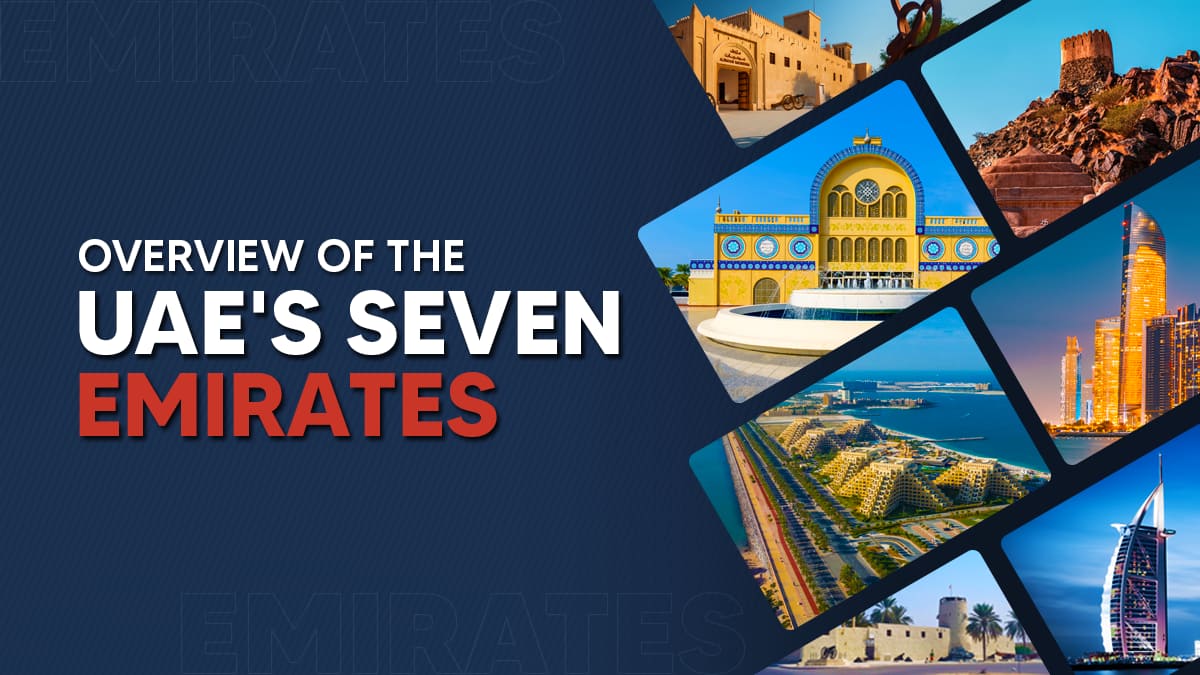
  • Overview of the UAE’s seven Emirates

    Overview of the UAE’s seven Emirates

    The United Arab Emirates (UAE) is a nation known for its rapid development, modern architecture, and booming economy. It consists of seven emirates, each with its unique characteristics and significance. These 7 emirates of the UAE have collectively transformed the country into a global hub for trade, tourism, and innovation.

    In this blog, we will explore the overview of the UAE’s seven Emirates: Abu Dhabi, Dubai, Sharjah, Ajman, Umm Al Quwain, Ras Al Khaimah, and Fujairah. 

    If you’re an Indian entrepreneur, explore how you can invest in Dubai from India and choose the right emirate for your business.

    What are the 7 UAE Emirates? 

    7 UAE Emirates” refers to the seven emirates that comprise the United Arab Emirates (UAE). These are not separate countries but are individual emirates within the UAE. Each emirate is governed by its ruler. 7 Emirates of the UAE in order below:

    1. Abu Dhabi: The capital and largest emirate. 
    2. Dubai: The most populous and well-known emirate. 
    3. Sharjah: Known as the cultural capital of the UAE. 
    4. Ajman: The smallest emirate by area. 
    5. Umm Al Quwain: Known for its quiet, traditional lifestyle. 
    6. Ras Al Khaimah: Noted for its mountainous landscape. 
    7. Fujairah: The only emirate on the eastern coast along the Gulf of Oman. 

    These emirates together form the country of the United Arab Emirates. 

    Who is the current leader of the UAE?

    His Highness Sheikh Mohamed bin Zayed Al Nahyan was elected the third and current president of the UAE by the Federal Supreme Council on 14 May 2022.

    7 Emirates of the UAE and Their Rulers 

    While the UAE is a unified nation, each of its seven emirates is governed by its royal family. The seven emirates of the United Arab Emirates (UAE) are ruled by the following dynasties: 

    Emirate   Ruling Family  Present Ruler 
    Abu Dhabi  Al Nahyan  His Highness Sheikh Mohamed bin Zayed Al Nahyan 
    Dubai  Al Maktoum  His Highness Sheikh Mohammed bin Rashid Al Maktoum 
    Sharjah  Al Qasimi  His Highness Dr. Sheikh Sultan bin Mohammed Al Qasimi 
    Ajman  Al Nuaimi  His Highness Sheikh Humaid bin Rashid Al Nuaimi 
    Umm Al Quwain  Al Mualla  His Highness Sheikh Saud bin Rashid Al Mu’alla 
    Ras Al Khaimah  Al Qasimi  His Highness Sheikh Saud bin Saqr Al Qasimi 
    Fujairah  Al Sharqi  His Highness Sheikh Hamad bin Mohammed Al Sharqi 

     7 Emirates of the UAE and their specialities  

    The 7 Emirates of the UAE each boast their unique specialities, ranging from cultural heritage. Mentioned below are the seven emirates of the UAE and their specialities:   

    1. Abu Dhabi 

    Abu Dhabi is the UAE’s largest emirate and capital. It is nearly around 87% of the country’s land area.  As the country’s capital, it is also its political and administrative centre. 

    Abu Dhabi is famous for its top attractions. Notable among them is the Sheikh Zayed Grand Mosque, also one of the biggest in the world. It is also a world-class art gallery (check out the Louvre Abu Dhabi). 

    Additionally, Abu Dhabi has beautiful natural wonders to enjoy. Liwa Oasi is a peaceful area with Liwa dunes and Sir Bani Yas Island, populated by numerous species of animals are among them. 

    Specialities of Abu Dhabi: 

    • Political and administrative centre. 
    • A major contributor to the UAE’s economy. 
    • Home to the Sheikh Zayed Grand Mosque and Louvre Abu Dhabi. 
    • Features the Liwa Oasis and Sir Bani Yas Island. 
    • Initiatives like Masdar City focus on sustainability. 

    Looking to set up in the capital? Explore company formation in Abu Dhabi and understand the Abu Dhabi business setup cost.

    2. Dubai 

    This is the most populous and well-known emirate, with a futuristic skyline, fantastic architecture, luxury shops, and exciting nightlife in Dubai. It attracts millions of tourists each year as a global city. 

    Initially, Dubai was a small fishing village in a major metropolis. Other sectors, such as real estate, tourism, and finance, have contributed to Dubai’s growth. Entrepreneurs can set up via mainland company formation or through one of Dubai’s many free zones.

    Boasting one of Dubai’s most recognisable features. The fantastic view, the experiences and the tallest building in the world, Burj Khalifa. You can start a business in Dubai Free zone which includes IFZA, JAFZA, IFC, DIFZ, Ajman, and Meydan, the most popular free zones in Dubai. Check our guide on Dubai company formation costs to plan your budget.

    Specialities of Dubai: 

    • Known for its futuristic skyline and booming economy. 
    • Attractions like the Burj Khalifa, Palm Jumeirah, and Dubai Mall. 
    • A major centre for finance, real estate, and trade — explore the top business opportunities in Dubai.
    • It is Home to Expo 2020 and other groundbreaking developments. 
    • Famous for luxury shopping, hotels, and nightlife. 

    Ready to start? Learn about getting a business trade license in Dubai.

    3. Sharjah 

    Aimed at preserving their heritage, art and culture – it is the home of UAE’s cultural scene -Sharjah. Moreover, in 2019, UNESCO declared Sharjah the World Book Capital. It aligns with its cultural-conscious pledge. 

    It is one of the best museums you can visit in Dubai, where displays usually are gone through and actualised. For example, the Sharjah Museum of Islamic Civilization and the Sharjah Art Foundation are vital attractions. Sharjah is also the home of three of the five Middle Eastern Airports in the World: Sharjah/Port. 

    In addition, Sharjah is the economic centre within a travel triangle, highlighting manufacturing and logistics-based production as well as education. This friendly business environment makes business setup in Sharjah an attractive option for entrepreneurs.

    Specialities of Sharjah: 

    • Known for its museums, art galleries, and cultural festivals. 
    • Named World Book Capital in 2019. 
    • Known for its parks, heritage sites, and family-oriented attractions. 
    • Strong focus on manufacturing, logistics, and education sectors. 

    4. Ajman 

    Ajman, the smallest of the 7 emirates in both area and population, has seen significant development in recent years. This growth has been concentrated mainly in the real estate and construction sectors. 

    Additionally, Ajman’s economy is primarily driven by its port. Businesses can take advantage of Ajman Free Zone company formation for cost-effective setup with 100% foreign ownership. which stands as one of the UAE’s leading maritime hubs. Furthermore, the emirate boasts an industrial sector, contributing to its economic hub. 

    Specialities of Ajman: 

    • Compact size with significant recent development. 
    • Offers tranquil, less crowded coastal areas. 
    • Rapid expansion in construction and housing. 
    • Active port and manufacturing sector. 
    • Known for a more budget-friendly lifestyle compared to other emirates. 

    Explore Ajman mainland company formation for businesses targeting the local UAE market.

    5. Umm Al Quwain 

    Umm Al Quwain is the least populated emirate. It is known for its relaxed and traditional lifestyle. Unlike the other cities of Dubai and Abu Dhabi, Umm Al Quwain offers a more laid-back atmosphere. 

    The emirate is committed to preserving its natural environment and cultural heritage. It is known for its coastal mangroves, scenic beaches, and the Dreamland Aqua Park. These are one of the UAE’s largest water parks. 

    In addition to its natural attractions, Umm Al Quwain has a rich historical backdrop. Moreover, the archaeological sites, such as Al-Dour, date back to the 3rd century, adding to the emirate’s cultural significance. 

    Specialities of Umm Al Quwain: 

    • Known for its peaceful, traditional lifestyle. 
    • Features coastal mangroves and pristine beaches. 
    • Home to the ancient Al-Dour archaeological site. 
    • Houses Dreamland Aqua Park, a popular water park. 
    • Ideal for fishing, sailing, and other water sports. 

    6. Ras Al Khaimah 

    Ras Al Khaimah (RAK) is located in the northernmost part of the UAE. For entrepreneurs, RAKEZ (Ras Al Khaimah Economic Zone) offers one of the UAE’s most affordable and flexible free zone setups. RAK is popular destination for people who are interested in outdoor activities. It offers a range of activities, such as hiking, mountain climbing, and water sports. 

    Among its key attractions is Jebel Jais Mountain. The emirate also features historical sites like Dhayah Fort and the National Museum of Ras Al Khaimah. It highlights its rich heritage. 

    Additionally, Ras Al Khaimah has a growing economy focusing on tourism, manufacturing, and real estate. Its free zones include the Ras Al Khaimah Economic Zone (RAKEZ). It offers appealing incentives for businesses and investors. 

    Specialities of Ras Al Khaimah: 

    • Includes mountains, deserts, and beaches. 
    • Home to the UAE’s highest peak and a popular destination for outdoor activities. 
    • Features historical sites like Dhayah Fort and the National Museum of Ras Al Khaimah. 
    • Known for adventure sports, such as zip-lining and mountain climbing. 
    • Focuses on tourism, manufacturing, and real estate. Browse the full RAKEZ business activities list to find your permitted activity.

    You can also explore RAK mainland company formation for direct UAE market access.

    7. Fujairah 

    Fujairah is the only emirate located entirely on the eastern coast of the UAE along the Gulf of Oman. It is celebrated for its rugged mountains, stunning beaches, and historical sites. Its strategic location makes it an important centre for trade and commerce, particularly in shipping and logistics. 

    The emirate boasts a diversified economy with critical agriculture, fishing, and tourism industries. Fujairah is home to Fujairah Port. It’s one of the region’s most significant oil-exporting ports. 

    Additionally, Fujairah’s historical landmarks include the Fujairah Fort and Al-Bidyah Mosque. It attracts tourists seeking a blend of cultural and natural experiences. 

    Specialities of Fujairah: 

    • Unique position along the Gulf of Oman, contrasting with the western coast’s Arabian Gulf. 
    • Features rugged mountains and scenic landscapes. 
    • Home to Fujairah Fort and Al-Bidyah Mosque, one of the oldest in the UAE. 
    • Known for its beautiful beaches and excellent diving spots. 
    • Important for maritime trade and oil exports. 

    Not sure which emirate suits your business? Read our guide on the best location to set up a business in Dubai and the UAE.

    Must-See Attractions in the 7 Emirates of the UAE 

    Explore the top must-see attractions across the 7 emirates of the UAE. It is where each destination offers its distinctive blend of culture, history, and adventure. 

    In Abu Dhabi 

    • Sheikh Zayed Grand Mosque   
    • Qasr Al Hosn 
    • Ferrari World Abu Dhabi 
    • Louvre Abu Dhabi  
    • Mangrove Parks 

    In Dubai 

    • Burj Khalifa 
    • The Museum of the Future 
    • Palm Jumeirah 
    • Dubai Mall 
    • Al Fahidi District   
    • Dubai Opera 
    • Dubai Souks 

    In Sharjah 

    • Sharjah Art Museum 
    • Sharjah Safari Park 
    • Al Noor Mosque 

    In Ajman 

    • Ajman Museum 
    • UAE Pygmy Zoo 
    • Al Zorah Nature Reserve  

    In Umm Al Quwain 

    • Falaj Al Mualla Fort 
    • Ed-Dur Site 
    • Umm Al Quwain National Museum 

    In Ras Al Khaimah 

    • Jebel Jais 
    • Wadi Shawka 
    • National Museum of Ras Al Khaimah 

    In Fujairah 

    • Fujairah Beaches 
    • Tim’s Reef   
    • Madhab Spring Sulphuric Park   
    • Wadi Wurayah National Park 

    If you’re considering a free zone, see our comparison: IFZA vs Meydan vs RAKEZ — how to choose the right free zone.

    Ready to explore your business in 7 Emirites

    The UAE is made up of seven emirates: Abu Dhabi, Dubai, Sharjah, Ajman, Umm Al Quwain, Ras Al Khaimah, and Fujairah. Each one offers something unique, from Dubai’s towering skyscrapers to Sharjah’s cultural richness and Fujairah’s natural beauty. The UAE is full of opportunities for residents, tourists, and investors. 

    If you’re considering starting a business in any of these emirates, Shuraa India is here to help. With over 26+ years of experience, we provide expert guidance on business registration, licensing, and legal compliance.  

    Whether you’re interested in Dubai’s bustling city life or Fujairah’s peaceful landscapes, Shuraa India makes the process easy and smooth. Reach out to us today to turn your business dreams into reality! 

    Shuraa India offers end-to-end company formation services across all 7 UAE emirates — from license to visa to bank account.

  • GDRFA Dubai: Services, Procedures, and Application Status

    GDRFA Dubai: Services, Procedures, and Application Status

    The General Directorate of Residency and Foreigners Affairs (GDRFA) plays a crucial role in the lives of residents and visitors in Dubai. This authoritative government entity is entrusted with overseeing visa and residency services, ensuring the smooth integration of individuals from around the world. 

    From visa regulations to residency permits, the GDRFA Dubai is responsible for overseeing all matters related to immigration and ensuring the smooth flow of individuals in and out of Dubai. 

    Therefore, understanding the GDRFA’s functions and services is essential for anyone seeking to visit, work, or reside in Dubai. 

    What is GDRFA?

    The General Directorate of Residency and Foreigners Affairs – Dubai (GDRFA) is a government agency responsible for regulating the entry, exit, and residency of foreign nationals in Dubai, United Arab Emirates.  

    It manages visa issuance, residency permit applications, and other services related to foreigners living in or visiting Dubai. The Dubai GDRFA plays a crucial role in ensuring the smooth movement of people across Dubai’s borders and maintaining a secure and orderly immigration system. 

    Its headquarters are located in Al Jafliya, near Burj Khalifa, the tallest building in the world. The GDRFA is committed to providing efficient and effective services to its customers, both individuals and businesses. It operates through a network of offices and service centres across Dubai, making its services accessible to the public. 

    What Does GDRFA Dubai Do? 

    The GDRFA Dubai offers a wide range of services to foreign nationals, including: 

    • Processing visa applications for visitors, residents, and investors 
    • Issuing residency permits for foreign nationals living in Dubai 
    • Regulating the entry and exit of foreign nationals through Dubai’s airports and seaports 
    • Monitoring the status of foreign nationals residing in Dubai 
    • Enforcing immigration laws and regulations 
    • Providing support services to businesses employing foreign workers 

    Popular GDRFA Services 

    The GDRFA Dubai offers a range of popular services that cater to the needs of residents, visitors, and businesses. Here are some of the most sought-after GDRFA services: 

    1. Visa Services

    GDRFA facilitates various visa categories, including tourist visas, employment visas, and long-term residency visas. The simplicity and accessibility of the visa application process make it a popular choice for individuals seeking entry into Dubai. 

    2. Residency Services

    GDRFA plays a central role in establishing and managing residency status for expatriates in Dubai. The services include initial residency permits, renewals, and cancellations, providing a comprehensive framework for individuals to navigate their legal status within the city. 

    3. Entry permit/visa cancellation

    This service allows foreign nationals to cancel their entry permits or visas before they depart from Dubai. 

    4. E-Services

    The introduction of online platforms and digital tools by GDRFA has transformed the way individuals interact with immigration processes. E-services allow users to submit visa applications, renew residency permits, and conduct various transactions seamlessly, reducing the need for physical visits to government offices. 

    5. Amer Centers

    GDRFA operates Amer Centers, which serve as one-stop service centres providing a range of immigration-related services. These centres have become popular among residents and businesses for their efficiency and convenience. 

    6. Smart Applications & GDRFA Visa Status

    GDRFA has developed smart applications to enhance user experience. The use of mobile applications allows individuals to track visa and residency status, receive notifications, and access essential information on the go. 

    7. Port services

    The GDRFA provides immigration services at Dubai’s ports, including visa issuance, clearance, and inspection. 

    8. Legal services

    The GDRFA provides legal services to foreign nationals who are involved in legal disputes or require legal assistance. 

    9. Customer Happiness Centers

    GDRFA places a strong emphasis on customer satisfaction. Customer Happiness Centers provide a dedicated space for individuals to seek assistance, provide feedback, and address any concerns they may have regarding immigration services. 

    10. VIP Services

    For individuals seeking a premium and expedited experience, GDRFA offers VIP services. These services may include personalized assistance, fast-track processing, and additional amenities to enhance the overall service experience. 

    How to Apply for GDRFA Services 

    Applying for General Directorate of Residency and Foreigners Affairs – Dubai (GDRFA) services can be done through two channels: online or in person at an Amer Center. 

    1. Online Application

    • Go to the GDRFA website
    • Create an account by clicking on the “Register” button. 
    • Enter your personal information, such as your name, email address, and password. 
    • Once you have created an account, you can log in and select the service you want to apply for. 
    • Fill out the application form and upload the required documents. 
    • Pay the service fee. 
    • You will receive a confirmation email once your application has been submitted. 
    • You can track the status of your application online. 

    The processing time for GDRFA services varies depending on the type of service being requested. However, most applications are processed within a few days. 

    Here are some additional tips for applying for GDRFA services: 

    • Make sure you have all of the required documents before you start the application process. 
    • Complete the application form carefully and accurately. 
    • Pay the applicable fees online or in person. 
    • Keep a copy of your application form and any supporting documents. 
    • Track the status of your application online or by calling the GDRFA. 

    GDRFA Fees 

    The GDRFA in Dubai charges various fees for its services, including visa issuance, residency permits, and passport processing. These fees cover the administrative costs associated with providing these services and help to ensure that the GDRFA can continue to operate effectively.

    GDRFA Dubai fees are as follows: For individuals, a fee of 190 AED is required, along with the Amer Center fees. GDRFA Dubai fees can be paid online using a credit card or debit card. Payment can also be made in person at a GDRFA Amer Center using cash or a card.

    Moving to Dubai Made Easy with Shuraa Business Setup

    GDRFA emerges as the cornerstone of Dubai’s commitment to inclusivity, supporting economic growth, and facilitating the seamless movement of people. 

    For those seeking to explore Dubai’s boundless opportunities, the GDRFA serves as a welcoming guide, issuing visas and permits that unlock the doors to this vibrant metropolis. For entrepreneurs envisioning groundbreaking ventures, the GDRFA acts as a steadfast ally, streamlining business setup processes and fostering an environment conducive to innovation. 

    And if you’re looking to move to Dubai and establish your business there but are worried about the laws and regulations and the process of setting up a business in Dubai, then worry not. Shuraa Business Setup is here to help. 

    Shuraa India stands as a reliable partner, offering comprehensive solutions from company registration to visa assistance. With a team of expert consultants, lawyers, and PRO executives, Shuraa ensures a smooth and hassle-free journey, empowering individuals and businesses.  

    So, let Shuraa India be your trusted partner in shaping your success story in Dubai. 

  • What is No Objection Certificate in UAE?

    What is No Objection Certificate in UAE?

    Handling official approvals in the UAE can feel overwhelming, especially if you’re unfamiliar with local procedures. One such essential document is the No-Objection Certificate in Dubai, which is often required for employment changes, business activities, visas, property matters, or government approvals.

    Simply put, this certificate confirms that the concerned authority, employer, or sponsor has no objection to you proceeding with a specific request. Understanding how the process works and who needs to issue it can save you time, stress, and unnecessary delays.

    In this guide, we break down the process of obtaining a No-Objection Certificate in a clear, practical, and easy-to-understand way, so you know exactly what to expect at every stage.

    What is NOC in the UAE?

    A No-Objection Certificate (NOC) is an official document that confirms that one party has no objection to a specific action or request made by another party. In simple terms, it’s a written approval that says, “We’re aware of this, and we have no problem with it.”

    In the UAE, especially residents, employees, and business owners, a No-Objection Certificate in Dubai is commonly required to complete various legal, professional, or administrative processes. It helps authorities ensure that all involved parties are informed and that there are no conflicts or unresolved obligations.

    For example, an employer may issue an NOC to allow an employee to:

    • Start a side business
    • Change jobs or sponsors
    • Apply for certain government services

    Similarly, landlords, banks, or government entities may issue an NOC to approve activities like property-related changes, visa processes, or business setup formalities.

    Overall, a No-Objection Certificate acts as a trust-building document. It simplifies approvals, prevents disputes, and ensures that processes move forward smoothly, without unnecessary delays or legal complications.

    What is the Kafala System?

    The Kafala system is a sponsorship-based framework used in several Middle Eastern countries to regulate the employment and residency of foreign workers. Under this system, a migrant worker’s legal status is linked to a local sponsor (kafeel), who is usually the employer.

    In simple terms, the sponsor manages the worker’s visa, residency permit, and legal stay. Traditionally, this meant that workers needed their sponsor approval to change jobs or leave the country, and employment and residency were tied to a single employer.

    In response to criticism of limited worker mobility, many Gulf countries have introduced labour reforms. The UAE, for example, has updated its labour laws to allow greater job flexibility and stronger worker protections. Today, while sponsorship still exists for visa purposes, it operates in a more regulated, balanced manner.

    Benefits of Obtaining a No-Objection Certificate (NOC)

    A No-Objection Certificate in Dubai plays an important role in ensuring smooth approvals and hassle-free processes, whether you’re dealing with employment matters, business setups, visas, or property-related activities.

    1. Ensures Legal Compliance

    A No-Objection Certificate in Dubai confirms that the relevant authority, employer, or sponsor has no objections to your planned activity. This helps you stay compliant with local regulations and avoid legal complications.

    2. Speeds Up Approvals

    Many government departments and private entities require an NOC before processing requests. Having it ready can significantly reduce delays and make approvals faster and smoother.

    3. Builds Trust & Transparency

    An NOC acts as formal written consent, creating clarity between all parties involved. It shows transparency and builds trust with authorities, banks, employers, and service providers.

    4. Supports Business & Professional Growth

    For entrepreneurs and professionals, a No-Objection Certificate is often required to start a side business, change jobs, or apply for certain licenses. It enables growth without regulatory roadblocks.

    5. Facilitates Visa & Immigration Processes

    NOCs are commonly required for visa applications, sponsorship changes, or family-related approvals. Having one simplifies immigration procedures and reduces the risk of rejection.

    6. Prevents Disputes & Misunderstandings

    Since an NOC clearly states that there are no objections, it helps avoid future conflicts or misunderstandings between employers, sponsors, or authorities.

    7. Recognised by Authorities

    A No-Objection Certificate is widely accepted by government departments, free zone authorities, banks, and educational institutions, making it a reliable supporting document.

    Need a UAE NOC? Our PRO team handles the paperwork end-to-end — get started free

    Types of No-Objection Certificates in the UAE

    A No-Objection Certificate (NOC) is not a one-size-fits-all document in the UAE. Depending on your purpose, whether it’s for work, business, travel, or personal matters, different types of NOCs are issued by different authorities.

    Below are the most common types you may come across, including situations where a No-Objection Certificate in Dubai is required.

    1. Employment No Objection Certificate

    This NOC is issued by an employer to confirm they have no objection to an employee:

    • Changing jobs
    • Working part-time or freelance
    • Applying for a visa or bank loan

    In many employment-related processes, a No-Objection Certificate helps ensure smooth approvals and legal clarity.

    2. Business No Objection Certificate

    Issued by business partners, sponsors, or relevant authorities, this NOC is commonly required when:

    • Starting a new business
    • Adding or changing business activities
    • Opening a branch or modifying company ownership

    For entrepreneurs, a No-Objection Certificate is often part of company setup and compliance procedures.

    3. Visa-Related No Objection Certificate

    This type of NOC is required for immigration or residency matters, such as:

    • Sponsoring family members
    • Transferring visas
    • Applying for a visit or residence visa

    Authorities may request a No-Objection Certificate to confirm the current sponsor’s consent.

    4. Travel No Objection Certificate

    Frequently used for minors, employees, or dependents, this NOC confirms permission to travel. It is commonly required when:

    • A child travels with one parent or a guardian
    • Employees travel for official purposes

    A travel-related No-Objection Certificate in Dubai helps avoid issues at immigration checkpoints.

    5. Property No Objection Certificate

    Issued by developers, landlords, or relevant authorities, this NOC is required for:

    • Selling or transferring property
    • Making structural modifications
    • Connecting utilities

    If you’re buying or selling property, a No-Objection Certificate ensures there are no outstanding legal or financial issues.

    6. Bank & Financial No Objection Certificate

    Banks may issue or request an NOC when:

    • Closing a loan or credit facility
    • Opening certain accounts
    • Applying for financial approvals

    A financial No-Objection Certificate in Dubai confirms that there are no pending liabilities or objections.

    Key Considerations When Applying for an NOC

    Before applying for a No Objection Certificate (NOC), it’s important to understand a few key points to avoid delays and ensure a smooth approval process.

    • Purpose of the NOC: Clearly understand why the No Objection Certificate is required, whether for a job change, business setup, visa process, or legal approval.
    • Issuing Authority: Determine who should issue the NOC, the employer, the sponsor, the landlord, or a government authority.
    • Eligibility & Conditions: Ensure you meet all requirements, including contract terms, notice periods, and outstanding dues.
    • Supporting Documents: Keep the necessary documents ready, including a passport, a copy of the visa, an Emirates ID, and relevant contracts.
    • Validity Period: Some NOCs are time-bound, so use them within the specified period.
    • Legal Compliance: Ensure the NOC complies with current UAE laws and regulations, as rules may vary by emirate or situation.

    Taking these factors into account helps avoid delays and ensures a smooth NOC application process.

    How Indians Can Obtain a NOC in the UAE?

    Getting a No-Objection Certificate is usually a straightforward process if you know who to approach and what is required. Here’s how it typically works:

    Step 1: Identify Who Needs to Issue the NOC

    First, figure out who should give you the NOC. This could be your employer, sponsor, landlord, bank, or a government authority, depending on why you need the certificate (job change, business setup, visa process, etc.).

    Step 2: Make a Formal Request

    Submit a clear and polite request to the concerned party. In many cases, this can be done via email, through the company’s HR, or via an official application form. Mention the purpose of the No-Objection Certificate in Dubai to avoid confusion.

    Step 3: Prepare the Required Documents

    You may be asked to provide basic documents such as:

    • Emirates ID
    • Passport and visa copy
    • Employment contract or tenancy agreement
    • Details of the activity or process requiring the NOC

    Requirements can vary, so always confirm in advance.

    Step 4: Review and Approval

    Once submitted, the issuing authority will review your request to ensure there are no pending obligations, dues, or legal issues. If everything is in order, the request is approved.

    Step 5: Receive the NOC

    After approval, you’ll receive the No-Objection Certificate in Dubai, either as a signed physical letter or a digital document. Some authorities may also issue it directly through official portals.

    Step 6: Use the NOC for Your Application

    Submit the NOC to the relevant department or authority to proceed with your application. Make sure it’s valid and accepted for the specific purpose you’re applying for.

    Get NOC in Dubai Easily for Indians with Shuraa India

    Obtaining a No-Objection Certificate in Dubai doesn’t have to be complicated. When you clearly understand why the NOC is required, who needs to issue it, and what documents are involved, the process becomes much smoother and stress-free. Whether it’s for employment changes, business setup, visa matters, property transactions, or financial approvals, an NOC ensures transparency, legal compliance, and faster approvals.

    By following the right steps and staying aligned with UAE regulations, you can avoid delays and move forward confidently with your personal or professional plans. If you’re unsure about the requirements or want expert assistance to handle the process correctly, professional guidance can save you time and effort.

    For reliable support and end-to-end assistance with obtaining a No-Objection Certificate in Dubai, connect with Shuraa India. Call us at +971 501 549 180 or email us at enquire@shuraa.in.

    FAQs

    Q1. In what situations might I suddenly be asked for an NOC in the UAE?

    You may be asked for an NOC when you’re making a change that affects your legal, work, or residency status, such as switching employers, starting a side activity, modifying a rented property, or dealing with visas and approvals.

    Q2. Is an NOC only related to jobs, or does it apply to personal matters too?

    An NOC isn’t limited to employment. It can also be required for personal matters like sponsoring family members, enrolling in certain courses, making property changes, or completing government procedures.

    Q3. Who usually has the authority to approve or deny an NOC request?

    The authority depends on your situation. It could be your employer, visa sponsor, landlord, bank, or a government department, basically the party that has a formal stake in your request.

    Q4. Can residents in the UAE apply for an NOC without professional help?

    Yes, many NOCs can be requested directly if you know the process and documents. However, professional assistance is helpful when the request involves business setup, legal approvals, or multiple authorities.

    Q5. Does holding a valid UAE visa automatically mean I won’t need an NOC?

    No. Even with a valid visa, certain actions, like business registration, visa changes, or additional work, may still require an NOC to confirm there’s no conflict with existing obligations.

    Q6. Are students and interns also expected to provide an NOC?

    Yes, in some cases. Students and trainees may need an NOC from their sponsor or institution to take up internships, part-time roles, or skill-based training in the UAE.

    Q7. Is an NOC a one-time document, or does it expire?

    Most NOCs are issued for a specific purpose and for a specific time. Once that purpose is completed, the NOC usually cannot be reused for another request unless stated otherwise.

    Q8. Will government authorities process my request without an NOC if it’s missing?

    In most cases, no. If an NOC is listed as a requirement and isn’t provided, your application may be delayed, rejected, or put on hold until the document is submitted.

    Q9. Does every business-related activity in the UAE require an NOC?

    Not always, but many business actions, such as adding activities, partnering with another company, or operating alongside employment, often require an NOC to ensure compliance with local regulations.

    Q10. What is the main purpose of an NOC in the UAE system?

    The core purpose of an NOC is clarity and consent. It assures authorities that all relevant parties are informed, there are no objections, and the process can move forward legally and smoothly.

  • When Your Clients Think Dubai, Think Shuraa

    When Your Clients Think Dubai, Think Shuraa

    Wealth management firms and legal professionals today play a much broader role than just compliance or documentation. Clients increasingly rely on their trusted advisors for strategic guidance, especially when it comes to international expansion, asset structuring, and choosing the right jurisdiction to do business.

    One destination that consistently comes up in these conversations is Dubai, UAE. With its business-friendly policies, global connectivity, strong regulatory framework, and growing demand for international company formation, the UAE has become a natural extension of advisory services offered by CAs, lawyers, and business consultants.

    This is where partnering with an experienced business setup firm like Shuraa Business Setup creates meaningful value – for both professionals and their clients.

    UAE Company Formation: A Natural Extension of Your Advisory Role

    Many clients already approach their CA or lawyer with questions such as:

    • Should I expand my business internationally?
    • Is Dubai suitable for my business model?
    • What structure works best from a tax and compliance perspective?
    • How do I manage residency, banking, and regulatory approvals?

    For professionals, offering UAE company formation through a reliable partner allows you to answer these questions with confidence, without stepping outside your core expertise.

    The UAE offers:

    • 100% foreign ownership in most Mainland and Free Zone activities
    • A stable, internationally respected legal and banking ecosystem
    • Simplified company structures suitable for global operations
    • Strong infrastructure for trade, consulting, technology, and services

    Rather than sending clients to unfamiliar third parties, partnering with a trusted local expert ensures continuity, credibility, and better outcomes.

    Why Shuraa Is the Right Partner for Global Wealth & Law Firms

    Choosing the right business setup partner is critical. Your reputation is attached to every recommendation you make. Shuraa understands this responsibility and works as an extension of your practice, not a replacement.

    With over 25 years of experience and a track record of supporting 100,000+ businesses, Shuraa has established itself as one of the most reliable business setup consultancies in the UAE.

    What makes Shuraa a preferred partner:

    Deep Execution Expertise

    Shuraa handles the complete operational side of UAE business setup, including:

    This allows you to focus on advisory strategy while Shuraa manages execution on the ground.

    Transparent, Client-First Approach

    Shuraa is known for:

    • Clear processes and ethical practices
    • Transparent pricing structures
    • Realistic timelines and expectations
    • Honest advice on what works—and what doesn’t

    Your clients receive clarity, not confusion. And that trust reflects back on you.

    Strong Free Zone & Government Relationships

    With established relationships across major UAE free zones and authorities, Shuraa ensures smoother processing and faster turnaround, something first-time founders often struggle with on their own.

    How This Partnership Benefits Your Clients

    From the client’s perspective, working through their CA or lawyer in collaboration with Shuraa offers a major advantage: integrated decision-making.

    Instead of fragmented advice from multiple vendors, clients receive:

    • Structuring guidance from their trusted advisor
    • Local execution by an experienced UAE specialist
    • Faster setup with fewer compliance risks
    • Support beyond incorporation, including banking and taxation

    This significantly reduces delays, errors, and post-setup surprises tell clients typically face when navigating a foreign jurisdiction independently.

    Post-Setup Support That Truly Matters

    Setting up a company in the UAE is only the first step. Ongoing compliance is where many businesses face challenges, especially international founders unfamiliar with local regulations.

    Shuraa supports businesses well beyond incorporation, offering:

    • VAT and Corporate Tax registration and filings
    • Accounting and audit readiness support
    • License renewals and business amendments
    • Guidance on regulatory changes and compliance updates
    • Cross-border considerations aligned with home-country regulations

    Who Should Consider Partnering with Shuraa?

    The partnership model is ideal for professionals who regularly advise:

    • Entrepreneurs and SME owners
    • Consultants and service providers
    • High-net-worth individuals
    • Family businesses exploring global expansion
    • Clients seeking UAE residency or international structuring

    Whether you are a CA, lawyer, tax consultant, or business advisor, collaborating with Shuraa allows you to expand your service portfolio while protecting your client relationships.

    A Partnership Built on Trust, Not Transactions

    Partnering with Shuraa is not about one-time referrals. It’s about building a long-term professional alliance that enhances your advisory value and demonstrates commitment to your clients’ growth.

    You remain the primary advisor.
    Shuraa becomes your trusted execution partner in the UAE.

    Together, this model helps clients set up their businesses smoothly, compliantly, and confidently, while strengthening your own professional standing in an increasingly global advisory landscape.

    Does this sound like the right fit for your practice?

    A 30-minute personal consultation with our multilingual advisors from 18+ nationalities can help you explore the next step.