Blog

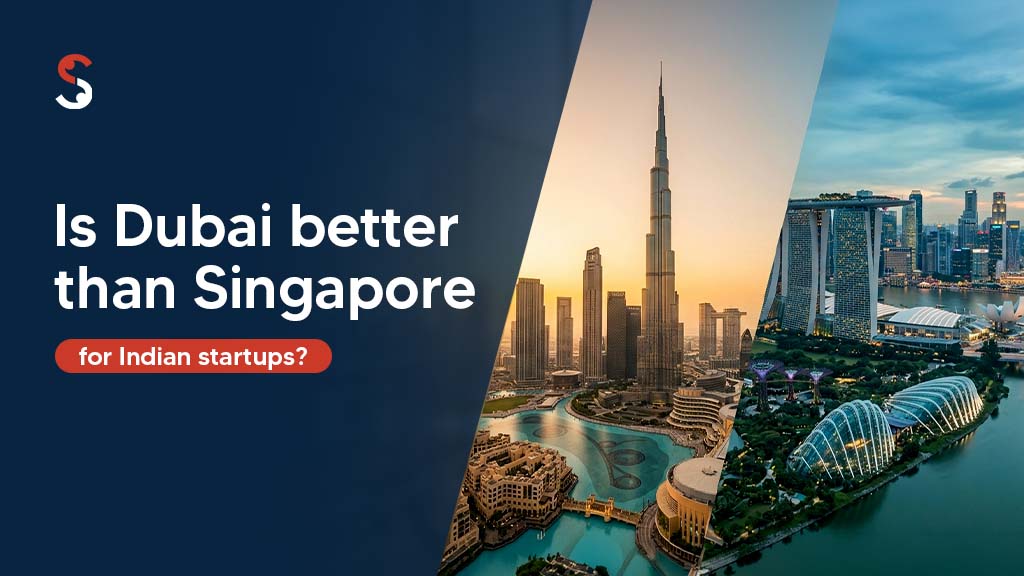
  • Is Dubai better than Singapore for Indian startups?

    Is Dubai better than Singapore for Indian startups?

    A Bengaluru-based startup founder recently shared something interesting during a startup networking event in Dubai. His startup grew significantly within one year after launch. His client base included people from the UAE, Europe, and Southeast Asia. Payments were arriving in USD, and expansion opportunities were opening up across global markets.

    So, he started exploring a location for his business expansion plans. When he researched which country would help in maximising his profits through tax savings and a better client base, two names came to the top of his list. These two names were Dubai and Singapore. 

    And honestly, this is exactly where many Indian entrepreneurs find themselves today. A few years ago, international business expansion was something only large corporations thought about. Now, even early-stage founders, agencies, SaaS startups, e-commerce brands, consultants, and digital businesses are comparing global business hubs before scaling. 

    Choosing between Dubai and Singapore as your next business destination can appear difficult. Both attract founders from across the world. Both offer strong business environments. But the better choice depends entirely on what kind of startup you are building and how you want to scale it. 

    In this blog, we will break down the complete Dubai vs Singapore business setup comparison for Indian startups in 2026. 

    Dubai vs Singapore for Startups: Quick Comparison 

    Before diving into details, here’s a quick overview of how both destinations compare for Indian entrepreneurs. 

    Factor  Dubai  Singapore 
    Business Setup Time  Fast  Fast 
    Corporate Tax  9% (0% in many free zone cases)  17% with exemptions 
    Personal Income Tax  0%  Progressive tax rates 
    Foreign Ownership  100% ownership available  100% ownership available 
    Market Access  Middle East, Africa, Europe  Asia-Pacific (APAC) 
    Ease of Setup  Very flexible and founder-friendly  More compliance-oriented 
    Investor Ecosystem  Growing rapidly  Highly mature 
    Best For  Trading, consulting, e-commerce, logistics, agencies  SaaS, fintech, AI, VC-backed startups 
    Operational Costs  Moderate  Higher 
    Lifestyle for Indian Founders  Familiar and highly connected to India  Structured and premium 

    Both destinations are highly business-friendly. The difference lies in what your startup prioritises more i.e., operational flexibility or long-term institutional positioning. 

    Why Indian Startups Are Comparing Dubai and Singapore? 

    Over the last few years, Indian startups have become far more global in their thinking. Indian entrepreneurs are no longer limiting themselves to one market. Modern startups often work with international clients, remote teams, global payment systems, and overseas investors from day one. 

    Because of this, founders are now looking for jurisdictions that offer: 

    • Better tax efficiency 
    • Easier international banking 
    • Faster company setup 
    • Global business credibility 
    • Access to new markets 
    • Better founder lifestyle and mobility 

    Dubai and Singapore have become two of the most preferred options because both offer strong infrastructure, international connectivity, and startup-friendly environments. 

    Dubai has become extremely attractive for founders who want faster setup, lower taxes, easier residency options, and direct access to the Middle East and Africa. Singapore, on the other hand, continues to attract startups looking for strong investor credibility, advanced financial systems, and deeper access to Southeast Asian markets. 

    This is why the startup in Dubai vs Singapore debate has become much bigger in 2026 than ever before. 

    Dubai vs Singapore Business Setup Process 

    When founders decide to expand internationally, one of the first concerns is how quickly and smoothly the company can actually be established. In this area, both Dubai and Singapore perform very well compared to most global jurisdictions. However, Dubai often feels more flexible and founder-friendly for Indian entrepreneurs, especially during the early stages. 

    Setting Up a Business in Dubai 

    Dubai has become one of the easiest places in the world to start a business. The process is fast, digital, and designed to attract foreign entrepreneurs. Indian founders can choose between Mainland company setup, Free zone company setup, and Offshore structures. 

    Free zones are especially popular among startups because they offer: 

    • 100% foreign ownership 
    • Easy licensing 
    • Simplified compliance 
    • Flexible office solutions 
    • International business operations 

    Many startups in consulting, e-commerce, digital marketing, IT services, trading, and logistics prefer Dubai free zones because setup can often be completed within a few days. 

    Another major advantage is that founders can also apply for UAE residency through their business setup. This makes it easier for founders to live in Dubai and operate globally. 

    Dubai’s business ecosystem is designed for speed. Founders usually spend less time dealing with paperwork and more time focusing on growth. 

    Popular UAE Free Zones for Startups: 

    Setting Up a Business in Singapore 

    Singapore also offers a fast and digital incorporation process. The country is known for its highly organised regulatory system and strong legal framework. However, the setup process can be slightly more structured for foreign entrepreneurs.  

    In many cases, foreign founders need: 

    • A local nominee director 
    • Additional compliance documentation 
    • Banking approvals 
    • Corporate service providers for setup support 

    Singapore works exceptionally well for startups planning long-term regional expansion across Asia-Pacific markets. 

    The ecosystem is especially strong for SaaS startups, Fintech companies, AI businesses, Venture capital-backed startups, and Deep tech ventures. While incorporation is efficient, operational compliance can feel more detailed compared to Dubai. 

    Dubai vs Singapore Tax Benefits for Startups 

    Tax is one of the biggest reasons founders compare these two destinations. 

    Here’s a simplified overview: 

    Tax Factor  Dubai  Singapore 
    Personal Income Tax  0%  Up to 22% 
    Corporate Tax  9%  17% 
    VAT/GST  5% VAT  9% GST 
    Capital Gains Tax  Generally favourable  No capital gains tax 
    Profit Repatriation  Allowed  Allowed 

    For founders generating international revenue, Dubai’s tax environment can significantly improve cash flow efficiency. 

    However, Indian entrepreneurs should also remember that FEMA regulations, tax residency rules, DTAA provisions, and RBI compliance still matter when operating internationally. 

    Many startups rush into overseas incorporation without understanding tax residency and compliance requirements properly. Speaking with Shuraa India experts before expanding internationally can help avoid costly restructuring later. 

    Cost of Running a Startup in Dubai vs Singapore 

    Startup Costs in Dubai 

    Dubai is often more cost-efficient than Singapore for many early-stage businesses. Operational flexibility is one of the biggest reasons behind this. 

    Founders can choose from virtual office solutions, shared workspaces, flexible visa packages, and different free zone pricing options. 

    That said, Dubai is still a premium international business destination. Costs can increase depending on: 

    But overall, many startups find Dubai easier to manage financially during the growth stage. 

    Startup Costs in Singapore 

    Singapore is known for higher operational costs. Businesses often spend more on: 

    • Office rentals 
    • Salaries 
    • Corporate compliance 
    • Professional services 
    • Living expenses 

    However, many founders see this as a tradeoff for stability, strong infrastructure, and investor confidence. For funded startups targeting global markets, the higher costs are often considered part of building a premium international presence. 

    Dubai vs Singapore for Startup Funding and Investors 

    Dubai’s Growing Startup Ecosystem 

    Dubai’s startup ecosystem has grown rapidly over the last few years. The UAE government has invested heavily in: 

    • Innovation programs 
    • AI initiatives 
    • Tech infrastructure 
    • Startup accelerators 
    • Investor ecosystems 

    Dubai is becoming increasingly attractive for startups in Fintech, Web3, E-commerce, LogisticsReal Estate Tech, and AI services. The city is also attracting global founders because of its business-friendly policies and international connectivity. 

    For many Indian entrepreneurs, Dubai offers a practical combination of growth opportunities, tax efficiency, and global expansion potential. 

    Singapore’s Strong VC Ecosystem 

    Singapore remains one of Asia’s strongest hubs for venture capital and startup funding. The country has built deep investor confidence over decades. 

    Many international investors prefer Singapore structures because of strong corporate governance, legal transparency, IP protection, and financial system stability. 

    This makes Singapore particularly attractive for startups planning: 

    • Institutional fundraising 
    • International acquisitions 
    • Large-scale APAC expansion 
    • Enterprise technology growth 

    For startups heavily dependent on venture capital, Singapore often has an edge in fundraising maturity. 

    Market Access: Dubai vs Singapore 

    Dubai’s Global Position 

    Dubai sits between Asia, Europe, and Africa, making it a major international business gateway. 

    Startups operating from Dubai can easily serve: 

    • GCC countries 
    • Middle East markets 
    • Africa 
    • Europe 
    • South Asia 

    This is especially valuable for businesses in trading, logistics, export-import, consulting, and international services. For Indian entrepreneurs, the UAE also offers geographical proximity and easier travel connectivity. 

    Singapore’s APAC Advantage 

    Singapore is often used as a regional headquarters for Asia-Pacific operations. It offers excellent access to: 

    • Indonesia 
    • Malaysia 
    • Vietnam 
    • Thailand 
    • Philippines 
    • Broader ASEAN markets 

    Many global technology companies use Singapore as their APAC headquarters because of its regulatory stability and advanced financial infrastructure. This makes Singapore highly attractive for startups planning deep expansion into Southeast Asia. 

    Lifestyle, Residency and Founder Experience 

    Lifestyle may not seem like a business factor initially, but for founders building long-term companies, it matters more than people expect. 

    Dubai has become highly attractive for Indian founders because of: 

    • Golden Visa opportunities 
    • Political Stability 
    • Strong Indian business community 
    • Luxury lifestyle 
    • Modern infrastructure 
    • International networking environment 
    • Easier relocation flexibility 

    Many entrepreneurs also feel culturally comfortable in Dubai because of its large Indian population and familiar business ecosystem. 

    Singapore offers a different kind of appeal. It is known for: 

    • Political stability 
    • Clean urban environment 
    • Strong public systems 
    • High-quality education 
    • Efficient public transport 
    • Family-friendly living 

    Both cities offer high safety standards and world-class infrastructure. The right choice depends more on the lifestyle and expansion environment a founder personally prefers. 

    Startup in Dubai vs Singapore: Which One Should You Choose? 

    After comparing every major factor, the final answer depends on your startup goals. 

    Choose Dubai For – 

    • Faster and simpler setup 
    • Tax efficiency 
    • Access to Middle East markets 
    • Lower operational friction 
    • Global lifestyle flexibility 
    • Easier business scalability 
    • Strong international connectivity 

    Dubai works extremely well for founders in building profitable, globally operating businesses. 

    Choose Singapore For – 

    • Strong investor ecosystem 
    • APAC expansion 
    • Institutional credibility 
    • Deep tech ecosystem 
    • Long-term fundraising opportunities 
    • Strong IP and regulatory frameworks 

    Singapore is often preferred by startups focused heavily on venture-backed scaling. 

    Note:  

    Every startup has its own operational needs, and a single ecosystem doesn’t work for all. Some businesses prioritise profitability and operational ease. Others look for funding and institutional credibility. 

    Here’s where each destination usually performs better. 

    Business Type  Better Fit 
    E-commerce Business  Dubai 
    Trading & Export Companies  Dubai 
    Consulting & Agencies  Dubai 
    Logistics & Supply Chain  Dubai 
    SaaS Startup  Singapore 
    AI & Deep Tech  Singapore 
    VC-Funded Startup  Singapore 
    MENA Expansion Business  Dubai 
    APAC Expansion Business  Singapore 
    Freelancers & Solopreneurs  Dubai 

    For many Indian SMEs and service-based startups, Dubai often becomes the more practical choice because of operational flexibility and easier international scaling. 

    Can Indian Startups Use Both Dubai and Singapore? 

    Yes, and many growing businesses have already done this. Some startups operate with: 

    • UAE entity for operations and tax efficiency 
    • Singapore structure for fundraising or APAC presence 
    • India operations for talent and development 

    Hybrid structures are becoming increasingly common among globally scaling Indian startups. The right structure depends on your revenue model, founder residency, investor plans, client geography, and expansion goals. 

    Professional guidance becomes extremely important here because international structures must comply with Indian regulations, FEMA guidelines, and taxation rules. 

    Which is better for Indian Startups – Dubai vs Singapore? 

    The Dubai vs Singapore for startups debate does not have one universal answer. Both are world-class business destinations. Both offer major advantages. And both continue attracting ambitious Indian founders in 2026. 

    Singapore offers structure, investor confidence, and strong APAC positioning. Dubai offers speed, flexibility, tax efficiency, and global expansion advantages that are difficult to ignore. 

    Statistically, Dubai is more preferred launchpad for Indian founders because it combines international business access with founder-friendly operations. The UAE government’s focus on innovation, foreign investment, and entrepreneurship has made the country one of the most attractive destinations for modern startups. 

    If your goal is to build a globally connected business with operational flexibility and strong growth potential, Dubai offers a highly compelling environment to scale. 

    How Shuraa India Can Help You Set Up a Business? 

    Choosing the right country is only the first step. The real challenge is choosing the right jurisdiction, license, business activity, and the right setup structure. 

    At Shuraa India, we help Indian entrepreneurs simplify the entire Dubai business setup process. From company formation, free zone setup, mainland licensing, visas, banking assistance, and compliance guidance, our team supports you throughout the process. 

    If you are planning to expand your startup internationally, this is the right time to explore how Dubai can support your business growth. 

    Get in touch with Shuraa India today and build your Dubai business with expert guidance. 

    Frequently Asked Questions 

    1. Is Dubai better than Singapore for Indian startups?

    Dubai is often considered better for Indian startups looking for faster setup, lower taxes, easier scalability, and access to Middle Eastern markets. Singapore is usually preferred by startups focused heavily on venture capital funding and APAC expansion. 

    2. Which is cheaper for startups: Dubai or Singapore?

    In most cases, operational costs in Dubai are lower than in Singapore, especially for early-stage businesses and SMEs. Singapore generally has higher office, staffing, and living costs. 

    3. Is Dubai good for SaaS startups?

    Yes, Dubai is becoming increasingly attractive for SaaS startups, especially those targeting MENA markets. However, startups seeking aggressive VC funding and APAC-focused expansion may also consider Singapore. 

    4. Can Indian entrepreneurs fully own a company in Dubai?

    Yes. Many UAE free zones and mainland structures allow 100% foreign ownership for Indian entrepreneurs. 

    5. Which country offers lower taxes: Dubai or Singapore?

    Dubai offers 0% personal income tax and competitive corporate tax rates, making it one of the most tax-friendly business destinations globally. 

    6. Is Singapore better for startup funding?

    Singapore has a highly mature investor ecosystem and is often preferred for venture capital-backed startups, fintech businesses, and deep-tech companies. 

    7. Can Indian startups operate in both Dubai and Singapore? 

    Yes. Many startups use hybrid business structures depending on their operational, tax, fundraising, and market expansion goals. 
  • JAFZA vs DAFZA Free Zone: Which Is Better for Indian Exporters?

    JAFZA vs DAFZA Free Zone: Which Is Better for Indian Exporters?

    International business expansion isn’t a faraway dream for Indian business owners, especially when the United Arab Emirates offers some Free Zones that are the most strategic across the globe. However, when it’s about choosing from two key players like JAFZA and DAFZA, the final decision often comes after a thorough JAFZA vs DAFZA comparison.  

    That’s why, in this blog, we are going to talk about all the things Indian exporters should know, from cost to location benefits, suitability of business, and logistics, for you to decide better and with confidence.  

    That said, no matter if you’re looking for a DAFZA setup or want a JAFZA Free Zone company, Shuraa India is with you every step of the way. From assisting you in figuring out the correct Free Zone to taking care of the paperwork, setup, and licensing. We make the procedure easy for you by providing holistic support. 

    Explained: JAFZA & DAFZA Free Zones  

    What’s JAFZA? 

    One of the biggest and most established UAE Free Zones, the Jebel Ali Free Zone (JAFZA) is located near the world-renowned Jebel Ali Port. This acts as a major hub when it comes to trade, manufacturing, as well as logistics.  

    For those who do not know, a Jebel Ali Free Zone company is particularly advantageous for exporters who deal with goods in bulk. This is because it has direct access to shipping routes that are international.  

    What’s DAFZA? 

    Strategically situated near the Dubai Airport Freezone Authority, Dubai International Free Zone (DAFZA) is recognised for its premium-quality infrastructure and connectivity that’s seamless. It’s perfect for businesses that deal with products that are high-value and time-sensitive.  

    To add, companies that depend on quick international distribution and air cargo systems that are efficient often prefer a DAFZA setup 

    JAFZA vs DAFZA Comparison: What are the Major Differences? 

    Selecting between these options calls for an in-depth look at how different they are across business factors that are critical. Let’s understand one by one.  

    1. Logistics and Location  

    JAFZA allows access to sea routes quite directly, which makes large shipments very cost- ffective. Whereas the airport proximity offered by DAFZA makes sure that there’s rapid delivery across global markets.  

    This is a central distinction when we talk about the JAFZA vs DAFZA comparison. 

    2. Activities for Business  

    Jebel Ali Port Free Zone supports a wide industry range. This includes manufacturing, trading, as well as logistics. However, the Dubai Airport Free Zone Authority is inclined towards sectors such as aviation, electronics, IT, and professional services.  

    3. Price and Setup 

    In general, JAFZA is more cost-effective, especially for businesses that need industrial space and warehouses. On the other hand, a DAFZA setup is more premium, offering quicker processing and an infrastructure that’s high-end. Here’s the starting price for both: 

    • JAFZA: Starts from *AED 50,000  
    • DAFZA: Starts from *AED 40,000  

    4. Infrastructure 

    From offices that are smart and facilities that are tech-enabled in DAFZA to industrial land as well as logistics parks present in JAFZA, both zones serve distinct operational requirements.  

    This, here, is yet another major factor when we talk about JAFZA vs DAFZA comparison. 

    5. Connectivity for Exporters  

    Both JAFZA and DAFZA come with powerful connectivity to India. JAFZA links via key sea routes, whereas DAFZA allows for air cargo movement that’s quick. This makes both a great option when we talk about a UAE Free Zone for exporters in India. 

    JAFZA vs DAFZA Comparison

    Bird’s Eye View of the JAFZA vs DAFZA Comparison 

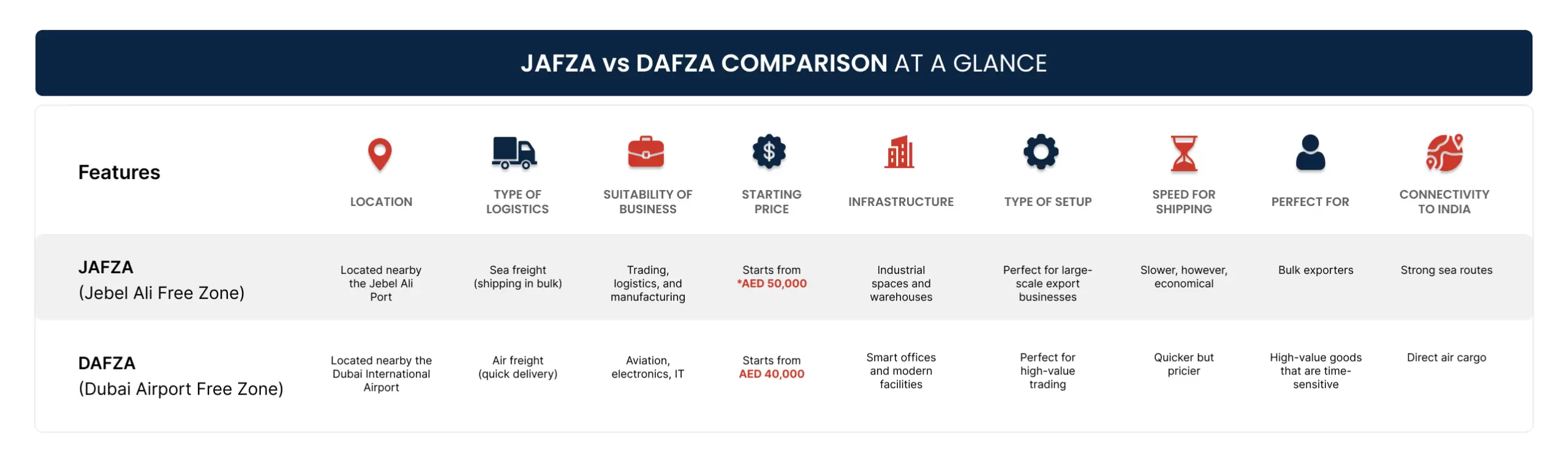
    To make the decision-making process easier for you, have a look at a quick comparison between both of these Free Zones: 

    Features  JAFZA (Jebel Ali Free Zone)  DAFZA (Dubai Airport Free Zone) 
    Location  Located nearby the Jebel Ali Port  Located nearby the Dubai International Airport 
    Type of Logistics  Sea freight (shipping in bulk)  Air freight (quick delivery) 
    Suitability of Business  Trading, logistics, and manufacturing  Aviation, electronics, IT 
    Starting Price  Starts from *AED 50,000  Starts from *AED 40,000 
    Infrastructure  Industrial spaces and warehouses  Offices that are smart, facilities that are modern 
    Type of Setup  Perfect for export businesses that are large-scaled  Perfect for trading that is of high value 
    Speed for Shipping  Slower, however, economical  Quicker but pricier 
    Perfect For  Bulk exporters  High-value goods that are sensitive to time 
    Connectivity to India  Sea routes that are strong  Air cargo that is direct 

    Rest assured, the aforementioned perfectly reveals the essence of the JAFZA vs DAFZA comparison for quick evaluation. 

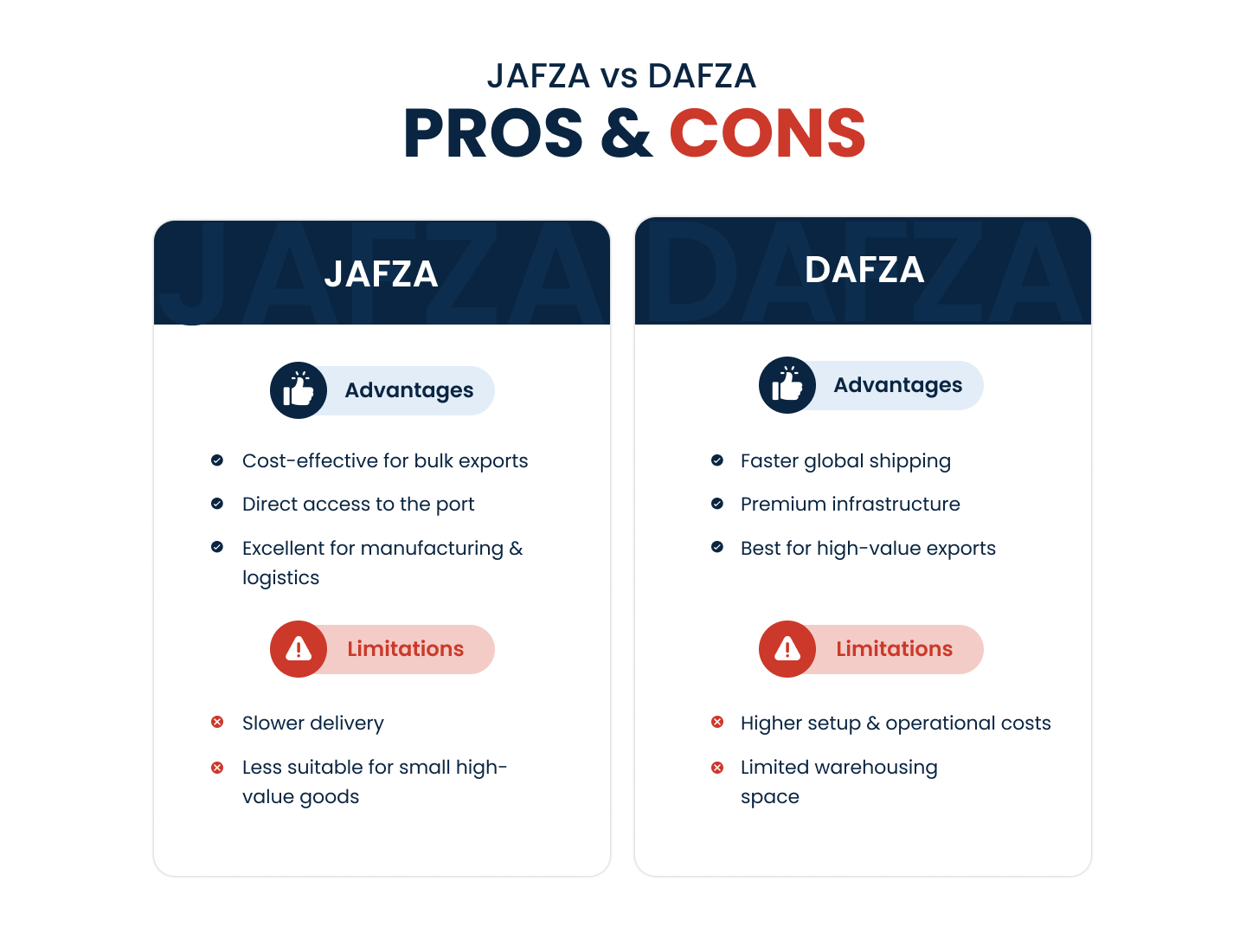
    JAFZA vs DAFZA Comparison: Pros and Cons Explained 

    Listed below are some of the benefits and limitations of both the Free Zones:  

    Advantages of JAFZA 

    • Cost-effective when it comes to bulk exports 
    • Helps you with direct access to the port 
    • Excellent when it comes to manufacturing as well as logistics 

    Limitations of JAFZA 

    • The delivery is slower when you compare it with air freight 
    • It is not quite suitable for goods that are small and of high value 

    Advantages of DAFZA 

    • Global shipping that’s faster 
    • Infrastructure is premium  
    • Excellent for exports that are of high value  

    Limitations of DAFZA 

    • Set-up as well as operational expenses are higher 
    • Warehousing space is limited 

    JAFZA vs DAFZA Comparison: Pros and Cons Explained

    JAFZA or DAFZA: Which One is Better for Indian Exporters? 

    We know that by this point, you might be wondering which of the two Free Zones is better when it comes to Indian exporters. To put it simply, there isn’t a universal answer to this question.  

    • If your company is focusing on exports that are of large-scale, efficiency in terms of costs, and warehousing, JAFZA could be a better option.  
    • If you prioritise speed, a reach that’s global, and handling of premium-quality products, DAFZA could be an excellent option.  

    Ultimately, selecting the correct UAE Free Zone Business Setup for Indian exporters is based on your business goal and logistics strategy alignment.  

    Want to Set Up Your Business? Do It with Shuraa India! 

    If you are an Indian exporter who’s trying to figure out the Free Zone setup in the UAE, there are chances that you might feel confused regarding the process. And honestly, without proper guidance, the process could appear complex, too. That’s why Shuraa India makes everything simple and efficient for you. 

    We help you assess the options, handle paperwork, and launch your UAE business without any hassles. Our legacy? Over decades of experience and having helped thousands of entrepreneurs successfully launch their UAE business 

    So, no matter if you want to go ahead with a DAFZA setup or feel like choosing a Jebel Ali Free Zone company, our experts can make it possible for you. All you have to do is book your free consultation today!  

    FAQs 

    1. Which Free Zone is More Expensive? DAFZA or JAFZA?

    A DAFZA setup typically has higher prices because of its top-class infrastructure and it being in the proximity to the Dubai airport.  

    2. Can Indian Business Owners Completely Own Their Business in These Zones?

    Of course. JAFZA and DAFZA permit 100% foreign ownership. This makes these Free Zones appealing for Indian Exporters who want to expand internationally. 

    3. JAFZA or DAFZA: Which is Best When It Comes to Warehousing & Logistics?

    JAFZA, because of its huge industrial spaces and access to the Jebel Ali Port, is more suited when it comes to warehousing and logistics.  

    4. Which is the Biggest Free Zone in the UAE?

    The United Arab Emirates’ very first Free Zone, Jebel Ali Free Zone Authority in Dubai, is the largest Free Zone.  

    5. Is DAFZA a Designated Zone? 

    Of course. DAFZA is recognised as a designated zone under the VAT regulations of the United Arab Emirates.  

  • Benefits of Opening a Company in Dubai

    Benefits of Opening a Company in Dubai

    Businesses are no longer limited by geography. They are now shaped by speed, policy, taxation, and access to global markets. And today, Dubai stands at the center of that transformation. 

    For Indian entrepreneurs, Dubai is not just another foreign market. It is a strategic expansion ground. It offers ease of business setup, ownership freedom, tax advantages, state-of-the-art infrastructure, and access to international trade routes. Whether you are starting fresh or expanding from India, Dubai provides an environment where businesses can move faster and grow with fewer restrictions. 

    Key Advantages of Establishing Your Business in Dubai 

    Let us break down why so many founders are evaluating the benefits of starting a business in Dubai today. 

    1. Complete Ownership andDecision-Making Power 

    Among the many benefits of opening a company in Dubai, full ownership stands out as a decisive factor for Indian entrepreneurs. In most business activities, entrepreneurs can own 100 percent of their company without the need of a local partner. 

    This means complete control over operations, profits, and decision making. You build your business on your own terms while operating within a clear legal framework. 

    For many Indian business owners who have experienced complex compliance structures or partnership constraints, this level of clarity and independence is a strong advantage. 

    2. Tax Efficiency That ProtectsYourProfits 

    Dubai offers zero personal income taxes. The UAE currently applies a competitive 9 percent corporate tax rate, which remains among the lowest globally, and many Free Zones provide exemptions for eligible businesses. There is no capital gains tax, and profits can be fully repatriated without restrictions. 

    For Indian entrepreneurs used to higher taxation and layered compliance structures, this creates a major difference in retained earnings. More retained earnings mean stronger reinvestment, better scaling, and improved cash flow management. 

    Dubai’s tax system is structured to encourage business growth, not restricting it, which is why tax efficiency remains one of the strongest benefits of starting a business in Dubai. 

    3. Fast and Structured Business Setup

    Speed matters in modern business. In Dubai, company registration follows a clearly defined and streamlined process. Licensing systems are digital, documentation requirements are clear, and approvals are structured. Entrepreneurs know what to expect, how long it will take, and what is required at every stage. 

    And if the process feels unfamiliar or complex at first, it is common for entrepreneurs to seek professional guidance from experienced advisory firms such as Shuraa India that assist with approvals, documentation and compliance. 

    4. Strategic Global Location

    Dubai sits at the intersection of Asia, Europe, and Africa. This geographical advantage translates into commercial power. 

    Its airports and seaports are among the busiest in the world. Logistics networks are efficient and internationally connected. Import export, trading, ecommerce, manufacturing and service businesses benefit from this connectivity. 

    Indian entrepreneurs who want international exposure without moving too far from home often find Dubai to be the most practical choice. Direct flights connect Dubai daily with Delhi, Mumbai, Bengaluru, and Kolkata, typically within three to four hours. This adds to another key element in the long list of benefits of opening a company in Dubai. 

    5. Over 45 Specialized Free Zones

    Dubai and the wider UAE offer more than 45 Free Zones. Each of these Free Zones are designed for specific industries such as technology, media, healthcare, trading and manufacturing. Popular Free Zones include IFZA, RAKEZ, DWTC, Ajman Free Zone, and DMCC, that offer distinct advantages depending on business activity and expansion plans. 

    Free Zones allow 100 percent ownership, full profit repatriation, and simplified regulations. In addition, entrepreneurs benefit from ready-to-use infrastructure, industry-driven communities, and strategic networking opportunities.  

    This structured ecosystem helps startups and SMEs enter markets with lower operational friction and reinforces the practical advantages of setting up a company in Dubai. 

    6. Strong Government Support and Policy Stability

    Dubai’s leadership has consistently focused on building a pro-business environment. Regulations are updated to encourage foreign investment, protect investors, and support long-term economic growth. 

    The UAE’s vision for innovation, digital economy, and entrepreneurship is not theoretical. It is backed by infrastructure, regulatory clarity, and active government participation. 

    For Indian entrepreneurs who sometimes face regulatory delays or sudden policy shifts, this predictability adds confidence. 

    7. Advanced Infrastructure and Digital Ecosystem

    Dubai has built an ecosystem that supports efficient operations. High speed internet, modern office spaces, smart government services, and advanced transport systems support smooth operations. 

    The city has invested heavily in digital transformation across sectors such as healthcare, logistics, ecommerce, and financial services. This creates a modern operating environment where businesses can scale digitally without structural barriers. 

    8. Easy Residency and Visa Access

    Business owners can obtain residency visas for themselves and their families. Investor visas and long-term residency options allow entrepreneurs to build a stable personal and professional base in the UAE. 

    This makes expansion more practical. Because building a business is not simply about obtaining a license. It is about establishing a presence. 

    9. A Diverse and High Spending Market

    Dubai’s population includes professionals, investors, and consumers from across the world. Purchasing power is strong, and demand for quality products and services remains consistently high. 

    Dubai itself is not only a hub for international consumers but also attracts high-income shoppers, with retail spending per capita among the highest globally (retail spending surge to nearly $300 billion by 2028), second only to major cities like New York. 

    For Indian brands and entrepreneurs, this creates new revenue channels beyond domestic markets – one more reason why the benefits of starting a business in Dubai continue to attract global founders. 

    10. A Bridge Between India and Global Expansion

    Many Indian businesses are not leaving India. They are expanding beyond it. Dubai provides that bridge. It allows Indian companies to maintain operations in India while establishing an international presence in a stable, tax efficient and globally connected market. 

    This dual presence often improves brand perception, investor confidence, and international credibility. 

    The shift requires careful planning. Understanding costs, compliance requirements, jurisdiction options and long-term obligations is important before taking the step. Consulting experienced advisors such as Shuraa India can provide clarity on opportunities and realistic timelines through free initial consultations. 

    Ready to open your Dubai company? Get a free setup plan today

    Why Indian Entrepreneurs Prefer Shuraa India for UAE Setup 

    The benefits of opening a company in Dubai go far beyond tax savings or faster licensing. It is about operating an ecosystem designed for business success. 

    Dubai offers a business environment built around clarity, ownership, and global connectivity. For Indian entrepreneurs evaluating the advantages of setting up a company in Dubai, the decision is less about relocation and more about strategic positioning. In that equation, Dubai stands out as a logical and strategic destination. 

    Shuraa India supports entrepreneurs at every stage of their UAE expansion journey. Be it choosing the right jurisdiction, handling documentation, securing approvals or ensuring compliance, the team simplifies what can otherwise feel complex. If you are planning to expand beyond India and explore the UAE market, connect with Shuraa India for a FREE personalized consultation. Take the next step with clarity, confidence, and the right guidance. 

    The opportunity is real. The ecosystem is ready. The next move depends on how prepared you are to act on it. 

    1,00,000+ businesses have been set up with Shuraa India — join them and experience the UAE’s tax-free business advantage

  • RAKEZ Business Activities List –  A Complete Guide

    RAKEZ Business Activities List – A Complete Guide

    The Ras Al Khaimah Economic Zone (RAKEZ) is one of the UAE’s most popular free zones, known for making business setup quick, flexible, and affordable. The freezone is situated in Ras Al Khaimah and has now grown into a thriving hub for more than 50 different industries. It’s not just about location or affordability; RAKEZ stands out because it offers flexible licensing, modern facilities, and a business-friendly environment that makes starting and running a company far smoother than many expect. 

    But before you set up your company in RAKEZ, you need to choose the right RAKEZ business activity. This decision affects the type of license you’ll get, the approvals required, the facilities you can use, and even how many visas you’re eligible for. Picking the wrong activity can lead to delays and extra costs. 

    That’s why we will take you through the type of business activities in RAKEZ, so you can make the right choice from the start.  

    What is RAKEZ? 

    The Ras Al Khaimah Economic Zone (RAKEZ) is one of the largest and fastest-growing free zones in the UAE. The free zone was established in 2017 through the merger of RAK Free Trade Zone and RAK Investment Authority. It has quickly become a strong business hub that attracts entrepreneurs, SMEs, and multinational companies from all over the world. 

    RAKEZ is strategically located in Ras Al Khaimah, which allows businesses easy access to key trade routes. The emirate is also known for its affordability compared to other parts of the UAE. 

    Types of Businesses in RAKEZ 

    Thanks to its diverse infrastructure and license options, RAKEZ supports a wide range of industries. Some of the businesses that thrive here include: 

    • Trading companies (import/export, general trading, e-commerce) 
    • Service providers (consultancies, IT firms, marketing agencies, professional services) 
    • Manufacturing and industrial units (light manufacturing, assembly, packaging, logistics) 
    • Educational institutions (training centres, consultancies, academies) 
    • Media companies (publishing, advertising, production, digital content) 

    Doesn’t matter if you’re a freelancer, a growing SME, or a large-scale manufacturer, RAKEZ offers a business-friendly environment tailored to different needs 

    RAKEZ Business Activities List 

    RAKEZ offers a wide range of business activities to give investors the freedom to choose the model that best suits their goals. Below are the major categories and some popular activities under each: 

     1. Commercial/Trading Activities 

    These involve buying, selling, or distributing goods locally or internationally. 

    • General Trading 
    • Import & Export of Goods 
    • Building Materials Trading 
    • Food & Beverage Trading 
    • Electrical Equipment Trading 
    • Automotive Spare Parts Trading 
    • Medical Equipment Trading 
    • Fashion, Apparel & Accessories Trading 
    • Electronics & Gadgets Trading 
    • Jewellery & Watches Trading 
    • Beauty & Personal Care Products Trading 
    • Toys & Baby Products Trading 
    • Home Appliances Trading 
    • Chemicals & Laboratory Supplies Trading 
    • Raw Materials Trading 

    2. Service/Consultancy Activities 

    Professional services and expert solutions. 

    • Business Consultancy 
    • IT Services & Solutions 
    • Marketing & Advertising Consultancy 
    • HR & Recruitment Services 
    • Accounting & Bookkeeping 
    • Project Management Consultancy 
    • Legal Advisory Services 
    • Engineering & Technical Consultancy 
    • Financial & Investment Advisory 
    • Event Planning & Management 
    • Tourism & Travel Consultancy 
    • Facility Management Services 
    • Real Estate Consultancy 
    • Management & Strategy Consulting 
    • Translation & Language Services 

    3. Industrial/Manufacturing Activities 

    For production, assembly, or light manufacturing. Popular industrial/manufacturing activities include: 

    • Food & Beverage Production 
    • Furniture Manufacturing 
    • Packaging & Labeling 
    • Garments & Textile Production 
    • Plastic & Rubber Products Manufacturing 
    • Printing & Publishing 
    • Building Materials Manufacturing 
    • Assembly of Electronics / Light Equipment 
    • Metal Fabrication 
    • Paper & Stationery Products Manufacturing 
    • Leather Goods Manufacturing 
    • Chemical Processing 
    • Cosmetics & Personal Care Production 
    • Woodworking & Carpentry 
    • Automotive Components Assembly 

    4. Educational Activities 

    Businesses offering training, coaching, and educational services. 

    • Educational Consultancy 
    • Training Institutes & Coaching Centres 
    • E-Learning Services 
    • Professional Development Programs 
    • Skill Development & Vocational Training 
    • Tutoring & Test Preparation Services 
    • Language Schools 
    • IT & Technical Training 
    • Corporate Training Programs 
    • Art & Music Schools 
    • Sports & Fitness Training Centres 
    • Childcare & Early Learning Programs 

    5. Media Activities 

    For creative, publishing, and content-related businesses. 

    • Advertising Agencies 
    • Publishing & Printing 
    • Digital Media Production 
    • TV, Radio, and Film Production 
    • Event Management Services 
    • Graphic Design & Creative Studios 
    • Social Media Management 
    • Photography & Videography Services 
    • Animation & Motion Graphics 
    • Content Writing & Copywriting 
    • PR & Communications Consultancy 
    • Influencer Marketing Services 
    • Media Buying & Planning 
    • Podcast & Audio Content Production 

    6. E-Commerce Activities 

    Businesses operating online platforms, digital sales, and services. 

    • Online Retail Trading 
    • Online Food & Grocery Delivery 
    • Marketplace Platform Operator 
    • E-Services & Digital Products 
    • Web & Mobile Application Development 
    • Dropshipping Business Models 
    • Subscription Box Services 
    • Online Fashion & Accessories Store 
    • Electronics & Gadget E-commerce 
    • Online Health & Wellness Products 
    • Digital Marketing & Advertising Services 
    • Online Bookstore or Publishing Platform 
    • Virtual Event & Workshop Platforms 
    • Online Educational Platforms & Courses 

    7. Research & Development/Innovation Activities 

    • Scientific Research Centres 
    • Tech & Product Development 
    • Lab & Prototype Testing 
    • Innovation & Technology Incubators 
    • Environmental & Sustainability Research 

    8. Hospitality & Tourism Activities 

    • Hotels & Resorts Management 
    • Travel Agencies & Tour Operators 
    • Restaurant & Catering Services 
    • Event Management & Planning 
    • Leisure & Entertainment Services 
    • Hospitality Consultancy 

    Note: RAKEZ also allows combining multiple activities under a single license in many cases, which makes it flexible for entrepreneurs who want to diversify their offerings. 

    How to Choose the Right RAKEZ Business Activity? 

    Choosing the right business activity in RAKEZ is crucial because it determines your license type, approvals, office requirements, and even visa eligibility. Follow these steps to make the right choice: 

    1. Define Your Business Purpose 

    First, clearly define what your business will do. Be specific. Are you providing a service, selling a physical product, manufacturing goods, or a combination? Your business activity should accurately reflect your core operations, both now and in the foreseeable future. RAKEZ offers an extensive list of over a thousand activities, so take the time to find the one (or up to five) that best matches your business model. 

    2. Understand the RAKEZ License Types 

    Once you have a clear idea of your business activity, you can identify the corresponding license type. RAKEZ issues licenses based on the nature of the business. The main types include: 

    • Commercial License: The license is suitable for businesses engaged in trading, such as import/export, retail, and wholesale of goods. 
    • Professional/Service License: This is for companies that offer professional services and consultancies, including marketing, IT, legal, and accounting services. 
    • Industrial License: The license is required for businesses involved in manufacturing, processing, assembly, and packaging of products. 
    • General Trading License: A more flexible version of the commercial license that allows for a broader range of products to be traded under one license. 
    • Freelancer Permit: A cost-effective option for individuals working independently in specific fields like media, education, and technology. 

    3. Check for Multiple Activities and Future Plans 

    One of RAKEZ’s key advantages is its flexibility. You can often include multiple business activities under a single license, which is great for a diversified business model. For example, if you plan to sell goods online and also offer marketing consultancy services, you might be able to combine these under a single license type or a special package. 

    4. Verify Approvals & Restrictions 

    Some activities may require special approvals from UAE authorities (e.g., medical, educational, or industrial activities). Confirm eligibility and necessary permits before finalising your activity. 

    5. Consult the Official RAKEZ Activity List 

    RAKEZ provides a comprehensive and detailed activity list of all approved business activities, often with specific codes. It is crucial to review this official list to ensure your intended activity is permitted and to find the exact classification. 

    6. Consult Experts for Guidance 

    RAKEZ setup rules can be detailed, and choosing the wrong activity may cause delays or extra costs. Work with business setup consultants like Shuraa India, who understand RAKEZ licensing and can guide you in selecting the right activity. 

    How Shuraa India Can Help

    Picking the right business activity is one of the most important steps when choosing a business setup in RAKEZ. Your choice affects your license, the approvals you need, the kind of office or warehouse you can use, and even the visas you can get. Choosing correctly from the start can save you a lot of time, money, and hassle. 

    RAKEZ offers incredible opportunities for entrepreneurs across a wide range of industries. At Shuraa India, we make this process simple. We can help you choose the right RAKEZ business activity, guide you through license applications and paperwork, and provide ongoing support for compliance, renewals, and scaling your business. 

    Get started today! Contact Shuraa India for a free consultation. 

  • Benefits of Mainland Company Setup in Dubai

    Benefits of Mainland Company Setup in Dubai

    Mainland Company setup in Dubai allows you to conduct business locally in Dubai, as well as in other parts of the UAE and internationally. Unlike before, you no longer require a local sponsor who is a UAE national to establish a Dubai Mainland Company, granting you the opportunity for 100% foreign ownership in the mainland region. 

    To initiate the process, simply contact the expert team at Shuraa India. They will assess your business activities to determine if your venture qualifies for complete foreign ownership. Thanks to recent amendments to the Companies Law, the Dubai Department of Economy and Tourism (DET) has approved over 1000 activities for full expatriate ownership.  

    All you need now is a reliable local service agent (LSA) who will assist you in securing the necessary license. In return for their support, they will charge a fixed compensation. Reach out to Shuraa India to explore this opportunity further. In this blog, we will discuss the benefits of a mainland business setup in Dubai.  

    Why Choose Mainland Dubai for Your Company Setup?

    Dubai, renowned as a global hub for tourism and business, offers unparalleled opportunities for entrepreneurs. Choosing the mainland for your company setup in Dubai proves to be the wisest decision for several reasons: 

    1. Tax Exemption:

    Mainland companies in Dubai enjoy corporate tax exemptions, providing significant financial benefits for business owners.

    2. Versatile Trading:

    Mainland companies can freely trade with other entities within the UAE and internationally, unlike their counterparts in free zones restricted to specific zones. 

    3. Diverse Business Activities:

    Mainland businesses enjoy a broader spectrum of permissible activities than their free zone counterparts. Unlike limited scope in free zones, mainland companies can explore a wide range of opportunities across the UAE. 

    4. Flexible Office Locations:

    Mainland companies can select office locations anywhere in Dubai, facilitating easy access to the local market and establishing multiple branches for a strong UAE presence. 

    5. Government Contract Opportunities:

    Mainland companies are privileged to work with the government, a prospect not available to free zone entities limited to private commercial ventures. 

    6. Unlimited Visa Allocation:

    Mainland companies can obtain an unrestricted number of visas, depending on available office space—the more space, the more visas, providing flexibility for employee recruitment. 

    7. No Currency Restrictions:

    Mainland businesses face no currency restrictions, ensuring seamless financial transactions locally and internationally. 

    8. Repatriation of Funds:

    Mainland companies can repatriate capital and profits entirely, offering financial flexibility to business owners. 

    9. Straightforward Registration:

    The registration process for mainland businesses is streamlined and efficient, eliminating unnecessary bureaucratic hurdles. Additionally, there’s no mandatory yearly audit requirement, simplifying the operational process. 

    With these advantages, establishing your business in the Dubai mainland opens doors to opportunities and growth.  

    Set up your Dubai mainland company — free advisor consultation

    Key Benefits of Dubai Mainland Company Setup

    When setting up your business, the Benefits of Mainland Business Setup in Dubai are many advantages, ensuring a future for your entrepreneurial ventures. Here are the key benefits that make mainland company setup an attractive choice: 

    1. Unrestricted Trade and Location Freedom

    Mainland companies enjoy free trade without constraints and can operate anywhere in Dubai. There are no limitations on business interactions with other companies, government entities, or consumers across the UAE. Additionally, the flexibility to establish multiple branches strengthens market presence significantly. 

    2. Diverse Business Opportunities

    Mainland businesses can diversify their offerings extensively. Should you wish to expand your business activities, registering new ventures with the Dubai Department of Economy and Tourism (DET) is a seamless process. This flexibility allows for effortless entry into various sectors and markets. 

    3. Access to Lucrative Government Contracts

    Dubai and the UAE invest substantially in government projects, offering substantial business opportunities. By establishing your company on the mainland, you position yourself to bid for and secure lucrative government tenders. This access can be a game-changer for business growth and sustainability. 

    4. Complete Ownership Control

    Mainland company formation grants entrepreneurs the unique advantage of complete ownership control. This level of ownership was traditionally available only in free zones or specific professional services companies. Now, with the mainland set up, entrepreneurs can exercise complete control over their business entities, enhancing decision-making autonomy and strategic planning. 

    5. Versatility in Business Activities

    Mainland companies have the flexibility to engage in a wide array of business activities. Whether manufacturing, trading, or providing services, the scope is vast. Adjusting or expanding your offerings to meet market demands is hassle-free, promoting adaptability and innovation within your business.  

    Choosing a mainland company setup in Dubai provides an open gateway to a dynamic business landscape, empowering entrepreneurs with unparalleled freedom and opportunities for growth and success. 

    Transitioning from Free Zone to Mainland

    Suppose your business currently operates within the confines of a free zone structure, and you’re contemplating the shift to establishing a mainland company. In that case, we’re here to guide you through the process. Presently, more than 30,000 companies conduct business within the three largest UAE-free zones. Foreign entrepreneurs often choose free zones due to the convenience of pre-packaged business solutions. However, as your business matures, these models come with limitations.

    While free zone setups serve as an excellent starting point for UAE businesses, the strategic move towards expansion necessitates transitioning to a mainland company. This shift is pivotal for ensuring sustained business prosperity. With the assistance of the right UAE national sponsor like Shuraa India, transitioning from a free zone setup to the UAE mainland represents a savvy and manageable step toward your business’s growth and success.  

    Start Your Mainland Company with Shuraa India

    Shuraa India is your reliable partner throughout the entire process. We guide you through the benefits and complexities of establishing a Mainland Company in Dubai, ensuring a smooth and hassle-free experience. Contact us today to ensure a smooth and hassle-free experience, allowing you to focus on building and growing your business confidently. 

    Our advisors have set up 50,000+ mainland companies in Dubai — get a free cost breakdown and structure recommendation

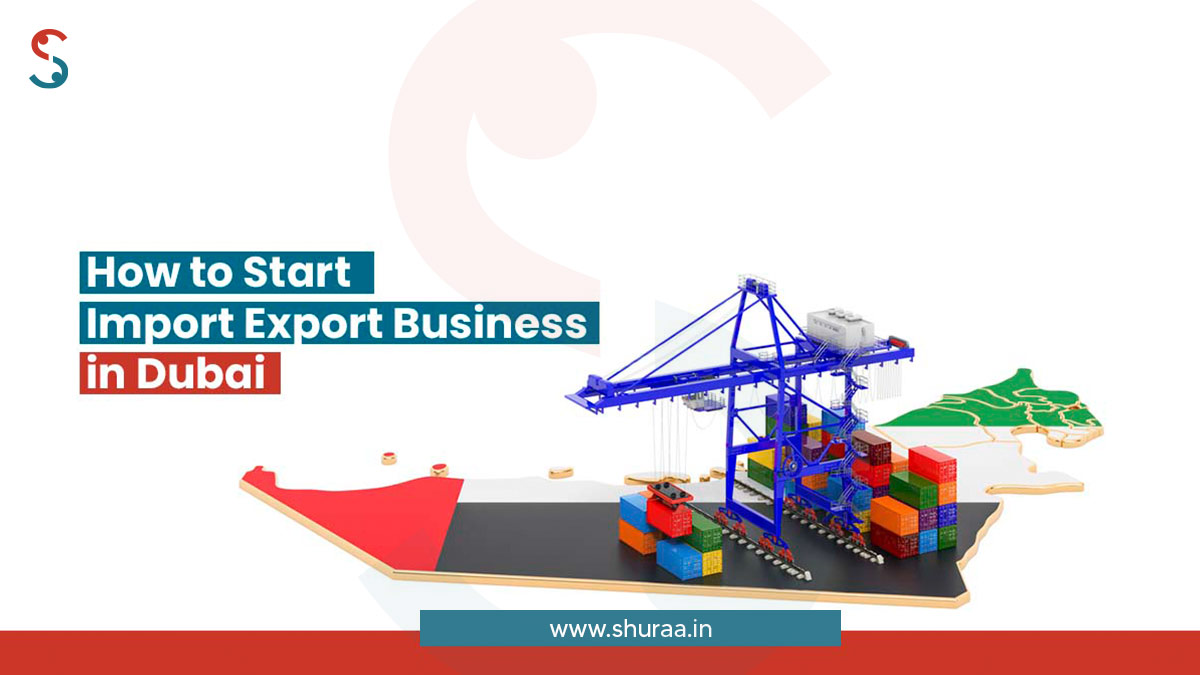
  • How to Start an Import-Export Business in Dubai?

    How to Start an Import-Export Business in Dubai?

    Dubai is globally recognised for its powerful import-export and international trade ecosystem, making it a prime destination for entrepreneurs planning to enter this high-growth sector. With AED 3.5 trillion in non-oil foreign trade recorded in 2023, Dubai has consistently broken records and reinforced its position as a global trading powerhouse. This momentum continues strongly into 2026, supported by infrastructure expansion, digital customs systems, and global trade partnerships.

    Starting an import-export business in Dubai may appear complex at first, but with the right guidance, the process is smooth and highly rewarding. From obtaining the appropriate licenses and approvals to building reliable supplier and logistics networks, each step plays a critical role in long-term success.

    This guide explains how to start an import-export business in Dubai, outlining the requirements, costs, benefits, and the best setup options to help you enter this lucrative industry with confidence.

    Why Start an Import-Export Business in Dubai in 2026?

    Dubai has a long history of being a major trading center, and there are several reasons why it’s a good place to start an import-export business today: 

    1. Business-Friendly Environment 

    The UAE government has created a welcoming environment for businesses by offering tax breaks, streamlined regulations, and free trade zones. There is a 0% corporate tax on income up to AED 375,000 and a modest 9% tax beyond that. This can save you a significant amount of money compared to doing business in other countries. 

    2. Geographical Advantage

    Dubai is geographically well-positioned at the meeting point of Asia, Africa, and Europe. This makes it a natural hub for transporting goods between these continents, reducing shipping times and costs. 

    3. Free Trade Agreements

    The UAE has free trade agreements with many countries around the world. This means that you can import and export goods without having to pay high tariffs, which can make your business more profitable. 

    4. Open Economy

    The UAE has a very open economy, with few restrictions on trade. This allows you to import and export a wide variety of goods with minimal bureaucratic hurdles. 

    5. Government Support

    The UAE government actively supports the import and export sector through initiatives and programs that can benefit your business. This can include access to financing, market research assistance, and trade missions. 

    6. Top-notch Infrastructure

    Dubai boasts world-class infrastructure, including one of the busiest airports in the world and the largest man-made harbor. This efficient infrastructure makes it easier and faster to move goods in and out of the country. 

    Import-Export Business Setup Options in Dubai (Mainland vs Free Zone vs Offshore)

    When choosing to set up an import-export business in Dubai, the type of company registrationMainland, Freezone, or Offshore – impacts your business operations significantly. Here’s a breakdown of each to help you decide: 

    1. Mainland Import-Export Business Setup in Dubai

    Benefits: 

    • You can trade anywhere in the UAE, including the mainland and free zones. 
    • Offers the most extensive range of business activities for import-export. 
    • 100% foreign ownership is now allowed. 

    Drawbacks: 

    • Requires a local service agent in some cases (depending on the activity). 
    • Higher setup and operational costs compared to free zones. 
    • More complex regulations compared to free zones. 

    2. Free Zone Import-Export Business Setup

    Benefits: 

    • 100% foreign ownership and repatriation of profits. 
    • Streamlined company setup process. 
    • Typically enjoys tax exemptions on corporate income and import/export duties (depending on the specific free zone). 
    • Many free zones cater to specific industries, offering specialized facilities and support. 

    Drawbacks: 

    • There may be restrictions on trading within the free zone and internationally. 
    • May have limitations on business activities compared to the mainland. 
    • Annual fees associated with maintaining the free zone license. 

    3. Offshore Import-Export Business Setup

    Benefits: 

    • Lowest setup and operational costs. 
    • 100% foreign ownership and full repatriation of capital. 
    • No physical office space required in Dubai. 

    Drawbacks: 

    • Cannot conduct any business within the UAE (strictly for international transactions). 
    • Limited use for import-export businesses due to the restriction on UAE mainland operations. 

    If your primary market is the UAE, a mainland company is best. For international trade with limited UAE involvement, a free zone can work. Offshore is not suitable for import-export within the UAE. 

    Documents Required for an Import-Export Business License

    To start an import-export business in Dubai, you will need to obtain a trading license and registration. The documents required to obtain an import-export license in Dubai can vary depending on whether you choose to set up your business in the mainland or a free zone.  

    However, here are the general requirements: 

    • Completed the application form for the trade license 
    • Trade name options 
    • Business activity 
    • Passport copies of all the shareholders 
    • Passport-size photograph of all the shareholders 
    • Tenancy contract for your office space in Dubai 
    • Bank reference letter 

    How to Start an Import-Export Business in Dubai, UAE

    Here’s a step-by-step process to set up your import-export business in Dubai: 

    1. Choose a Business Model

    Decide whether to establish your business in a free zone or on the mainland. Free zones offer benefits like 100% foreign ownership and tax exemptions, while mainland companies can trade directly in the local market. 

    2. Finalize Your Business Name

    Pick a unique and relevant name that complies with Dubai’s naming regulations. 

    3. Register Your Business in Dubai

    This involves registering with the Dubai Department of Economy and Tourism (DET) if operating in the mainland or the relevant free zone authority. Approval processes may differ slightly. 

    4. Obtain an Import-Export License

    Apply for a trade license from the Dubai Chamber of Commerce and Industry that authorizes import-export activities. 

    5. Register with Dubai Customs

    Register your company with Dubai Customs to comply with customs regulations and procedures for importing and exporting goods. You must obtain an Import-Export Code, which is essential for trading activities. 

    6. Open a Corporate Bank Account

    Choose a bank and open a corporate account to handle transactions. Provide the necessary documents, including trade license, passport copies, and proof of address. 

    7. Obtain Visas

    Depending on your business structure and number of employees, you may need to apply for visas for yourself, partners, and staff. 

    8. Logistics and Shipping Arrangements 

    Partner with reliable freight forwarding companies for shipping and logistics. Hire customs clearance agents to handle import-export procedures smoothly. 

    Keep thorough records of all transactions, including invoices, shipping documents, and customs paperwork. Regularly update yourself on changes in trade regulations and policies.  

    The specific requirements may vary depending on your chosen business location and activities. It’s advisable to consult with business formation specialists in Dubai at Shuraa India for professional guidance tailored to your situation. 

    Import-Export License Cost in Dubai (2026)

    The cost of obtaining an import-export license in Dubai is between AED 13,500 to AED 28,500. However, the actual cost can vary depending on several factors, including: 

    • Business Location: The fees can differ between setting up in Dubai mainland or free zone. Mainland tends to be slightly more expensive. 
    • Number of Visas Required: If you need visas for employees or partners, that can add to the cost. 
    • Specific Free Zone: Free zones have their own fee structures, so the cost might vary depending on the chosen zone. 

    Besides the import-export license cost, there may additional costs involved such as: 

    • Initial Approval 
    • Name Reservation 
    • Local Sponsor (if required) 
    • Office Space 
    • Ejari Registration 
    • Import-Export Code 
    • Bank account opening fees 

    Therefore, it’s advisable to consult with a business setup advisor at Shuraa for precise and up-to-date cost estimates tailored to your specific business needs. 

    Start Your Import-Export Business in Dubai with Shuraa India

    Starting an import-export business in Dubai is a fantastic opportunity with great potential for success. The city’s booming trade scene, perfect location, and friendly business rules make it an ideal place for entrepreneurs looking to expand their reach globally. While the process can be complex, it doesn’t have to be difficult with the right help. 

    At Shuraa India, we’re here to make things easy for you. With our deep knowledge of Dubai’s business environment and years of experience, we simplify every step. From picking the right business model, registering your company, getting licenses, handling paperwork, providing PRO services, finding office space, helping with visas, and much more—we’ve got you covered. 

    We’re committed to making your journey smooth and hassle-free. Let us take care of the details, so you can focus on growing your import-export business in one of the world’s most dynamic markets. Reach out to Shuraa India today and take the first step toward your success in Dubai. 

  • Benefits of Free Zone Company in Dubai, UAE

    Benefits of Free Zone Company in Dubai, UAE

    You’ve come to the right place if you’re thinking about starting a business and want to learn the top benefits of a free zone company in Dubai. Take a moment to review some crucial information about doing business in the UAE before learning more about the benefits of free zone company formation in the UAE. 

    For many years now, the UAE government has taken the initiative to attract foreign investment to the Emirates from all over the world. The UAE’s economic advancement is primarily attributable to a forward-thinking government, business-friendly policies, and the entrepreneurial spirit of its citizens. We’ll get a quick overview of the Free Zone jurisdiction in this blog, along with some advantages. 

    What are the UAE’s free zones? 

    Free zones are special economic regions or jurisdictions that grant financial and tax exclusions as well as operating licenses for commercial establishments. The seven Emirates are home to over 50 free zones in total. The Free Zone Authority is the name of the administrative unit in charge of a free zone. The governing body in charge of the crucial tasks related to free zone operations and license issuance is known as the Free Zone Authority or FZA. 

     In a UAE free zone, an investor may establish one of the following three business entities. 

    • Free zone company (FZCO) 
    • Free zone establishment (FZE) 
    • Branch of a foreign company 

    Top 9 Benefits of a Free Zone Company in Dubai

    First and foremost, free zones in Dubai are essentially national boundaries. Without the interference of onerous customs regulations, commodities, services, and other goods can be traded in these areas. Companies in Dubai’s free zones pay no taxes or very little tax, depending on the specific arrangement. 

    This promotes economic activity and a higher rate of successful business operations without having to worry about paying taxes or capital gains to the government. In the Dubai Mainland, every free zone is a separate legal entity with its own free zone authority. Within the boundaries of that free zone, this authority is in charge of administration, registration, and license issuance. 

    The establishment of a business in a UAE free zone has many advantages, including: 

    1. 100% Foreign ownership 

    Acquire total control over your business in a free zone. In the United Arab Emirates, a foreign investor or a group of foreign nationals may fully own a free zone company. For their company, a local sponsor is not required. The ownership of businesses in free zones is open to all nationalities. 

    2. Confidentiality 

    The highest level of confidentiality is maintained by free zone authorities when it comes to information on assets owned by free zone businesses. 

    3. No trade restrictions 

    There are no limitations on trade or the volume of business that free zone businesses can conduct with businesses outside the zone as well as within it. 

    4. No currency regulations  

    Currency regulations are governmental restrictions on the exchange of foreign currencies. There are no currency regulations in the free zones. In UAE free zones, there are no currency restrictions of any kind. This facilitates financial transactions. 

    5. Exemption from import and export taxes  

    In the UAE, the free zone jurisdictions are exempt from import and export taxes. This aids in advancing global trade. 

    6. Workspaces are easily accessible  

    Free zone jurisdictions have access to a variety of warehouse and office options. UAE free zones are excellent for startups and SMEs. 

    7. Easy incorporation of a business 

    The processes for incorporating a business in a free zone are easy and straightforward. In comparison to other jurisdictions, the licensing process can be completed in fewer days. 

    8. trouble-free Immigration procedures 

    Immigration facilities connected to the UAE-free zones are effective and save time. 

    9. Excellent infrastructure and communication  

    UAE free zones have the most modern infrastructure and communication systems.  

    Shuraa India has placed companies in 40+ UAE free zones — get expert guidance on which free zone gives your business the best advantages

    List of best free zones in the UAE

    1. IFZA – International Free Zone Authority
    2. RAKEZ – Ras Al Khaimah Economic Zone
    3. Meydan Free Zone
    4. SHAMS – SHAMS – Sharjah Media City

    Conclusion

    Unquestionably, establishing a company in a free zone is one of the best moves an entrepreneur can make. This is so that businesspeople looking to enter the UAE‘s business market can take advantage of the free zones’ many advantages. Additionally, the advantages of a free zone business in Dubai outweigh any potential drawbacks. 

    One of the top companies in the UAE for business setup is Shuraa India. We have been assisting business owners in the nation to establish and grow their enterprises for over 25+ years. We guarantee that the setup of your business will go off without a hitch. Our knowledgeable consultants will walk you through every step of the procedure, from setting up your business to figuring out how much a free zone license will cost. 

  • What is the New Rule for Family Visa in Dubai, UAE?

    What is the New Rule for Family Visa in Dubai, UAE?

    The family visa in Dubai, also known as the dependant visa, allows family members of UAE residents to reside and work in Dubai. Many Families living in Dubai often need to reintroduce their UAE family residence visas regularly, as the country does not offer permanent residency to expats. This blog provides the latest updates regarding the renewal fees for UAE family residence visas in 2026. Since an important portion of the UAE’s population, particularly its workforce, comprises expats, many individuals and their families choose to extend their stay beyond their visa expiry.  

    However, overstaying results in penalties, motivating individuals to renew their visas before expiration to avoid penalties. Refreshing a visa typically involves returning to one’s home country, reapplying for the visa, and returning to the UAE after a month.  

    What is a Family Visa in Dubai? 

    A family visa in UAE or a Dependent visa allows family members of Dubai to reside and work in Dubai. UAE residents need an immigration document for families moving to the UAE. Family members, including the visa holders’ spouses, parents, and children, are eligible to renew their visas. 

    Dubai Family Visa Requirements 

    To get a family visa in the UAE as per the 2026 regulations: 

    • The sponsor needs a valid residence visa and a minimum monthly salary (AED 4,000 or AED 3,000 with accommodation). 
    • Female sponsors require a minimum salary (AED 10,000 or AED 8,000 with accommodation). 
    • Mothers cannot sponsor if the father is present and can sponsor their children. 
    • Sponsors must initiate dependents’ residence permits within 60 days of their arrival. 
    • Applicants aged 18+ need a UAE medical fitness exam. 
    • The sponsor’s wife needs a translated, authenticated marriage certificate. 
    • Unmarried daughters of any age can be sponsored. 
    • Unmarried sons can be sponsored until age 25. 
    • No age limit for sponsoring children with disabilities. 
    • Sponsoring parents require a guarantee from the immigration department per parent. 

    Sponsor your family in Dubai — get a free eligibility check today.

    Family Visa Cost in Dubai 2026 

    The Dubai family visa cost 2026 for Indians ranges from AED 4,500 – 5,500, excluding insurance. For applicants outside Dubai, a 2-year family visa price in Dubai, including insurance, is AED 5,000 – 6,000. Costs cover entry permit, medical test, Emirates ID, visa stamping, and sponsor fees. Use Shuraa India for accurate cost estimation and smooth processing.

    • Entry Permit: AED 550.
    • Medical Test: AED 300 – 500.
    • Emirates ID (2 years): AED 250 – 450.
    • Visa Stamping: AED 500 – 580.
    • Mandatory Health Insurance (per person): AED 1,500 – 3,000.
    • Sponsor File Fees: AED 268 – 1,138.

    How to apply for a family visa in Dubai?  

    You can apply for a family visa online or offline in Dubai or the UAE. The required documents and conditions differ based on whether you sponsor children, a spouse, parents, or stepchildren. After gathering all the necessary documents, the next step is to start the visa application process.  

    This includes submitting the application and paying the required fee for a family visa in Dubai. It’s worth noting that the costs for a UAE residence visa can vary depending on the type of visa you are applying for. 

    Required Documents for Family Visa Dubai- Application 

    Below are the required documents for a family visa application:   

    • Photocopy of passport/visa  
    • Emirates ID 
    • One passport-sized photo with a white background  
    • Photocopy of the passport  
    • Salary certificate (if employed in a free zone company)  
    • Three months’ bank statement and memorandum of agreement (if an investor or partner)  
    • Labour contract (if employed in the private sector)  
    • Marriage certificate attested by MOFA (if sponsoring a wife)  
    • Birth certificate attested by MOFA (if sponsoring children)  
    • Ejari (if the sponsor is renting)  
    • Title deed (if the sponsor owns the house)  
    • DEWA bills (proof of utility payments)  
    • IBAN number  
    • Opening file number  
    • Medical results  
    • EIDA application  
    • Family medical insurance  

    What is the Validity Duration for a UAE Family Visa?  

    A Family visa in Dubai typically lasts 2 years if renewed promptly before expiry. It’s crucial to note that the validity of these visas hinges on the sponsor’s visa status. If the sponsor’s visa expires or is cancelled, the family visas become invalid. 

    However, UAE authorities provide a 30-day grace period for visa renewal. Starting the renewal process within this period is highly recommended to prevent penalties and legal issues. 

    Our visa team handles complete family visa sponsorship for Indian residents in UAE — 40,000+ visas processed successfully.

    What are the Renewal Fees for the UAE Family Visa?

    Before initiating the renewal process, it’s crucial to meet these requirements: 

    • Employed residents in the UAE can renew family members’ visas if they meet certain criteria, such as earning a minimum salary of AED 4,000 or AED 3,500 with company-provided accommodation. 
    • Individuals aged 18 and above require a valid medical test report. 
    • Emirates ID renewal is necessary before renewing the residence visa. 
    • Basic health insurance is mandatory in Dubai, ensuring family members have adequate coverage. 

    New UAE Family Visa Rules 2026  

    Here are the 2026 rules for UAE family visas: 

    • Employers and employees with valid residence visas and a minimum salary of AED 4,000 or AED 3,000 with accommodation can sponsor their families. 
    • Professional nature no longer affects eligibility for a family visa. 
    • Fathers in the UAE can sponsor children; mothers cannot. 
    • Visa issuance depends on job type and labour contract terms. 
    • Sponsors have 60 days to apply for dependents’ visas after arrival. 
    • Applicants aged 18+ need a UAE medical fitness test. 
    • For wives, an Arabic-translated marriage certificate is required. 
    • Certain Muslims can sponsor two wives under specific conditions. 
    • Sponsorship for unmarried children up to 18 (or 21 if in education). 
    • Stepchildren sponsorship under GDRFA guidelines. 
    • Parents sponsored by employees with immigration department guarantees. 
    • Women in specific professions with an AED 8,000+ salary plus accommodation can sponsor families. 

    Who Can You Sponsor for a Family Visa in Dubai?  

    Below is the list of people who you can sponsor for a Family Visa in the UAE: 

    • Wife: Male expatriates with a UAE Residence Visa can sponsor their wives. Muslim residents may sponsor up to two wives, subject to GDRFA conditions. 
    • Sons: Male expatriates can sponsor sons aged 18 or younger. Sons over 18 must be students under 21 and visit the UAE every six months to maintain their visas. 
    • Daughters: Male expatriates can sponsor unmarried daughters. 
    • Parents: Male expatriates can sponsor both parents under specific conditions: sponsorship is required unless one parent has passed away, an AED 2,500 deposit per parent is needed, and parents must have medical insurance. The sponsor’s salary should be at least AED 20,000 or AED 19,000 with a two-bedroom accommodation. 
    • Stepchildren: Male expatriates can sponsor stepchildren with written consent from the biological parent. The stepchildren’s visa is initially valid for one year and can be renewed. 

    Is it possible for a woman to sponsor her family members for a UAE family visa? 

    A woman can sponsor her family members, but the criteria are stricter compared to men: 

    • She can sponsor her husband and children. 
    • Her monthly salary with accommodation must be at least AED 10,000, or AED 8,000. 
    • She must work as an engineer, teacher, or in a medical-related profession (such as a doctor or nurse). 
    • In some cases, approval from the DRND may allow sponsorship even if she does not work in the specified categories. 
    • If her husband can sponsor the children, she cannot sponsor them herself; the husband must do the sponsorship. 

    Choose Shuraa India for Your Visa Processing 

    Reorganisation of visa processing is easy with dependable and seasoned PRO service providers. Shuraa India excels at analysing your visa needs and facilitating the smooth acquisition of your family visa in the UAE.  

    We at Shuraa make sure of smooth documentation by expertly handling the clearance process at government offices. Our team acts as your primary point of contact for all service requirements. The efficient management of tasks from entry permit processing to visa stamping. Reach out to us now for further information! 

    FAQs  

    Q1. Is it permissible for my wife to work under my sponsorship on a family visa? 

    Yes, it is allowed. The required procedures can be carried out through the “Thasheel” company. 

    Q2. Can I get medical insurance after obtaining family visa status for my family or parents? 

    Certainly! It is permissible to apply for medical insurance even after receiving the family visa stamp. The family visa sponsor can choose a medical insurance plan from an external insurance provider according to their specific needs.  

    Q3. How can I cancel my separated wife’s family visa? 

    Cancelling the family visa of your separated wife is a simple procedure. As the sponsor, you are required to submit the following documents: 

    • Emirates ID of both the sponsor and the dependent 
    • Soft copies of the passport and visa pages 
    • Additionally, the sponsor is responsible for covering all applicable processing charges and government fees. 
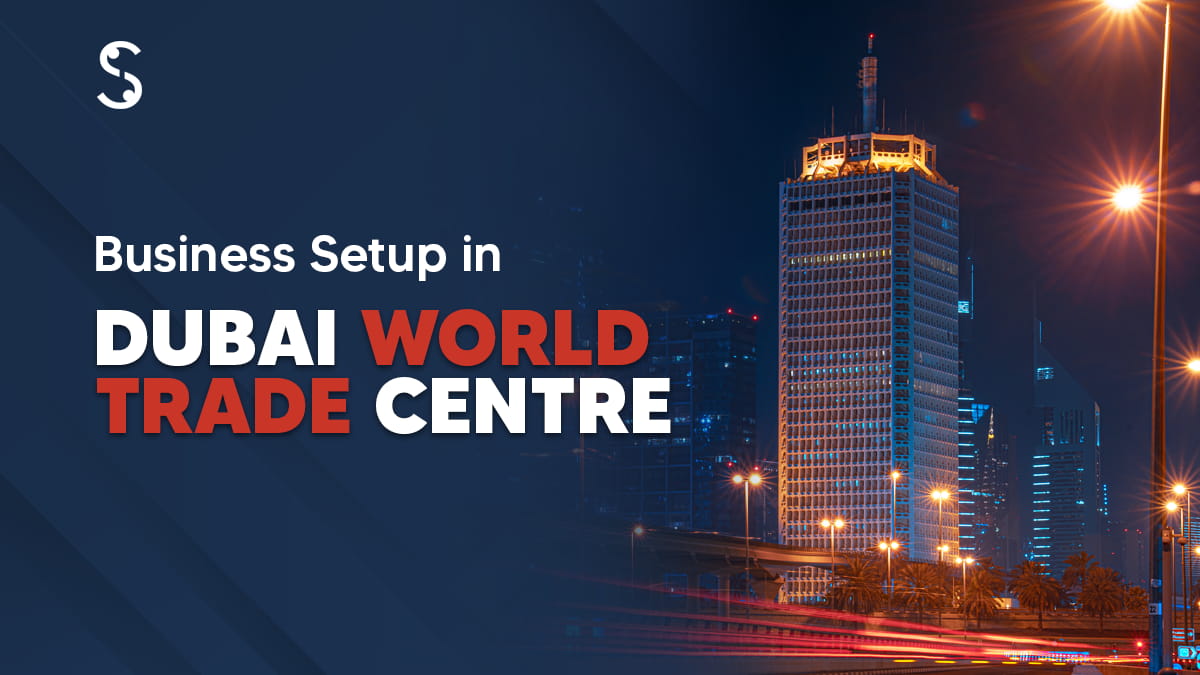
  • Business Setup in DWTC

    Business Setup in DWTC

    Dubai World Trade Centre (DWTC) is a renowned business hub in Dubai, UAE. As one of the leading business centres in the Middle East, DWTC offers a wide range of services and amenities to support companies of all sizes. From flexible office spaces to world-class conference facilities, DWTC provides everything a business needs to thrive in today’s competitive market. Business Setup in the DWTC Free Zone offers 100% ownership, tax exemptions, and numerous benefits for entrepreneurs and companies looking to establish a presence in the Middle East.

    Additionally, being in DWTC gives businesses access to a wide range of networking opportunities, events, and exhibitions that can help them connect with potential clients and partners. If you’re also considering expanding your business in the UAE, let’s understand why and when DWTC can be the perfect choice for your business in Dubai. 

    What is a DWTC Free Zone? 

    The Dubai World Trade Centre Free Zone (DWTC) is a premier business hub situated within the Dubai World Trade Centre complex, a renowned international exhibition and conference venue. This prime location offers excellent accessibility, with easy access to major transportation networks, including Dubai International Airport and the Dubai Metro. 

    DWTC Free Zone offers a range of benefits, including 100% foreign ownership, tax exemptions, and streamlined processes for setting up and operating a business. These incentives make it an attractive option for both local and international companies looking to establish a presence in Dubai. In addition, DWTC Free Zone also offers a range of business opportunities for companies operating in various industries. 

    Benefits of Business Setup in DWTC Free Zone 

    Company formation in the DWTC Free Zone comes with many advantages that make it an attractive destination for entrepreneurs and international companies alike. Here are the key benefits: 

    1. 100% Foreign Ownership 

    Businesses in DWTC Free Zone enjoy complete foreign ownership, eliminating the need for a local partner. This allows investors full control over their company’s operations and profits. 

    2. Full Repatriation of Profits and Capital

    Businesses can repatriate their profits and capital without any restrictions. 

    3. Tax Exemptions

    Businesses in the DWTC Free Zone enjoy a full exemption from corporate taxes. There is also no personal income tax imposed on individuals working in the free zone. 

    4. World-Class Infrastructure

    The free zone provides state-of-the-art facilities, including modern offices, warehouses, and exhibition spaces. 

    5. Ease of Business Setup

    The business setup process in DWTC Free Zone is streamlined, with minimal bureaucracy and quick approval timelines. 

    6. Ability to Operate in Both Free Zone and Mainland

    A key advantage of the DWTC Free Zone is the flexibility to conduct business both within the free zone and on Dubai’s mainland. This dual-operating capability is unique and allows businesses to expand their reach. 

    Types of Businesses Suitable for DWTC Free Zone

    DWTC offers a diverse range of business opportunities, catering to various industries and sectors, including: 

    These are just a few examples of the types of businesses that can be established in DWTC. 

    Facilities Offered at DWTC 

    Dubai World Trade Centre (DWTC) offers a wide range of world-class facilities to support businesses and events, including: 

    • Exhibition Halls 
    • Serviced Offices 
    • Co-working Spaces 
    • Conference Centers 
    • Meeting Rooms 
    • Restaurants and Cafés 
    • Transportation Services 
    • Business Support Services 
    • Event Management Services 
    • DWTC Business Center 

    Types of Licenses Offered at DWTC Free Zone

    The DWTC Free Zone offers a variety of licenses tailored to different business activities. Primary licenses include: 

    1. General Trading License 

    This license allows businesses to engage in a wide range of commercial activities, including import and export. 

    2. Industrial License 

    This license is required for businesses involved in manufacturing activities. This license is suitable for businesses that assemble products from imported components. 

    3. Professional License 

    This license is granted to businesses providing professional services such as consulting, accounting, legal, and engineering. Freelancers can obtain this license to offer their services independently. 

    4. Dual License 

    The Dual License allows companies operating in the DWTC Free Zone to also conduct business on the Dubai mainland without the need to open a separate branch.  

    The specific type of license required will depend on the nature of the business activity. Businesses should consult with Shuraa’s experts to determine the appropriate license for their operations. 

    Documents Required for Company Setup in DWTC Free Zone

    You’ll need to submit a set of documents to the DWTC authority. Common requirements include: 

    • Passport copies of shareholders and managers 
    • A business plan or activity description 
    • Memorandum of Association (MOA) for corporate entities 
    • Application form 
    • No Objection Certificate (NOC) if you’re already employed in the UAE 

    Process of DWTC Free Zone Company Formation

    Business Setup in DWTC is a streamlined and efficient process. Here’s  the Step-by-Step Process:

    1. Choose a Business Structure

    Sole Proprietorship: Suitable for small, single-owner businesses. 

    Limited Liability Company (LLC): The most common structure for foreign investors, offering limited liability. 

    2. Select a Business Name

    Choose a unique and available name that complies with local regulations. Avoid offensive or misleading names. 

    3. Submit the Application to the DWTC Authority

    Once the documents are ready, submit the application to the DWTC Free Zone authority. The application can typically be completed online or through authorized business setup consultants like Shuraa India. After your application is reviewed and approved, DWTC will issue your business license.  DWTC company registration may require additional permits or approvals required by relevant government departments. 

    4. Register for Office Space

    DWTC Free Zone offers flexible office space options, from shared desks to fully furnished offices. Based on the type of business you’re operating, choose an office setup that suits your needs. 

    5. Open a Corporate Bank Account

    Open a corporate bank account with a local bank to facilitate business transactions.

    6. Obtain Visas for Employees and Shareholders

    As part of the business setup, you can also apply for residency visas for shareholders, employees, and family members. Shuraa professionals can assist you through the process and ensure compliance with local regulations. 

    Company Setup Cost in DWTC Free Zone

    The cost of a business license at DWTC Free Zone starts from AED 30,000 to AED 50,000. The cost of obtaining a business license depends on the type of license and the specific activities involved. If you need to obtain visas for foreign employees or investors, there will be associated visa fees.  

    DWTC offers various Free Zone packages to suit your business needs and budget. These packages may include discounted fees for license issuance, office space rentals, and other services. To explore these budget-friendly options, get in touch with Shuraa India. 

    How Can Shuraa India Help You in the DWTC Free Zone?

    Business setup in Dubai World Trade Centre (DWTC) Free Zone is quickly becoming a top choice for businesses looking to grow in a global, connected environment. DWTC is an ideal place for startups, small businesses, and large companies to thrive. Setting up here can help you reach new markets and unlock growth potential. 

    If you’re thinking about starting your business in DWTC, now is the perfect time to make the move. To make the process easier, reach out to Shuraa India. Our team of experts will guide you through every step, from choosing the right license to finding the best free zone in Dubai for your business. Let us help you start your journey to success in one of Dubai’s leading free zones. 

  • How to Invest in Dubai from India?

    How to Invest in Dubai from India?

    Dubai has become one of the top choices for people around the world looking to invest, and it’s easy to see why! With a booming economy, investor-friendly policies, and no personal income tax, the city offers countless opportunities for great returns. For Indian investors, Dubai is especially appealing because it’s close to home, has a large Indian community, and offers easy access to global markets.  

    Did you know that Indians are one of the largest groups of property buyers in Dubai? In 2026 alone, they contributed significantly to real estate investments, making Dubai’s real estate market one of the most sought-after globally. Beyond real estate, Dubai also offers exciting opportunities in the stock market, business setups, and even innovative sectors like cryptocurrency and tech startups. 

    If you’re curious about how to invest in Dubai from India, we’re here to help. We’ll walk you through the benefits of investing in Dubai, the available options, and a simple step-by-step process to help you get started. 

    Why Dubai is an Attractive Destination for Indian Investors? 

    Dubai has emerged as a highly attractive destination for Indian investors for business expansion due to several compelling reasons: 

    1. Tax-Free Environment 

    Dubai’s tax policies are a huge draw for investors. With no personal income tax, capital gains tax, or inheritance tax, investors can enjoy maximum returns on their investments. 

    2. Proximity to India 

    Dubai is just a short flight from major Indian cities, making it a convenient location for business operations and investment management. Additionally, the city has a large Indian expatriate community, which makes it feel like a home away from home. 

    3. Business-Friendly Policies 

    Dubai offers 100% foreign ownership for businesses in many sectors, making it easy for Indian entrepreneurs to establish their presence. Free zones provide additional benefits like zero customs duty and simplified company setup processes. 

    4. Golden Visa and Residency Options 

    Dubai offers long-term visas to investors, property buyers, and entrepreneurs, making it easier for Indians to establish a personal and professional base in the city. 

    5. Strong Bilateral Relations Between India and the UAE 

    India and the UAE share a strong trade and economic relationship. The UAE is one of India’s largest trading partners, with trade volumes exceeding $85 billion in 2025. This robust partnership fosters trust and makes Dubai a natural choice for Indian investors. 

    6. Favorable Time Zone 

    Dubai’s time zone (GMT+4) works perfectly for Indian investors, overlapping with India’s business hours. This facilitates seamless communication and coordination between the two countries. 

    7. No Currency Restrictions 

    Indian investors benefit from Dubai’s liberal financial policies. There are no restrictions on the repatriation of profits or capital, making it easy to transfer earnings back to India. 

    8. Beneficial to the Indian Economy 

    Investments in Dubai contribute positively to the Indian economy by enhancing bilateral trade, boosting exports, and encouraging foreign exchange remittances. Moreover, Dubai acts as a gateway for Indian businesses to enter global markets, thereby benefiting India’s global economic footprint. 

    Investment Options in Dubai for Indian Investors 

    Dubai offers many investment opportunities for Indian investors, including real estate, financial markets, business setup, and emerging sectors like cryptocurrency.  

    1. Real Estate Investments 

    Dubai’s real estate market is renowned for its luxury residential and commercial properties. Indian investors have been significant contributors, owning approximately USD 22 billion worth of property between 2015 and 2021. 

    UAE Golden Visa through Property Investment:  

    Investing in property can qualify investors for the UAE’s Golden Visa, a long-term residency permit. To be eligible, one must invest at least AED 2 million (approximately INR 4.5 crore) in real estate. This investment can be spread across multiple properties, provided the total value meets the threshold.  

    2. Stock Market and Mutual Funds 

    Dubai Financial Market (DFM) and Nasdaq Dubai, exchanges offer access to a variety of stocks and financial instruments. Notable companies like DP World are listed, providing opportunities for portfolio diversification. Investors can explore mutual funds that invest in the UAE and broader Middle Eastern markets, offering exposure to diverse sectors. 

    3. Business Setup in Dubai, UAE 

    Dubai is a global business hub that offers unparalleled opportunities for entrepreneurs and investors looking to establish or expand their businesses. Its strategic location between Europe, Asia, and Africa, coupled with investor-friendly policies, makes it an ideal choice for Indian investors seeking to enter international markets. 

    Here’s why setting up a business in Dubai is a lucrative investment: 

    Mainland Company Setup: 

    • 100% Foreign Ownership: Recent reforms now allow full foreign ownership of mainland companies in various sectors, removing the need for a local Emirati sponsor in many cases. 
    • Diverse Market Access: Mainland businesses can operate across the UAE and internationally without restrictions, offering flexibility and broader market reach. 
    • Economic Stability: Dubai’s strong economy, supported by industries like tourism, logistics, real estate, and finance, ensures a stable environment for businesses. 

    Free Zone Company Setup: 

    • Tax Benefits: Free zones like Jebel Ali Free Zone (JAFZA), International Free Zone Authority (IFZA) and Dubai Multi Commodities Centre (DMCC) offer 0% corporate and personal income tax and no customs duties on imports and exports. 
    • 100% Ownership: Businesses in free zones enjoy full foreign ownership and profit repatriation, making them attractive to international investors. 
    • Sector-Specific Zones: Many free zones cater to specific industries, such as technology, media, healthcare, and trade, providing tailored infrastructure and support. 

    4. Cryptocurrency Investments 

    Dubai is positioning itself as a crypto hub, with regulatory frameworks established by entities like the Dubai Virtual Assets Regulatory Authority (VARA). Platforms like Binance and Crypto.com, operating under VARA, make trading secure and transparent. 

    5. Other Investment Options 

    Startups and Venture Capital: 

    Dubai’s growing startup ecosystem and government-backed initiatives like the Dubai Future Accelerators provide opportunities for investors interested in innovative ventures. 

    Bonds and Savings Schemes: 

    Sovereign and corporate bonds, as well as savings schemes like the National Bonds Corporation, offer low-risk investment opportunities with steady returns. 

    Eligibility and Requirements for Indian Investors in Dubai 

    Investing in Dubai is straightforward, but Indian investors must meet certain eligibility criteria and comply with specific requirements. This typically includes: 

    • Investors must be at least 18 years old to invest in Dubai. 
    • Investors should demonstrate sufficient financial resources for their chosen investment type, whether in real estate, business, or other sectors. 
    • Indian citizens with a valid passport and clean legal records can invest in Dubai. 
    • Minimum investment thresholds may apply, particularly for visa-linked property purchases (e.g., AED 750,000 for a 2-year investor visa, for real-estate investment. 
    • Investments must adhere to UAE laws, including anti-money laundering (AML) and combating financing of terrorism (CFT) regulations. 
    • Indian entrepreneurs can get Dubai’s Golden Visa by investing at least AED 2 million in real estate, innovative industries or businesses with high economic impact. 

    Documents Required to Invest in Dubai from India 

    Here are the documents required for Indian investors looking to invest in Dubai: 

    For Real Estate Investment:  

    • Copy of a valid Indian passport. 
    • Proof of income or bank statements for financial stability. 
    • Sale and purchase agreement (for property transactions). 
    • Emirates ID (if applicable) and residency details. 

    For Stock Market Investments: 

    • Passport copy. 
    • Bank account details. 
    • Investor identification documents issued by Dubai Financial Market (DFM) or Nasdaq Dubai. 

    For Business Setup: 

    • Passport copies of all business partners/shareholders. 
    • Business plan outlining the nature and objectives of the company. 
    • Proof of registered office address in Dubai. 
    • Memorandum of Association (MOA) and Articles of Association (AOA) for company formation. 
    • No-objection certificate (NOC) from the sponsor (if applicable). 
    • Trade name registration certificate. 
    • Tenancy contract (Ejari certificate). 
    • Approval from Department of Economic Development (DED) or respective Free Zone Authority. 

    For General Investments: 

    • Proof of investment funds (bank statements or financial declarations). 
    • Tax clearance certificates (for Indian investors transferring funds internationally). 
    • Power of Attorney (POA) if appointing a representative. 

    How to Invest in Dubai from India? 

    Here’s a simple step-by-step guide to invest in Dubai from India: 

    1. Determine Your Investment Budget 

    Determine how much you are willing to invest. Ensure you have sufficient funds for your chosen investment type. Account for transaction fees, taxes, and service charges. For real estate, this includes registration fees and maintenance costs. 

    2. Choose the Right Investment Opportunities in Dubai 

    Before investing, it’s crucial to identify the type of investment that aligns with your goals. Common options include: 

    • Real Estate (Investing in residential or commercial properties) 
    • Stock Market and Mutual Funds 
    • Business Setup 
    • Cryptocurrency 
    • Franchising 

    3. Choose the Right Investment Jurisdiction 

    Deciding whether to invest in Mainland, Free Zones, or Offshore depends on your business or investment goals: 

    • Mainland: Ideal for businesses seeking to operate in the local market without restrictions. 
    • Free Zones: Offer tax incentives, full foreign ownership, and ease of doing business. Choose a zone that aligns with your industry (e.g., Dubai Silicon Oasis for tech). 
    • Offshore: Suitable for setting up a company with minimal physical presence. 

    4. Legal Requirements and Documentation 

    Gather all required documents, such as your passport, bank statements, and property or business documents. If you plan to make a significant investment, explore the option of the UAE Golden Visa, which grants long-term residency for substantial investors. 

    5. Set Up a Bank Account in Dubai 

    To make investments, you will need a bank account in Dubai. Dubai has several banks that cater to foreign investors, such as Emirates NBD, Dubai Islamic Bank, and Mashreq Bank. You’ll need to provide your passport, proof of address, business documents (if applicable), and financial statements. 

    Keep in mind, Indian investors should comply with the Reserve Bank of India (RBI)’s Liberalized Remittance Scheme (LRS), which allows individuals to remit up to USD 250,000 per year for investments. 

    6. Register Your Investment 

    Depending on your investment type, you’ll need to complete certain registration and licensing processes: 

    • Real Estate: Register your property with the Dubai Land Department (DLD) and secure your property title deed. 
    • Business Setup: Work with Shuraa India to complete the paperwork and obtain the necessary licenses from the Department of Economic Development (DED) or relevant free zone authority. 
    • Stock Market: Open a trading account with a licensed brokerage firm and register with the Dubai Financial Market (DFM). 

    7. Obtain Necessary Visas 

    As an investor, you may need a residency visa or investor visa. Dubai offers several visa options: 

    • Investor Visa: This is available for individuals who make significant investments, such as in real estate or a business. 
    • Golden Visa: For high-value investors who meet specific criteria (e.g., AED 2 million in real estate). 
    • Employment or Partner Visa: If you set up a business, you may need a visa to employ staff or as a partner. 

    8. Tax Compliance and Reporting 

    While Dubai offers tax advantages, ensure you are aware of any tax liabilities in India, such as capital gains tax, and comply with both Indian and UAE tax regulations. In the case of business setup, file the necessary annual returns with the UAE authorities and ensure you meet other regulatory requirements. 

    The investment process can be complex, especially for foreign investors. It’s highly recommended to consult with experts at Shuraa India for your business, register your licenses, and provide ongoing support. 

    Why Choose Shuraa India for Investment Assistance?

    Dubai is just the perfect place for Indian investors & entrepreneurs, thanks to its easy business setup process, tax benefits, strong economy, and geographical location. We encourage you to explore the investment options in Dubai and take advantage of the city’s fast-growing market. 

    At Shuraa India, we make the investment process easy and hassle-free. Our experienced team helps Indian investors set up businesses and manage investments in Dubai. We offer services like company formation, PRO services, real estate advice, and support with licensing, documentation, and tax-related matters. Get in touch with Shuraa today and let us help you start your investment journey in Dubai with ease. 

    Frequently Asked Questions 

    1. Can Indians Buy Property in Dubai? 

    Yes, Indians can buy property in Dubai. In fact, Dubai offers freehold ownership to foreign nationals in specific areas. This means Indians can own property outright and have complete control over it. 

    2. Is it good to invest in real estate in Dubai from India? 

    Yes, Dubai’s real estate market offers strong returns, no property taxes, and high demand for residential and commercial properties, making it a good investment choice for Indians. 

    3. How much money is required to invest in Dubai? 

    The amount varies. For real estate, a minimum of AED 750,000 is required for certain property investments. For business setup, license costs start at AED 10,000-20,000 depending on the type and jurisdiction. 

    4. How can I invest in Dubai from India? 

    You can invest in Dubai by exploring real estate, the stock market, or starting a business. The process involves researching the market, transferring funds, and complying with legal requirements.