Author: Ritish

  • UAE Visa Rule Update 2026

    UAE Visa Rule Update 2026

    UAE’s 2026 visa updates focus on attracting skilled talent, easing tourist entry, and offering longer-term residency options. Key changes include specialized visas for AI experts, multiple-entry visas for cruise passengers, and simplified sponsorship for family members. Indian nationals also benefit from streamlined visit visa processes, making travel more accessible. In 2026, new changes have been introduced to make it easier for people to live, work, and do business in the UAE.

    If you’re an expat living in the UAE, a business owner looking to invest, or a tourist planning a visit, it’s important to stay updated on these new rules. For Indian travellers, the new visit visa rules in the UAE for Indian nationals bring important updates, making travel more convenient and accessible.

    They affect everything from residency visas and work permits to tourist visas and long-term stay options like the Golden Visa. So, here are the latest New Visa Rules in the UAE 2026 in a simple and easy-to-understand way. 

    What are the New Rules for UAE Visa 2026?

    The UAE has introduced significant visa rule changes in 2026 to make it easier for residents, investors, and visitors, especially Indian nationals. Here’s a summary of the latest updates:

    1. New Visit Visa Rules for the UAE

    • Extended Stay Options: Visitors can now apply for 60-day and 90-day visit visas, offering more flexibility for tourism or business trips.
    • Multiple-Entry Tourist Visa: A 5-year multiple-entry visa allows stays of up to 90 days per entry, extendable for another 90 days. Ideal for frequent travelers and business visitors.
    • Required Documents: Applicants need to provide proof of funds (AED 5,000), accommodation confirmation, and return flight tickets.
    • Grace Period Removal: The 10-day grace period for overstaying has been removed. Fines and deportation will now apply for overstaying your visa.

    2. Visa Extension Policies

    • In-Country Extensions: Visitors can extend their visas within the UAE without leaving the country, with up to two 30-day extensions, allowing a total stay of 120 days in a year.

    3. New Visit Visa Rules for Indians

    • Starting in 2026, Indian nationals with a valid passport (minimum 6 months) can get a 14-day visa on arrival, simplifying travel to the UAE for business or tourism.

    4. Updates on UAE Residence Visas

    • Retiree Visa: A 5-year renewable visa for expatriates over 55 with a certain financial background.
    • Golden Visa Expansion: The Golden Visa program now includes superyacht owners, scholars, and humanitarian leaders, offering 10-year residency.
    • Blue Visa for Environmental Leaders: A 10-year residency for professionals in sustainability, encouraging environmental leaders to move to the UAE.
    • Dubai Gaming Visa: This 10-year visa targets professionals in the gaming industry, including game developers and esports athletes.

    5. Unified GCC Visa

    • GCC Grand Tours: A unified visa system allows travel to all six GCC countries (UAE, Saudi Arabia, Qatar, Oman, Bahrain, and Kuwait) with a single visa.

    6. Stricter Compliance Measures

    • The UAE has enforced tougher penalties for overstaying visas, including fines and bans on future entry. Adhere to the visa validity to avoid penalties.

    7. New Employment Visa Rules in the UAE

    • Employment visas are now more flexible and provide faster processing for skilled workers, making it easier for Indian professionals to work in the UAE.

    How These New Visa Rules Benefit Expats and Foreign Nationals

    The UAE’s new visa rules benefit Indians significantly:

    • Easier Access: With 14-day visas on arrival, longer stays, and multiple-entry options, Indian nationals can visit the UAE more easily.
    • Business and Investment: The changes support Indian entrepreneurs and investors looking to set up businesses or invest in the UAE’s growing economy.

    How to Apply for UAE Visas?

    Applying for a UAE visa in 2026 involves a few essential steps, depending on the type of visa you’re applying for. Here’s a guide for Indian nationals:

    1. Determine the Type of Visa 

    The UAE offers various visa types, including: 

    • Tourist Visa (Short-term & Long-term) 
    • Visit Visa (For family or business visits) 
    • Residency Visa (Employment, Investor, Freelancer, Retirement, Golden Visa, etc.) 
    • Student Visa 
    • Freelance Visa 
    • Green Visa & Golden Visa 
    • Dubai Gaming Visa (For professional gamers and e-sports industry experts) 

    2. Check the Eligibility Criteria 

    Each visa type has different eligibility criteria. Some key requirements include: 

    • Passport validity (minimum of six months) 
    • Sufficient financial proof (for self-sponsored visas) 
    • Employment contract (for work visas) 
    • Investment proof (for investor and entrepreneur visas) 
    • Sponsorship (for family visas) 

    3. Gather Required Documents 

    The required documents vary based on the visa type but typically include: 

    • Passport-size photographs (as per UAE standards) 
    • Valid passport with at least six months’ validity 
    • Proof of accommodation (hotel booking or rental agreement) 
    • Flight tickets (return tickets for short-term visas) 
    • Bank statements (for certain visa types) 
    • Health insurance coverage 
    • Sponsor’s Emirates ID (for family or employment visas) 

    3. Submit the Application Online or Through an Agency 

    • For Tourist & Visit Visas: Apply through airlines (Emirates, Etihad), travel agencies, or hotel partners. 
    • For Residency & Work Visas: Apply through a company, sponsor, or the General Directorate of Residency and Foreigners Affairs (GDRFA). 
    • For Golden, Green, & Investor Visas: Apply through the Federal Authority for Identity and Citizenship (ICP) or GDRFA Dubai. 

    Applications can be submitted: 

    • Online via ICP (icp.gov.ae) or GDRFA Dubai (gdrfad.gov.ae) 
    • Through Amer Centers in Dubai for certain visa types 
    • Through authorized travel agencies 

    4. Pay the Visa Fees 

    Visa fees vary depending on the type and duration of stay. 

    5. Undergo Medical Examination & Biometric Registration 

    Medical fitness tests are mandatory for employment, investor, and long-term residence visas. Biometric registration (fingerprints & eye scan) is required for new applicants. 

    6. Receive Visa Approval & Stamping 

    Once approved, the visa will be electronically issued. For residency visas, the passport must be submitted for visa stamping. 

    7. Entry & Emirates ID Registration 

    Upon arrival, complete the Emirates ID application (for residency holders). Collect the Emirates ID after visa stamping to complete the process. 

    How Shuraa India Helps with UAE Visa and Updates?

    Shuraa India offers expert assistance in navigating the latest UAE visa regulations and updates. Whether you’re an expat, business owner, or tourist, Shuraa India ensures you understand the new rules, including visas for skilled professionals, AI specialists, tourist entry, and family sponsorship.

    With tailored guidance, we help Indian nationals secure the right visas quickly and efficiently. Our team provides end-to-end support, from application processing to visa renewals, ensuring a smooth experience. Stay updated with Shuraa India to simplify your UAE immigration process and take advantage of the most recent visa opportunities.

    • Visa Application: Streamlined application process for Indian nationals.
    • Document Preparation: Help with the required documents to ensure your visa is approved.
    • Visa Processing: Fast-track processing for work visas, business visas, and residency applications.

    Act Now and Get Your UAE Visa Today!

    • Limited-time offer: Get 10% off on your UAE visa application when you apply by 19 Mar, 2026!
    • Free consultation: Speak with our experts to understand which UAE visa suits you best.

    Frequently Asked Questions (FAQs)

    1. What is the recent update on business visas in the UAE?

    The UAE has streamlined the business visa process, making it easier for entrepreneurs and investors to set up businesses. New long-term residency options have been introduced for significant investors.

    2. What are the eligibility changes with the job seeker visa?

    Eligibility for the job seeker visa has expanded to include professionals in specialized fields. Applicants need to prove qualifications, skills, and financial stability, enabling easier access to job opportunities in the UAE.

    3. What are the mandatory requirements for a job visa?

    To obtain a job visa, you must provide proof of employment, pass a medical fitness test, submit valid educational documents, and meet the minimum salary requirement, depending on the sector.

    4. Was the visit visa extension a point in the new visa rules in UAE?

    Yes, the new visa rules allow a longer visit visa duration with easier extensions. Visitors can extend their stay in the UAE for additional 60 to 90 days based on conditions.

    5. What is the duration of getting a renewed residence visa as per new rules in UAE?

    The renewed residence visa processing time is typically 2-4 weeks. Applicants must meet updated requirements, including medical tests and proof of employment or investment, for quicker processing.

  • How to Register a Company in Dubai from India?

    How to Register a Company in Dubai from India?

    If you’re an entrepreneur in India, you’ve likely noticed that the world is getting a lot smaller. In 2026, the business bond between India and the UAE is at an all-time high. Thanks to recent trade agreements, it’s no longer just big corporations making the move – thousands of Indian startups and small business owners are now looking to register a company in Dubai from India. In fact, Indian investors are currently the top foreign group starting new businesses in the city. 

    But why is everyone heading to Dubai? Every year, thousands of Indian entrepreneurs register companies in Dubai across sectors like trading, consulting, e-commerce, logistics, and professional services. Here is why so many Indian founders are registering their companies there: 

    • Keep More of Your Profits: You still enjoy 0% personal income tax. Even the corporate tax is a low 9%. 
    • You are the Boss: You can now have 100% ownership of your company. 
    • Speedy Setup: In 2026, you can practically register a company from your laptop in India. The process is digital, transparent, and often takes less than a week. 
    • World-Class Lifestyle: Beyond business, the Golden Visa options make it easier than ever for Indian families to move and live in one of the safest cities in the world. 

    Setting up abroad might sound intimidating, but it’s actually more straightforward than you think. In this guide, we’ll break down exactly how you can take your Indian business to Dubai this year without the headache. 

    Why Start a Company in Dubai from India in 2026? 

    In 2026, Dubai has become one of the most practical and profitable destinations for Indian entrepreneurs to start a business. 

    1. The $200 Billion Trade Partnership 

    Recently, the UAE President visited India and set a massive new goal: doubling bilateral trade to $200 billion by 2032. For an Indian business owner, this means the CEPA trade agreement is now in full swing, offering zero-duty access to almost 90% of Indian goods entering Dubai. If you’re in manufacturing, textiles, or food, Dubai is an extension of your home market. 

    2. Bharat Mart 2026 

    Opening in 2026, Bharat Mart in Jebel Ali (Dubai) is a game-changer for Indian SMEs. It’s a 2.7 million-square-foot facility with 1,500 showrooms specifically for Indian exporters. You can display and store your products in Dubai, allowing you to sell directly to buyers from Africa and Europe without expensive middlemen or long shipping delays from India. 

    3. Dubai Allows 100% Foreign Ownership 

    Dubai allows 100% ownership for foreign nationals in most business activities – both in Mainland and Free Zones. Indian entrepreneurs don’t need a local partner just to start or run their business, which gives full control and peace of mind. 

    4. Avoiding Global Tariff Hikes 

    With global trade tensions rising, some countries have doubled tariffs on Indian-made goods (like jewellery and textiles). However, because of the India-UAE CEPA deal, the UAE remains a safe harbour. By adding just a small amount of value to your product in a Dubai Free Zone (like final packaging or assembly), your product officially becomes “Made in UAE.” 

    5. You Can Start the Company from India 

    One of the biggest reasons Dubai is popular in 2026 is that you can register a company remotely from India. From documentation to approvals, most steps can be handled online. Travel is usually required only for banking or visa formalities, if at all. 

    6. Strong and Reliable Banking System 

    Dubai has a globally recognised banking system with access to multi-currency accounts, international transfers, and stable financial regulations. For Indian entrepreneurs dealing with overseas clients, payments and fund management become much easier. Thanks to a new agreement to link India’s UPI with the UAE’s Jaywan payment system, cross-border payments have become nearly instant and much cheaper. 

    Types of Company Structures for Indian Citizens in Dubai

    Dubai offers different business structures to suit various goals, budgets, and industries. Before picking a legal form (like an LLC), you must choose where your company will be registered. This is the most important decision you’ll make. 

    1. Mainland Company 

    A Mainland company is licensed by the Dubai Department of Economy & Tourism (DET) and allows businesses to operate anywhere in the UAE and beyond. If you plan to serve clients within the UAE and need unlimited visa quotas, the Mainland is the best choice. 

    Popular Mainland Business Structures: 

    1. LLC (Limited Liability Company)

    The Gold Standard for Indian business owners. In 2026, you can now have 100% ownership of an LLC in most sectors without needing a local Emirati partner. 

    • Most common structure for trading & service businesses.  
    • Requires a minimum of 2 shareholders and a maximum of 50.  
    • Liability limited to each shareholder’s contribution.  
    • Can engage in commercial, industrial, and professional activities. 

    2. Sole Proprietorship

    This is a business owned 100% by one person. Unlike an LLC, you have unlimited liability, meaning you are personally responsible for all business debts. 

    • Owned by a single individual.  
    • Best for consultants, professionals, and freelancers.  
    • Full personal liability for business debts. 

    3. Branch of a Foreign Company

    If you already have a successful company in India (e.g., in Mumbai or Delhi) and just want an extension in Dubai, you can open a branch. 

    • A foreign company can set up a 100% owned branch in the Dubai Mainland.  
    • The branch can conduct activities identical to the parent company.  
    • Requires a Local Service Agent (LSA) but does not own any shares. 

    4. Civil Company

    • Specifically designed for professionals (Doctors, Lawyers, Engineers, Accountants, or Consultants). 
    • 100% owned by professionals but may require a local service agent (LSA) for administrative purposes. 
    • Liability is not limited (owners are personally liable). 

    2. Free Zone Company 

    A Free Zone company operates within designated zones regulated by specific Free Zone authorities. Free Zones are ideal for import/export businesses, e-commerce, consulting, and tech startups. 

    Popular Free Zone Business Structures: 

    1. Free Zone Establishment (FZE)

    An FZE is a single-shareholder company, ideal for solo entrepreneurs or consultants starting their business in Dubai. It offers full control, limited liability, and a straightforward setup process. Many Indian founders choose this structure when launching small to mid-sized ventures. 

    2. Free Zone Company (FZCO/FZ-LLC)

    This structure is suitable for multiple shareholders – individuals or corporate entities. It’s commonly used by startups, partnerships, and family-run businesses from India that plan to scale operations in Dubai while maintaining limited liability protection. 

    3. Offshore Company 

    An Offshore company is designed for businesses operating outside the UAE, offering tax benefits and confidentiality. They cannot conduct business inside the UAE. Offshore companies are ideal for investors, holding companies, and businesses engaged in international trade. 

    Register your Dubai company today — free step-by-step guidance.

    What are the Types of Business Licenses in Dubai? 

    Your business license in Dubai depends on the activity you plan to carry out. Choosing the right license from the start is important, as it defines what your company is legally allowed to do. 

    1. Commercial License 

    A Commercial License is required for businesses involved in buying, selling, importing, exporting, or trading goods. This is one of the most common licenses chosen by Indian entrepreneurs, especially for trading, general commerce, and distribution businesses. If you are using Bharat Mart to store or display products, this is the license you will need. It allows you to move goods freely across the globe. 

    Permitted Activities:

    • General trading (multiple product categories)
    • Import and export operations
    • Wholesale and retail distribution
    • E-commerce trading (physical products)
    • Commodity trading
    • Building materials trading
    • Food and beverage trading
    • Electronics and consumer goods trading

    2. Professional License 

    This license is suitable for service-based businesses that rely on skills, expertise, or professional knowledge. It’s ideal for consultants, IT professionals, marketing agencies, designers, trainers, and freelancers. Many Indian professionals opt for this license due to its flexibility and lower setup requirements. 

    Permitted Activities:

    • Business consulting and management advisory
    • IT services and software development
    • Digital marketing and advertising agencies
    • Graphic design and creative services
    • Accounting and bookkeeping services
    • Legal consulting (subject to UAE Bar Association requirements)
    • Engineering consulting
    • Educational training and coaching
    • Event management and planning
    • Public relations services
    • Translation and interpretation services

    3. Industrial License 

    An Industrial License is required for businesses involved in manufacturing, production, or industrial activities. This includes factories, assembly units, and processing businesses. It usually requires additional approvals, warehouse space, and compliance with safety and environmental regulations. 

    Permitted Activities:

    • Manufacturing and production facilities
    • Food processing and packaging
    • Assembly and fabrication operations
    • Industrial processing
    • Recycling and waste processing
    • Chemical processing
    • Textiles and garment manufacturing
    • Furniture manufacturing

    4. E-Commerce License 

    An E-commerce License allows businesses to sell products or services online, either within the UAE or internationally. This license is popular among Indian entrepreneurs running online stores, digital platforms, or dropshipping businesses from Dubai. 

    Permitted Activities:

    • Online retail (selling physical products via website/app)
    • Digital services and subscriptions
    • Dropshipping operations
    • Online marketplace platforms
    • Digital content sales
    • Software as a Service (SaaS) offerings

    5. Freelance Permit 

    In 2026, the Freelancer path is the fastest way for a solo creator to live and work in Dubai. It is best for writers, photographers, independent IT tutors, and media professionals. It’s a permit issued to you as an individual, not as a company. It’s significantly cheaper than a full trade license but doesn’t allow you to hire employees. 

    Who Is This For:

    • Writers, content creators, and copywriters
    • Photographers and videographers
    • Graphic designers and illustrators
    • Independent IT professionals and developers
    • Social media managers and digital marketers
    • Consultants (business, marketing, HR)
    • Tutors and trainers
    • Artists and creative professionals

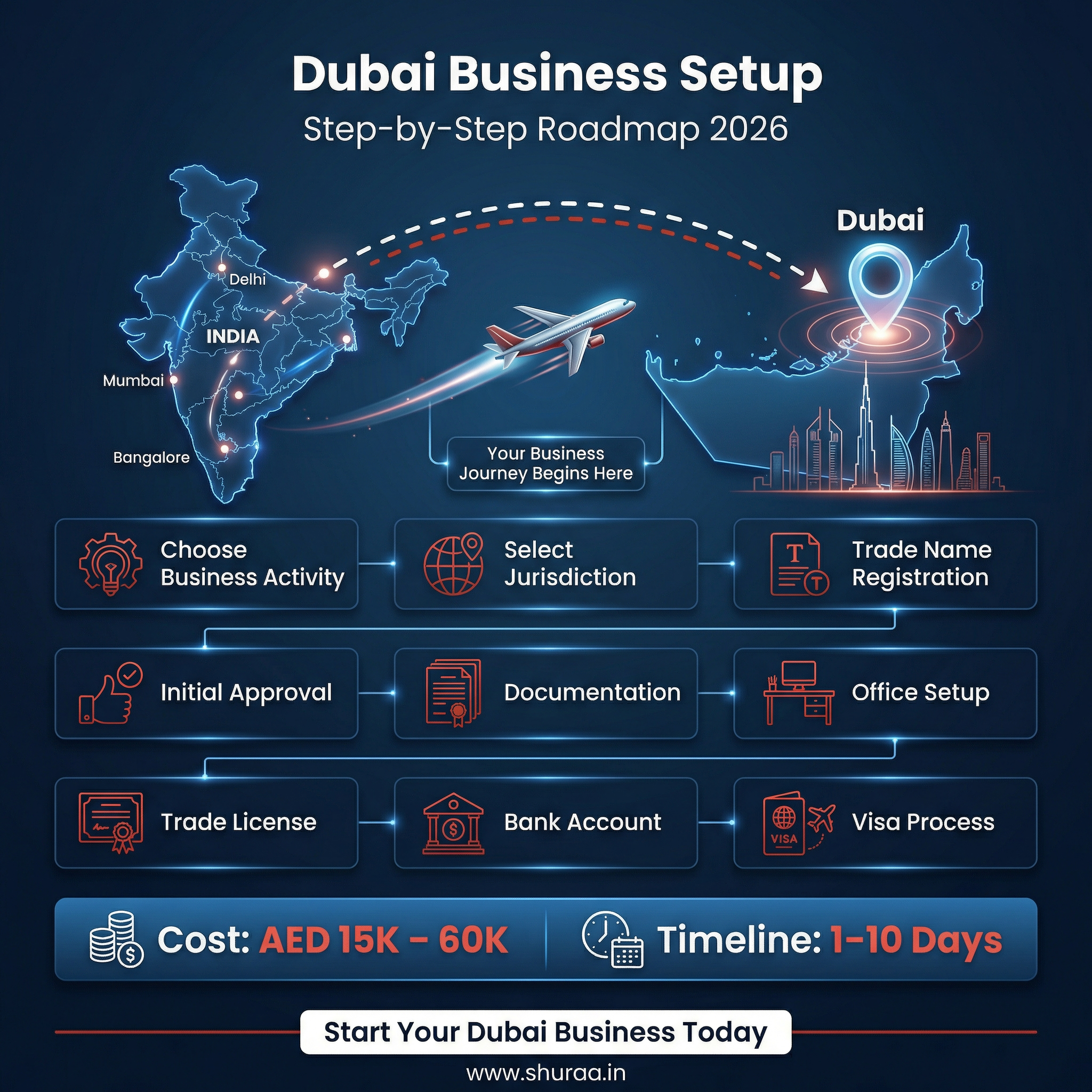
    How to Register a Company in Dubai from India

    How to Register a Company in Dubai from India in 2026 

    The process of company setup in Dubai from India in 2026 is a streamlined, digital-first experience. Because of recent updates, you can now complete nearly 90% of the process remotely without leaving India. 

    1. Decide Your Business Activity 

    Start by clearly defining what your business will do. Dubai has a predefined list of approved business activities, and your license will be issued based on this selection. Choosing the right activity is crucial, as it affects licensing, approvals, and costs. 

    2. Choose the Right Jurisdiction 

    This is arguably the most important strategic decision in your Dubai company setup, as it determines ownership structure, costs, market access, and operational flexibility. Three Main Options:

    Option A: Mainland (DET Licensed)

    Choose Mainland If:

    • You want to directly serve UAE consumers (retail, restaurants, services to individuals)
    • Your business targets UAE companies and government entities
    • You need an unlimited geographic scope across all Emirates
    • You want no restrictions on where you can operate physically
    • Your business model requires local market presence (showrooms, offices, service centers)

    2026 Update: 100% foreign ownership is now available for most commercial and professional activities, removing the previous 51% UAE partner requirement for many sectors.

    Option B: Free Zone

    Choose Free Zone If:

    • You operate internationally or primarily export from the UAE.
    • You want guaranteed 100% ownership across all activities
    • You prefer streamlined, fast setup processes
    • Tax efficiency is a priority (0% corporate tax in many zones)
    • You run an e-commerce, trading, or service business without the need for a UAE mainland physical presence
    • Cost optimization is important (generally lower setup and operational costs)

    Option C: Offshore

    Choose Offshore If:

    • Your business operates entirely outside the UAE (international consulting, global trading)
    • You need a holding company for international assets or investments
    • Privacy and confidentiality are priorities
    • You want tax optimization for global operations
    • You’re establishing an intellectual property holding company

    3. Reserve Your Trade Name 

    In 2026, you can check name availability instantly through the Invest in Dubai portal or your chosen Free Zone’s website. Avoid offensive words, religious references, or names of government bodies. 

    4. Apply for Initial Approval 

    Initial approval confirms that UAE authorities have no objection to you starting the business. At this stage, you submit basic details about the company, shareholders, and business activity. 

    5. Submit Required Documents 

    You’ll need to provide documents such as passport copies, photographs, and business details. Depending on the setup, additional documents like MOA or shareholder resolutions may be required. 

    6. Secure a Business Address 

    Depending on your license type, you may need a physical office, flexi-desk, or virtual office. Many Free Zones offer affordable workspace options, especially for startups and small businesses. 

    7. Pay Fees & Get Your License 

    Once your documents are uploaded and the office space is confirmed, you’ll receive a payment link. After payment, your Digital Trade License is emailed to you. You are now officially a business owner in Dubai. 

    8. Apply for Your Investor Visa & Emirates ID 

    With your license in hand, you can apply for your 2-year Investor Visa. You can start the visa process from India. You only need to fly to Dubai for a quick medical test and to collect your Emirates ID card. 

    9. Open a Corporate Bank Account 

    The final step is opening a corporate bank account in Dubai. While documentation requirements are strict, having a properly structured company and clear business activity helps ensure smoother approval. 

    Why UAE Corporate Banking Can Be Challenging:

    UAE banks maintain strict compliance standards due to:

    • Anti-Money Laundering (AML) regulations
    • Know Your Customer (KYC) requirements
    • Financial Action Task Force (FATF) compliance
    • Combating Financing of Terrorism (CFT) regulations

    Major UAE Banks for Business Accounts (2026):

    Traditional Banks:

    • Emirates NBD: Largest UAE bank, comprehensive business solutions
    • Abu Dhabi Commercial Bank (ADCB): Strong business banking focus
    • Mashreq Bank: Entrepreneur-friendly with digital solutions
    • Commercial Bank of Dubai (CBD): Good for SMEs
    • Dubai Islamic Bank: Sharia-compliant banking
    • RAKBank: Competitive rates and flexible terms

    Required Documents for Account Opening:

    • Trade License (original or attested copy)
    • Memorandum of Association (MOA) (for LLCs)
    • Certificate of Incorporation (some banks require)
    • Shareholders’ passport copies (all partners)
    • Shareholders’ Emirates ID copies (UAE residents)
    • Shareholders’ visa copies (UAE residents)
    • Proof of business address (Ejari, tenancy contract, utility bill)
    • Business plan (detailed, with financial projections)
    • Board resolution (authorizing account opening and signatories)
    • Authorized signatory documents (passports, IDs of account operators)
    • Personal bank reference letter (from bank in India)
    • Source of funds declaration (explaining initial capital source)
    • Company profile/presentation (explaining business model)
    • Proof of business activity (contracts, invoices, purchase orders as available)

    Note: Working with a professional business setup consultant like Shuraa India can help avoid delays and ensure everything is done correctly the first time. 

    We’ve registered 1,00,000+ companies in Dubai — our experts handle every step from name registration to trade license.

    Documents Required to Open a Company in Dubai from India  

    The documentation process to register a company in Dubai from India is fairly straightforward. Most documents are simple personal and business details, and many can be submitted digitally during the initial stages. 

    Basic Documents Required (For Indian Nationals): 

    • Passport copy (colored, all pages, minimum 6 months validity)
    • Recent passport-size photographs (2-4 photos, white background)
    • Proof of address (utility bill, bank statement, rental agreement from India – dated within last 3 months)
    • Educational/professional certificates (for professional licenses – degrees, certifications)
    • Curriculum Vitae (CV/Resume) (for certain professional activities)
    • Emirates ID copy (if shareholder is already UAE resident)
    • Visa copy (if shareholder holds UAE residence visa)

     Business-Related Documents: 

    • Proposed company name options 
    • Business activity details 
    • Memorandum of Association (MOA), Required for certain company structures, especially Mainland setups 
    • Shareholder details 

     Additional Documents (If Applicable): 

    • Visa copy/Emirates ID 
    • No Objection Certificate (NOC) 
    • Parent company documents (For branch or subsidiary setups) 

    What is the Cost of Registering a Company in Dubai from India? 

    For those wanting to form a proper company (LLC), Free Zone packages are highly popular. A standard professional or e-commerce license in 2026 generally starts between ₹2.8L and ₹4.1L. Many zones, like IFZA, offer “all-in-one” bundles that include a virtual office address and one investor visa eligibility, helping you avoid separate rental costs. 

    If you plan to open a physical shop or trade directly with the local Dubai market, a Mainland license is required. These typically start at ₹3.4L to ₹5.7L for commercial activities. 

    Mandatory Visa & Residency Costs: 

    Even if you own the company, you need a residency visa to open a bank account and live in the UAE. 

    • Establishment Card: ₹37,700 – ₹62,900 (One-time/Renewable). 
    • Investor/Partner Visa: ₹88,000 – ₹1,25,700 (Valid for 2–3 years). 
    • Medical Test & Emirates ID: ₹30,200 – ₹45,300. 
    • Health Insurance: ₹15,100 – ₹62,900 (Basic essential plans are mandatory). 

    Annual license renewals, office lease renewals, and visa renewals are also your recurring expenses you should plan for in your budget. 

    UAE Visa Options for Indian Business Owners 

    Dubai offers multiple visa options for Indian business owners, depending on how actively they want to be involved in the business and whether they plan to live in the UAE. 

    1. The Standard Investor/Partner Visa (2–3 Years) 

    This is the most common route for Indian founders. Once you register your company (Mainland or Free Zone), you are eligible for this residency. 

    • Validity: Usually 2 years (Free Zone) or 3 years (Mainland), renewable indefinitely. 
    • Key Benefit: It is the standard requirement for opening a personal bank account and sponsoring your family (spouse, children, and parents). 
    • 2026 Update: The process is now fully digital; you can start the application in India and only fly to Dubai for a medical test and biometrics. 

    2. The Golden Visa (10 Years) 

    UAE Golden Visa has become much more accessible for pioneering entrepreneurs and startup founders. 

    • Eligibility: You can qualify if you own a project with a minimum value of ₹4.6 Crore or if you have approval from a certified business incubator in Dubai. 
    • Key Benefit: You can stay outside the UAE for more than 6 months without losing your residency (unlike standard visas). It also allows you to sponsor an unlimited number of domestic staff. 
    • 2026 Update: AI specialists and Future-Tech founders now have a fast-track nomination process for the Golden Visa. 

    3. The Green Visa (5 Years) 

    The Green Visa is a self-sponsored residency designed for those who want more flexibility than a standard visa but aren’t ready for the Golden Visa. 

    • Eligibility: It is ideal for freelancers or self-employed individuals with a bachelor’s degree who can prove an annual income of approx ₹82 Lakhs for the last two years. 
    • Key Benefit: If your business closes or your license expires, you get a 6-month grace period to stay in the UAE and find a new opportunity, rather than the standard 30 days. 

    4. The Business Exploration Visa (90 Days) 

    If you aren’t ready to commit to a company setup yet, this is a specialized entry permit for 2026. 

    • Purpose: It allows you to enter Dubai specifically to scout for office space, meet partners, and finalise your business plan. 
    • Requirement: It does not require a sponsor (like a hotel or a friend). You simply need to show proof of your business background in India. 

    Set up your Company in Dubai with Shuraa India 

    Starting a company in Dubai from India is a well-planned business decision backed by strong India–UAE ties, business-friendly policies, and global opportunities. With clear regulations, tax efficiency, and easy access to global markets, the path is far more straightforward than it once was. 

    That said, getting the setup right from day one makes all the difference. From choosing the right jurisdiction and license to handling documentation, visas, and bank accounts, professional guidance can save you time, cost, and unnecessary stress. Shuraa India supports Indian entrepreneurs at every stage – before, during, and even after company registration. If you’re considering taking the next step, exploring expert support can help turn your Dubai business plans into a smooth and successful reality. 

    Commonly Asked Questions 

    1. Can an Indian citizen register a company in Dubai? 

    Yes, Indian citizens are currently the most active foreign group starting businesses in Dubai. Under the 2026 regulations, Indian entrepreneurs can own 100% of their company in most sectors (Mainland and Free Zone) without needing a local Emirati partner or sponsor. 

    2. How long does it take to register a company in Dubai from India? 

    In many cases, company registration can be completed within a few days to a couple of weeks, depending on the business activity and jurisdiction. 

    • Mainland: 10-24 business days for standard activities
    • Free Zone: 7-15 business days (often same day for simple cases)

    3. Can I register a Dubai company from India remotely? 

    Yes. Thanks to the Invest in Dubai digital platform and the UAE Pass app, nearly the entire process – from name reservation to receiving your digital trade license, can be completed online from India. You generally only need to visit Dubai once to complete your medical test for the residency visa. 

    4. Do Indians have to pay corporate tax in Dubai? 

    The UAE introduced a federal corporate tax of 9%, but it is very entrepreneur friendly. Small businesses are exempt if their annual profit is below approx ₹85 Lakhs. Additionally, many Free Zone companies still qualify for a 0% tax rate on income earned from outside the UAE. 

    5. Can I open a bank account for my Dubai company from India? 

    While you can start the application and upload documents to digital banks (like Wio or Zand) from India, most traditional banks still require a physical meeting or a video verification once you have your Emirates ID. It is highly recommended to plan a short 3-day trip to Dubai once your visa is processed to finalise your banking.
  • Company Formation Cost in Dubai

    Company Formation Cost in Dubai

    Dubai isn’t just about tall towers and luxury living, it has quietly become one of the most exciting places to start a business. Entrepreneurs from all over the world, especially Indians, are drawn here because of the city’s tax-friendly rules, world-class infrastructure, and global connectivity. For many, Dubai feels like the perfect gateway to international markets while still being close to home. 

    When you’re planning to start a company in Dubai, one of the most important things to understand is the company formation cost in Dubai. The total cost depends on several factors, such as whether you set up in the mainland or a free zone, the type of license you need, the number of visas, office requirements, and additional government approvals. 

    On average, the first-year cost for a mainland company may range between AED 15,000 and AED 50,000, while free zone companies often start at a lower cost but can go higher depending on the package and facilities you choose. 

    Getting a clear idea of these costs upfront will save you a lot of stress later. It helps you budget wisely, avoid hidden surprises, and pick the setup that actually matches your business goals. 

    What Factors Affect Company Formation Cost in Dubai?

    Dubai company formation cost isn’t fixed, it depends on several factors. Here are the main ones you should know about: 

    1. Type of Jurisdiction (Mainland, Free Zone, or Offshore)

    Dubai offers three options: Mainland, Free Zone, and Offshore. Each comes with its own rules, benefits, and cost structure. 

    • Mainland setups usually require office space and can be more expensive. 
    • Free zones often have packages that include a license, visas, and office facilities. 
    • Offshore companies are cheaper but limited in business activities. 

    2. Business Activity & License Type 

    The nature of your business plays a big role in cost. A commercial license (for trading) may have a different fee than a professional license (for services). Certain sectors like healthcare, finance, or food & beverage may need extra approvals, which add to the overall cost. 

    3. Office Space Requirements in Dubai

    Mainland companies need physical office space (Ejari), which increases setup costs. Free zones offer flexible options like flexi-desk, co-working, or private offices that can suit smaller budgets. 

    4. Visa Requirements & Costs

    The number of visas you need for yourself, your employees, or family members will impact the cost. Visa quotas vary by jurisdiction and office size, the more visas you apply for, the higher the expense. 

    5. Government & Regulatory Approvals

    Some industries require special permissions from government bodies (for example, tourism, education, or medical services). These approvals add both time and cost to the setup. 

    6. Additional Services & Documentation 

    Costs can also include: 

    • Trade name reservation 
    • Initial approval fees 
    • Notary and legal translation charges 
    • PRO services for paperwork and renewals 
    • Bank account opening support 

    Dubai Company Formation Cost Breakdown (2026)

    The cost of starting a company in Dubai depends on a mix of fees, approvals, and requirements. Here’s a simple breakdown of the main expenses you should plan for: 

    1. Trade License Fees 

    Every business in Dubai needs a license. The cost usually falls between AED 15,000 and AED 50,000 for mainland companies, while free zones can range from AED 10,000 to AED 50,000 depending on the zone and activity. Offshore licenses are cheaper, often around AED 10,000 to AED 18,000. 

    2. Name Reservation & Initial Approvals 

    Before you register, you’ll need to reserve your company name and get initial approvals. This typically costs between AED 600 and AED 2,500, although some free zones include this in their packages. 

    3. Office Space or Workspace Rental Costs

    Mainland companies must rent a physical office, and this can cost anywhere from AED 15,000 to AED 50,000+ per year, depending on size and location. Free zones offer more flexible options – from flexi-desk or shared spaces (AED 5,000–15,000) to private offices that can go much higher. Offshore companies don’t usually need office space, which keeps costs lower. 

    4. Visa and Immigration Costs in Dubai

    If you plan to live and work in Dubai or hire staff, visas are a must. Each visa (investor, partner, or employee) costs roughly AED 3,000 to AED 6,000 per person, including medical tests and an Emirates ID. Free zones and mainland setups both follow similar pricing, but offshore companies don’t provide visas. 

    5. Government and Administrative Fees

    These cover things like chamber of commerce membership, labour card, immigration card, and other paperwork. Expect to spend an extra AED 1,000 to AED 10,000, though some free zones bundle these costs. 

    6. Bank Account Opening Requirements

    While there may not be a direct fee, many banks require a minimum balance, which can be a significant amount to maintain. 

    7. Annual Renewal Costs

    Remember, most costs repeat each year. License renewals, office rent, and visa renewals can add up to AED 10,000 to AED 25,000+, depending on your setup. 

    Total Company Formation Cost in Dubai: Quick Summary

    1. So, in total, A mainland company in Dubai with one visa and a modest office will generally cost AED 15,000 to AED 50,000+ in the first year. 
    2. A free zone package with private offices and a single visa can typically start from AED 12,500, but can reach up to AED 35,000+ depending on premium packages, business activity, and multiple visas.
    3. An offshore company is the most affordable, usually around AED 20,000 to AED 65,000, but it doesn’t allow local trading or residence visas. 

    Note: The good news is that with Shuraa’s right guidance, you can avoid hidden expenses and choose a setup that matches your business goals. 

    Get your personalised Dubai company formation cost — in INR, instant.

    Smart Tips to Reduce Dubai Business Setup Costs

    Starting a business in Dubai doesn’t always have to drain your pocket. With the right planning and smart decisions, you can cut down on unnecessary expenses while still setting up a strong business foundation.

    Here are some simple tips to save money during your company formation journey: 

    1. Choose the Right Jurisdiction Based on Your Business Needs

    Mainland, Free Zone, or Offshore all come with different costs. If you don’t need to trade directly in the UAE market, a Free Zone company can be much more affordable. 

    2. Pick a Cost-Effective License Type

    Dubai offers several license types (commercial, professional, industrial, etc.). Go for the one that directly fits your business needs instead of choosing a broad or high-cost license. 

    3. Start Small with Office Space

    Instead of renting a big office right away, you can opt for a Flexi-desk or shared office facility in a Free Zone. This helps you save on rent while still meeting legal requirements. 

    4. Leverage Business Setup Packages

    Many consultants, including Shuraa, offer bundled packages that cover licenses, visas, and PRO services at discounted rates compared to doing it separately. 

    5. Plan Your Visa Needs in Advance

    Each additional visa adds to your overall cost. Estimate how many visas you’ll actually need to avoid overpaying. 

    6. Take Advantage of UAE Tax Benefits

    The UAE offers 0% personal income tax, but you’ll still need to register for VAT and corporate tax if applicable. Knowing the rules early helps avoid penalties later. 

    Important: Partnering with experts like Shuraa India can save you both time and money. With over 26+ years of experience and 100,000+ businesses successfully established, Shuraa can guide you to the most budget-friendly setup options without compromising on compliance or growth opportunities. 

    No hidden fees. No surprises. Get a transparent, itemised Dubai company formation cost estimate from our licensed advisors.

    Why Indian Entrepreneurs Should Work with a Business Setup Consultant in Dubai

    The company formation cost in Dubai isn’t the same for everyone; it really depends on your chosen jurisdiction, the type of business activity, and how many visas you’ll need. That’s why having the right guidance from the start can make all the difference. 

    Working with a trusted business setup consultant like Shuraa India helps you save both time and money. From giving you a clear and accurate cost breakdown to handling documentation, approvals, and government procedures, Shuraa ensures there are no hidden surprises along the way. 

    If you’re planning to start your business in Dubai, get in touch with Shuraa India today for a free consultation. Our experts will guide you through the most affordable and efficient business setup path. 

  • Business Activity List in Dubai

    Business Activity List in Dubai

    Business setup in Dubai begins with a single, defining choice: your business activity. The Business Activity List in Dubai is an official list that shows all the business types approved by the Department of Economy and Tourism (DET) and Free Zone authorities. Your chosen activity defines what your company is legally allowed to do. 

    Every business in Dubai must be registered under a specific activity. Whether you plan to trade products, offer professional services, run an online business, or open a factory, the activity you select decides your license type, visa options, banking approval, and tax responsibilities. Picking the wrong one can lead to delays, extra costs, and compliance issues later on. 

    That’s why understanding the list of business activities in Dubai is so essential before you start. 

    What Is a Business Activity in Dubai? 

    A business activity in Dubai simply means what your company is allowed to do legally. It clearly explains the nature of your work, whether you are selling products, offering services, running an online business, or manufacturing goods. Every company in the UAE must select one or more approved activities from the official government list while applying for a trade license. You can only operate within the activities mentioned on your license. 

    For example, if you say you want to “open a restaurant,” the Department of Economy and Tourism (DET) needs to know if your specific activity is: 

    “Restaurant” (selling food to seated customers) 

    “Floating Restaurant” (on a boat) 

    “Cafeteria” (selling small snacks) 

    Difference Between Business Activity and Business License 

    Many people think a business activity and a business license are the same, but they are actually different. 

    • A business activity explains what your business does (for example, IT consultancy, restaurant, or general trading). 
    • A business license gives you legal permission to operate that activity in Dubai. 

    Example: If you choose the activities “Accounting Services” and “Tax Consultancy,” the government will issue you a Professional License. You do not get an “Accounting License”; you get a Professional License that lists those two specific activities. 

    Who Regulates Business Activities in Dubai? 

    Regulation depends entirely on where your business is registered (Mainland vs. Free Zone) and what you are doing. 

    The Primary Regulators (Issuing Authorities): 

    • Mainland Dubai: Regulated by the Department of Economy and Tourism (DET) (formerly the DED). They manage the master list of over 2,000 permitted activities. 
    • Free Zones: Regulated by the specific Free Zone Authority (e.g., IFZA, DMCC, JAFZA, DIFC). Each Free Zone has its own list of permitted activities, often tailored to specific industries (e.g., Dubai Internet City focuses on tech activities). 

    The External Regulators (Sector-Specific): 

    Some activities are considered “sensitive” or “regulated” and require a No Objection Certificate (NOC) from a third-party government body before the DET or Free Zone can issue the license. 

    • Healthcare Activities: Regulated by Dubai Health Authority (DHA). 
    • Education/Training: Regulated by Knowledge and Human Development Authority (KHDA). 
    • Construction/Engineering: Regulated by Dubai Municipality. 
    • Financial Services: Regulated by the Central Bank of UAE or SCA. 
    • Food Trading/Manufacturing: Regulated by the Food Safety Department. 

    Complete List of Business Activities in Dubai, UAE 

    Dubai offers thousands of approved business activities across different industries. To make it easy to understand, these activities are divided into categories based on the nature of the business. Below is a simplified, category-wise Dubai business activity list: 

    Commercial Business Activities: 

    These activities mainly involve buying, selling, and trading of goods. 

    1. General Trading 
    2. Import & Export Trading 
    3. Wholesale & Retail Trading 
    4. Food & Beverage Trading 
    5. Electronics & Mobile Trading 
    6. Computer & IT Equipment Trading 
    7. Furniture & Home Décor Trading 
    8. Garments, Textiles & Fabric Trading 
    9. Perfumes & Cosmetics Trading 
    10. Watches & Jewellery Trading 
    11. Toys & Baby Products Trading 
    12. Stationery & Office Supplies Trading 
    13. Building Materials Trading 
    14. Hardware & Tools Trading 
    15. Sanitary Ware & Plumbing Materials Trading 
    16. Auto Spare Parts & Accessories Trading 
    17. Tyres & Battery Trading 
    18. Medical Equipment Trading 
    19. Safety & Security Equipment Trading 
    20. Agricultural Products Trading 
    21. Cleaning Materials Trading 
    22. Used Goods Trading 
    23. Scrap Trading 
    24. Cold Store & Refrigerated Goods Trading 

    Professional Business Activities: 

    These are service-based activities where skills, knowledge, or expertise are offered. 

    1. Business & Management Consultancy 
    2. Marketing, Advertising & PR Services 
    3. IT & Software Consultancy 
    4. Web Design & App Development 
    5. Accounting, Auditing & Bookkeeping 
    6. HR & Recruitment Services 
    7. Legal Consultancy 
    8. Real Estate Consultancy 
    9. Engineering Consultancy 
    10. Educational & Training Services 
    11. Immigration & Visa Consultancy 
    12. Interior Design & Decoration Services 
    13. Architecture Services 
    14. Translation & Typing Centres 
    15. Project Management Consultancy 
    16. Media Production Services 
    17. Photography & Videography Services 
    18. Security Consultancy 
    19. Environmental Consultancy 
    20. Market Research & Data Analysis 
    21. Corporate Training Services 
    22. Event Planning & Management 
    23. Quality Control & Testing Services 

    Industrial Business Activities: 

    These activities involve manufacturing, production, and processing. 

    1. Food Processing & Manufacturing 
    2. Bakery & Confectionery Manufacturing 
    3. Beverage & Mineral Water Production 
    4. Plastic Products Manufacturing 
    5. Paper & Packaging Manufacturing 
    6. Garment & Textile Manufacturing 
    7. Furniture Manufacturing 
    8. Carpentry & Wood Products Manufacturing 
    9. Metal Fabrication & Steel Works 
    10. Aluminium & Glass Manufacturing 
    11. Cement Products Manufacturing 
    12. Chemical & Cleaning Products Manufacturing 
    13. Soap & Detergent Manufacturing 
    14. Printing Press & Publishing 
    15. Bottle & Container Manufacturing 
    16. Rubber Products Manufacturing 
    17. Electrical Equipment Manufacturing 
    18. Cable & Wire Manufacturing 
    19. Prefabricated Building Manufacturing 
    20. Industrial Machinery Manufacturing 

    Tourism & Hospitality Activities: 

    These activities are related to travel, tourism, and guest services. 

    1. Travel Agency 
    2. Tour Operator 
    3. Inbound & Outbound Tourism 
    4. Holiday Homes Rental 
    5. Hotel & Resort Management 
    6. Guest House Operations 
    7. Desert Safari Services 
    8. Cruise & Yacht Charter Services 
    9. Car Rental Services 
    10. Tourism Consultancy 
    11. Event & Exhibition Management 
    12. Catering & Outdoor Catering Services 
    13. Restaurant, Café & Food Truck Operations 
    14. Party Planning Services 
    15. Recreational Activity Centres 

    E-Commerce & Online Business Activities: 

    These activities cover businesses that operate digitally or sell online. 

    1. E-commerce Trading 
    2. Online Store for Products 
    3. Online Service Marketplace 
    4. Digital Marketing Agency 
    5. SEO & Social Media Management 
    6. Influencer Marketing Services 
    7. Website Design & Development 
    8. Mobile App Development 
    9. Software Development 
    10. IT Support & Maintenance 
    11. Cloud Computing Services 
    12. Online Education & Coaching 
    13. Dropshipping Business 
    14. Subscription-Based Online Services 
    15. Digital Content Distribution 

    Freelance & Creative Business Activities: 

    This is ideal for independent professionals and creative entrepreneurs. 

    1. Freelance Photography 
    2. Videography & Film Production 
    3. Graphic Design 
    4. Content Writing & Copywriting 
    5. Social Media Influencer 
    6. Fashion Designing 
    7. Animation & Motion Graphics 
    8. Game Design 
    9. Music Composition & Production 
    10. Voice Over Services 
    11. Makeup Artist 
    12. Wedding & Lifestyle Event Planning 
    13. Visual Arts & Illustration 
    14. UI/UX Designing 
    15. Creative Direction Services 

    Healthcare & Medical Activities (Special Approval Required): 

    These activities require additional government approvals. 

    1. Medical Clinics & Polyclinics 
    2. Dental Clinics 
    3. Physiotherapy & Rehabilitation Centres 
    4. Diagnostic & Pathology Labs 
    5. Pharmacies 
    6. Medical Equipment & Surgical Devices Trading 
    7. Home Healthcare Services 
    8. Healthcare Consultancy 
    9. Wellness & Alternative Therapy Centres 
    10. Fitness & Rehabilitation Studios 

    Education & Training Activities (Special Approval Required): 

    These include teaching and skill development services. 

    1. Schools & Nurseries 
    2. Training Institutes 
    3. Vocational Training Centres 
    4. Professional Skill Development Centres 
    5. Online Learning Platforms 
    6. Language Training Centres 
    7. Test Preparation Institutes 
    8. Corporate Training Services 
    9. Special Education Centres 
    10. Music, Dance & Art Academies 

    Financial & Investment Activities (Special Approval Required): 

    Highly regulated business activities in Dubai. 

    1. Financial Consultancy 
    2. Investment Advisory 
    3. Insurance Brokerage 
    4. Stock Brokerage 
    5. Commodity Trading Brokerage 
    6. Forex Brokerage 
    7. Fintech Services 
    8. Crypto Asset Services 
    9. Crowdfunding Platforms 
    10. Wealth Management Services 

    Transport, Logistics & Construction Activities: 

    For infrastructure, logistics, and transport services. 

    1. Transport & Passenger Transport Services 
    2. Cargo & Freight Forwarding 
    3. Courier & Delivery Services 
    4. Logistics & Supply Chain Services 
    5. Warehouse & Storage Facilities 
    6. Shipping Agency 
    7. Construction Contracting 
    8. General Maintenance Services 
    9. Heavy Equipment & Crane Rental 
    10. Road, Bridge & Infrastructure Contracting 
    11. Scaffolding Services 
    12. Demolition Services 

    Note: Not all business activities are available in every Mainland and Free Zone jurisdiction. Some activities also require external government approvals before the license is issued. 

    How to Choose the Right Business Activity in Dubai? 

    Selecting the right business activity in Dubai is the most critical step in your company setup because it dictates your legal liability, cost, and operational limits. 

    1. Understand What Your Business Will Actually Do 

    Start by clearly defining your business model. Ask yourself: 

    • Will you be selling products or providing services? 
    • Will your business be online, offline, or both? 
    • Are you targeting local customers, international clients, or both? 

    Your business activity should match your actual operations, not just what sounds profitable. 

    2. Choose Between Trading, Professional, or Industrial 

    Your activity will fall under one of these main categories: 

    • Commercial (Trading): Buying and selling goods 
    • Professional: Service-based businesses 
    • Industrial: Manufacturing and production 

    3. Check the Location Compatibility 

    • Local Market Focus: If you want to open a shop, restaurant, or trade directly with Dubai consumers, you generally need a Mainland license. 
    • International/Remote Focus: If you are a consultant or online business targeting clients globally or outside the UAE, a Free Zone license is often cheaper and easier. 

    4. Identify Regulated Activities  

    Ask yourself: Does my business involve health, money, food, or education? If yes, you cannot just “pick” the activity. You must factor in 1–3 months extra for approvals from bodies like the DHA (Health), KHDA (Education), or SCA (Finance). 

    5. Verify Visa Requirements  

    Some activities (like construction or cleaning services) allow you to hire unlimited staff (labourers). Others (like home-based consultancies) may cap you at 0–2 visas. Ensure the activity code grants the visa quota you need. 

    6. Consider Banking & Tax Requirements 

    Certain business activities face stricter: 

    • Bank account checks 
    • VAT registration rules 
    • Corporate Tax obligations 

    For example, trading businesses often need VAT registration once they cross the threshold, while professional services may have different tax planning needs. 

    7. Get Expert Guidance Before Finalising 

    Dubai has thousands of approved activities, and many of them sound similar but come with very different rules. A small mistake in activity selection can lead to: 

    • License rejection 
    • Banking issues 
    • Compliance penalties  

    This is why taking help from business setup experts like Shuraa India, before finalising your business activity, is always a smart move. 

    Can You Add Multiple Business Activities Under One License? 

    Yes, you can add multiple business activities under one license in Dubai, as long as the activities are related, compatible, and approved by the authorities. This is a popular option for entrepreneurs who want to offer more than one product or service without opening multiple companies. 

    When Is It Allowed? 

    You can add more than one business activity under a single license if: 

    • The activities fall under the same license category (Commercial, Professional, or Industrial), or 
    • The authorities approve a mixed-activity license 
    • The activities are logically connected to each other 

    For example, you can combine: 

    • Electronics Trading + Mobile Accessories Trading 
    • IT Consultancy + Web Development Services 
    • Marketing Consultancy + Digital Advertising Services 

    When Is It Not Allowed? 

    You generally can’t mix unrelated business activities without special approval. For example: 

    • A restaurant + financial consultancy 
    • Medical clinic + car rental services 
    • Manufacturing + legal consultancy 

    Such combinations require extra approvals, separate licenses, or may not be allowed at all. 

    How Many Activities Can You Add Under One License? 

    • Dubai Mainland (DET): You can typically add up to 10 activities per license for one standard fee. If you go above 10, you pay a small extra fee per additional activity. 
    • Free Zones: Most standard packages come with 3 to 5 activities. If you want to add more, you usually pay a fee (e.g., AED 1,000–2,000) per extra activity. 

    How to Add a Business Activity? 

    If you already have a license and want to expand your business scope, you don’t need a new company. You can perform a “License Amendment.” 

    1. Initial Approval: Apply to the DET or Free Zone Authority to add the new activity code. 
    2. External Approval (If required): If the new activity is regulated (e.g., you are adding “Engineering” to a “Construction” license), you must get the NOC from the Municipality/relevant body. 
    3. Update MOA: If you are an LLC, you must amend your Memorandum of Association (MOA) to reflect the new scope of work (requires a notary signing). 
    4. Pay Fees: Pay the amendment fee (approx. AED 2,000–5,000 depending on jurisdiction). 
    5. New License: You receive an updated license copy with the new activities listed. 

    How Shuraa India Can Help 

    Dubai truly stands out as a place where businesses from almost every industry can grow and succeed. The key is choosing the right business activity from the start, because that single decision shapes your license, visas, banking, taxes, and overall compliance journey. 

    And if you ever feel confused about where to start, Shuraa India is here to guide you at every step. We offer a free consultation to help you choose from the list of business activities in Dubai, support you with Mainland and Free Zone licenses, take care of all documentation and approvals, and even assist with bank account and tax registration. Get a free consultation today! 

  • Top 21 Successful Business Ideas in Dubai, UAE

    Top 21 Successful Business Ideas in Dubai, UAE

    Dubai is known for its booming economy and business-friendly environment which makes it a hub for entrepreneurs and investors from around the world. With its strategic location, state-of-the-art infrastructure, and supportive government policies, Dubai is a popular choice among entrepreneurs for innovative business ideas in Dubai and startups.

    In recent years, Dubai witnessed a significant increase in startup registrations. The introduction of new visa options like the 5-year Green Visa and the 10-year Golden Visa specifically targets entrepreneurs and investors, attracting skilled professionals and high net-worth individuals to establish businesses in Dubai.

    However, with so many business ideas in Dubai with low investment, choosing the right one can be confusing. But worry not, we are here to explore the top 21 successful business ideas in Dubai including tech startups, luxury services, E-commerce, Pet care services and many more.

    We’ll also explain how you can tap into the market and build your business empire in this dynamic city of opportunities.

    Top 21 Business Ideas in Dubai in 2026

    If you’re an Indian entrepreneur planning to start a low-investment business in Dubai, UAE, here are some of the top business ideas in Dubai to help you build and grow successfully.

    1. E-commerce Business

    Electronic commerce, or e-commerce, refers to the buying and selling of goods and services online. This can include anything from fashion and electronics to groceries and homeware.

    Dubai has a high internet penetration rate and a growing population comfortable with online shopping. E-commerce allows businesses to reach a wider audience and eliminates the need for physical storefronts eventually reducing overhead costs.

    Read More about How to Start an eCommerce Business in Dubai?

    2. Tourism and Hospitality

    The tourism sector in the UAE is booming. The sector includes businesses that cater to tourists, such as hotels, travel agencies, restaurants, and tour operators. Dubai’s reputation as a global tourist destination attracts millions of visitors every year.

    The city’s luxurious accommodations, world-class attractions, and diverse cultural experiences make it a popular choice for travellers. Dubai’s tourism industry is highly competitive. To stand out, businesses can offer unique experiences and leverage online platforms for marketing and promotion.

    Read More about How To Start A Tourism Business In Dubai?

    3. Real Estate and Property Management

    Real estate in the UAE involves buying, selling, renting, and managing properties. It can include residential, commercial, and industrial properties. Dubai’s ever-growing population and booming real estate market create consistent demand.

    Property management services are also in high demand due to the transient nature of Dubai’s population. Whether you choose to focus on sales, rentals, or property management, ensure you have the necessary real estate licenses and expertise.

    Read More about How to start a Real Estate Business in Dubai?

    4. Fintech and Digital Payments

    Fintech (financial technology) refers to businesses that use technology to deliver financial services. This can include mobile payments, online banking, cryptocurrency, and investment platforms.

    Dubai is a major financial center with a government actively promoting innovation in the fintech sector. The UAE’s large unbanked population also presents an opportunity for financial inclusion through digital solutions.

    The fintech landscape is rapidly evolving, so staying updated on the latest trends and regulations is essential. Dubai requires fintech businesses to obtain specific licenses depending on the services offered.

    Turn your business idea into a UAE company — our advisors will guide you step-by-step from license to visa, free first call.

    5. Health and Wellness

    The health sector in the UAE caters to the growing demand for preventative healthcare, healthy living, and physical and mental well-being. It can include businesses like fitness centers, yoga studios, healthy cafes, personalized nutrition services, and wellness spas.

    Dubai’s increasingly health-conscious population and focus on preventative healthcare create a strong market. With a high disposable income, residents are willing to invest in their well-being, making this a lucrative sector.

    Read More: How to Start a Healthcare Business in Dubai?

    6. Event Management

    Dubai is a hub for international events, exhibitions, and conferences. The city’s focus on luxury and entertainment creates demand for high-end event experiences. Event management companies plan, organize, and execute events of all kinds, from corporate conferences and product launches to weddings and concerts. Having a strong online presence and effective marketing strategies are essential for attracting clients.

    Read More: How to start an event management company in Dubai?

    7. IT Solutions and Services – Best business in Dubai for indian

    Dubai’s rapidly growing economy and digital transformation initiatives create a strong demand for IT solutions and services. Entrepreneurs can establish IT consulting firms, software development companies, cybersecurity firms, or cloud computing services. Staying updated on the latest IT trends and specializing in a particular niche like cybersecurity or cloud solutions can be beneficial. Therefore, the IT Solutions business setup in Dubai is among the best business ideas in Dubai with low investment for entrepreneurs.

    Read More about How to Start an IT Company in Dubai?

    8. Logistics and Supply Chain Management

    Dubai’s strategic location as a global trade hub makes it a center for logistics activities. The booming e-commerce sector further fuels the demand for efficient and reliable logistics solutions. 

    Businesses can provide freight forwarding services, warehousing solutions, last-mile delivery services, or supply chain consultancy.

    Read more about How to Start a Logistics Company in Dubai?

    9. Consultancy Services – Best business in Dubai for indian

    Many businesses in Dubai lack in-house expertise in specific areas and rely on consultants for specialized knowledge. With a diverse range of industries operating in Dubai, there’s a demand for consultancy services across various sectors. Entrepreneurs can offer consultancy services in areas such as management, finance, marketing, human resources, real estate, or legal advisory.

    Read more: Top Business Consultant in Dubai

    10. Cryptocurrency Trading

    Cryptocurrency trading involves buying and selling digital assets like Bitcoin or Ethereum on cryptocurrency exchanges. Dubai is emerging as a global hub for cryptocurrency and blockchain technology. The government is actively creating a regulatory framework to support the growth of this sector. However, cryptocurrency trading is highly volatile and speculative.

    Read more about How to get a crypto license in Dubai?

    11. Bookkeeping and Accounting

    Bookkeeping involves recording financial transactions, while accounting analyzes, interprets, and communicates financial information. Businesses of all sizes need these services to maintain accurate financial records, comply with tax regulations, and make informed decisions.

    Many businesses in Dubai outsource their bookkeeping and accounting needs, especially startups and small businesses. Specializing in a specific industry like hospitality or real estate can help you attract clients.

    Read more: Accounting and Bookkeeping Services in Dubai

    12. HR Consultancy – Best For Indians

    Dubai’s diverse workforce and constantly evolving labour laws create a demand for HR expertise. Businesses may lack the in-house resources or expertise to handle complex HR tasks.

    HR consultancy firms provide expertise and guidance to businesses on all aspects of human resources management including recruitment and onboarding, payroll processing, employee relations, training and development, etc.

    Read more: How to Get an HR Consultancy License in Dubai?

    13. Renewable Energy and Sustainability Solutions

    Dubai has ambitious sustainability goals, and the government actively supports businesses in this sector. There’s a growing awareness of environmental issues that create the demand for eco-friendly solutions.

    Entrepreneurs can provide products and services that promote sustainability and reduce dependence on fossil fuels such as selling solar panels, energy-efficient building materials, waste management solutions, and green consultancy services.

    Have a business idea? Our advisors will tell you exactly how to set it up in Dubai — free call

    14. Cleaning Services

    Dubai’s busy lifestyle and growing population create a demand for convenient and professional cleaning services. Many people and businesses outsource their cleaning needs to free up their time. 

    Cleaning service companies can provide residential and commercial cleaning services, including regular maintenance cleaning, deep cleaning, carpet cleaning, window cleaning, and specialized cleaning services.

    Read More about: How can I start a cleaning company in Dubai?

    15. Car Rental and Transportation Services

    With a large expatriate population and a high demand for transportation, car rental and transportation services are essential in Dubai. 

    Entrepreneurs can start car rental businesses offering a range of vehicles, from budget-friendly options to luxury cars, to address the different customer segments. Building partnerships with travel agencies and hotels can increase your customer base.

    Read More about How to Start a Car Rental Business in Dubai?

    16. Freelance Services

    Freelancers are self-employed individuals who offer their skills and services to clients on a project-by-project basis. This can include web design, writing, marketing, graphic design, and IT consulting.

    The rise of the gig economy and the growing demand for specialized skills create opportunities for freelancers in Dubai.  Businesses may prefer to hire freelancers for specific projects rather than maintaining a large in-house staff.

    17. Restaurant

    Restaurants provide prepared meals and beverages for customers to eat on-site or take away. Dubai offers a diverse culinary scene with options ranging from international cuisine to local Emirati fare.

    Dubai’s large population with a high disposable income and a significant tourist market create a strong demand for dining options. There’s a growing trend for unique dining experiences and healthy food options.

    Read More: How to Open a Restaurant in Dubai?

    18. Construction and Infrastructure Development

    Dubai’s rapid urbanization and ambitious infrastructure projects create opportunities for entrepreneurs in the construction sector.

    Businesses can specialize in construction services such as residential and commercial building construction, infrastructure development, or renovation and restoration projects. Major government investments in infrastructure projects provide opportunities for construction companies.

    Read More about How to start a Real Estate Business in Dubai?

    19. Gold Trading

    Dubai is a global hub for gold trading, with a long history and established infrastructure. Businesses in this sector buy and sell gold bullion, coins, and jewellery. Dubai’s tax-free environment and strategic location make it attractive for gold traders. There’s a strong demand for gold from tourists and investors seeking a safe haven asset.

    Read More: How to Start Gold Trading Business in Dubai?

    20. VAT Consultancy

    The introduction of Value Added Tax (VAT) in the UAE has created a demand for VAT consultancy services. These businesses help companies comply with VAT regulations, including registration, record-keeping, and filing returns.

    Many businesses in Dubai lack the internal expertise to manage VAT compliance. VAT regulations can be complex, and penalties for non-compliance can be significant. Having qualified tax professionals on staff is essential for providing accurate and reliable advice.

    Read More about Detailed Guide to UAE VAT Registration Services in Dubai

    21. Fashion and Beauty

    Dubai’s status as a fashion and beauty hub attracts international brands and a style-conscious population. The growing disposable income and focus on luxury experiences create a strong market. There’s also a rise in demand for sustainable and ethical fashion options.

    Businesses can establish fashion brands offering trendy clothing, footwear, accessories, or luxury fashion collections. Additionally, setting up retail outlets in prominent shopping destinations or online e-commerce platforms can help fashion businesses reach a wider audience.

    Read More about How to set up a Beauty Salon in Dubai?

    Women entrepreneurs can also explore our dedicated guide: 20 profitable business ideas for ladies in Dubai.

    How can Shuraa India fulfill your business ideas in Dubai?

    This list of 21 successful business ideas in Dubai only scratches the surface of the possibilities that await in this city. However, it’s essential to remember that setting up a business in Dubai requires careful planning, understanding of the local market, and obtaining the necessary licenses and permits. If you have a great business idea but need help turning it into reality, discussing your plans with Shuraa can provide you with the guidance and support needed.

    Our comprehensive services include everything you need to get started, including company registration, obtaining the necessary licenses, PRO services, securing office space, and even visa assistance. So, if you have a brilliant business idea, Dubai is the place to bring it to life. Contact Shuraa India today, and let’s turn your vision into a flourishing reality.

    Faq

    1. What are the key factors contributing to the success of businesses in Dubai?

    The strategic location of the city, pro-business policies, World-class Infrastructure, high living standards, favorable visa regime, and a pool of skilled workforce are some of the key factors contributing to the success of businesses in Dubai.

    2. Which business is good in Dubai for Indians

    Dubai has a thriving environment for entrepreneurs which means almost all kinds of business can flourish in this city including real estate, construction, e-commerce, IT solutions, manufacturing, logistics, marketing, and others.

    3. What are the costs involved in starting a business in Dubai?

    The cost of setting up a business in Dubai majorly depends on the activity you choose to engage in. However, there are many other elements contributing to this cost. For example, license type, location, trade name, authority approvals, and more.

    4. What are the top 10 industries for new businesses in Dubai?

    Dubai is a great place for trade and commerce. Therefore, it is not that tough to make money out of a business opportunity. From e-commerce and hospitality to technology and real estate, one can capitalize on a plethora of business ideas.

    1. Import & export
    2. Cryptocurrency
    3. Artificial intelligence
    4. Gaming
    5. Healthcare
    6. Lab-grown diamonds & coloured gemstones
    7. E-commerce
    8. Renewable energy
    9. Gold
    10. Fitness technology

    5. Can foreigners start a business in Dubai?

    Yes, they can. Foreigners account for more than 50% population of Dubai. Hence, it is not just easy to grab a job but also to start a business, that too with 100% ownership. In addition, they are also exempted from personal income taxes, which they can repatriate or re-invest in their business.

    6. What are the benefits of starting a business in Dubai?

    The benefits of starting a new company in Dubai are not few but many. To begin with, you get huge tax benefits and wide access to international markets. Even the regulatory measures and legal procedures are also quite easy to deal with. You can speak with the business advisors at Shuraa for further information.

    7. How can I find more information about starting a business in Dubai from India?

    For all the information and specifics related to company formation in Dubai, you can reach out to Shuraa India, one of the leading corporate service providers in the city. From creating a solid business plan to obtaining the business license, they will be at your assistance at every step.

  • Corporate Tax in the UAE

    Corporate Tax in the UAE

    The UAE, well known for its record economic growth, has announced plans to impose a federal corporate tax on business (net) profits. The UAE Ministry of Finance will establish a corporation tax in Dubai on the net profit of multinationals from June 1, 2023, as part of a comprehensive tax overhaul. 

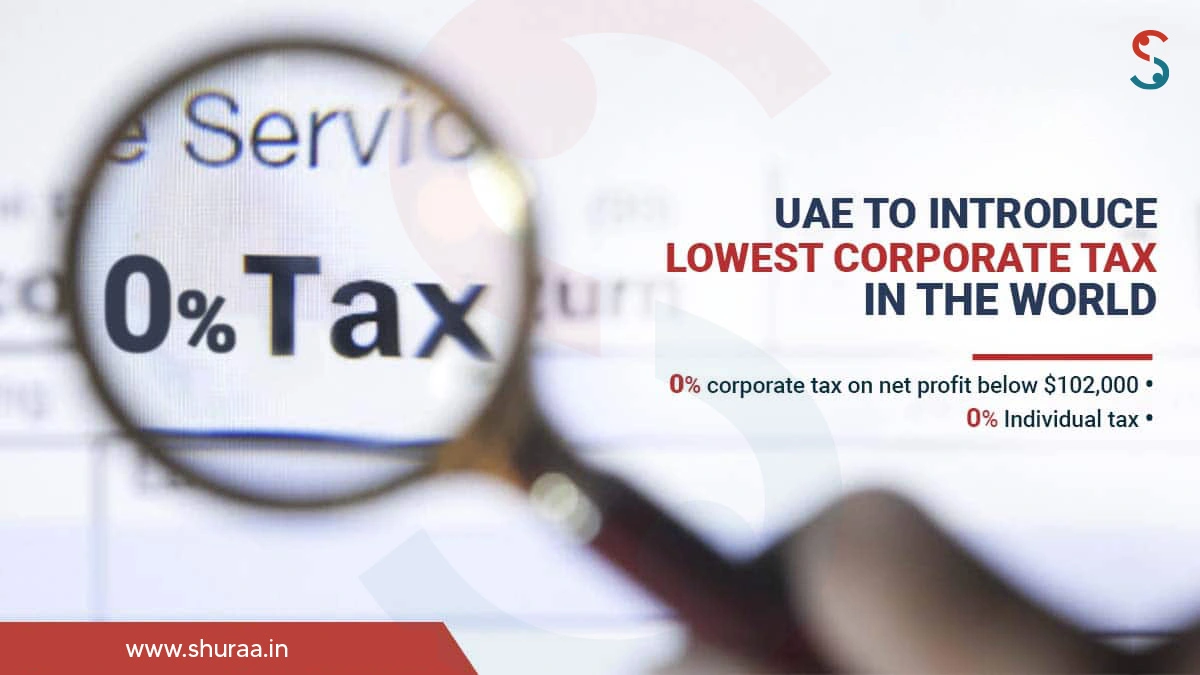
    The Ministry of Finance declared that net profits up to Dh 375,00 (INR 75,96,910 Lakh) would be tax-free. This is in keeping with a big initiative aimed at assisting small & medium enterprises. Furthermore, the government will levy a 9% corporate tax on businesses for net profits over $102,000 (INR 75,96,910 Lakh). And 0 percent for net profits below that amount.

    These substantial improvements will open a new window of financial growth for businesses and in coming years, this reform can prove to be a big advantage for Indian entrepreneurs. 

    The 9% corporate tax on businesses is the lowest across the globe. Thus, big multinational companies should prioritize the UAE to open their new branch. Also, according to a Fundera survey, the average small business owner earns INR 53,85,975 per year. As a result, this announcement is a big boon for small and medium enterprises too as they can continue to take advantage of 0% TAX

    What Are the Highlights of New UAE Corporate Tax

    Due to favorable tax regimes in most GCC nations, the Gulf Cooperation Council remains an attractive jurisdiction for foreign investment. However, several reforms are in the works to generate new revenue streams while lowering the region’s reliance on traditional revenue sources. Below are the highlights of the new tax regime in the UAE.

    1. Individual Earnings

    Individuals will continue to be exempt from taxation on earnings from work, real estate, equity investments, and other sources of personal income not tied to a UAE trade or business. Therefore, the personal income tax rate in the UAE still stands at 0 percent. Foreign investors who do not conduct business in the country will also be exempt from the corporate tax in Dubai.

    2. Regulations on Loss Utilization

    Loss utilization regulations will be generous in the UAE’s corporate tax framework. Furthermore, UAE groups will be taxed as a single entity. They can also use collective relief for losses, intra-group transactions, and reorganizations.

    3. UAE Corporate Tax on Net Profits

    In terms of profit, corporate tax on business in the UAE will be applied to the business’s adjusted accounting net profit. For instance, a business’s turnover is AED 1 Million ( INR two crores). after all deductions (e.g. REntal, Salary). the company’s net profit comes out to be AED 3,00,000 ( INR 60 lakhs ). The enterprise will be exempt from taxation in the UAE.

    4. Tax Incentives

    In the case of free zones, the 9% tax will be applied to enterprises within the free zones that gain commercially from the mainland. The current advantages for free zone enterprises will be honored for businesses that comply with all regulatory standards – and do not conduct business with the mainland.

    5. Minimal Compliance Costs

    The corporate tax in UAE will ensure that compliance costs are kept to a minimum for multinationals that develop as well as maintain appropriate financial records. The corporate tax will be levied on the earnings of UAE companies as reported in their financial statements. Moreover, the reports should be prepared by internationally accepted accounting standards, with exceptions and adjustments.

    Moreover, the administrative burden to businesses to file corporate tax returns will be significantly less. Thanks to the digitalisation of government services over the last few years

    6. Business Activities

    Except for the extraction of natural resources, which will continue to be subject to emirate-level corporate taxation, the UAE corporate tax will apply to all enterprises and commercial activities.

    7. Assessment Year

    Multinationals would only have to file one corporate tax return every fiscal year. Furthermore, they will no longer have to make advance tax payments or prepare provisional tax filings. With reference to the OECD Transfer Pricing Guidelines, UAE enterprises will be subject to transfer pricing and documentation requirements.

    How Will The UAE Tax Regime Benefit Small Businesses?

    Many people consider small businesses an essential source of employment creation and technical innovation.  Small company owners have long been lauded for their contributions to the economy in the UAE. Their impact on employment growth and innovation, in particular. As a result, the new federal income tax policy will benefit small businesses and startups. 

    Here are some ways the UAE corporate tax on multinational companies will boost small businesses.

    1. Reducing Corporate Concentration

    Corporate concentration is the reason for the slowing of productivity growth and the economy’s slowing in general. Net income, revenues, assets, and market capitalization are distributed more evenly among the largest firms. The rising concentration reveals that big companies raise prices while decreasing salaries, offering lower-quality goods and services, and limiting output. Large enterprises and multinationals will be impacted by UAE taxation, but startups and small businesses will benefit from the expanding economy. 

    2. Promoting Healthy Competition

    Corporate concentration links to rising inequality and large businesses’ increasing political weight, in addition to suffocating competition. The concentration of wealth and power in the hands of a few large corporations can instill a sense of discontent among small enterprises. As a result, the UAE is introducing a business tax to line with worldwide efforts to promote healthy competition amongst global investors.

    3. Combating Tax Evasion

    Corporates are given credit for increasing competition and improving customer welfare due to their ability to utilize economies of scale. Large firms’ increasing efficiencies in comparison to their smaller counterparts are well-known. The tax for Indian entrepreneurs who are planning to do business in Dubai is only when their net earnings go beyond INR 75.96 Lakh. This new tax regime will help small businesses to stand out in the market while keeping a check on the issue of corporate tax evasion.

    4. Transparent System of Corporate Taxation

    It makes sense for the government to take action as the UAE’s economy grows and it assumes a larger position on the world stage. Tax transparency allows a high-level understanding of an MNE’s business activities through tax data. The UAE corporate tax is a reasonable price to pay for the benefit of conducting business as a corporation.

    It can fund the costs of public services that benefit businesses in particular, as well as to capture a portion of large corporations’ revenues. Hence, the new tax regime will also meet issues posed by the global economy’s digitisation.

    5. Prevent Harmful Tax Practices

    The new corporate tax regime takes the UAE several steps to meet international standards on ‘tax transparency’ and prevent ‘harmful’ practices. The administration will pave the way for the UAE to handle the problems posed by the global economy’s digitization and other issues. Furthermore, put its support for creating a worldwide minimum tax rate into action by applying a different corporation tax rate to large multinationals that meet specified criteria laid forth in the plan above.

    UAE Corporate Tax Rate in 2026

    As per the Ministry of Finance, CT rates are:

    • 0 percent for taxable income up to AED 375,000.
    • 9 percent for taxable income above AED 375,000.

    Get a free UAE corporate tax compliance check for your business

    Ready to Launch Your Business in The UAE?

    The new tax regime lays the groundwork for a robust economic recovery in the UAE, allowing the country to return to pre-pandemic levels. As a result, it is a perfect moment to start a business in the UAE. Speak to Shuraa specialists now if you’re still unsure whether Dubai is the right place for your company. 

    Shuraa India is a pioneer in Dubai business setup services. We have branch offices across the globe in major cities like London, Delhi, and Mumbai. 

    From guiding you on the right path to transforming your entrepreneurial idea into a successful firm, we do it all. You can connect with any of our nearest offices for a consultation. Thus, leverage the UAE’s cutting-edge infrastructure, strategic location, outstanding connectivity, and supportive workforce and start a business in Dubai today.  

    Shuraa’s tax advisors manage corporate tax registration & filings for 40,000+ UAE businesses — transparent, expert-led service

  • How to Start a Tourism Business in Dubai, UAE

    How to Start a Tourism Business in Dubai, UAE

    Dubai is one of the world’s most popular tourist destinations, known for its iconic landmarks, luxurious hotels, and endless entertainment options. With its strategic location, world-class infrastructure, and supportive government policies, Dubai is also a prime destination for entrepreneurs looking to start a travel and tourism business from India. Dubai welcomed over 14 million international tourists, marking a 182% increase from the previous year. This growth is expected to continue in the coming years, driven by Dubai’s ambitious tourism development plans. 

    Not only this, but the tourism industry is also a major contributor to Dubai’s economy, accounting for over 15% of GDP and generating over 300,000 jobs. This booming tourism industry undoubtedly presents a wealth of opportunities for entrepreneurs. Therefore, we are here to guide you on starting a tourism business in Dubai, including tips on choosing a business idea, registering your business, and the Dubai tourism license cost. 

    Why Indian Start a Tourism Business in Dubai? 

    Starting a tourism business in Dubai offers a wealth of opportunities, driven by a combination of factors that make this city a prime destination for entrepreneurs in the industry. 

    Here are just a few: 

    1. Dubai Is a Global Tourism Hub

    Dubai is a global tourism hub. In 2025, Dubai welcomed over 17 million international visitors, making it the fourth most visited city in the world. This number is expected to grow to 30 million by 2026. 

    2. Strategic Location

    Situated at the crossroads of Europe, Asia, and Africa, Dubai is a convenient global travel hub. Over 66% of the world’s population can reach Dubai within an 8-hour flight, making it an ideal stopover destination. 

    3. World-Class Attractions and Experiences

    Dubai offers an extensive range of attractions, from iconic landmarks like the Burj Khalifa and Palm Jumeirah to cultural experiences in the historic district of Al Fahidi. 

    4. Politically Stable and Business-Friendly Environment

    The UAE’s political stability and business-friendly policies make Dubai an attractive destination for entrepreneurs. 

    5. Ideal Year-Round Weather

    Dubai enjoys a warm climate year-round, which makes it an ideal destination for tourists from all over the world. 

    6. One of the Safest Cities in the World

    Dubai has a very low crime rate and is considered to be one of the safest cities in the world. 

    7. Business Incentives and Easy Market Entry

    Dubai offers a number of incentives for businesses, including tax breaks and easy access to capital.

    Types of Tourism Business License for Indians

    To start a tourism business in Dubai, there are several types of tourism business licenses that you can obtain depending on the specific nature of your tourism-related activities. This includes: 

    1. Inbound tour operator license

    This license allows you to organize travel activities for visitors to Dubai. This includes things like booking hotels, transportation, and activities, as well as providing tour guide services. This license also permits the operator to organize global conferences and exhibitions. 

    2. Outbound tour operator license

    An outbound tour operator license allows you to organize travel packages for residents of Dubai to travel to other countries. This includes things like booking flights, hotels, and activities, as well as providing visa assistance. 

    3. Travel agency license

    This license allows you to act as a travel agent and sell travel products and services on behalf of other tourism businesses. 

    The type of license you need will depend on the specific activities that you plan to offer. For example, if you want to organize both inbound and outbound tours, you will need both an inbound and an outbound tour operator license. 

    Documents Required for Tourism Business

    The documents required to get a tourism business license in Dubai are:

    • Trade name registration 
    • Passport copies 
    • Passport-sized photograph 
    • Visa stamp or entry page copies 
    • Article of incorporation (if required) 
    • Business plan (if required) 

    Launch your Dubai tourism business — free license cost estimate

    How to Start a Tourism Business in Dubai? 

    Starting a travel and tourism business in Dubai involves several steps, from choosing your business structure and location to marketing your services. Here’s a step-by-step process to guide you through the journey: 

    Step 1: Choose a Business Location 

    There are two main types of business locations in Dubai: mainland and free zone. 

    • Mainland: A mainland company is registered with the Dubai Department of Economy and Tourism (DET) and can operate anywhere in Dubai. However, mainland companies are subject to more regulations than freezone companies. 
    • Freezone: A freezone company is registered with a freezone authority and can operate within the freezone. Freezone companies enjoy a number of benefits, including tax breaks and exemption from customs duties. 

    Step 2: Register Your Company and Obtain the Necessary License 

    Once you have chosen a location, you need to register your company with the Dubai Department of Economy and Tourism (DET) or the relevant freezone authority. The DET will issue you a trade license, which is required to operate any business in Dubai.  

    You are also required to apply for a tourism business license in Dubai from the Department of Tourism and Commerce Marketing (DTCM). The DTCM will issue you a tourism license if your company meets certain requirements, as required by the authority. 

    Step 3: Open a Corporate Bank Account 

    You will need to open a corporate bank account to operate your tourism business. You can open a corporate bank account with any bank in Dubai. 

    Step 4: Visa and Immigration 

    If you choose the mainland, you’ll need to establish a legal entity and may apply for visas for yourself and any expatriate employees. 

    Free zones often provide visa packages for company owners and employees. 

    Step 5: Regulatory Compliance 

    Ensure that your business complies with all local regulations and safety standards, including insurance requirements. 

    Shuraa has helped 200+ tourism companies get licensed in Dubai — DTCM, DED and free zone expertise all in one place

    Cost of Starting a Tourism Business in Dubai 

    The cost of starting a tourism business in Dubai generally starts from AED 14,900 to AED 30,000 and will vary depending on a number of factors, including the type of business, the size of the business, and the location of the business. 

    However, there are some general costs that all tourism businesses will need to budget for, such as: 

    As a general rule of thumb, the cost of obtaining a tourism business license in Dubai, UAE generally starts from AED 14,900*. Please note that these are just rough estimates, we recommend getting in touch with business setup experts like Shuraa India to get the right assistance in establishing a tourism business in Dubai. 

    Dubai Tourism Business Made Easy with Shuraa India

    Starting a tourism business in Dubai can be a rewarding experience, but it can also be challenging. There are a number of factors to consider, such as choosing the right location, obtaining the necessary licenses, and marketing your business. 

    If you are an aspiring entrepreneur with a passion for tourism, we encourage you to take the opportunity and start your own business in Dubai.  And you don’t have to go it alone. Shuraa India, with over 26+ years of experience, can help you every step of the way. 

    We offer everything from company registration to office space solutions, visa assistance, and more. Reach out to Shuraa India today.

    The time to start your tourism business in Dubai is now!