Author: Dhruv

  • How Indian CAs and Accountants Can Practice in Dubai

    How Indian CAs and Accountants Can Practice in Dubai

    Imagine being a talented CA who hails from India. You are practising well, your clients trust you 100%, and you have a strong career going on for yourself. But as you see new opportunities coming towards you, you start looking at the bigger picture and start thinking. Maybe you want to cater to global clients, grow your services or establish an international presence.  

    That’s where Dubai, UAE, enters the frame. Being one of the top business hubs of the world, it gives a plethora of opportunities to individuals who work in finance, including talented CAs from India. That’s why, in this blog, we will be talking about business setup for Indian CAs in Dubai. 

    For those who do not know, Indian CAs have an important role to play in the entrepreneurial world of the UAE. The financial knowledge that they bring, their international outlook, and expertise in the Indian as well as the UAE markets really benefit businesses. No matter if it’s about making sure there’s compliance, figuring out complicated regulations, or creating opportunities that are new, CAs from India are dependable partners when it comes to the growth of the company. 

    Alright! Now that we’ve established that, let’s dive in deeper to understand the business setup for Indian CAs in Dubai. 

    Why Dubai Appeals to Indian CAs? 

    Dubai is one of the top business hubs of the world. That’s why it appeals to small and medium enterprises, startups, MNCs, and global investors. That said, once companies expand, so does their requirement for expert financial services. These include accounting, compliance with VAT, bookkeeping, reporting of finances, CT advisory, management of payroll, and auditing.  

    A few major benefits for Indian CAs are: 

    • Increasing need for tax and accounting knowledge 
    • Access to a client base that is diverse and international  
    • Prime location that links Asian, European & African markets 
    • Regulations that are business-friendly  
    • Advanced financial ecosystem 
    • Chances to work with law firms, consultants, etc.  

    Thanks to these factors, business setup for Indian CAs in Dubai is an appealing choice for expert professionals who want to grow outside of the Indian market. 

    Is It Possible for Indian CAs to Practice in Dubai? 

    Of course. Indian CAs can give accounting as well as consultancy services lawfully in Dubai, as long as they secure the crucial company licenses and approvals.  

    Based on the provided services, professionals might set up:  

    • Consultancy firms for accounting 
    • Practices with respect to financial advisory 
    • Companies that provide bookkeeping services 
    • Firms that provide tax consultancy 
    • Businesses that provide corporate finance advice 

    To function lawfully, professionals need to finish the needed process for CA firm registration in Dubai and secure permission from the concerned authorities.  

    Explained: Available Business Structures for Indian CAs 

    Before you begin your operations, you need to choose the correct structure of your business, as it’s necessary. Some of the most typical options are: 

    UAE Mainland  

    A company in the UAE Mainland lets accounting professionals cater to their clients across the United Arab Emirates. There are no geographical restrictions. To add, a Mainland setup is perfect for those firms that want to directly work with companies that are local, corporations that are huge, and government entities.  

    UAE Free Zone  

    Some Free Zones in the United Arab Emirates provide professional licenses that suit accounting as well as consultancy activities. Free Zones such as DWTC, IFZA, and DMCC come with simplified processes for registration. Often, these get a preference from the business owners who want an affordable market entry.  

    Remember, going with the correct structure is an extremely important step when it comes to Business setup for Indian CAs in Dubai. The reason? It has a direct impact on the operational flexibility as well as the growth of your business. 

    Licenses Needed to Launch Your Accounting Practice 

    Securing the right license is crucial before you start providing professional services. Based on the activities, you might need an accounting consultancy license in Dubai that allows services like: 

    • Bookkeeping 
    • Reporting of the finances 
    • Tax consultancy 
    • Consulting for compliance 
    • Management accounting 
    • Advisory for business 

    Remember, the exact requirements related to licensing might differ depending on what jurisdiction you go with and the nature of the services being provided.  

    What Are the Steps for CA Firm Registration in Dubai? 

    We are sure that by now, you might be thinking about the CA firm registration in Dubai process. To put it simply, it usually includes the following steps: 

    Step 1. Finalise Your Business Activities 

    Start by establishing what services will be provided by your firm, like reporting of finances, bookkeeping, consultation regarding taxes, etc. When you clearly highlight your activities, it aids in establishing the requirements for approval & licensing. 

    Step 2. Pick a Business Jurisdiction 

    Select whether you wish for your firm to be established in the Mainland or a UAE Free Zone, depending on the market you’re targeting as well as your operational requirements. Remember, every jurisdiction comes with specific advantages, regulations, and opportunities for business.  

    Step 3. Secure Your Unique Business Name 

    Pick a trade name that is unique and in compliance with the naming guidelines of the United Arab Emirates. To add, the name should be a reflection of your professional services. After it is approved, that name will get reserved for the process of your company registration.  

    Step 4. Get Initial Approvals 

    Turn in the needed paperwork as well as applications (for initial approval) to the concerned authorities. This step is a confirmation that the business activities you proposed meet regulatory needs.  

    Step 5. Submit Your License Application 

    Make sure you’re applying for your accounting consultancy license in Dubai that’s appropriate and is in line with the services you plan to provide. Securing the right license is crucial if you wish to operate your accounting practice lawfully. 

    Step 6. Finish Registering Your Company 

    Make sure you have finalised all the formalities related to the incorporation, such as submission of paperwork and approvals from the government. This finishes the process of accounting firm company formation & establishes your business officially.  

    Step 7. Open a Corporate Bank Account 

    After the registration of your company, you need to set up your business bank account with a bank that is based in the United Arab Emirates. This lets you take care of the transactions related to your business, payments, as well as operations related to finances with efficiency.  

    If you want a seamless experience when it comes to business setup for Indian CAs in Dubai and begin legally serving your clients, make sure you follow these steps. 

    What Are the Services Provided by Indian CAs in Dubai? 

    Accounting experts can offer a variety of services post getting the needed approvals, such as: 

    • Accounting & bookkeeping 
    • CT advisory 
    • Preparation of the financial statement 
    • Processing of the payroll 
    • Value Added Tax registration & compliance 
    • Assessment of the internal controls  
    • Valuation of the business  
    • Consulting for finances 
    • Advisory on risk management 
    • CFO services 

    The flexibility offered by the United Arab Emirates’ market makes it simpler for you to start an accounting business in Dubai and serve businesses in a variety of industries. 

    Top 4 Advantages of Establishing an Accounting Firm in Dubai 

    Here are several benefits of going for a professional accounting practice set up in Dubai: 

    Growing Market Access 

    Many new businesses get set up in the United Arab Emirates annually. This makes a constant demand for services related to accounting.  

    Global Client Exposure 

    The international business environment of Dubai lets firms collaborate with clients from across nations & industries.  

    Opportunities for Business Expansion 

    It’s possible for professionals to grow their operations by providing consulting solutions as well as financial services that are specialised. 

    Solid Regulatory Framework 

    The evolving financial regulations of the United Arab Emirates make opportunities for expert professionals who are able to help companies stay compliant.  

    These benefits have made a significant contribution to the growing demand for the services related to accounting firm setup in Dubai among professionals from India.  

    Challenges One Should Consider 

    Yes, there are substantial opportunities. However, as a professional, you need to be aware of the challenges, too. These are: 

    • Licensing & compliance needs 
    • Competition in the market 
    • Strategies for client acquisition 
    • Knowing the tax regulations of the UAE 
    • Ensuring professional certifications as well as standards 

    Cost of Establishing an Accounting Firm in Dubai 

    Although the cost lies between AED 12,900* to AED 30,000*, the entire price of an accounting firm setup in Dubai is based on certain factors, such as: 

    • Jurisdiction of your business 
    • Licensing needs 
    • Allocation of the visas 
    • Office space needs 
    • Fee for the government 
    • Professional service costs 

    Since requirements differ, getting personalised assistance could be a great idea before you execute your accounting firm company formation process.  

    Set Up Your Accounting Firm in Dubai with Shuraa India! 

    Establishing your professional UAE accounting practice includes several regulatory, licensing, and paperwork requirements. Which is why it can seem like a hassle if you are doing it on your own. Don’t worry! That’s where Shuraa India comes into the picture. We make the process simple by helping you right from registration to banking assistance. 

    Over the past few decades, we have enabled thousands of Indian business owners to realise their UAE business dream, and you could be next. With us, you don’t get overpromised claims or complicated solutions. Our team of experts understands your unique requirements and helps you with what’s best for your business.  

    So, no matter if you want support with your CA firm registration in Dubai, want to get your accounting consultancy license in Dubai, or wish to start an accounting business in Dubai, all you need to do is contact us, and we will take care of the rest.  

    FAQs 

    1. How to Register a CA Firm in Dubai?  

    To do it, you need to follow the necessary steps that enable you to register your firm.  

    2. Is an Indian CA Valid in Dubai?  

    Of course! Their international outlook, knowledge related to finances, and command of the Indian as well as the UAE markets are really advantageous for businesses.  

    3. What Are the Best Business Setup Consultants for Indian CAs in Dubai? 

    If you’re an Indian CA looking for reliable consultants to set up your firm in Dubai, Shuraa India is one of the leading names that you can trust. 

    4. Cost of Company Formation for Indian Chartered Accountants in Dubai? 

    Although the price falls between AED 12,900* to AED 30,000*, there are several factors that influence the entire costing such as jurisdiction of your business and licensing needs, etc. 

    5. Is Dubai Good for Accountants?  

    Totally! The city offers a good environment for the growth and success of accounting firms. 
  • UBO Registration UAE: What Indian Business Owners Must Know

    UBO Registration UAE: What Indian Business Owners Must Know

    The United Arab Emirates has turned out to be a preferable business hub for business owners from India (who want to expand internationally). And why should we blame them? Whether it is policies that are tax-friendly or business setup options that are easy, the UAE provides a lot of opportunities for growth to anyone who dares to dream loudly. 

    That said, with global business activity rising, the government in the United Arab Emirates has also done its bit to strengthen the regulations related to corporate transparency. And this is exactly why we’d be talking about one of the major requirements for compliance, i.e., UBO registration in the UAE. 

    If you have your very own UAE company or are managing one, it is extremely important for you to understand the regulations related to the Ultimate Beneficial Owner (UBO). This is because if you fail to comply, it can result in legal complexities, penalties & disruptions when it comes to your operations. That’s why, in this blog, we will tell you all that you need to know regarding UBO registration in the UAE, such as why it is important, what you require, the eligibility, and the process for compliance. 

    What Do You Mean by UBO Registration in the UAE? 

    UBO, or Ultimate Beneficial Owner, refers to the natural person who directly or indirectly owns, controls, or has significant influence over a company, usually through 25% or more ownership or voting rights. Under UAE regulations, companies are required to identify and maintain records of their UBOs to enhance corporate transparency and help prevent financial crimes such as money laundering and terrorism financing. 

    The process via which the ownership details are submitted to the concerned authorities is referred to as UBO registration in the UAE. For those who do not know, the regulation is applicable to the majority of the companies in the Mainland, entities in the Free Zone & other licensed companies that operate in the United Arab Emirates. 

    The goal? Enhancing accountability & making the United Arab Emirates aligned with the global standards for anti-money laundering. 

    Explained: The Reason Behind the UBO Regulation Being Introduced 

    The UBO rules were introduced by the UAE as a part of its attempts to fortify its economic ecosystem and improve global trust. The aim of the authorities is to make a business atmosphere that is transparent, where the identification of the actual owners behind companies becomes easy. 

    The following are supported by these regulations: 

    • Money laundering prevention 
    • Financial fraud reduction 
    • Better compliance for AML that’s a must for India-UAE companies to follow 
    • Investor confidence that’s stronger 
    • Improved credibility for international business 

    For Indian business owners who are functioning in the United Arab Emirates, compliance is not just optional. Keeping precise records when it comes to ownership is an extremely important legal responsibility now. 

    Who Needs to Register for UBO in the UAE? 

    A lot of companies that are based in the UAE have to adhere to the UBO rules. This involves: 

    • Companies in the Mainland 
    • Companies in the Free Zone 
    • Entities that are commercial 
    • Businesses that operate in the UAE that are foreign owned 

    If you happen to be the beneficial owner of a UAE company, you might need to submit your information as part of the registration process of the Ultimate Beneficial Owner. 

    What Information Do You Need for UBO Registration?  

    As a business, for you to finish the process of registration, you generally need to give:  

    • Complete name of the individual who’ll be the beneficial owner 
    • Details related to the passport 
    • The nationality 
    • Residential address  
    • Percentage of ownership 
    • Control nature in the business 
    • Details related to the visa or the Emirates ID (if applicable) 

    Authorities might also ask for corporate paperwork that is supportive in nature, copies of the license, as well as shareholder structures.  

    That’s why ensuring your records are up to date is equally important. If there are any changes in terms of ownership or structure of control, usually, they must be reported within the timeframe that is prescribed.  

    Why is It Important for Indian Business Owners to Maintain UBO Compliance? 

    Indian entrepreneurs often go for company formation in Dubai & other emirates to expand internationally, plan their taxes, and access markets. That said, if you ignore compliance needs, you’d be putting yourself at serious risk.  

    Listed below are the reasons why you need to go for UBO registration in the UAE:  

    1. To Steer Clear of Penalties

    If you aren’t compliant, it might lead to huge fines, company operation restrictions, or challenges when it comes to renewing your trade license. 

    2. To Keep Up Banking Relationships

    UAE banks carry out tight due diligence checks. If you, as a business, have proper UBO records, it can help you keep up financial credibility as well as banking operations that are smooth.  

    3. To Encourage Corporate Transparency 

    Having ownership disclosures that are strong means contributing to the UAE’s corporate transparency. This increases trustworthiness when it comes to investors, financial institutions, as well as authorities. 

    4. Boost Your International Image

    As a company, if you comply with the international standards for ownership disclosure & AML, you could be seen as more dependable and credible.  

    What is the Procedure for UBO Registration? 

    The process for UBO registration in the UAE generally includes the following steps: 

    Step 1: Determine Your Ultimate Beneficial Owners 

    Figure out those people who will be owning or controlling the business directly or indirectly, such as investors, shareholders, or people who have a lot of power to make decisions for the business when it comes to the business.  

    Step 2: Make Sure Your Supporting Documents are Ready 

    Have the identification paperwork, records related to the ownership, and information regarding the shareholders in place. It is important to ensure that all the paperwork is updated, accurate, and in line with the legal structure of the company ahead of submission.  

    Step 3: Make the Information Submission to Authorities 

    Make sure you are filing the needed details with the concerned authority of the Free Zone or the relevant licensing authority of the UAE Mainland within the timeline that has been prescribed.  

    Step 4: Ensure Your Records are Updated  

    Companies need to make sure that information related to ownership remains precise and up to date. If there are any changes in the structure of control or shareholding, they should be promptly reported to the concerned authority.  

    Remember, finishing UBO registration in the UAE in a correct manner helps companies steer clear of needless delays as well as challenges related to compliance. 

    What Are Some Typical Challenges Companies Face? 

    A lot of Indian business owners come across challenges like: 

    • Complicated structures for ownership  
    • Difficulty in figuring out indirect ownership 
    • Incomplete paperwork 
    • Submissions that are delayed 
    • Insufficient knowledge when it comes to regulatory updates 

    That’s why it becomes important to take professional advice, as it can make the entire process simple and minimise the risks related to compliance in a significant manner.  

    How Can Expert Business Setup Consultants in the UAE Be Helpful? 

    Expert business setup consultants can help businesses: 

    • Understand regulatory requirements 
    • Identify beneficial owners accurately 
    • Prepare the required documentation 
    • Ensure timely submissions and filings 
    • Stay compliant with changing regulations 

    For Indian business owners who are not familiar with the compliance processes of the UAE, professional assistance is time-saving, error-reducing, and helps streamline the operations of the business.  

    Make Your UAE UBO Registration Easy in Shuraa India! 

    Knowing the regulations related to compliance in the United Arab Emirates can seem complex, particularly for business owners from India who are taking care of cross-border company operations. From figuring out the ultimate beneficial owners to making sure you are ready with precise paperwork, even a single, tiny mistake can result in penalties or needless delays. 

    At Shuraa India, our experts simplify the entire UBO registration process for UAE businesses. From understanding legal requirements and organising ownership records to preparing documents and ensuring timely submissions, we help you stay fully compliant with ease. 

    No matter if you have a business in the Mainland or a company in the Free Zone, our expert consultants offer comprehensive support, helping you remain compliant and concentrate on the growth of your business.  

    FAQs 

    1. Who is Eligible for UBO Registration in the UAE?

    Any person who is owning 25% or above shares or voting rights in a business (directly/ indirectly), or can significantly exercise control concerning the decisions related to the business, is usually regarded as qualified when it comes to UBO. 

    2. What Does UBO Stand for?

    The person who ultimately has either direct or indirect ownership or control over a business is referred to as the UBO (also known as Ultimate Beneficial Owner) 

    3. Is It Mandatory to Go for UBO Registration in the UAE?

    Of course! Most of the UAE Mainland companies and even Free Zone businesses need to adhere to the UBO regulations.  

    4. Can a CEO Be a Beneficial Owner? 

    Totally! It is possible for a CEO to be considered as a beneficial owner provided they are owning the business (25% or more, whether directly or indirectly) or exercising control that is significant when it comes to the business’ operations or decision-making.  

    5. What Are the Documents Required for Beneficial Ownership? 

    The paperwork needed for beneficial ownership typically involves copies of the passport, Emirates ID, or copies of the visa (if applied), details of the shareholder, ownership records of the company, copies of the trade license, and supporting corporate paperwork that shows the structure of the ownership. 

  • Can I Run a Business in India and Dubai at the Same Time?

    Can I Run a Business in India and Dubai at the Same Time?

    These days, every business owner thinks of expanding their entrepreneurial imprint across borders, and frankly, it’s not impossible. The proof? In the present times, a lot of Indian business owners are opting to run a business in India and Dubai simultaneously. The reason why they do it is to tap into wider markets, avail better tax benefits, and access global opportunities for growth.  

    With Dubai making it to the list of the most pro-business locations in the world, it’s understandable why Indian entrepreneurs are increasingly looking for methods to have a solid UAE presence while maintaining their operations back in India. However, the question of the hour is, is it possible to practically and lawfully take care of both businesses simultaneously?  

    Well, you’ll be happy to know that IT IS! And that’s exactly where Shuraa India comes into the picture. But hold on, we’ll talk about how we can help you in some time. For now, just know that if you plan properly, are legally compliant, and have a solid operational structure, it’ll be possible for you to run a business in India and Dubai with no significant issues. 

    Why Do Indian Businesses Expand to Dubai?  

    Dubai has turned out to be a preferred international destination for small and medium enterprises, startups, and even companies that are established. This is because it has a prime location, policies that are business-friendly, and innovative infrastructure. For those who do not know, business owners who want opportunities for India to Dubai business setup get drawn to advantages like:  

    • Total foreign ownership in a lot of sectors 
    • Global market access  
    • A tax environment that is appealing 
    • Company registration procedures that are easy  
    • Top-class banking as well as logistics systems 

    Simultaneously, India keeps on offering a solid potential for growth and a huge market for consumers. This is what makes it excellent for business owners who wish to run a business in India and Dubai, because they can think of an expansion that is long-term. 

    Can You Legally Operate Companies in Both India & Dubai?  

    Yes. As an Indian citizen, you can lawfully own & operate businesses in India as well as Dubai, UAE. This is because there is no restriction that stops business owners from having dual business ownership in India and the UAE (if they are able to fulfil all the tax-related, legal, and regulatory requirements when it comes to both nations).  

    However, they must make sure: 

    • They do their company registration in Dubai, UAE, properly 
    • There’s compliance with respect to the Indian Foreign Exchange Management Act (FEMA) regulations 
    • They file their taxes accurately in both nations 
    • There’s proper banking and paperwork related to the finances 

    A lot of entrepreneurs these days are able to manage a business in the UAE and India successfully by making distinct legal entities while maintaining operations that are integrated. 

    Is It Possible to Open a Company in Dubai While You Live in India? 

    Yes. You can open a company in Dubai from India. The best part? You don’t have to permanently shift to the United Arab Emirates. As a matter of fact, a lot of Dubai Free Zones permit registration for remote businesses with minimal documentation.  

    The usual process involves: 

    • Finalising the activity for your business 
    • Registering the name of your company 
    • License and approval applications 
    • Setting up a business bank account 
    • UAE residency visa application (if required) 

    Thanks to professional consultants who provide complete assistance for Dubai company formation for Indians, the entire process has turned out to be quite easier.  

    Top 5 Advantages of Running Companies in India & Dubai at the Same Time 

    Often more than not, entrepreneurs who are able to run a business in India and Dubai successfully get to experience certain strategic benefits. These are:  

    1. Global Market Access 

    Dubai, as a city, helps Indian companies scale internationally by letting them tap into the European, African, and Middle Eastern markets.  

    2. Diverse Sources of Revenue

    When you are operational in 2 countries, it minimises your reliance on one market and enhances the stability of your business.  

    3. Efficiency in Taxation

    Dubai has tax policies that are favourable for companies. These can help them in profit optimisation while staying completely compliant.  

    4. Better Credibility for Your Brand

    If you have a presence in the UAE, it improves the global perception of your brand, attracting clients from around the world.  

    5. Global Trade Made Easier

    If you have a solid cross-border business structure for India & the UAE, it can help simplify importing, exporting, and global partnerships for you.   

    Managing Businesses in 2 Countries: Key Challenges Explained 

    While, as a business owner, you can operate two businesses in different countries, you need to be ready for several challenges. These include:  

    1. Adherence to Regulations 

    India & the United Arab Emirates both have tax & legal systems which you need to mandatorily comply with separately.  

    2. Management of Finances 

    When you have to manage accounting, banking, as well as exchange of currency across borders, you need to plan carefully.  

    3. Different Time Zones & Coordination for Operation 

    You might need powerful communication systems to manage teams, clients, as well as your suppliers that are spread across regions.  

    4. Considerations for Tax Residency  

    Knowing the status of your tax residency is crucial if you wish to steer clear of double taxation issues.  

    How to Manage Companies in India & Dubai: Top Tips 

    As an entrepreneur, if you are strategising to run a business in India and Dubai, here are a few practical tips that you can turn out to be of great help: 

    1. Go with Operational Structures That are Separate 

    It is important for you to have separate legal entities, systems for accounting, and bank accounts for both the United Arab Emirates and India.  

    2. Work with Local Experts 

    Hire business consultants, legal advisors, and tax professionals who know everything about the regulations of both nations. 

    3. Know About the Tax Implications 

    Speak to the experts to know what are the benefits concerning the Double Taxation Avoidance Agreement (DTAA) between the United Arab Emirates and India.  

    4. Ensure Responsibility Delegation 

    Having solid management teams in India as well as the UAE can help make sure that your daily operations are smooth.  

    Why Do It with Shuraa India?   

    By now, many of you might be wondering why Shuraa India could be a preferable choice for you. This is because when you have the right consultancy by your side, managing your companies in the UAE & India becomes much simpler.  

    And this is exactly why we are here. Listed below are some of the reasons why going with us could be a great move for you: 

    • Expert assistance for expanding your India and UAE company seamlessly  
    • Full support when it comes to company setup & licensing 
    • Visa, legal paperwork, and banking assistance  
    • Personalised approach towards solutions  
    • Expert consultants who are extensively familiar with the UAE market 
    • Quick, clear, and stress-free process for setup 
    • Comprehensive assistance for streamlined cross-border operations for your business 

    Give Wings to Your Business Dreams with Shuraa India!  

    In the present-day international economy, it is entirely possible for any entrepreneur to run a business in India and Dubai simultaneously. With correct planning, strategy for operations, and compliance, business owners can use the key benefits offered by both the UAE & Indian markets for scaling faster & expanding globally.  

    So, no matter if you wish to scale your already existing UAE business or want to begin a new one altogether, you can choose Shuraa India to make the whole process easy and streamlined. From company formation to post setup assistance, we make sure your cross-border company journey is compliant and hiccup-free.  

    So, what are you waiting for? Contact us today! 

    FAQs 

    1. Can I Open a Business in Dubai from India?  

    Yes. Indian business owners can lawfully open a Dubai business from India via Free Zone business formation. That way, they won’t have to relocate permanently.  

    2. What Are the Benefits of Owning a Business in Dubai & India?

    The key benefits involve international market access, income sources that are diversified, international credibility for your brand, tax benefits, and opportunities for easier global trade.  

    3. What are some of the best-working businesses across the UAE & India? 

    If you are an entrepreneur who wants to run a business in India and Dubai, here are some industries that you can tap into that can thrive: 

    • Software and IT services 
    • E-commerce 
    • Businesses related to import and export 
    • Digital marketing agencies 
    • Services related to real estate 
    • Consulting firms 
    • Wellness & healthcare-related brands 

    Businesses wishing to expand internationally are especially supported by Dubai’s global ecosystem. 

    4. What are Some of the Best Consultancies for Business Setup in Dubai?

    Shuraa India is one of the leading names when we talk about the best consultancies for business setup in Dubai 

    5. Can Indian Citizens Begin Their Dubai Company?

    Yes. Citizens from India can lawfully begin and completely own a Dubai company. However, the same depends on the activity of their business and the finalised jurisdiction.  

  • JAFZA vs DAFZA Free Zone: Which Is Better for Indian Exporters?

    JAFZA vs DAFZA Free Zone: Which Is Better for Indian Exporters?

    International business expansion isn’t a faraway dream for Indian business owners, especially when the United Arab Emirates offers some Free Zones that are the most strategic across the globe. However, when it’s about choosing from two key players like JAFZA and DAFZA, the final decision often comes after a thorough JAFZA vs DAFZA comparison.  

    That’s why, in this blog, we are going to talk about all the things Indian exporters should know, from cost to location benefits, suitability of business, and logistics, for you to decide better and with confidence.  

    That said, no matter if you’re looking for a DAFZA setup or want a JAFZA Free Zone company, Shuraa India is with you every step of the way. From assisting you in figuring out the correct Free Zone to taking care of the paperwork, setup, and licensing. We make the procedure easy for you by providing holistic support. 

    Explained: JAFZA & DAFZA Free Zones  

    What’s JAFZA? 

    One of the biggest and most established UAE Free Zones, the Jebel Ali Free Zone (JAFZA) is located near the world-renowned Jebel Ali Port. This acts as a major hub when it comes to trade, manufacturing, as well as logistics.  

    For those who do not know, a Jebel Ali Free Zone company is particularly advantageous for exporters who deal with goods in bulk. This is because it has direct access to shipping routes that are international.  

    What’s DAFZA? 

    Strategically situated near the Dubai Airport Freezone Authority, Dubai International Free Zone (DAFZA) is recognised for its premium-quality infrastructure and connectivity that’s seamless. It’s perfect for businesses that deal with products that are high-value and time-sensitive.  

    To add, companies that depend on quick international distribution and air cargo systems that are efficient often prefer a DAFZA setup 

    JAFZA vs DAFZA Comparison: What are the Major Differences? 

    Selecting between these options calls for an in-depth look at how different they are across business factors that are critical. Let’s understand one by one.  

    1. Logistics and Location  

    JAFZA allows access to sea routes quite directly, which makes large shipments very cost- ffective. Whereas the airport proximity offered by DAFZA makes sure that there’s rapid delivery across global markets.  

    This is a central distinction when we talk about the JAFZA vs DAFZA comparison. 

    2. Activities for Business  

    Jebel Ali Port Free Zone supports a wide industry range. This includes manufacturing, trading, as well as logistics. However, the Dubai Airport Free Zone Authority is inclined towards sectors such as aviation, electronics, IT, and professional services.  

    3. Price and Setup 

    In general, JAFZA is more cost-effective, especially for businesses that need industrial space and warehouses. On the other hand, a DAFZA setup is more premium, offering quicker processing and an infrastructure that’s high-end. Here’s the starting price for both: 

    • JAFZA: Starts from *AED 50,000  
    • DAFZA: Starts from *AED 40,000  

    4. Infrastructure 

    From offices that are smart and facilities that are tech-enabled in DAFZA to industrial land as well as logistics parks present in JAFZA, both zones serve distinct operational requirements.  

    This, here, is yet another major factor when we talk about JAFZA vs DAFZA comparison. 

    5. Connectivity for Exporters  

    Both JAFZA and DAFZA come with powerful connectivity to India. JAFZA links via key sea routes, whereas DAFZA allows for air cargo movement that’s quick. This makes both a great option when we talk about a UAE Free Zone for exporters in India. 

    JAFZA vs DAFZA Comparison

    Bird’s Eye View of the JAFZA vs DAFZA Comparison 

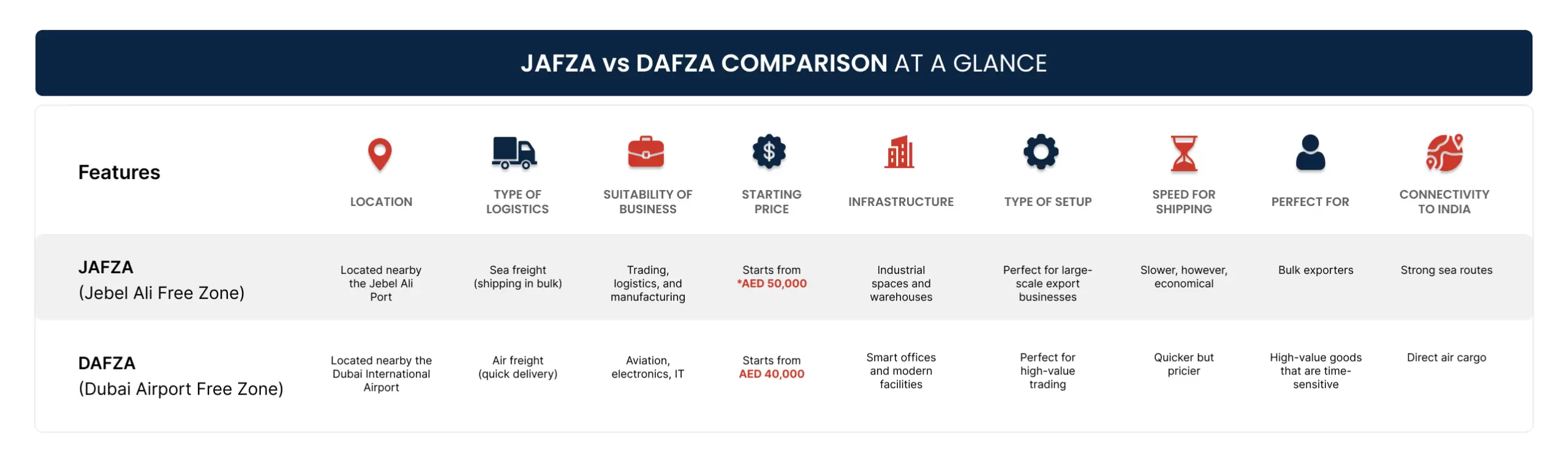
    To make the decision-making process easier for you, have a look at a quick comparison between both of these Free Zones: 

    Features  JAFZA (Jebel Ali Free Zone)  DAFZA (Dubai Airport Free Zone) 
    Location  Located nearby the Jebel Ali Port  Located nearby the Dubai International Airport 
    Type of Logistics  Sea freight (shipping in bulk)  Air freight (quick delivery) 
    Suitability of Business  Trading, logistics, and manufacturing  Aviation, electronics, IT 
    Starting Price  Starts from *AED 50,000  Starts from *AED 40,000 
    Infrastructure  Industrial spaces and warehouses  Offices that are smart, facilities that are modern 
    Type of Setup  Perfect for export businesses that are large-scaled  Perfect for trading that is of high value 
    Speed for Shipping  Slower, however, economical  Quicker but pricier 
    Perfect For  Bulk exporters  High-value goods that are sensitive to time 
    Connectivity to India  Sea routes that are strong  Air cargo that is direct 

    Rest assured, the aforementioned perfectly reveals the essence of the JAFZA vs DAFZA comparison for quick evaluation. 

    JAFZA vs DAFZA Comparison: Pros and Cons Explained 

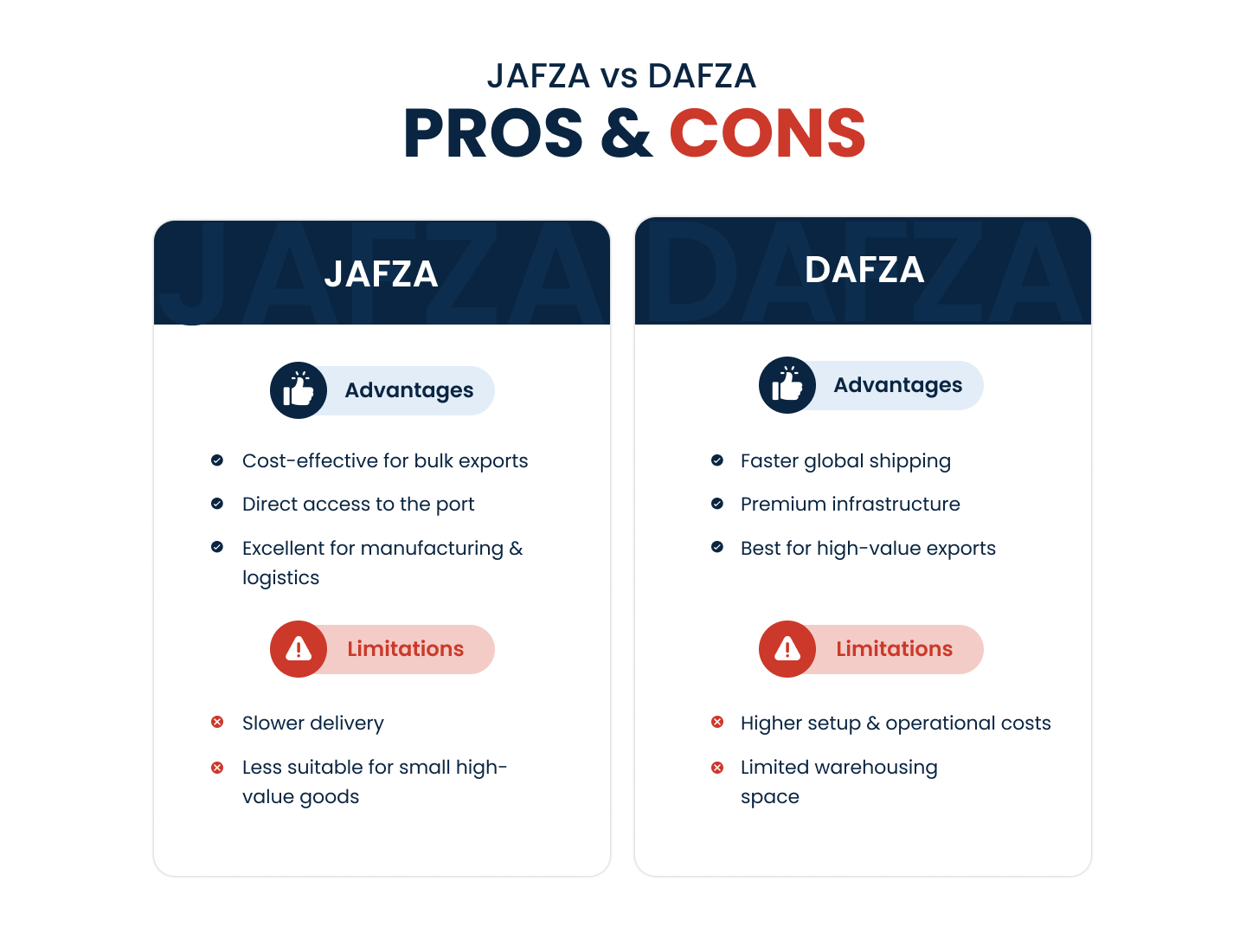
    Listed below are some of the benefits and limitations of both the Free Zones:  

    Advantages of JAFZA 

    • Cost-effective when it comes to bulk exports 
    • Helps you with direct access to the port 
    • Excellent when it comes to manufacturing as well as logistics 

    Limitations of JAFZA 

    • The delivery is slower when you compare it with air freight 
    • It is not quite suitable for goods that are small and of high value 

    Advantages of DAFZA 

    • Global shipping that’s faster 
    • Infrastructure is premium  
    • Excellent for exports that are of high value  

    Limitations of DAFZA 

    • Set-up as well as operational expenses are higher 
    • Warehousing space is limited 

    JAFZA vs DAFZA Comparison: Pros and Cons Explained

    JAFZA or DAFZA: Which One is Better for Indian Exporters? 

    We know that by this point, you might be wondering which of the two Free Zones is better when it comes to Indian exporters. To put it simply, there isn’t a universal answer to this question.  

    • If your company is focusing on exports that are of large-scale, efficiency in terms of costs, and warehousing, JAFZA could be a better option.  
    • If you prioritise speed, a reach that’s global, and handling of premium-quality products, DAFZA could be an excellent option.  

    Ultimately, selecting the correct UAE Free Zone Business Setup for Indian exporters is based on your business goal and logistics strategy alignment.  

    Want to Set Up Your Business? Do It with Shuraa India! 

    If you are an Indian exporter who’s trying to figure out the Free Zone setup in the UAE, there are chances that you might feel confused regarding the process. And honestly, without proper guidance, the process could appear complex, too. That’s why Shuraa India makes everything simple and efficient for you. 

    We help you assess the options, handle paperwork, and launch your UAE business without any hassles. Our legacy? Over decades of experience and having helped thousands of entrepreneurs successfully launch their UAE business 

    So, no matter if you want to go ahead with a DAFZA setup or feel like choosing a Jebel Ali Free Zone company, our experts can make it possible for you. All you have to do is book your free consultation today!  

    FAQs 

    1. Which Free Zone is More Expensive? DAFZA or JAFZA?

    A DAFZA setup typically has higher prices because of its top-class infrastructure and it being in the proximity to the Dubai airport.  

    2. Can Indian Business Owners Completely Own Their Business in These Zones?

    Of course. JAFZA and DAFZA permit 100% foreign ownership. This makes these Free Zones appealing for Indian Exporters who want to expand internationally. 

    3. JAFZA or DAFZA: Which is Best When It Comes to Warehousing & Logistics?

    JAFZA, because of its huge industrial spaces and access to the Jebel Ali Port, is more suited when it comes to warehousing and logistics.  

    4. Which is the Biggest Free Zone in the UAE?

    The United Arab Emirates’ very first Free Zone, Jebel Ali Free Zone Authority in Dubai, is the largest Free Zone.  

    5. Is DAFZA a Designated Zone? 

    Of course. DAFZA is recognised as a designated zone under the VAT regulations of the United Arab Emirates.  

  • Is Dubai Company Setup Worth It for Indian Startups?

    Is Dubai Company Setup Worth It for Indian Startups?

    If you’re an Indian startup founder who’s been dreaming of making it BIG in the Middle East, chances are, you’ve already looked up Dubai company formation online. And honestly, we get it! Over the past couple of years, Dubai has emerged as a global hub for trade and business. Many Indian founders have explored ways to bring their company to the city, whether it is to expand globally, cut down on taxes, or get access to international markets such as Asia and Africa. 

    But the question comes: Is Dubai company setup for Indian startups actually worth it or just a social media whitewash? The answer isn’t as simple as you think, because it totally depends on the type of business you have, your growth stage, market focus, and overall long-term goals. 

    And that’s exactly why, in this guide, we’ll talk about the costs and benefits to help you understand whether a business setup in Dubai could be a strategic move or an added expense for you. But before we get there, let’s understand why more and more Indian startups are considering Dubai. 

    What Makes Indian Startups Get Attracted to Dubai?  

    Truth be told, it’s not a pure coincidence that so many Indian entrepreneurs are thinking of starting their own business in Dubai. The city has established itself as a major gateway for startups, and the reasons are obvious:  

    1. 0% Personal Income Tax

    Unlike in India, founders and employees in Dubai don’t pay personal income tax. This turns out to be a major advantage, as it increases the amount you can take home as an employee or an entrepreneur. 

    2. Corporate Tax @9% (Above Threshold)

    The UAE imposes a 9% corporate tax on net profits exceeding AED 375,000. This is considerably less than the standard Indian corporate tax rates, another reason why the city is startup-friendly.   

    3. 100% Foreign Ownership

    In a lot of mainland sectors and especially in Dubai Free Zones, Indian entrepreneurs can own 100% of their company. This means you don’t need any local sponsors, and you can retain your power to make key decisions. Already searching for how to start a business in Dubai from India? Wait! There’s more. 

    4. Access to Global Markets

    Due to its geographic location, Dubai serves as the ideal entry point to high-growth markets across the GCC, Africa, and parts of Europe. This location benefit means faster trades and greater logistics efficiency for new ventures.   

    5. Getting Global Talent

    Since Dubai has emerged as a business hub, it has also become a haven for international talent. People from across the globe move to the city to seek employment, which means you get to select from a diverse pool of talent.   

    6. Business-Friendly Environment

    Gone are the times when it was difficult to set up a business in Dubai. The city offers streamlined company registration processes, access to free trade zones, and an overall innovative environment that is perfect for new businesses.   

    7. Brand Recognition & Perception

    What’s the first thing that comes to mind when you say you’re a “Dubai-based company”? Trust, global presence, a sense of premium-ness? That’s exactly what it means to start a business in Dubai from India.  

    8. India-UAE$200 Billion Trade Target By 2032  

    Indian startups will greatly benefit from the plan by Narendra Modi and Mohamed bin Zayed Al Nahyan to boost India-UAE trade to $200 billion by 2032. This means more business, greater investment, and smoother cross-border expansion. Additionally, it makes Dubai a great place for new ventures.  

    So, there you have it… the key benefits of setting up your business in Dubai that reveal why so many startups are considering the city. Now, as important as it is to be aware of the benefits, there are certain key challenges that you should know of before you make a move. 

    Get a free personalised Dubai startup setup plan — talk to an advisor today

    Dubai Business Setup for Indians: Key Challenges  

    Dubai may be business-friendly; however, it does not mean that it is business casual. Compliance, documentation, renewals, and financial reporting are taken very seriously here; that’s why businesses need to operate with full transparency and structure.  

    Listed below are some of the key factors that you must not miss: 

    1. Operational Costs Can Add Up

    The cost of maintaining a company in Dubai is higher, especially when compared to a country like India. You need to take care of the office cost, visa, license fee, and renewals.  

    2. Due Diligence in Banking is Strictly Needed

    It’s common for UAE banks to run thorough checks before they allow you to open a corporate bank account. You must be on point with your documentation, proof of business, and finances. 

    3. Annual License Renewals are Compulsory

    As an entrepreneur in Dubai, you must renew your trade license every year. Missing deadlines can result in penalties and affect your business operations. 

    4. Corporate Tax Compliance Must be Followed

    As mentioned before, you need to pay a corporate tax of 9% if your net profit is more than the allotted threshold, i.e., AED 375,000. Failing to pay it timely can result in a fine, potential license suspension or worst, legal action. 

    Now that we have the challenges in place, it’s time we move to the question of the hour.   

    Dubai Company Setup for Indian Startups: Is It Actually Worth It?  

    We know by now many of you must be having the same question: Whether it’s actually beneficial to start your startup journey in Dubai. The answer is simple. It depends on your growth ambition.  

    If you wish to set up a startup that scales globally, earns foreign currency, and comes with long-term international expansion, Dubai can be a great move for you. Whereas, if you’re a bootstrapped business which is in its early stages, the higher operational costs can pose a challenge.   

    You need to understand that Dubai is not a shortcut and that you need to be strategic with your approach. All in all, if you’re a startup that’s thinking globally, following legal tax optimisation, and wanting credibility that’s international, Dubai is actually WORTH IT!  

    Join 1,00,000+ Indian entrepreneurs in Dubai — get a free personalised company setup plan with cost estimate in INR

    Why Shuraa India is the Ideal Partner for Business Setup in Dubai?  

    Your business is important; that’s why choosing the correct business setup partner comes first. We, at Shuraa India, understand this deeply and work with you as your trusted advisors. 

    Over the last 26+ years, we have helped 100,000+ businesses take shape in the UAE, carving our name as one of the most transparent and reliable business setup consultancies. 

    We help you with:  

    • Company formation: Mainland, Free Zone, and Offshore  
    • Government approvals and trade name registration   
    • PRO services and legal documentation   
    • Visas for employees and investors  
    • Opening corporate bank accounts  
    • Registration for Corporate Tax and VAT  
    • Support with ongoing amendments and renewals  
    • Helping you maintain compliance  

    This helps you focus on other things while we take care of all the groundwork for you.  

    The bottom line is, Dubai, as a city, has a lot to offer, whether it is opportunity, stability, or global access. However, you need to know your business model, target market, and long-term goals to launch your startup in the city. Planned well, it could turn out to be a great strategic move.  

    That said, if you aren’t calculative, it could turn out to be an expensive experiment. So, make sure you choose the right business partners who know what the Dubai business setup for Indians looks like. At Shuraa India, we have deep expertise in setting up businesses in Dubai. To learn more about our services, email us at enquire@shuraa.in. 

    FAQs  

    1. Is It Worth Setting Up a Business in Dubai?

    Absolutely! Setting up a business in Dubai is totally worth it because of its tax-friendly environment, strategic geographic location, and excellent infrastructure. The best part is that the city allows 100% foreign ownership in a lot of sectors and access to many free zones. It also offers business-friendly regulations and a stable economy. That said, you must take costs like licensing, office space, and visas into consideration before you make the final call.   

    2. Can I Set Up a Company in DubaiFromIndia?  

    Yes, it’s possible for you to set up a company in Dubai from India, because as an Indian entrepreneur, you can legally register your business in Dubai. In fact, many business owners end up choosing Free Zones, especially because they come with remote registration and 100% foreign ownership.  

    3. Which Business is Best in Dubai for Indians?

    Below is a list of some businesses that could work really well for Indian entrepreneurs in Dubai:  

    • E-commerce and Online Shopping   
    • Trading, Importing, and Exporting   
    • Food and Beverages/Cloud Kitchen   
    • Professional Services and Consulting   
    • Fitness, Health & Wellbeing  

    4. Is Dubai 100% Tax Free?

    No. Dubai is not 100% tax free. You don’t have to pay personal income tax in the city, so the salary you take is yours to keep. However, businesses need to pay a corporate tax of 9% if their profits exceed AED 375,000. Furthermore, many goods and services in Dubai come with a 5% VAT.   

    5. Is Dubai Company Setup for Indian Startups too Complicated?

    No. You can easily set up your startup in Dubai as compared to a lot of other global markets. There’s a streamlined process, with clear license options, whether you opt for a Free Zone or Mainland area. The best part is that most businesses allow 100% foreign ownership.   

    A lot of registrations can happen from India remotely, and approvals are typically faster if you are accurate with your documents. That said, selecting the correct license type, knowing the costs, and opening a bank account need detailed planning and expert advice.