Tag: vat

  • Tax Invoice Format UAE – FTA VAT Invoice Format

    Tax Invoice Format UAE – FTA VAT Invoice Format

    A tax invoice is a written or electronic document that documents the occurrence and specifics of a taxable supply and is defined as such by the UAE VAT Law.  Article 65 of the VAT Law requires the tax registrants making taxable supplies to issue an original Tax Invoice Format in the UAE and send it to the recipients of the goods and services. In cases where the provisions exceed AED 10,000, all tax registrants must produce tax invoices on taxable deliveries to other registrants with all mandatory details.

    Businesses that don’t send out tax invoices are subject to administrative fines. The UAE VAT Law has established several requirements for issuing tax invoices. Businesses in the UAE must strictly adhere to these requirements to avoid administrative VAT penalties.

    Requirements for Tax Invoice Format UAE

    Understanding the Tax Invoice Format in UAE is essential for businesses. To comply with the requirements, a UAE tax invoice must include the following details:

    1. Title: The words “Tax Invoice” must be displayed.
    1. Invoice Number: A unique sequential number for each invoice.
    1. Date of Issuance: The date the invoice was issued.
    1. Seller Information:
    • Name
    • Address
    • Tax Registration Number (TRN)
    1. Buyer Information:
    • Name
    • Address
    • TRN (if applicable)
    1. Description of Goods/Services: Detailed description of the goods or services provided.
    1. Quantity and Unit Price: Breakdown of the quantity and unit price of the supplies.
    1. Tax Details:
    • Applicable Tax rate
    • The exact amount of Tax charged

    Meeting these requirements ensures that your tax invoices are clear, comprehensive, and legally compliant, facilitating accurate VAT calculation and reporting. This helps protect businesses from potential penalties and legal issues in the UAE.

    UAE Requirements for Issuing Tax Invoices

    To issue a tax invoice in the UAE, businesses must meet certain requirements according to Article 59 of the Executive Regulations. Here are the key points:

    Tax Invoice Requirement:

    • Companies must provide a tax invoice whenever a supply is made.
    • The recipient of the supply must receive the tax invoice.

    Simplified Tax Invoice:

    • Only eligible suppliers can issue a simplified tax invoice.
    • A simplified tax invoice does not require a net value (amount excluding tax).

    Full Tax Invoice:

    • Each line item’s tax value and net value must be displayed.
    • Gross value is not required.

    Mandatory Details:

    • Date of issuance.
    • Unique invoice number.
    • Description of the goods or services supplied.

    VAT Amount:

    • Indicate the amount of VAT being charged.
    • This should be separate from the total amount being charged.

    Zero-Rated or Exempt Supplies:

    • Clearly state that no VAT is charged for zero-rated or exempt supplies.

    Record Keeping:

    • Keep a record of all VAT invoices issued and received.
    • Helps in staying on top of VAT reporting requirements.

    Compliance:

    • Ensure the VAT invoice format complies with UAE VAT regulations.
    • The format should include all mandatory information and be easy to understand.

    Proper Signing and Dating:

    • Ensure VAT invoices are properly signed and dated to avoid disputes.

    Following these guidelines ensures your tax invoices comply with UAE regulations and helps avoid potential issues.

    UAE’s Issuance of a Simplified Tax Invoice for VAT

    The Federal Tax Authority permits the tax invoice’s contents to contain less information than is customary in certain circumstances. In the United Arab Emirates, these invoices are simplified tax invoices, which are permitted by Article 59(5) of the Executive Regulations. It is possible to issue a simplified tax invoice in the following situations:

    • If the recipient is a VAT-registered party and the supply’s consideration is AED 10,000 or less.

    VAT Invoice Format UAE

    VAT invoice Format in UAE is an important activity for all organisations registered for VAT. When a taxable supply of goods or services is made, a registrant must issue a tax invoice, a crucial document.

    All firms must adhere to the VAT invoice format established by the FTA to avoid VAT fines and penalties in the UAE. For all organisations, knowing how to create a tax invoice in the UAE is a crucial duty and question.
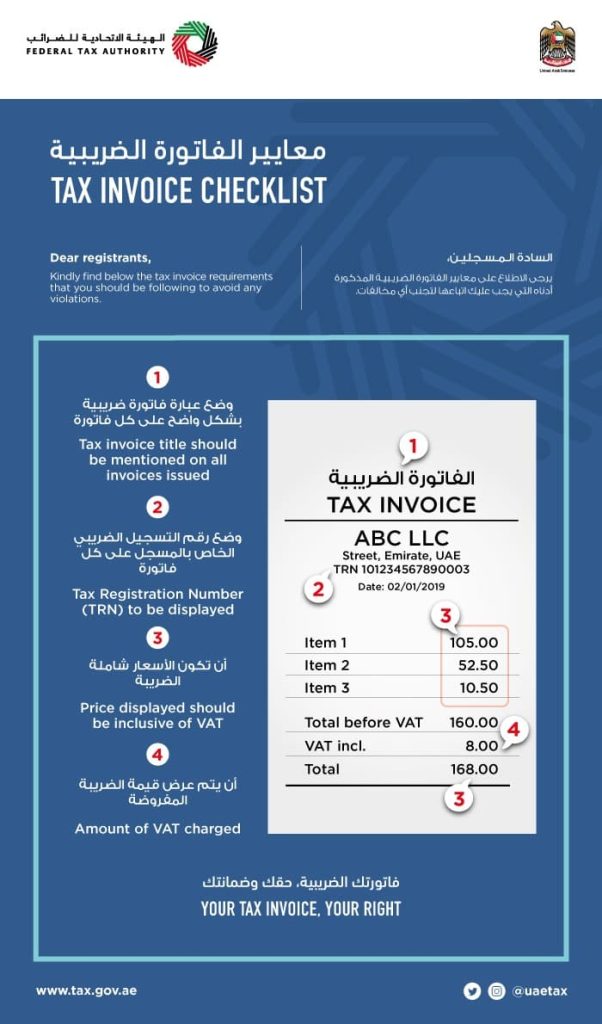
    VAT Invoice Format UAE
    Source: www.tax.gov.ae

    UAE FTA Tax Invoice Format

    Maintaining the correct VAT invoice format in the UAE is important for complying with the UAE VAT regulations. The Federal Tax Authority (FTA) has specific requirements for VAT invoices that businesses must follow. These requirements help ensure accurate reporting and payment of VAT.

    Why Proper VAT Invoice Format is Important

    • Compliance: Avoid penalties and fines from the FTA for non-compliance.
    • Accurate Record-Keeping: Helps businesses track VAT transactions and calculate VAT liabilities accurately.

    Types of Tax Invoices

    • Simplified Tax Invoice
    • Full Tax Invoice

    By following the FTA’s requirements, businesses can stay compliant and manage their VAT transactions effectively.

    Simplified Tax Invoice

    Line items will be displayed at the gross value in a streamlined tax invoice.

    The following information must be included in a simplified tax invoice format UAE:

    • The invoice plainly states that it is a “Tax Invoice”.
    • The supplier’s name, address, and Tax Registration Number (TRN).
    • The day the tax invoice was sent out.
    • A summary of the products or services offered.
    • The total consideration was received, and the taxes were paid.
       

    The whole consideration (or total gross value) is displayed at the bottom of the simplified tax invoice, and the tax included in that value is shown on a separate line.

    Full Tax Invoice

    Businesses are typically required to provide a complete tax invoice. The following information should be included in a comprehensive tax invoice format UAE:

    • A clear depiction of the text Tax Invoice.
    • The supplier’s name, address, and tax identification number.
    • The recipient’s name, address, and tax identification number.
    • Tax invoice number in order.
    • When the invoice was first issued.
    • Supply date.
    • A summary of the products or services.
    • Total amount due in AED.
    • Each line must contain net value and tax amount

    Tax Invoices Issued in Foreign Currencies

    When issuing a tax invoice in a foreign currency, the following details are required:

    1. Tax Amount: The tax amount payable must be expressed in AED.
    1. Exchange Rate: The exchange rate applied, as per the rates published by the UAE Central Bank on the date of supply, must be included.

    Tax Invoice Rounding

    When a tax invoice must be made, and the tax owed on the supply is expressed as a fraction of a Fils, the amount may be rounded mathematically to the closest Fils.

    As previously stated, the tax amount should be calculated line by line. In practice, any rounding should also be done line by line.

    Mathematical logic should be used to round the tax value on the tax invoice to the closest whole Fils or two decimal places. This is meant by “rounding the value on a mathematical basis.”

    For instance: 9.862 AED would change to 9.86, while 2.357 AED would become 2.36.

    VAT for Discounted Bills

    VAT will be applied to the value that is calculated after taking the discount into account. After the discount, VAT will be added to the pricing.

    Only if the following requirements, which are outlined in UAE VAT Executive regulations, are satisfied will the discount be permitted to be deducted from the value of supply:

    • The price drop has been advantageous to the buyer.
    • The discount was funded by the supplier.

    For example, if the supply value is 10,000 AED and the discount is 500 AED. In this instance, after considering the discount value, the value of the supply is determined to be AED 9,500. VAT will be applied to AED 9,500.

    Tax Invoice-Related Administrative Penalties format

    The UAE Tax Procedures Law makes it illegal to disregard tax invoice standards. According to the amended VAT penalties regime, firms that fail to produce a tax invoice when making any supply will receive an AED 2,500 fine for each case.

    Businesses that issue tax invoices electronically, if they do not follow the rules and regulations for the UAE’s issue of electronic tax invoices, will be subject to a fine of AED 2,500. Dubai’s VAT advisors can help companies avoid fines.

    FTA Approved Tax Agents in the UAE

    Businesses that fail to send tax invoices will be subject to severe fines, but VAT consultants in Dubai, like Shuraa Tax Consultants, can help you avoid the penalty. One of the top FTA-approved tax agents in the UAE, our knowledgeable staff can assist you with requirements such as UAE VAT registration, VAT deregistration, VAT compliance / VAT Return, excise tax services, and services linked to VAT reconsideration, Corporate Tax filing, etc. Get in touch today at +971508912062. You can also email us at info@shuraatax.com.
  • VAT on Free Zones in UAE – Dubai

    VAT on Free Zones in UAE – Dubai

    Value Added Tax (VAT) has become an important part of running a business in the UAE since it was introduced in January 2018. With a standard rate of 5%, VAT applies to many goods and services, meaning businesses need to be aware of the rules and how to comply with them. One of the unique features of the UAE is its free zones.

    Free Zone is a term for free trade zones that encourage foreign ownership of businesses. Businesses in Free Zones must follow the rules set by the Free Zone Authority to do business in this area. Under UAE law, certain Free zones are known as “designated zones.” According to Article 51 of the Executive Regulations, the following meet the description of marked zones:

    • A particular geographic region that is enclosed and secured.
    • Security measures and customs rules are in place to keep track of who comes and goes and what moves in and out of the area.
    • It has internal rules about how things should be kept, stored, and worked on in the area.
    • The person in charge of the Designated Zone must follow the rules set by the FZ Authority.

    Therefore, any Free zone that satisfies the requirements and is listed on the cabinet’s list will be considered a Designated zone. Some of the famous free zones include IFZA, JAFZA, DIFC, and RAKEZ.

    While free zones provide great opportunities, they also have specific VAT rules that businesses need to understand, especially regarding VAT for free zone companies in UAE. For example, knowing the difference between designated and non-designated zones, what qualifies for zero-rated supplies, and the steps for VAT compliance can all affect a company’s finances. That’s why it’s essential for businesses operating in Dubai’s free zones to get a clear grasp of VAT implications.

    Is there VAT for Freezone Companies in the UAE?

    Yes, VAT can apply to Free Zone companies in the UAE, but it depends on several factors. Some people think that only limited companies can sign up for VAT in the UAE. Any business that meets the minimum requirement for VAT registration in the UAE must go through the FTA’s VAT registration process. A free zone company in the UAE can register independently if it makes between AED 187,500 and AED 375,000.

    For free zone companies, understanding whether they reach this threshold is crucial, as it determines their VAT registration requirements. If they exceed the threshold, they must comply with all VAT obligations, including charging VAT on their taxable supplies and filing regular VAT returns. This is an important aspect of VAT registration for free zone companies in UAE.

    Distinction Between Designated Zones and Non-Designated Zones

    One of the key concepts in VAT for free zone companies is the distinction between designated zones and non-designated zones.

    Designated Zones

    Designated free zones in the UAE are specific free zones that have been designated by the Federal Tax Authority (FTA) as being outside the territorial scope of the UAE for VAT purposes. This means that goods and services supplied within these zones are generally exempt from VAT.

    However, there are some exceptions:

    • Supply of Services to Mainland Businesses: If a free zone company supplies services to a mainland business, VAT is applicable at a standard rate of 5%.
    • Supply of Goods or Services to Non-Business Consumers: If a free zone company supplies goods or services to non-business consumers within the zone, VAT may be applicable.

    Non-Designated Zones

    On the other hand, non-designated zones do not enjoy the same VAT benefits as designated zones. Businesses operating in these areas are subject to the standard VAT rates. Therefore, it’s important for companies to know which category their free zone falls into to understand their VAT obligations better.

    VAT Treatment in the UAE Free Zones

    The standard VAT rate in the UAE Free Zone is set at 5%. This rate applies to most goods and services that do not qualify for any exemptions or special treatment. However, there are also zero-rates supplies and tax-exempt supplies.

    Tax-Exempt VAT

    Tax-exempt supplies are goods and services that are not subject to VAT. This means that businesses do not charge VAT on these supplies, and they also cannot claim any input tax credits on related purchases. Examples of tax-exempt supplies include certain healthcare and educational services.

    Zero-Rated VAT

    Zero-rated VAT means that the VAT rate charged on a good or service is 0%. Businesses can still recover the VAT incurred on their purchases related to these supplies. This treatment often applies to exports and specific goods and services that meet certain criteria. In designated free zones in the UAE, goods that are moved outside the zone may also qualify for zero-rated VAT.

    Specific VAT Treatments for Goods and Services within Free Zones

    The VAT treatment of goods and services in free zones can vary, with several important considerations:

    Import and Export

    In designated zones, imported goods can be stored without VAT until they are moved outside the zone. This can significantly reduce the cash flow burden for businesses. Exports from these zones are typically zero-rated, allowing companies to sell goods to international customers without adding VAT.

    Services

    When it comes to services, VAT may apply depending on the nature of the service and where it is supplied. For instance, services provided within a designated zone may not incur VAT, while services supplied to customers outside the zone might be subject to VAT.

    VAT Refunds

    Free zone companies may also be eligible for VAT refunds on certain expenses incurred within the zone. This can provide a financial advantage and enhance cash flow management.

    How to Register for VAT in UAE Free Zone?

    While most free zones in the UAE are designated zones, exempting them from VAT, some may require VAT registration depending on their specific activities and the nature of their supplies. Here’s a general process on how to register for VAT in a UAE Free Zone:

    1. Determine VAT Registration Requirement

    Not all free zones are designated. Designated zones are generally exempt from VAT. However, if you supply goods or services to non-business consumers within the zone or to entities outside the zone, you may need to register.

    Companies in non-designated zones are subject to VAT and must register if they meet the standard VAT registration threshold i.e. AED 375,000 per year. However, businesses below this threshold can still register voluntarily if they choose.

    2. Prepare Required Documents

    Gather the necessary documents before beginning the registration process. Commonly required documents include:

    • Trade license of the free zone company
    • Copy of the owner’s passport or identification
    • Proof of business address in the free zone
    • Bank account details
    • Financial statements (if applicable)
    • Information about taxable supplies and imports

    3. Access the Federal Tax Authority (FTA) Website

    Visit the official website of the Federal Tax Authority (FTA) of the UAE. This is the government body responsible for managing tax matters, including VAT registration.

    4. Create an Account on the FTA Portal

    If you do not already have an account, you will need to create one on the FTA portal. Click on the registration section and follow the instructions to set up your account. You’ll need to provide your email address and set a password for your account.

    5. Complete the VAT Registration Application

    Once logged in, navigate to the VAT registration section and fill out the application form. You’ll need to provide details about your business, including:

    • Business activities
    • Estimated annual turnover
    • Details about your free zone

    Ensure all information is accurate and complete, as any discrepancies can delay the registration process.

    6. Submit the Application

    After filling out the application form, review all the information and submit it through the FTA portal.

    7. Review and Approval

    The FTA will review your application. If they require any additional information or documentation, they will contact you. Upon approval, you will receive a Tax Registration Number (TRN).

    What happens if a company does not register for VAT?

    If a company that works in and out of a free zone in the UAE doesn’t register for VAT in time though required as per law, the FTA will register the business from the date it should have been registered for VAT.

    So, Businesses failing to comply with VAT registration rules will receive fines and must retroactively apply the correct VAT rate to all past sales. If your yearly sales hit the threshold, you can hire a licenced tax agent in the UAE to help you. This is very important if you don’t know when your business needs to be registered or if it has already reached the required size.

    VAT Registration in Freezone with Shuraa Tax

    Understanding VAT for free zone companies in UAE is essential for businesses operating in these areas. Whether you’re in a designated or non-designated zone, knowing the VAT rules helps you stay compliant, avoid fines, and make informed financial choices. Since VAT regulations can be tricky, it’s smart to get professional guidance to ensure your business follows all the rules.

    Shuraa Business Setup not only help business owners set up their companies in mainland, free zone, and overseas areas, but we also help you get our in-house finance teams ready for accounts reporting, auditing, UAE tax support like VAT, Corporate tax, Excise Tax, Tax Residency Certification.

    Our qualified tax team of advisors and UAE tax agents assist businesses to be UAE tax compliant and to have effective documentation which is required by UAE authority. Contact us today at +971508912062 or info@shuraatax.com to make the process simple and hassle-free.

    Frequently Asked Questions

    1. What is VAT for freezone companies in UAE?

    VAT for freezone companies in the UAE is the value-added tax that businesses operating in free zones must comply with, depending on whether they are in a designated or non-designated zone. The standard VAT rate in the UAE is 5%, but designated zones enjoy special VAT treatment, such as exemptions or zero-rated supplies for certain transactions.

    2. What are Designated Free Zones in UAE?

    Designated free zones are specific free zones that have been designated by the Federal Tax Authority (FTA) as being outside the territorial scope of the UAE for VAT purposes. This means that goods and services supplied within these zones are generally exempt from VAT.

    3. Do freezone companies need to register for VAT in the UAE?

    Yes, freezone companies must register for VAT if their taxable supplies and imports exceed AED 375,000 per year. Even if they don’t meet this threshold, companies can voluntarily register for VAT to benefit from input tax recovery on their purchases.

    4. How does VAT impact goods moving in and out of free zones?

    In designated free zones in UAE, goods moving in and out of these areas can be VAT-free, particularly when they are exported outside the UAE. However, if goods are transferred into the UAE mainland from a designated zone, VAT will be charged at the standard rate.

  • Treatment of VAT in Free zones of UAE

    Treatment of VAT in Free zones of UAE

    The VAT in UAE was introduced from 1 January 2019 and applies to those supplies of goods and services which take place within the territorial boundaries of the UAE. As in the case of goods and services supplied within free zones in the UAE, the rules of VAT are applicable to undergo a certain change.

    Free zones are defined as those areas which are specifically designed to promote international businesses in the UAE by providing attractive incentives to foreign investors and businesses. In the UAE, there are currently more than 37 Free Zones such as:

    • Jebel Ali Free Zone
    • Dubai Airport Free Zone
    • Dubai Cars and Automotive Zone and many more

    As per UAE VAT law and Executive Regulations, not all Free zones are ‘VAT Free Zones’ and only those listed in a Cabinet Decision are eligible for the special VAT treatment. These Free Zones are referred to as Designated Zones for VAT purposes, according to Cabinet Decision No. 59 of 2017.

    Few supplies occurring within the Designated Zones will not invite the standard rate of VAT i.e. 5% under circumstances mentioned in VAT regulations. This is only in the case of a supply of goods. However, suppliers of services in the designated zone will be subjected to the usual VAT rate at 5%. It’s important to understand the conditions which businesses need to follow for the VAT-free supply of goods between the Designated Zones as prescribed by UAE VAT Executive Regulations.

    Following are the conditions which are mandatory to consider any UAE free zone as a Designated Zone to

    1. It should be enclosed within a specific fenced geographical area.
    2. It should have security measures and customs controls in place for monitoring the entry and exit of individuals and goods to and from the area.
    3. There should be laid out internal procedures related to the method of keeping, storing and processing goods within the Designated Zone.
    4. The operator of the Designated Zone should show support or comply with the procedures laid down by the Federal Tax Authority (FTA) of UAE.

    If any free zone no longer fulfills the above conditions, it cannot be then treated as a designated zone. It will be considered and treated as a part of the UAE And general VAT rules will be applicable to such free zones.

    Below are few examples of Free zones which are designated zones:

    • Jebel Ali Free Zone (North-South)
    • Dubai Cars and Automotive Zone (DUCAMZ)
    • Free Zone Area in Al Quoz
    • Umm Al Quwain Free Trade Zone in Ahmed Bin Rashid Port
    • FOIZ (Fujairah Oil Industry Zone)
    • Khalifa Industrial Zone

    As per the registration for VAT is considered, these businesses within the Designated Zone have to register, report and account for VAT as per the UAE laws. In case of failing to register for VAT within the due date, a penalty of AED 20,000/- will be levied as per the UAE Federal Cabinet Decision No.40.

    Consult Shuraa Tax Consultants and Accountants to get assured and accurate help on the VAT laws related to the Free Zones in the UAE. We are a group of FTA approved tax agents in Dubai with a goal to provide accurate services of VAT in UAE (VAT registration and implementation, Tax compliance & VAT Return Filing). Contact us to get complete assistance and guidance on the VAT registration in UAE. All you need to do is reach out to us at info@shuraatax.com or call us at +971 508912062.