Blog

  • What are the benefits of a UAE Tax Agent?

    What are the benefits of a UAE Tax Agent?

    Tax Agent is “An agent registered with the Authority, who is appointed by a person to act in his name and on his behalf regarding his tax affairs to represent him before the Authority and assist him in fulfillment of the tax obligations.

    The definition and provision related to Tax Agent are clearly defined in Article 12, 13,14,15,16, Chapter 2 of Federal Law Number 7 of 2017 on Tax Procedures.

    Tax Agents basically help taxable people to meet the requirements that are set by the government for the tax system. The responsibility of a tax agent is to enable the Company to fulfill the tax compliance effectively.

    Benefits of a UAE tax agent are listed below:

    • A UAE Tax Agent offers freedom from legal representation, as a Tax Agent will always act and represent the Company legally and be in accordance with the Federal Tax Authority (FTA).
    • UAE Tax Agents ensure that the taxable persons are complying their obligations as tax-registered businesses.
    • Tax agents represent the taxable Companies by registering the Companies with the FTA. Tax Agent helps in submitting tax returns in a timely manner.
    • UAE Tax Agents can be contacted by the taxable entities for tax advice. Tax Agent does not only help through the procedural matters but also guides the Companies to avoid any unforeseen events or fines.
    • Tax Agent can also represent foreign companies that do not have their establishment/offices in the UAE. On behalf of the foreign Company, the Tax Agent collects the tax amount from their customers and makes the payments to the Federal Tax Authority (FTA).
    • Having a Tax Agent in UAE is also beneficial as they are aware of the latest amendments in the commercial and tax laws. They caution the companies beforehand as well as help to maintain the integrity of the country’s tax system.
    • As per Article 16, Chapter 2 of Federal Law Number 7 of 2017 on Tax Procedures, FTA may request for any tax-related information, documents or records related to tax affairs of the Company represented by him. A Tax Agent can assist the taxable entities in case of an inspection by the Authority and provide relevant legal and accounting details to the FTA inspector.
    • Having a Tax Agent also eases the communication, follow up with the Federal Tax Authority (FTA) and offers quick solutions.

    Need to know more about a tax agent in Dubai or to connect with a tax agent, contact Shuraa Tax Consultants. Call us on +971508912062. You can also email us your query on info@shuraatax.com or log on to www.shuraatax.com for more information.

  • Why do you need an FTA tax agent in UAE?

    Why do you need an FTA tax agent in UAE?

    Before understanding the need for an FTA tax agent in UAE, it is crucial to know who an FTA tax agent is. As per the Federal Law Number 7 of 2017 on Tax Procedures, a Federal Tax Authority Tax Agent also commonly known as an FTA Agent is an individual appointed for a Company to act in his name and on his behalf for his tax affairs.

    However, not everyone can become a tax agent in UAE. Individuals need to fulfil the mandatory requirements imposed by the Federal Tax Authority to become an FTA tax agent. The FTA has specified conditions and qualifications, in addition to passing the Authority’s tests to become a tax agent in Dubai UAE.

    So, why exactly would Companies require an FTA tax agent in Dubai?

    An FTA tax agent’s key role is to successfully implement UAE tax systems for your company. Nevertheless, there are a lot of contributions an FTA agent makes towards the taxation functioning of a company.

    Some of them are listed below:

    • FTA Tax agents strengthen ties between the Federal Tax Authority and the taxable persons.
    • FTA tax agent in UAE provides advanced knowledge and extensive practical experience which ultimately benefits the company.
    • A tax agent represents any entity or individual before the Authority, helping them meet their tax commitments and know their rights.
    • Tax agents help businesses be tax compliant, manage records, meet standards accurately, avoiding errors in registration.
    • FTA tax agents in Dubai are basically strategic partners for the companies. With businesses to fulfill their tax obligations toward the Authority, tax agents provide services such as filing returns, internal tax audit and prepare needed accounting procedures for tax compliance.
    • Tax agents are required to be fluent in Arabic and English. Because of which, companies can be locally efficient in terms of Arabic and translate documents effectively.
    • FTA agents can also submit requests for reconsideration of decisions issued by the FTA.
    • Tax agents can be helpful to represent foreign & offshore companies before FTA.

    If you are looking out for a competent tax agent in Dubai, then SHURAA’s Tax Agents can help you! Shuraa Tax Consultants offer FTA certified tax agents to manage all your requirements related to tax services, tax consultation and VAT registration in the UAE.

    To know more about our tax agent or for existing offers on tax and accounting services request a call back on +971508912062.

  • Will companies in the UAE have to reissue tax invoices?

    Will companies in the UAE have to reissue tax invoices?

    The Federal Tax Authority (FTA) recently clarified the exchange rates to be used for tax invoices which are raised in AED as well as in other foreign currencies. This was announced through VAT Public Clarification VATP004.

    According to the FTA, companies issuing tax invoices in foreign currencies will make use of the exchange rates applicable as per the date of supply. The circular also stated that only the exchange rates mentioned and documented by the UAE Central Bank are to be used in the tax invoices.

    The clarification was circulated to UAE companies in May 2018. Several companies were uncertain if they had to reissue the old invoices (i.e. an invoice dated from January 2018 until the date of clarification 17 May 2018). However, to everyone’s relief, the FTA also quoted that, “There is no requirement for businesses to reissue historical tax invoices from periods prior to 17 May 2018 to show the Central Bank exchange rate, provided the exchange rate used is from a reliable source and the same source has been used consistently.”

    Nevertheless, the FTA also noted that in case a tax invoice was issued after the 17 May 2018 and the date of supply was before 17 May 2018, companies need to make use of the older exchange rates published under the UAE Central Bank which were published in January 2018.  According to the circular, business entities need to make use of exchange rates provided by the Central Bank of the UAE. The circular also said that in terms of failure to account for the due tax on imports as per the FTA tax compliances there could be penalties.

    If you as a company are still not sure how to get your tax invoices tax compliant, book a VAT consultation with Shuraa Tax Consultants in Dubai. For more information call a Shuraa tax consultant in Dubai. Simply call on +971508912062. You may also drop in an email on info@shuraa.com or read more about Shuraa Tax Consultants on www.shuraatax.com.

  • FTA creates three categories to classify eligible good

    FTA creates three categories to classify eligible good

    In a press release published by the Federal Tax Authority (FTA) recently, they determined the three main categories of ‘eligible goods’. The eligible goods were classified for calculating the VAT – Value Added Tax in the UAE. VAT on the eligible goods will be calculated based on the profit margin scheme.

    The classification of edible goods are stated below –

    • Second-Hand Goods – Such as tangible moveable property, suitable for future use or upon repair.
    • Antiques – Goods that are older than 50 years.
    • Collectors’ Items – Such as stamps, coins, currency, scientific pieces, historical or archaeological artifacts, etc.

    FTA in the press release also noted that only the goods which had been subject to VAT before the supply may be subject to the profit margin scheme. The FTA also defined the profit margin scheme, they said that it will be considered as the difference between the buying and selling price of the item which includes taxes.

    The initial announcement about the eligible goods under the profit margin scheme was made in a “Public Clarification” as per the Federal Decree-Law No. (8) on Value Added Tax.

    Reportedly, the FTA informed the registered businesses to carefully verify eligible goods for the profit margin scheme. As a result, stock on hand of used goods that were attained prior to the effective date of Federal Decree-Law No. (8) on the VAT, or goods that have not previously been subject to VAT for other reasons, are not eligible to be sold under the profit margin scheme. VAT is, therefore, due to the full selling price of these goods, the release stated.

    The press release further explained that registered businesses may apply the scheme to eligible goods in situations such as:

    • If the goods were purchased from either a person who is not registered for VAT or a Taxable Person who calculated VAT on the supply by reference to the profit margin,
    • If the taxable person made a supply of goods where input tax was not recovered in accordance with Article 53 of Cabinet Decision No. (52) of 2017.

    The press release also said that a taxable person will not be allowed to apply the profit margin scheme in cases where they had issued a tax invoice or any other document mentioning an amount of VAT chargeable. They further mentioned that Taxable Persons must keep inventory and similar documents that clarify the situation of every item bought or sold. Also, purchase invoices with complete details of items bought under the profit margin scheme must be specified.

    If you are still not clear on the profit margin scheme or would want to know how to impose VAT in UAE simply contact Shuraa Tax Consultants for more details. You may call us on +971508912062.

    You may also drop in an email will your queries on info@shuraatax.com or chat for free will a live tax consultant on www.shuraatax.com.

  • Is commercial real estate subject to VAT in Dubai?

    Is commercial real estate subject to VAT in Dubai?

    Yes, all commercial properties are subject to VAT in Dubai as well as all over the UAE. The Federal Tax Authority (FTA) and the Dubai Land Department (DLD) are in agreement to charge 5% VAT on commercial properties and related real estate services.

    As per the authorities, any sale or purchase of a vacant commercial property or the off-plan sale of commercial properties – which could be under the building license is subject to 5% VAT.

    Nevertheless, the value-added-tax paid during the lease period can be recovered by the tenant, if they are taxable and are registered as well as entitled to a tax refund. Value-added-tax paid towards the purchase of an entire building may be refunded depending on the capital asset scheme. For example, if the cost of the property exceeds Dh5 million.

    Also, real estate services related to such commercial properties are also subjected to VAT in Dubai, UAE. VAT is also applied to management fees, brokerage and other real estate consultancy charges are subject to 5 % VAT. These charges are levied and taxed on the value of the service provided at the given location of the property and according to the normal taxation standards.

    Is VAT applicable on residential properties as well?

    No, VAT in Dubai as well as in any other Emirates is not applicable on residential buildings and residential properties such as villas, accommodation for armed forces, elderly homes, nursing homes, etc. Residential buildings are not taxable if sold or rented, but this law is not applied to buildings not fixed on lands, buildings offering services in addition to housing, hotels and hotel apartments, etc. Also, real estate transactions related to residential buildings are zero-rate.

    Residential properties constructed recently by developers or business entities are eligible for a tax refund if the supply is made within three years after the completion certificate.

    However, residential property leased out on a short-term basis to non-residents falls under the commercial category. If a lease is less than six months and the person living there doesn’t have an Emirates ID, it would be deemed commercial from a VAT perspective.

    So, is there VAT applicable if you buy a commercial building and convert it into a residential building?

    If you purchase or even rent a commercial property and convert it into a residential building, you are entitled to get a refund on the tax paid within a period of three years from the date of transfer.

    However, for mixed-use buildings – the residential area will be zero rate or exemption from tax; whereas the commercial area will be subjected to VAT in Dubai, UAE. The area will be converted into a percentage of VAT allotment.

    Will a real estate or property owner require tax registration in Dubai, UAE?

    No, property owners of the residential real estate do not have to register for VAT in Dubai or elsewhere in the UAE, if they do not have any other business. In case, if residential property owners have other commercial businesses, then they should consider registering VAT in Dubai, UAE.

    On the other hand, the owners of commercial properties must register for VAT in Dubai or any other Emirates if they exceed the threshold of supplies for the commercial property. If the value of supplies exceeds the threshold of 375,000 AED in a year – then VAT registration becomes mandatory.

    Is VAT also applicable on rented properties?

    VAT is not applicable on residential rented properties, however, rented commercial properties are subjected to 5% VAT in Dubai as well as across the UAE.

    Still, have doubts with regards to VAT on a property and real estate in the UAE? Contact SHURAA TAX CONSULTANTS for any further queries or book yourself a free appointment with one of our tax consultants in Dubai. To know more call, us at +971508912062 or email us at info@shuraatax.com

  • Accounting and Bookkeeping Services Cost in Dubai

    Accounting and Bookkeeping Services Cost in Dubai

    One thing all well-established firms have in common is up-to-date accounting and bookkeeping. Successful organisations can only function effectively when a dedicated crew keeps daily records that can be accessed at any time. And that is the mark of a stable and trustworthy business. Accounting and bookkeeping services in Dubai are not the same thing. They are the foundation of accounting because they keep a clear record of the day-to-day transactions that allow businesses to run smoothly.

    Accounting and bookkeeping services for business entities: method and need

    The double-entry method is the most often used accounting and bookkeeping system, in which each transaction is recorded simultaneously in the two related accounts. To keep the firm’s financial balance, the entire debt must match the total assets.

    As previously stated, Accounting & Bookkeeping relates to the keeping of everyday business records.

    Small business accounting and bookkeeping services

    Initiating a start-up or starting a business entails tasks at several levels that must be recorded for various divisions involved in distinct operations to run smoothly. Accounting and bookkeeping services are critical to any organisation, regardless of size. Keeping this in mind, the computer industry has created customised software for small businesses to help with bookkeeping. For example, Zoho, Tally, Quick books, Zero. However, employing this technology to keep records necessitates the use of specialised staff who are trained to handle the records using the software to avoid confusion and to assist you in maintaining uninterrupted business processes.

    Dubai accounting and bookkeeping services

    So, Dubai is a global financial centre. However, the ruler’s aim of becoming the world’s largest commercial magnet drives the emirate. As businesses evolve, there will be a greater demand for accounting and bookkeeping services in Dubai, paving the path for additional growth for Accounting and Bookkeeping Mentors. All corporate entities in the UAE are required by law to follow the accounting standards and regulations established by the International Financial Reporting Standards (IFRS).

    Cost of accounting services in Dubai

    Accounting work type:

    Whether you need to file your VAT returns in the UAE, maintain your company’s bookkeeping, seek tax or VAT advice, or register for VAT in the UAE, the nature of activity will determine the cost. The cost of accounting services in the UAE varies according to the type of accounting services provided. If you need to engage a full-time bookkeeper, you will have to pay more money and he may have limited experience, but an outsourced accounting firm will work on all types of accounting tasks and will be much less expensive. 

    Size and intricacy of the organisation

    Size and intricacy of your organisation will also influence the cost of accounting services in Dubai. However, You could be a freelancer or a lone proprietor with only one bookkeeper, or you could be a larger corporation with an administrative assistant and a CPA to handle your taxation. A complex industry with extensive accounting standards may necessitate the use of specialised talents, resulting in a higher fee. 

    Number of transactions / turnovers of the company:

    Another key aspect in determining the cost of bookkeeping and accounting services in the UAE is the company’s turnover. So, UAE taxes are levied based on the commodity, jurisdiction, or yearly sales of the company. They do, however, assist in considering the accounting service charges that will be assessed. 

    Industry / business activity:

    Accounting and bookkeeping service costs in the UAE may vary from one business to the next. You may be in the trade sector or require bookkeeping services for a restaurant, real estate bookkeeping, small business bookkeeping, or another industry – the cost will vary. 

    Why should you outsource your accounting and bookkeeping to Shuraa?

    Maintaining a book of accounts can be difficult, especially for foreign businesses. In such a case, having a staff specialised in Accounting and Bookkeeping would be excellent; Shuraa encourages very high standards of Accounting and Bookkeeping practises, allowing you to be carefree and more focused on your key company agendas. 

    We are qualified to provide customised modules based on the structure of your organisation. We provide financial assistance to your company to establish a solid foundation for future growth and expansion into other parts of the world. 

    Affordable accounting and bookkeeping services in Dubai

    If you hire an in-house bookkeeper, you must pay a monthly salary, allowances, corporate facilities, & benefits. Outsourcing accounting and bookkeeping services in Dubai will cost you an average of AED 10,000 to AED 20,000 annually.

    Contact Shuraa Tax Consultants to learn more about the primary benefits of outsourcing bookkeeping services in Dubai. To receive a customised quote for your UAE accounting services. Call +971508912062 or contact info@shuraatax.com to schedule a free consultation with SHURAA Tax Consultants for accounting and bookkeeping services in Dubai, UAE.

  • Why do you need accounting and bookkeeping services in Dubai?

    Why do you need accounting and bookkeeping services in Dubai?

    Accounting and bookkeeping services in Dubai are the need of the hour! The implementation of VAT in the UAE has not only affected the tax calculation but also changed the way UAE companies operate and do business. Be it accounting services for small business in Dubai, or bookkeeping services for a multinational company – outsourced accounting services UAE can provide the best for you company!

    But if you are still thinking whether you need to outsource accounting and bookkeeping services in Dubai, here are some reasons that will help you decide.

    File UAE VAT returns

    Companies registered by the FTA for VAT in Dubai or anywhere across UAE need to file tax / VAT returns every interval. These intervals may be maintained on monthly or quarterly basis depending on the nature of the business.

    Follow FTA compliances

    Taxable entities must adhere the FTA compliances while doing business in the UAE. Businesses that appoint UAE bookkeeping and accounting firms or even tax consultants are for sure updated to incorporate the new VAT laws. Bookkeeping and accounting firms ensure that FTA compliances are updated in your operations, sales, accounting methods, business procedures and expense management systems.

    Reduced Costs & Limit Errors

    Accounting and bookkeeping services in Dubai – UAE can seem like an additional cost. However, outsourcing accounting services can help you reduce costs & limit errors. Accounting in UAE is a tedious task! If you do a mistake you will have to face the penalty, but a professional accountant will know how to lessen costs without any blunders. Professional accountants can limit human error, have complete knowledge about payments and tax obligation, due dates, etc.

    Focus on your core business

    Taxation in the UAE requires fulltime attention and monitoring. Outsourcing accounting and bookkeeping services in Dubai – UAE will enable you to focus on your core business. While you strategize, market, fund, sale and focus on your daily operational, an accounting and bookkeeping firm can handle the taxation aspects of your business.

    Thus, to ensure that your company has implied the FTA compliances in all realms and properly maintained the accounts contact Shuraa Tax Consultants.

    Shuraa Tax Consultants are the best in accounting and bookkeeping services in Dubai and across UAE. We are a Dubai accounting company offering bookkeeping services in UAE to help you manage your finances, assist you with VAT registration, raise VAT compliant invoices, create business reports, generate VAT returns and other bookkeeping services.

    For further details of accounting and bookkeeping services in Dubai book a free consultation with our expert tax consultants in Dubai or simply call on +971508912062. You can also email us your query at info@shuraatax.com and we will call you back to solve all your doubts.

  • Your questions related to VAT filing answered

    Your questions related to VAT filing answered

    How to file VAT returns in the UAE?

    Companies that are registered with the FTA, need to file their return using the Federal Tax Authority portal and their online services. VAT e-filing will be active on the portal of Federal Tax Authority www.tax.gov.ae. But, the best and easiest to do this is through appointing a tax consultant or taking guidance from tax advisories.

    When to file VAT returns to avoid penalties?

    The interval to file a tax return is likely to be 3 months for most of the companies, that can be calculated as 4 times a year. Nevertheless, there are also some companies that need to file VAT in the UAE on monthly basis.

    What are the penalties for not filing VAT return in the UAE?

    The procedures to file a VAT return in the UAE is quite simple and can be done with the help of a Tax Advisory firm. After the VAT implementation has been done by a company. Regular bookkeeping procedures and tax filing routine must be followed to avoid any penalties.

    Any delay is filing the tax return can attract penalties such as 1,000 AED for the first time and 2,000 AED in case of repetition within 24 months.

    Why is it crucial to file VAT returns?

    Filing VAT return in the UAE is a recognized process to report the financial proceeding of a company. VAT is paid every interval and must be accurate to the substantial records, ledgers, and the financial statements of the company. The main purpose of filing a return is to show the summary of the value added tax to the authorities. It stands as evidence that VAT obligations are thoroughly followed by the company.

    Get in touch with Shuraa Tax Consultants to file your first tax return.

    Shuraa Tax Consultants can help you with Tax Consultation, Tax Registration, VAT filing and everything related to VAT in the UAE. To know more about the VAT / Tax in the UAE or to get a free consultation email us at info@shuraatax.com and we will call you back to answer your questions.

  • Do you need a VAT Certificate to do business in Dubai?

    Do you need a VAT Certificate to do business in Dubai?

    Businesses and companies in Dubai as well as across the UAE have been introduced to value-added-tax for some time now. Coping with the changes, commercial entities have adopted various ways to tackle taxation within the organization. One such change that businesses have instigated is to verify the VAT certificate of their suppliers and dealers.

    But is VAT certificate a mandatory?

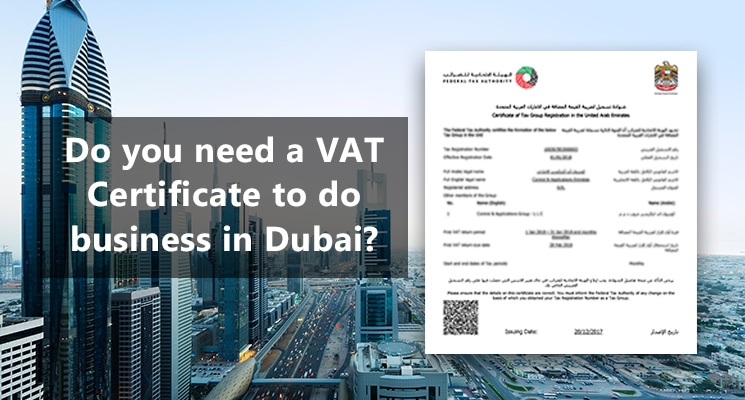
    To substantiate your business and commercial activities you would need to apply for a VAT certificate. However, to do business in the UAE, you do not need to get the VAT certificate from your suppliers and dealers.

    Businesses can just get the TRN Number / Tax Registration Number to verify their suppliers and dealers. The UAE VAT Registration Number or TRN number can be crosschecked on the official website of Federal Tax Authority (FTA). Thus, there is no need of directly checking the VAT certificate and the TRN number is sufficient.

    The Federal Tax Authority has also offered provisional Tax Registration Number of companies who submitted their UAE VAT registration applications after the deadline. The FTA did this to allow such companies to conduct business and comply with their tax obligations. Nevertheless, companies need to complete their UAE VAT Registration procedures and submit the FTA all required documents.

    The FTA also supports the UAE businesses to fulfill with tax regulations and to certify that their operations are not disordered. The provisional UAE Tax Registration Number enables commercial transactions and validates the legal status of the taxable entities. However, obtaining a validated UAE VAT certificate is only possible after completing the procedures.

    Therefore, whether you need to get your final UAE Tax Registration Number; get your VAT Certificate or manage VAT in the UAE – Shuraa Tax Consultants can help you with your every tax-related needs in UAE.

    To know more about the taxation system or to get a free consultation, contact  Shuraa Tax Consultant today! You can email us at info@shuraatax.com or follow us this section for VAT-related updates.

  • How to File VAT Returns in UAE?

    How to File VAT Returns in UAE?

    VAT return filing in Dubai or UAE is an essential obligation for businesses operating in the United Arab Emirates (UAE). As a progressive and modern country, the UAE has implemented a tax system that aligns with international standards. Therefore, the UAE introduced its tax system to diversify its revenue streams and support its economic growth.

    If your business is registered for VAT with the Federal Tax Authority (FTA), you need to file VAT returns regularly. This means reporting the VAT you’ve collected from your sales and the VAT you’ve paid on your purchases. Knowing how to file VAT in the UAE correctly is essential for staying compliant with the tax regulations.

    Currently, the authorities have set the VAT registration threshold at AED 375,000 per annum. Failure to file tax returns or comply with the country’s tax laws may result in penalties and fines. That’s why understanding the VAT filing process is crucial for businesses in the UAE.

    What is a VAT Return in the UAE?

    A VAT return in the UAE is a report that businesses submit to the government to show the amount of Value Added Tax (VAT) collected from customers and the amount of VAT paid to suppliers during a specific period.

    Think of it like this:

    • When a business sells something, it adds VAT and collects that money from customers — this is called output VAT.
    • When the same business buys goods or services for its operations, it also pays VAT — this is called input VAT.

    At the end of every tax period (usually every 3 months or sometimes every month), businesses must send a VAT return to the Federal Tax Authority (FTA) using the EMARATAX online system.

    The VAT return helps the FTA know:

    • How much VAT the business collected (from sales)
    • How much VAT the business paid (on purchases)
    • Whether the business needs to pay the difference or can get a refund

    The official form used for this in the UAE is called VAT 201. It includes:

    1. VAT on Sales – Total VAT collected from customers
    2. VAT on Purchases – Total VAT paid to suppliers
    3. Net VAT – The difference between what was collected and what was paid

    Example:

    If a company collects AED 10,000 in VAT from customers but pays AED 7,000 in VAT on purchases, it needs to pay AED 3,000 to the FTA.

    If it paid more VAT than it collected, it might get a refund or use the extra amount in the next return.

    Filing VAT returns on time is essential — it’s not just a legal requirement, but also helps businesses stay transparent and avoid fines.

    Who Needs to File VAT Returns in the UAE?

    Any business or individual registered for VAT in the UAE is required to file VAT returns. This includes:

    • Businesses with an annual turnover exceeding the mandatory VAT registration threshold of AED 375,000.
    • Voluntarily registered businesses with a turnover above AED 187,500.

    Frequency of Filing VAT Returns

    • Quarterly: Most businesses file VAT returns every quarter, covering three months of transactions.
    • Monthly: Larger businesses with a high turnover may need to file VAT returns monthly.

    Important VAT Return Filing Dates in the UAE

    If your business is registered for VAT in the UAE, you need to file VAT returns on time to avoid penalties. The Federal Tax Authority (FTA) gives each business a tax period – this is either every month or every three months (quarterly), depending on your business’s annual earnings.

    Quarterly VAT Filing (Turnover below AED 150 million)

    If your business makes less than AED 150 million per year, you’ll likely file VAT returns every quarter. Here’s when your returns are due:

    • Q1 (Jan – Mar): File by 28th April 2026
    • Q2 (Apr – Jun): File by 28th July 2026
    • Q3 (Jul – Sep): File by 28th October 2026
    • Q4 (Oct – Dec): File by 28th January 2027

    Monthly VAT Filing (Turnover above AED 150 million)

    If your business earns more than AED 150 million per year, you need to file VAT every month. The deadline is the 28th of the following month.

    For example:

    • The return for May 2024 must be filed by 28th June 2024.

    Important Note:

    The FTA may assign a different tax period to some businesses depending on their situation. So it’s always a good idea to double-check your business’s assigned tax period in your FTA account.

    What You Need to File the VAT 201 Return Form in the UAE

    If your business is registered for VAT, you must submit your VAT 201 return online through the FTA portal. The process is manual – you’ll need to enter all figures related to your business’s purchases, sales, and VAT amounts.

    The VAT 201 form is divided into seven key sections. Here’s a breakdown of what each section includes:

    1. Taxpayer Details

    Basic information like your TRN (Tax Registration Number), business name, and contact info.

    2. VAT Return Period

    This includes the start and end dates of the tax period you’re filing for (monthly or quarterly), plus the filing due date.

    3. VAT on Sales and Other Outputs

    Here, you report:

    • VAT is collected on your sales and services
    • Details of standard-rated, zero-rated, and exempt supplies
    • Sales within the UAE and exports

    4. VAT on Expenses and Other Inputs

    This section is for:

    • VAT you’ve paid on business purchases
    • Recoverable input VAT (e.g., on rent, supplies, etc.)

    5. Net VAT Due

    This is the calculation part:

    • If Output VAT > Input VAT, you need to pay the difference
    • If Input VAT > Output VAT, you may be eligible for a refund or carry it forward.

    6. Additional Reporting Requirements

    You’ll provide extra details if needed — for example, reverse charge transactions, import VAT, or any adjustments.

    7. Declaration and Authorised Signatory

    The final section is where you confirm all information is correct and provide the name and details of the person submitting the form.

    Note: Keep all invoices, receipts, and supporting documents ready while filling out the form. It helps ensure accuracy and avoids issues during audits.

    Pre-requisites for Filing VAT Returns in the UAE

    Before you can file your VAT returns in the UAE, there are a few essential steps to ensure you’re ready. Here’s what you need:

    1. VAT Registration with the Federal Tax Authority (FTA)

    To file VAT returns, your business must first be registered for VAT with the FTA. This involves obtaining a Tax Registration Number (TRN), which serves as your business’s unique VAT identification. Without this, you cannot file VAT returns or fulfil your tax obligations.

    2. Accurate Record-Keeping

    Maintaining accurate and up-to-date records of your business transactions is essential. These include:

    • Sales Records: Details of taxable and exempt sales.
    • Purchase Records: Invoices for expenses that include input VAT.
    • Expense Records: Any additional costs related to your business operations.

    These records are the foundation for calculating VAT owed or refundable and must be retained for at least five years for audit purposes.

    3. Access to the FTA e-Services Portal

    The FTA e-Services portal is the official platform for submitting VAT returns in the UAE. To use it, you’ll need:

    How To File VAT Return in UAE?

    VAT return filing in Dubai or UAE is a straightforward process when you follow these steps:

    Step 1: Log in to the FTA e-Services Portal

    Visit the official FTA e-Services portal. Enter your Tax Registration Number (TRN) and password to access your account.

    Step 2: Navigate to the VAT Returns Section

    Once logged in, go to the “VAT Returns” section on the dashboard. Select the VAT return form (VAT 201) for the relevant tax period.

    Step 3: Fill in the VAT Return Form

    The VAT return form is divided into sections where you need to provide the following information:

    Taxable Sales and Output Tax:

    • Enter the total value of your taxable supplies (sales) and the VAT collected from customers.
    • Provide details for standard-rated supplies within the UAE and exports.

    Purchases and Input Tax:

    • Enter the total value of your taxable purchases and the VAT paid on them.
    • Ensure this includes expenses eligible for VAT recovery.

    Net VAT Amount:

    The system will calculate the difference between output tax and input tax to determine the VAT payable or refundable.

    Step 4: Review the Form

    Double-check all the details for accuracy. Ensure there are no discrepancies between your records and the information entered.

    Step 5: Submit the VAT Return

    Click on “Submit” to file your VAT return. Once submitted, you will receive a confirmation message from the FTA.

    Step 6: Make the Payment (If Applicable)

    If your VAT return shows a payable amount, proceed to make the payment through the FTA portal. Payment can be made via:

    • E-Dirham or credit card.
    • Bank transfer using the provided GIBAN (Generated International Bank Account Number).

    Step 7: Retain a Copy for Records

    Save a copy of the filed VAT return and payment receipt for your records. These may be required during audits or for future reference.

    File your VAT return before the deadline to avoid penalties. If you notice errors after submission, you can correct them by filing a Voluntary Disclosure through the FTA portal.

    VAT Returns in UAE Contents

    The following two sections are in a VAT return in the UAE: –

    The first section is the central section, which includes the taxpayer’s details, sales, purchases, and net VAT due. Moreover, the central section is mandatory for all VAT-registered businesses in the UAE.

    The second section is the additional reporting requirements section, which only applies to certain businesses under specific conditions. Furthermore, this section includes fields related to the profit margin scheme.

    Main

    When you file VAT returns in the UAE, the central section contains all the necessary details pre-populated with the taxpayer’s data, including the tax year-end VAT stagger, tax form filing type, and submission date. In a UAE VAT return, the section that captures the taxpayer’s information is called Taxable Person Details.

    This section includes the Tax Registration Number (TRN), the name of the business in both English and Arabic, and the registered address or place of residence of the company.

    VAT on Sales and all other Outputs

    The VAT on Sales and all other Outputs section of the VAT return should contain details of all sales and supplies made by the taxpayer during the tax period.

    • The first column is for the total sales transaction amount which includes sum of sales value due to debit or credit notes. The second value is the VAT amount that has been collected, which also consists of any changes to the VAT collected due to changes in the taxable value captured in the previous column.
    • Finally, the third value shows any adjustments made to output tax or VAT collected during the earlier tax period.

    VAT on Expenses and all other Inputs

    This series of sections presents information on all VAT on purchases and expenses made during the tax period.

    • The total taxable business purchase amount is based on purchase invoices, which include any adjustments due to debit or credit notes from suppliers or corrections from previous tax periods.
    • The Recoverable VAT Amount, or the number of VAT refunds that can be claimed according to VAT law.
    • Any adjustments made to the input tax (VAT paid on purchases).

    Net VAT Due

    Calculating the net VAT due is crucial in determining the amount of VAT a taxpayer owes to the government. To calculate the net VAT due, the total recoverable VAT is subtracted from the total output VAT payable. Furthermore, if the output VAT payable is higher than the recoverable VAT, the difference is the net VAT due, and you will need to make a payment to the government.

    The government may refund or carry forward a VAT credit to future VAT periods if their recoverable VAT is higher than the output VAT payable. This section helps to ensure that businesses accurately report and pay their VAT obligations in accordance with the law.

    Additional Reporting Requirements

    To comply with tax regulations, businesses that sell secondhand goods and have enrolled in the profit margin scheme must complete this section. They need to select “yes” to indicate their enrollment under the scheme, which applies VAT only to the profit made during sales of secondhand products.

    How to Correct Errors in VAT Returns in the UAE

    Mistakes in VAT returns can happen, but it’s important to correct them promptly to avoid penalties and stay compliant with the UAE tax system. The Federal Tax Authority (FTA) allows businesses to correct errors through a process called Voluntary Disclosure. Here’s how you can do it:

    1. Log in to the FTA e-Services Portal

    Use your Tax Registration Number (TRN) and password to log in to your account. Once logged in, go to the “VAT” section and select the “Voluntary Disclosure” option.

    2. Select the Relevant VAT Return

    Choose the VAT return period where the error occurred.

    3. Explain the Error

    Clearly describe the mistake, including the nature of the error (whether it’s related to sales, purchases, input tax, output tax, etc.). Specify the correct figures and how the error occurred.

    4. Submit the Voluntary Disclosure

    Review the information and submit the disclosure. The FTA will assess the correction and may require additional documentation or clarification.

    5. Pay Any Additional VAT

    If the correction results in more VAT being owed, ensure that the payment is made promptly to avoid further penalties.

    Situations Where Corrections Are Necessary

    You must file a voluntary disclosure if any of the following situations occur:

    • Incorrect Calculation of VAT Payable or Refundable (e.g., input tax claimed incorrectly, or sales figures misreported)
    • Omissions or Underreporting of Taxable Transactions
    • Incorrect VAT Classification (e.g., zero-rated supplies reported as taxable)
    • Overclaiming Input Tax
    • Late Registration

    You must file a voluntary disclosure within 20 business days from the date you become aware of the error.

    How Shuraa Tax Can Help

    Knowing how to file VAT in the UAE on time is very important for your business in the UAE. It helps you stay compliant with the tax rules, avoids fines, and keeps your business running smoothly. If you miss the deadline or make mistakes, it can lead to penalties that can affect your finances.

    We understand that VAT filing can be tricky, and even minor errors can cause problems. That’s why it’s a good idea to get professional help. Hiring a professional VAT consultant ensures your filings are done correctly and on time, giving you peace of mind and helping you avoid costly mistakes.

    At Shuraa Tax, we offer a complete range of VAT services, from registration and filing to ensuring compliance. Our team of experienced professionals will make the entire process easy and hassle-free. Whether it’s your first VAT return filing in Dubai or you need ongoing assistance, Shuraa Tax is here to help. Get in touch with us today +971 508912062 or info@shuraatax.com to simplify your VAT process and keep your business on track.