Category: Value Added Tax

  • VAT Implications on Independent Director fees

    VAT Implications on Independent Director fees

    The fees charged by independent Directors to the Companies are subject to VAT in UAE. Independent Directors who provide managerial services to Companies and where their annual revenue exceeds the VAT registration criteria in UAE, such independent Directors must apply for VAT registration and should comply with UAE VAT regulations.

    The Federal Tax Authority (FTA) has levied certain VAT implications on the fees of Independent Directors of Companies. It mandated a basis for accounting VAT for the registered members providing independent Director’s services to Companies. According to which the date of supply for VAT concerning the independent Directors’ services is determined either as per the general laws or special laws of date of supply. The date of supply is greatly determined by whether the Director’s fee is known from the outset or not.

    When the Director knows the fees from the outset, the date of supply shall be determined based on Article 25 or 26 of Federal Decree-Law No. (8) of the year 2017 on Value Added Tax.. While in case such fees are not known from the outset, they shall be determined upon the conclusion of the Annual General Meeting and only then the date of supply shall be known. These could be classified as three conditions for determining the date of supply for the Director’s fees.

     With Shuraa’s excellent consultancy services and guidance, let’s understand it in a more detailed format.

    Independent Director unaware of the fee at the outset and gets to know only after the conclusion of the Annual General Meeting

    In certain cases, to know the Director’s fee, it’s possible only upon the conclusion of the Annual General Meeting. It’s after this point that attempts can be made to determine the Independent Directors’ fees and only then the date of supply shall be triggered. As the Director is not able to issue an invoice or receive any payment before the date of the conclusion of the AGM, the date of supply for VAT would be that date on which provisions of services may have been completed according to Article 25 of the Federal Decree-Law of the VAT law.

    For FTA, the Director’s services seem to be completed only when the fees are known to the Directors which is after the AGM’s conclusion, in spite of the fact that provision of services may have been completed earlier. Hence, according to this view, Independent Directors are required to account for VAT only after they know about their fees as only then the date of supply for VAT could be known. As per Article 67 of UAE’s VAT law, the Director is supposed to issue invoices within 14 days of the date of supply, if there is no periodic/ consecutive invoice issuance system.

    Independent Director knows the fee at the outset and periodic payments and invoices are made timely

    When the Independent Director knows its fee and periodic or multiple payments and invoices are made, the date of supply would be determined under Article 26 of the Federal Decree-Law Nos. (8) of 2017 on VAT law, which is earliest of below dates:-

    1. When the tax invoices will be issued
    2. Due date of payment as mentioned in the Tax invoice
    3. The date on which payment is received

     In situations where none of the events take place, the date of supply shall be triggered by the end of 12 months.

    Independent Director knows the fee at the outset but no periodic payments or invoices are made.

    When Directors make no periodic payments or issue any invoices, the date of supply is known as per Article 25 of UAE’s law on VAT according to which the date of supply would be determined at the earliest of:

    1. Date of issue of the tax invoice
    2. Date of payment receipt
    3. Date when the provision of services was completed

    Enquire now for more updates with Shuraa Tax Consultants and Accountants. Get easy and affordable tax consultation and advice from the best professionals in the industry. VAT Dubai Independent director fees.

  • Everything You Need to Know About VAT Returns and Payments

    Everything You Need to Know About VAT Returns and Payments

    VAT returns and payment is the medium to report the total amount of VAT payable or VAT receivable for the tax period to the Federal Tax Authority (FTA). The taxable person needs to submit their VAT return by the end of each tax period. There’s a certain procedure that businesses must follow while filing their VAT return. Let’s know everything about it in detail. 

    What is a VAT return?

    VAT returns & payment comprises the total value of supplies and purchases made by a taxable person during the VAT period and related VAT. This highlights the taxable person’s VAT liability/ VAT refund defined as a difference between total output tax charged to a taxable person on supplies of goods and services and input tax recovered on the purchases made. If the output tax over the input tax, then the difference becomes the amount payable to the Federal Tax Authority (FTA). When this input tax amount exceeds the output tax, the excess amount is the amount refundable to the taxable person. 

    When should I submit my VAT return & make payments?

    Following the end of the tax period, on the 28th day of the month, the FTA should receive the VAT return from the taxable person. In case there’s a weekend or a public holiday on that date, the taxpayer must file the return and pay VAT liability on or before the next working day. Also, if you decide to deregister for VAT, you need to provide your last VAT return for till the last return period, as specified by the FTA.

    To answer your any other VAT related query contact Shuraa, one of the best agencies delivering effective VAT consulting services to its clients. 

    How do I submit a VAT return?

    It’s easy to file a tax return in UAE. Log in to the FTA EmaraTax portal using your authentic username and password. Then, the next step is to go through the navigation menu and start with the filing process. Either the taxable person, or a tax agent, or an authorized legal representative can file the return.

    Shuraa Tax and Accounting Services LLC is a professional Accounting and Tax consulting Company which through its qualified team of Chartered accountants offers the clients with reliable services in VAT, accounting, Tax agencies in UAE.

    VAT returns & payment: Inclusions

    There are important details that are relevant when filing for your VAT returns & payment.

    1. Check and confirm the auto-populated details of the taxable person and tax period
    2. Value of supplies at the standard rate and VAT amount
    3. Value of exempt supplies and zero rates made in the tax period made during the tax period
    4. Value of any supplies subject to reverse charged basis VAT made during the tax period
    5. Expenses incurred with which the taxable person is entitled recovers the amount of input tax. 
    6. Total tax amount that is due and is recovered during the tax period
    7. Value of the payable and repayable tax during the tax period

    Contact Shuraa to know in detail about the procedure of VAT registration, UAE

    How do I make a VAT payment? 

    The Federal Tax Authorities (FTA) must receive the payments before the deadline date of the VAT returns i.e. 28th day (or following day – if it is public holiday/weekend) after the end of the tax period. There are various methods for payment like you can use e-services like e-Dirham payment method or a credit card, or a bank-to-bank transfer. If you are making payments via an e-dirham card, you will incur an extra charge of AED 3. However, if you use a credit card then there is a charge of 2-3% of the total payable amount.

    Conclusion

    The experts of Shuraa Tax will help you will all your return filings in a timely and efficient manner. Our range of services cover everything from VAT Registration, Return Filing, tax invoices, and more. Together, we will help to take your business to new zeniths. Call or text us at +971 508912062 or send an email to info@shuraatax.com.

  • What are the VAT guidelines on the Transfer of a business as a going concern in UAE?

    What are the VAT guidelines on the Transfer of a business as a going concern in UAE?

    A person planning to make a business transfer should know the VAT guidelines centered around the TOGC i.e. Transfer of a business as a going concern. According to Article 7(2) of the Federal Decree-Law No. (8) of 2017 on VAT “transferring the whole business or an independent part of the business from a person to a taxable person for the reason of continuing the business (TOGC) is not treated as a supply for VAT purposes. These are a type of business asset transfers, which is not treated as supply, hence no VAT can be imposed. 

    Here are the conditions for any transfer business to be treated as a TOGC which is not subject to UAE VAT

    1. The transfer of a whole or an independent part of the company

    When an owner decides to make a transfer of its business, it should involve a complete takeover of the business or independent part of the business by the purchaser and not just transfer of assets as the latter does not qualify the conditions for TOGC. The transferred business should be in a working condition before and during the time of making the transfer so that the purchaser finds no difficulty in running the business. 

    1. A buyer is a taxable person

    For a transfer of a business to be treated as a TOGC, the buyer must be a taxpayer at the time of transfer. This means he/she should be registered for VAT or has applied for the VAT registration and that application has been approved by FTA. 

    1. The buyer should genuinely be interested in running the business

    The buyer’s intention for running a business should be genuine. They should continue the business exactly the way it was handed over to them without making any fundamental changes in the business. At the moment, there are no restrictions about how long a buyer should run a business however, what matters is the genuine intention of the buyer for running it.

     Federal Tax Authority (FTA) has also clarified the concept of an asset sale, share sale, business sale. Details are as below: –

    Asset sale and share sale

    There’s a difference between share sale and an asset sale. A company is easily sold or bought using the shares sale. Because the company is not directly involved in the transaction, so such share transfers don’t affect the ongoing business operations, and everything stays the same except for the change in the ownership. The new owner takes over the company with all its assets and liabilities which also includes the company’s existing tax obligations.

    While in the assets sale because only assets get transferred there is no change in the ownership of the businesses. The buyer of assets has nothing to do with the existing liabilities of the company.  TOGC is a type of asset sale, which should qualify above mentioned three conditions and not a share sale.

    Assets sale and business sale

    On one hand, there’s a normal asset sale and on the second there’s asset sale involving TOGC. When a taxable person sells the assets of its company, it’s treated as a taxable supply since its supplying a good to the buyer and therefore VAT gets included. However, when the sale of assets happens as a part of TOGC, there is no real supply of goods, hence no VAT is applicable.

    For example, a business owner decides to sell it’s a machinery that will be eligible for VAT. However, if the owner decides to sell ‘all machinery related to one business unit along with factory space’, which can be run independently, it should be treated as a Transfer of a business as a going concern (TOGC), meaning it is not subject to UAE VAT. 

    We, Shuraa Tax and Accounting Services LLC, are among the best VAT Companies in Dubai, promising to give you the best Tax agency, VAT registration, and consultancy services in the UAE. To inquire more, contact our expert team members and know more about the VAT guidelines under TOGC.

  • What is Voluntary Disclosure under UAE VAT Law?

    What is Voluntary Disclosure under UAE VAT Law?

    What is Voluntary Disclosure?

    If a taxpayer makes an error or omission in a Tax Return, Tax Assessment or Tax Refund application Voluntary Disclosure can be filled. The Federal Tax Authority (FTA) has introduced a VAT voluntary disclosure form 211. It helps the taxable persons to rectify the errors committed while filing their UAE VAT return.

    When can taxable person submit Voluntary Disclosure?

    If taxable person is aware that a Tax Return submitted to the FTA has errors is incorrect then a Voluntary Disclosure Form can be submitted.

    If taxable person become aware that a Tax refund application submitted to the FTA is incorrect, which resulted in calculating the refund amount to which you are entitled according to the Tax Law, being more than it should have been, then Voluntary Disclosure must be submitted to correct such error.

    Is it compulsory to submit Voluntary Disclosure if errors are made while filing Tax Returns?

    Yes, it is compulsory to submit Voluntary Disclosure, however under two conditions Voluntary Disclosure can be avoided.

    1. If the difference in amount of tax paid and should have been paid is not more than AED 10,000 and
    2. If taxable person can correct the error during the period of filing tax returns.

    What are the criteria to submit Voluntary Disclosure?

    1. If due to the error, payable tax is more than tax required to be paid (which could be more than AED 10,000) then voluntary disclosure must be filed. The voluntary disclosure should be filed within 20 business days from the date when the taxable person become aware of the error.
    2. If due to the error, payable tax is less than tax required to be paid (which could be AED 10,000 or less)
    • Correct the error in the return period in which error is discovered. Time limit will be within the due date for filing the respective tax return.
    • If there is no means through which errors can be rectified and the unpaid tax liability if less than AED10,000 then voluntary disclosure should be filed within 20 business days from the date when the taxable person realised about the error.

    What are the supporting documents required to submit Voluntary Disclosure?

    Along with voluntary declaration a letter needs to be filed which should be explanatory of facts and details of errors. It is also important to mention the reasons because of which Voluntary Disclosures has been submitted. Supporting documents should be uploaded in this section along with mentioned letter.         

    Are there any penalties for submitting Voluntary Disclosure?

    There are 2 types of penalties for submitting Voluntary Disclosure.

    1. A fixed penalty of AED 3,000 is applied for submitting Voluntary Disclosure for the first time.
    2. Repeated submission of voluntary disclosure could cost a penalty of AED 5,000 or more.

    Nevertheless, the FTA also penalises based on percentages as showcased below –

    • If Voluntary Disclosure is filed before the authority notifies to taxable person and before any tax audit, then a 5% of the tax amount which was not disclosed earlier is charged as penalty.
    • If Voluntary Disclosure is filed after the authority notifies for a tax audit but before starting the tax audit, then 30% of the unpaid tax amount is charged as a penalty.
    • If Voluntary Disclosure is filed after start of tax audit, then 50% of the unpaid tax amount is charged as penalty.

    For any VAT related query please speak to our VAT and Tax Return experts. Call us on +971508912062.

  • Is commercial real estate subject to VAT in Dubai?

    Is commercial real estate subject to VAT in Dubai?

    Yes, all commercial properties are subject to VAT in Dubai as well as all over the UAE. The Federal Tax Authority (FTA) and the Dubai Land Department (DLD) are in agreement to charge 5% VAT on commercial properties and related real estate services.

    As per the authorities, any sale or purchase of a vacant commercial property or the off-plan sale of commercial properties – which could be under the building license is subject to 5% VAT.

    Nevertheless, the value-added-tax paid during the lease period can be recovered by the tenant, if they are taxable and are registered as well as entitled to a tax refund. Value-added-tax paid towards the purchase of an entire building may be refunded depending on the capital asset scheme. For example, if the cost of the property exceeds Dh5 million.

    Also, real estate services related to such commercial properties are also subjected to VAT in Dubai, UAE. VAT is also applied to management fees, brokerage and other real estate consultancy charges are subject to 5 % VAT. These charges are levied and taxed on the value of the service provided at the given location of the property and according to the normal taxation standards.

    Is VAT applicable on residential properties as well?

    No, VAT in Dubai as well as in any other Emirates is not applicable on residential buildings and residential properties such as villas, accommodation for armed forces, elderly homes, nursing homes, etc. Residential buildings are not taxable if sold or rented, but this law is not applied to buildings not fixed on lands, buildings offering services in addition to housing, hotels and hotel apartments, etc. Also, real estate transactions related to residential buildings are zero-rate.

    Residential properties constructed recently by developers or business entities are eligible for a tax refund if the supply is made within three years after the completion certificate.

    However, residential property leased out on a short-term basis to non-residents falls under the commercial category. If a lease is less than six months and the person living there doesn’t have an Emirates ID, it would be deemed commercial from a VAT perspective.

    So, is there VAT applicable if you buy a commercial building and convert it into a residential building?

    If you purchase or even rent a commercial property and convert it into a residential building, you are entitled to get a refund on the tax paid within a period of three years from the date of transfer.

    However, for mixed-use buildings – the residential area will be zero rate or exemption from tax; whereas the commercial area will be subjected to VAT in Dubai, UAE. The area will be converted into a percentage of VAT allotment.

    Will a real estate or property owner require tax registration in Dubai, UAE?

    No, property owners of the residential real estate do not have to register for VAT in Dubai or elsewhere in the UAE, if they do not have any other business. In case, if residential property owners have other commercial businesses, then they should consider registering VAT in Dubai, UAE.

    On the other hand, the owners of commercial properties must register for VAT in Dubai or any other Emirates if they exceed the threshold of supplies for the commercial property. If the value of supplies exceeds the threshold of 375,000 AED in a year – then VAT registration becomes mandatory.

    Is VAT also applicable on rented properties?

    VAT is not applicable on residential rented properties, however, rented commercial properties are subjected to 5% VAT in Dubai as well as across the UAE.

    Still, have doubts with regards to VAT on a property and real estate in the UAE? Contact SHURAA TAX CONSULTANTS for any further queries or book yourself a free appointment with one of our tax consultants in Dubai. To know more call, us at +971508912062 or email us at info@shuraatax.com

  • Your questions related to VAT filing answered

    Your questions related to VAT filing answered

    How to file VAT returns in the UAE?

    Companies that are registered with the FTA, need to file their return using the Federal Tax Authority portal and their online services. VAT e-filing will be active on the portal of Federal Tax Authority www.tax.gov.ae. But, the best and easiest to do this is through appointing a tax consultant or taking guidance from tax advisories.

    When to file VAT returns to avoid penalties?

    The interval to file a tax return is likely to be 3 months for most of the companies, that can be calculated as 4 times a year. Nevertheless, there are also some companies that need to file VAT in the UAE on monthly basis.

    What are the penalties for not filing VAT return in the UAE?

    The procedures to file a VAT return in the UAE is quite simple and can be done with the help of a Tax Advisory firm. After the VAT implementation has been done by a company. Regular bookkeeping procedures and tax filing routine must be followed to avoid any penalties.

    Any delay is filing the tax return can attract penalties such as 1,000 AED for the first time and 2,000 AED in case of repetition within 24 months.

    Why is it crucial to file VAT returns?

    Filing VAT return in the UAE is a recognized process to report the financial proceeding of a company. VAT is paid every interval and must be accurate to the substantial records, ledgers, and the financial statements of the company. The main purpose of filing a return is to show the summary of the value added tax to the authorities. It stands as evidence that VAT obligations are thoroughly followed by the company.

    Get in touch with Shuraa Tax Consultants to file your first tax return.

    Shuraa Tax Consultants can help you with Tax Consultation, Tax Registration, VAT filing and everything related to VAT in the UAE. To know more about the VAT / Tax in the UAE or to get a free consultation email us at info@shuraatax.com and we will call you back to answer your questions.

  • Do you need a VAT Certificate to do business in Dubai?

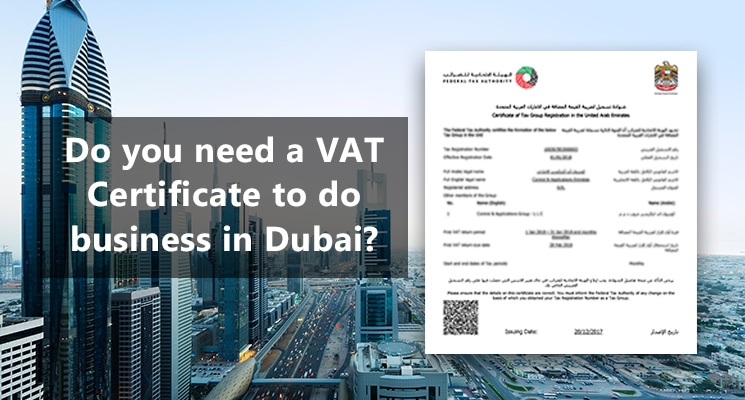
    Do you need a VAT Certificate to do business in Dubai?

    Businesses and companies in Dubai as well as across the UAE have been introduced to value-added-tax for some time now. Coping with the changes, commercial entities have adopted various ways to tackle taxation within the organization. One such change that businesses have instigated is to verify the VAT certificate of their suppliers and dealers.

    But is VAT certificate a mandatory?

    To substantiate your business and commercial activities you would need to apply for a VAT certificate. However, to do business in the UAE, you do not need to get the VAT certificate from your suppliers and dealers.

    Businesses can just get the TRN Number / Tax Registration Number to verify their suppliers and dealers. The UAE VAT Registration Number or TRN number can be crosschecked on the official website of Federal Tax Authority (FTA). Thus, there is no need of directly checking the VAT certificate and the TRN number is sufficient.

    The Federal Tax Authority has also offered provisional Tax Registration Number of companies who submitted their UAE VAT registration applications after the deadline. The FTA did this to allow such companies to conduct business and comply with their tax obligations. Nevertheless, companies need to complete their UAE VAT Registration procedures and submit the FTA all required documents.

    The FTA also supports the UAE businesses to fulfill with tax regulations and to certify that their operations are not disordered. The provisional UAE Tax Registration Number enables commercial transactions and validates the legal status of the taxable entities. However, obtaining a validated UAE VAT certificate is only possible after completing the procedures.

    Therefore, whether you need to get your final UAE Tax Registration Number; get your VAT Certificate or manage VAT in the UAE – Shuraa Tax Consultants can help you with your every tax-related needs in UAE.

    To know more about the taxation system or to get a free consultation, contact  Shuraa Tax Consultant today! You can email us at info@shuraatax.com or follow us this section for VAT-related updates.

  • How to File VAT Returns in UAE?

    How to File VAT Returns in UAE?

    VAT return filing in Dubai or UAE is an essential obligation for businesses operating in the United Arab Emirates (UAE). As a progressive and modern country, the UAE has implemented a tax system that aligns with international standards. Therefore, the UAE introduced its tax system to diversify its revenue streams and support its economic growth.

    If your business is registered for VAT with the Federal Tax Authority (FTA), you need to file VAT returns regularly. This means reporting the VAT you’ve collected from your sales and the VAT you’ve paid on your purchases. Knowing how to file VAT in the UAE correctly is essential for staying compliant with the tax regulations.

    Currently, the authorities have set the VAT registration threshold at AED 375,000 per annum. Failure to file tax returns or comply with the country’s tax laws may result in penalties and fines. That’s why understanding the VAT filing process is crucial for businesses in the UAE.

    What is a VAT Return in the UAE?

    A VAT return in the UAE is a report that businesses submit to the government to show the amount of Value Added Tax (VAT) collected from customers and the amount of VAT paid to suppliers during a specific period.

    Think of it like this:

    • When a business sells something, it adds VAT and collects that money from customers — this is called output VAT.
    • When the same business buys goods or services for its operations, it also pays VAT — this is called input VAT.

    At the end of every tax period (usually every 3 months or sometimes every month), businesses must send a VAT return to the Federal Tax Authority (FTA) using the EMARATAX online system.

    The VAT return helps the FTA know:

    • How much VAT the business collected (from sales)
    • How much VAT the business paid (on purchases)
    • Whether the business needs to pay the difference or can get a refund

    The official form used for this in the UAE is called VAT 201. It includes:

    1. VAT on Sales – Total VAT collected from customers
    2. VAT on Purchases – Total VAT paid to suppliers
    3. Net VAT – The difference between what was collected and what was paid

    Example:

    If a company collects AED 10,000 in VAT from customers but pays AED 7,000 in VAT on purchases, it needs to pay AED 3,000 to the FTA.

    If it paid more VAT than it collected, it might get a refund or use the extra amount in the next return.

    Filing VAT returns on time is essential — it’s not just a legal requirement, but also helps businesses stay transparent and avoid fines.

    Who Needs to File VAT Returns in the UAE?

    Any business or individual registered for VAT in the UAE is required to file VAT returns. This includes:

    • Businesses with an annual turnover exceeding the mandatory VAT registration threshold of AED 375,000.
    • Voluntarily registered businesses with a turnover above AED 187,500.

    Frequency of Filing VAT Returns

    • Quarterly: Most businesses file VAT returns every quarter, covering three months of transactions.
    • Monthly: Larger businesses with a high turnover may need to file VAT returns monthly.

    Important VAT Return Filing Dates in the UAE

    If your business is registered for VAT in the UAE, you need to file VAT returns on time to avoid penalties. The Federal Tax Authority (FTA) gives each business a tax period – this is either every month or every three months (quarterly), depending on your business’s annual earnings.

    Quarterly VAT Filing (Turnover below AED 150 million)

    If your business makes less than AED 150 million per year, you’ll likely file VAT returns every quarter. Here’s when your returns are due:

    • Q1 (Jan – Mar): File by 28th April 2026
    • Q2 (Apr – Jun): File by 28th July 2026
    • Q3 (Jul – Sep): File by 28th October 2026
    • Q4 (Oct – Dec): File by 28th January 2027

    Monthly VAT Filing (Turnover above AED 150 million)

    If your business earns more than AED 150 million per year, you need to file VAT every month. The deadline is the 28th of the following month.

    For example:

    • The return for May 2024 must be filed by 28th June 2024.

    Important Note:

    The FTA may assign a different tax period to some businesses depending on their situation. So it’s always a good idea to double-check your business’s assigned tax period in your FTA account.

    What You Need to File the VAT 201 Return Form in the UAE

    If your business is registered for VAT, you must submit your VAT 201 return online through the FTA portal. The process is manual – you’ll need to enter all figures related to your business’s purchases, sales, and VAT amounts.

    The VAT 201 form is divided into seven key sections. Here’s a breakdown of what each section includes:

    1. Taxpayer Details

    Basic information like your TRN (Tax Registration Number), business name, and contact info.

    2. VAT Return Period

    This includes the start and end dates of the tax period you’re filing for (monthly or quarterly), plus the filing due date.

    3. VAT on Sales and Other Outputs

    Here, you report:

    • VAT is collected on your sales and services
    • Details of standard-rated, zero-rated, and exempt supplies
    • Sales within the UAE and exports

    4. VAT on Expenses and Other Inputs

    This section is for:

    • VAT you’ve paid on business purchases
    • Recoverable input VAT (e.g., on rent, supplies, etc.)

    5. Net VAT Due

    This is the calculation part:

    • If Output VAT > Input VAT, you need to pay the difference
    • If Input VAT > Output VAT, you may be eligible for a refund or carry it forward.

    6. Additional Reporting Requirements

    You’ll provide extra details if needed — for example, reverse charge transactions, import VAT, or any adjustments.

    7. Declaration and Authorised Signatory

    The final section is where you confirm all information is correct and provide the name and details of the person submitting the form.

    Note: Keep all invoices, receipts, and supporting documents ready while filling out the form. It helps ensure accuracy and avoids issues during audits.

    Pre-requisites for Filing VAT Returns in the UAE

    Before you can file your VAT returns in the UAE, there are a few essential steps to ensure you’re ready. Here’s what you need:

    1. VAT Registration with the Federal Tax Authority (FTA)

    To file VAT returns, your business must first be registered for VAT with the FTA. This involves obtaining a Tax Registration Number (TRN), which serves as your business’s unique VAT identification. Without this, you cannot file VAT returns or fulfil your tax obligations.

    2. Accurate Record-Keeping

    Maintaining accurate and up-to-date records of your business transactions is essential. These include:

    • Sales Records: Details of taxable and exempt sales.
    • Purchase Records: Invoices for expenses that include input VAT.
    • Expense Records: Any additional costs related to your business operations.

    These records are the foundation for calculating VAT owed or refundable and must be retained for at least five years for audit purposes.

    3. Access to the FTA e-Services Portal

    The FTA e-Services portal is the official platform for submitting VAT returns in the UAE. To use it, you’ll need:

    How To File VAT Return in UAE?

    VAT return filing in Dubai or UAE is a straightforward process when you follow these steps:

    Step 1: Log in to the FTA e-Services Portal

    Visit the official FTA e-Services portal. Enter your Tax Registration Number (TRN) and password to access your account.

    Step 2: Navigate to the VAT Returns Section

    Once logged in, go to the “VAT Returns” section on the dashboard. Select the VAT return form (VAT 201) for the relevant tax period.

    Step 3: Fill in the VAT Return Form

    The VAT return form is divided into sections where you need to provide the following information:

    Taxable Sales and Output Tax:

    • Enter the total value of your taxable supplies (sales) and the VAT collected from customers.
    • Provide details for standard-rated supplies within the UAE and exports.

    Purchases and Input Tax:

    • Enter the total value of your taxable purchases and the VAT paid on them.
    • Ensure this includes expenses eligible for VAT recovery.

    Net VAT Amount:

    The system will calculate the difference between output tax and input tax to determine the VAT payable or refundable.

    Step 4: Review the Form

    Double-check all the details for accuracy. Ensure there are no discrepancies between your records and the information entered.

    Step 5: Submit the VAT Return

    Click on “Submit” to file your VAT return. Once submitted, you will receive a confirmation message from the FTA.

    Step 6: Make the Payment (If Applicable)

    If your VAT return shows a payable amount, proceed to make the payment through the FTA portal. Payment can be made via:

    • E-Dirham or credit card.
    • Bank transfer using the provided GIBAN (Generated International Bank Account Number).

    Step 7: Retain a Copy for Records

    Save a copy of the filed VAT return and payment receipt for your records. These may be required during audits or for future reference.

    File your VAT return before the deadline to avoid penalties. If you notice errors after submission, you can correct them by filing a Voluntary Disclosure through the FTA portal.

    VAT Returns in UAE Contents

    The following two sections are in a VAT return in the UAE: –

    The first section is the central section, which includes the taxpayer’s details, sales, purchases, and net VAT due. Moreover, the central section is mandatory for all VAT-registered businesses in the UAE.

    The second section is the additional reporting requirements section, which only applies to certain businesses under specific conditions. Furthermore, this section includes fields related to the profit margin scheme.

    Main

    When you file VAT returns in the UAE, the central section contains all the necessary details pre-populated with the taxpayer’s data, including the tax year-end VAT stagger, tax form filing type, and submission date. In a UAE VAT return, the section that captures the taxpayer’s information is called Taxable Person Details.

    This section includes the Tax Registration Number (TRN), the name of the business in both English and Arabic, and the registered address or place of residence of the company.

    VAT on Sales and all other Outputs

    The VAT on Sales and all other Outputs section of the VAT return should contain details of all sales and supplies made by the taxpayer during the tax period.

    • The first column is for the total sales transaction amount which includes sum of sales value due to debit or credit notes. The second value is the VAT amount that has been collected, which also consists of any changes to the VAT collected due to changes in the taxable value captured in the previous column.
    • Finally, the third value shows any adjustments made to output tax or VAT collected during the earlier tax period.

    VAT on Expenses and all other Inputs

    This series of sections presents information on all VAT on purchases and expenses made during the tax period.

    • The total taxable business purchase amount is based on purchase invoices, which include any adjustments due to debit or credit notes from suppliers or corrections from previous tax periods.
    • The Recoverable VAT Amount, or the number of VAT refunds that can be claimed according to VAT law.
    • Any adjustments made to the input tax (VAT paid on purchases).

    Net VAT Due

    Calculating the net VAT due is crucial in determining the amount of VAT a taxpayer owes to the government. To calculate the net VAT due, the total recoverable VAT is subtracted from the total output VAT payable. Furthermore, if the output VAT payable is higher than the recoverable VAT, the difference is the net VAT due, and you will need to make a payment to the government.

    The government may refund or carry forward a VAT credit to future VAT periods if their recoverable VAT is higher than the output VAT payable. This section helps to ensure that businesses accurately report and pay their VAT obligations in accordance with the law.

    Additional Reporting Requirements

    To comply with tax regulations, businesses that sell secondhand goods and have enrolled in the profit margin scheme must complete this section. They need to select “yes” to indicate their enrollment under the scheme, which applies VAT only to the profit made during sales of secondhand products.

    How to Correct Errors in VAT Returns in the UAE

    Mistakes in VAT returns can happen, but it’s important to correct them promptly to avoid penalties and stay compliant with the UAE tax system. The Federal Tax Authority (FTA) allows businesses to correct errors through a process called Voluntary Disclosure. Here’s how you can do it:

    1. Log in to the FTA e-Services Portal

    Use your Tax Registration Number (TRN) and password to log in to your account. Once logged in, go to the “VAT” section and select the “Voluntary Disclosure” option.

    2. Select the Relevant VAT Return

    Choose the VAT return period where the error occurred.

    3. Explain the Error

    Clearly describe the mistake, including the nature of the error (whether it’s related to sales, purchases, input tax, output tax, etc.). Specify the correct figures and how the error occurred.

    4. Submit the Voluntary Disclosure

    Review the information and submit the disclosure. The FTA will assess the correction and may require additional documentation or clarification.

    5. Pay Any Additional VAT

    If the correction results in more VAT being owed, ensure that the payment is made promptly to avoid further penalties.

    Situations Where Corrections Are Necessary

    You must file a voluntary disclosure if any of the following situations occur:

    • Incorrect Calculation of VAT Payable or Refundable (e.g., input tax claimed incorrectly, or sales figures misreported)
    • Omissions or Underreporting of Taxable Transactions
    • Incorrect VAT Classification (e.g., zero-rated supplies reported as taxable)
    • Overclaiming Input Tax
    • Late Registration

    You must file a voluntary disclosure within 20 business days from the date you become aware of the error.

    How Shuraa Tax Can Help

    Knowing how to file VAT in the UAE on time is very important for your business in the UAE. It helps you stay compliant with the tax rules, avoids fines, and keeps your business running smoothly. If you miss the deadline or make mistakes, it can lead to penalties that can affect your finances.

    We understand that VAT filing can be tricky, and even minor errors can cause problems. That’s why it’s a good idea to get professional help. Hiring a professional VAT consultant ensures your filings are done correctly and on time, giving you peace of mind and helping you avoid costly mistakes.

    At Shuraa Tax, we offer a complete range of VAT services, from registration and filing to ensuring compliance. Our team of experienced professionals will make the entire process easy and hassle-free. Whether it’s your first VAT return filing in Dubai or you need ongoing assistance, Shuraa Tax is here to help. Get in touch with us today +971 508912062 or info@shuraatax.com to simplify your VAT process and keep your business on track.