Category: Value Added Tax

  • How to Calculate Excise Tax in UAE?

    How to Calculate Excise Tax in UAE?

    Excise tax in UAE was introduced as part of the government’s efforts to reduce the consumption of goods that negatively impact public health and the environment. Implemented in October 2017, this tax targets specific products, such as tobacco, energy drinks, carbonated drinks, sweetened beverages, and electronic smoking devices. The rates are substantial, with a 100% tax on tobacco products, energy drinks, and electronic smoking devices and a 50% tax on carbonated and sweetened beverages.

    Businesses must determine the “Excise Price” to calculate UAE excise tax. This price includes the cost of the goods, shipping, and insurance (CIF). Once the Excise Price is established, the tax rate applicable to the product is applied. For example, if a company imports energy drinks with an Excise Price of AED 100, the excise tax would be 100%, resulting in an additional AED 100 tax, making the total cost AED 200.

    Businesses dealing with excisable goods must register with the Federal Tax Authority (FTA) and regularly file excise tax returns. Failing to adhere to these regulations could result in significant fines. By accurately calculating and paying excise tax, businesses not only avoid penalties but also contribute to the UAE’s broader health and environmental goals.

    What is Excise Tax in UAE? 

    Excise Tax in the UAE is a form of indirect tax levied on specific goods deemed harmful to human health or the environment. It was introduced to discourage the consumption of these goods and generate additional revenue for the government, which can be used to fund public services.

    Key Points about Excise Tax in the UAE:

    1. Introduction Date: The UAE introduced the Excise Tax on October 1, 2017.
    1. Taxed Goods: The Excise Tax applies to:
    • Tobacco products (including e-cigarettes and similar devices): 100% tax rate.
    • Energy drinks: 100% tax rate.
    • Carbonated drinks: 50% tax rate.
    • Sweetened beverages: 50% tax rate (introduced later in December 2019).
    1. Purpose: The tax aims to reduce the consumption of unhealthy goods, promote healthier lifestyles, and raise revenue for health-related initiatives.
    1. Registration: Businesses involved in the import, production, or storage of excise goods are required to complete excise tax registration in UAE with the Federal Tax Authority (FTA) and must file periodic tax returns.

    Implementing the Excise Tax is part of the UAE’s broader strategy to diversify its revenue sources and reduce its reliance on oil revenues.

    Excise Tax Rates in the UAE

    The UAE has implemented an excise tax on certain products and services, particularly those considered harmful to human health, such as tobacco, energy drinks, and sugary beverages. The UAE excise tax list is set as follows:

    • Tobacco Products: A 100% excise tax is imposed on tobacco products while doubling their retail price. This high tax rate aims to discourage tobacco use due to its well-documented health risks.
    • Energy Drinks: These beverages are marketed as stimulants for the body and mind and typically contain caffeine, taurine, ginseng, and guarana. The UAE applies a 100% excise tax on energy drinks. It includes any product that can be converted into beverages, such as concentrates, powders, gels, or extracts. This tax doubles the retail price of energy drinks.
    • Carbonated Drinks: The excise tax on carbonated beverages includes all aerated drinks except carbonated water. The price is set at 50% of the retail price. This category also covers products intended to be converted into carbonated drinks, such as powders, gels, or extracts.

    The UAE has implemented these high excise tax rates as part of a broader strategy to reduce the consumption of harmful products and promote healthier lifestyles among its residents.

    How to Calculate Excise Tax in UAE?

    The UAE employs two distinct methods for calculating excise tax on specific goods:

    Specific Method

    The specific method involves applying a fixed tax rate per product unit. This straightforward approach makes the tax amount predictable and easy to administer. For example:

    • Cigarettes: A fixed excise tax of AED 0.4 per cigarette.
    • Energy Drinks: A tax of AED 0.1 per millilitre.

    This method clarifies businesses and consumers by ensuring the tax amount remains consistent regardless of the product’s price.

    Ad Valorem Method

    The ad valorem method determines excise tax based on the product’s value. This method is typically used for goods where the value fluctuates significantly. For example:

    • Luxury Cars: A 50% excise tax on the retail price.
    • Jewellery: A 5% tax on the retail value.

    The ad valorem method is more complex, requiring an accurate product valuation to determine the taxable amount. This method is often applied to high-value or luxury items whose prices vary widely.

    Examples of Excise Tax Calculation in UAE

    Let’s examine some examples to better understand the excise tax calculation in UAE using the specific and ad valorem methods.

    Specific Method

    The specific method applies a fixed tax rate per product unit, making the calculation straightforward.

    Example 1: Cigarettes

    • Product: A pack of 20 cigarettes
    • Excise Tax Rate: AED 0.4 per cigarette

    Calculation:

    Total Excise Tax = 20 cigarettes × AED 0.4 per cigarette = AED 8

    So, the excise tax on a pack of 20 cigarettes would be AED 8, regardless of the pack’s retail price.

    Example 2: Energy Drinks

    • Product: A 250ml can of energy drink
    • Excise Tax Rate: AED 0.1 per millilitre

    Calculation:

    Total Excise Tax = 250ml × AED 0.1 per ml = AED 25

    The excise tax on a 250ml energy drink would be AED 25.

    Ad Valorem Method

    The ad valorem method calculates the excise tax based on the product’s value, making it a percentage of the retail price.

    Example 1: Luxury Car

    • Product: A luxury car with a retail price of AED 500,000
    • Excise Tax Rate: 50% of the retail price

    Calculation:

    Total Excise Tax = AED 500,000 × 50% = AED 250,000

    The excise tax on the luxury car would be AED 250,000.

    Example 2: Jewellery

    • Product: A piece of jewellery with a retail price of AED 10,000
    • Excise Tax Rate: 5% of the retail price

    Calculation:

    Total Excise Tax = AED 10,000 × 5% = AED 500

    The excise tax on the jewellery would be AED 500.

    These examples illustrate how the UAE uses specific and ad valorem methods to calculate excise tax, depending on the nature of the product. The specific method is used for items with a fixed unit measure, while the ad valorem method is applied to goods with variable values.

    Challenges in Implementing Excise Tax in the UAE

    Implementing the excise tax in the UAE presents key challenges:

    • Cross-Border Transactions: Enforcing tax compliance and collecting revenue in cross-border transactions is difficult, requiring robust border controls and international cooperation.
    • Impact on SMEs: Small and Medium-sized Enterprises (SMEs) may struggle with increased costs, needing to balance higher prices or lower profits. Addressing this impact requires careful policy adjustments.

      Documents Required for Excise Tax Registration

      To complete your excise tax registration, you must provide several key documents to verify your information. The required supporting documents include:

      • Passport Copy: For personal identification.
      • Emirates ID: This is for proof of residency and identity.
      • Trade License: To confirm your business operations in the UAE.
      • Other Official Records: Any additional documents that verify your business’s eligibility to conduct activities within the UAE.

      Business Details Required for Registration

      You will also need to provide specific information about your business, including:

      • Your Role: Indicate whether you register as a producer, importer, or another role.
      • Details of Excise Goods: Information about the excise goods your business handles.
      • Customs Authority Registration: Provide details if applicable.
      • GCC TRN: If registered for excise tax in another GCC state, include your Tax Registration Number (TRN).

      Make sure that all documents and details are accurate to facilitate a smooth registration process.

      Excise Tax Advisory Services in the UAE

      Dealing with the complexities of excise tax in the UAE can be challenging. To have smooth compliance and avoid substantial fines, it is important to seek guidance from qualified tax advisors.

      At Shuraa Tax, we specialise in excise tax consulting in Dubai. Our expert team is dedicated to helping you understand, calculate, and file your excise taxes with precision. We provide personalised advice to your specific needs, ensuring you stay compliant with all regulations.

      For expert support and the intricacies of excise tax, contact us at +971 50 891 2062 or email info@shuraatax.com. Let us help you manage your tax obligations smoothly and efficiently.

    • How to Calculate VAT in UAE

      How to Calculate VAT in UAE

      Calculating VAT in UAE might sound tricky, but with the right approach, it’s surprisingly simple. Understanding the process is essential for business owners trying to stay on top of their financial responsibilities. VAT, or Value Added Tax, is a tax on goods and services that’s added at each stage of production or distribution. The good news is that you don’t need to be a financial expert to calculate it.

      In this guide, we’ll walk you through the basics of VAT in the UAE, showing you exactly how to calculate VAT in the UAE without any hassle. We’ll cover what VAT is, why it’s important, and the simple steps you can follow to ensure you’re calculating it correctly.

      Along the way, we’ll also provide practical examples to make the process even clearer. By the end of this guide, you’ll feel confident in your ability to manage VAT calculations, whether for your business or personal understanding.

      What is VAT in UAE?

      VAT (Value Added Tax) in the UAE is a consumption tax levied on most goods and services. Introduced on January 1, 2018, at a standard rate of 5%, VAT is applied at each stage of the supply chain where value is added. Businesses collect VAT on behalf of the government, and consumers ultimately bear the cost when purchasing goods or services.

      The tax is part of the UAE government’s efforts to diversify revenue sources beyond oil. Under specific conditions, some goods and services, such as education and healthcare, may be exempt or zero-rated.

      How to Calculate VAT in UAE

      Businesses registered for VAT in the UAE must maintain accurate records of their income and VAT payments. VAT is charged at a rate of 5% on the invoice value for all customers of registered businesses. Additionally, businesses pay 5% VAT on the goods and services they purchase from suppliers.

      To manage VAT efficiently, it’s important to understand the difference between the VAT collected on sales (Output VAT) and the VAT paid on purchases (Input VAT). The VAT owed to the tax authorities or eligible for a refund is determined by the following formula:

      VAT=Output VAT−Input VAT 

      • Output VAT: The VAT collected on sales and services.
      • Input VAT: The VAT paid on raw materials and purchases.

      To use this formula, calculate the total Output VAT collected during the taxable period and the total Input VAT paid. Subtract the Input VAT from the Output VAT to determine your VAT liability.

      • If Output VAT exceeds Input VAT, the difference is the amount you owe to the tax authorities.
      • If Input VAT exceeds Output VAT, you are entitled to a refund, and no VAT is due.

      Understanding this process is essential for managing VAT effectively and ensuring compliance with UAE tax regulations.

      VAT Calculation Formula

      There are two methods for calculating VAT in the UAE, depending on whether VAT is included in or excluded from the sale price. Here’s how to apply each method:

      Adding VAT to the Sale Price

      Use this method when VAT is not included in the sale price. To calculate the VAT amount and the total price, including VAT, use the following formulas: 

      VAT Amount

      VAT Amount = Sale price X (VAT Rate/100)

      Gross Amount (Including VAT)

      Gross Amount = Sale Price x (1+VAT Rate/100)

      Excluding VAT from the Sale Price

      Use this method when VAT is included in the sale price. To find the VAT amount and the net sale amount (excluding VAT), use these formulas:

      VAT Amount:

      Net Sale Amount = Sale Price x (100/100+VAT Rate)

      Net Sale Amount (Excluding VAT):

      Net Sale Amount = Sale Price x (100/100+VAT Rate)

      VAT Calculation Example

      Let’s calculate VAT using an example with a sale amount of AED 1,000 and a VAT rate of 5%.

      When VAT is Part of the Sale Price:

      VAT Amount:

      Gross Amount = Sale Price x (1+VAT Rate/100)

      Net Sale Amount (Excluding VAT):

      AED1,000 X (100/105) = AED952.38

      When VAT is Excluded from the Sale Price:

      VAT Amount:

      AED1,000 X (100/105) = AED952.38

      Gross Amount (Including VAT):

      AED1,000 X (1+5/100) = AED1,050

      These methods will help you accurately calculate VAT based on whether it is included in or excluded from the sale price.

      How Business Owners Can Calculate VAT in the UAE

      In the UAE, the VAT rate is set at 5%, one of the lowest globally. Instead of the government collecting VAT directly, businesses are responsible for charging their customers and remitting the collected VAT to the authorities.

      To calculate VAT, use the following formula: 

      VAT Payable = Output Tax – Input Tax

      Output Tax

      Output tax is the VAT collected by a seller from customers on the selling price of the final product or service. In the UAE, VAT is 5%. For example, if the selling price of a product or service is AED 200, the output tax (VAT collected) would be:

      Output Tax=200×5%= AED10.00

      Output tax is also known as VAT Collected.

      Input Tax

      Input tax is the VAT a business pays on the cost price of goods or services used to produce a final product. The standard VAT rate is 5% in the UAE. For example, if the cost price of goods or services is AED 100, the input tax (VAT paid) would be:

      Input Tax=100×5%=AED5.00

      Input tax is also referred to as VAT Credit or Recoverable VAT.

      VAT Payable

      To determine the VAT payable to the government, subtract the input tax from the output tax:

      VAT Payable=Output Tax−Input Tax

      For example, if your output tax is AED 10.00 and your input tax is AED 5.00, the VAT payable would be:

      VAT Payable=10.00−5.00=AED5.00

      All businesses must collect VAT on sales (output tax) and recover VAT on purchases (input tax). The difference between the two amounts must be paid to the government.

      How to Register for VAT in the UAE

      In the UAE, VAT registration depends on your annual revenue:

      1. Mandatory Registration: If your business makes more than AED 375,000 annually, you must register for VAT. 
      1. Optional Registration: If your annual revenue is between AED 187,500 and AED 375,000, registration is optional. 
      1. Exempt from Registration: If your annual revenue is below AED 187,500, you do not need to register for VAT. 

      Steps to Register for VAT 

      1. Visit the FTA Website: Go to the Federal Tax Authority (FTA) website. 
      1. Create an e-Services Account: Sign up for an e-Services account to activate your profile. 
      1. Access Your Dashboard: Log in to your e-Services account. 
      1. Register for VAT: Click “Add New Taxable Person” and follow the simple process to complete your VAT registration. 

      By following these steps, you can easily register your business for VAT in the UAE.

      Simplify VAT Calculation with Shuraa Tax

      Calculating VAT in the UAE can seem complex, but with Shuraa Tax, it becomes straightforward. Our team simplifies the VAT process, guiding you through each step—from understanding VAT basics to calculating and managing VAT payments.

      With practical examples and clear instructions, Shuraa Tax ensures you handle VAT efficiently and comply with UAE regulations. For personalized assistance, contact us at +971 50 891 2062 or email info@shuraatax.com.

      FAQs

      Q1. How is VAT calculated in the UAE?

      To calculate VAT in the UAE, you need to apply the 5% VAT rate to the sale price. For example, if the price of a product or service is AED 100, the VAT amount would be AED 5 (calculated as AED 100 x 0.05). Thus, the total amount payable would-be AED 105 (AED 100 + AED 5 VAT).

      Q2. What is the VAT rate in the UAE?

      The UAE’s standard VAT rate is 5%. However, certain goods and services are classified as exempt or zero-rated, meaning no VAT is applied to them. Exempt supplies include specific healthcare and educational services, while zero-rated supplies may include certain international goods and services.

      Q3. How do you calculate 5% VAT in the UAE?

      To calculate 5% VAT, multiply the sale price by 0.05. For example, if the sale price is AED 200, the VAT is AED 10 (AED 200 x 0.05). Add this to the sale price to get the total amount payable, AED 210.

      Q4. How to calculate VAT on AED 100?

      For a product priced at AED 100, the 5% VAT would be AED 100 × 5% = AED 5.00. Thus, the Input VAT is AED 5.00.

      Q5. How do you find the price before VAT from a gross amount?

      To remove VAT from a price, follow these steps: First, divide the gross amount by 1 plus the VAT percentage (expressed as a decimal). Then, subtract the resulting value from the gross amount. Finally, multiply by -1 and round to the nearest value.

    • FTA’s VAT Administrative Exceptions in UAE

      FTA’s VAT Administrative Exceptions in UAE

      UAE VAT Administrative Exception is a way to provide registrants with concessions or exceptions allowed by the Federal Decree-Law No. 8 of 2017 on Value Added Tax (“Law”). UAE VAT Administrative Exception also stands under the Cabinet Decision No 52 of 2017 on the Executive Regulations of the Federal Decree-Law No. 8 of 2017 on Value Added Tax (“Executive Regulations”)

      The UAE VAT Administrative Exception is under mechanism if difficult circumstances prevent businesses and companies from following certain procedural aspects of the Law or the Executive Regulations.

      Eligibility Criteria for UAE VAT Administrative Exception

      Three conditions describe the eligibility for UAE VAT Administrative Exception for companies and businesses in the UAE: 

      1. It is crucial that the applicant is registered as a commercial entity with the Federal Tax Authority in the UAE.
      1. Fulfil the requirements regarding the relevant Exception Request, as outlined by your tax agent in Dubai or as advised by the FTA.
      1. Be sure to submit all the supporting documents related to the UAE VAT Administrative Exception.

      Categories of UAE VAT Administrative Exceptions

      Only specific categories can make UAE VAT Administrative Exception FTA Requests. Such categories and the fundamental conditions for the exceptions, along with reference from the Law

      UAE VAT Administrative Exceptions are grouped into the following categories –

      Tax Invoices

      The registrant must demonstrate the available records describing the particulars of any supply. The records must also prove that issuing a tax invoice per Article 59(1) or Article 59(2) of the Executive Regulations for UAE Tax Invoices would be impractical.

      Tax Credit Notes

      It is crucial for the registrants or applicants to show the records available to ascertain the particulars of any supply. They also must prove that it would be impractical to issue a Tax Credit Note as per Article 60(1) of the Executive Regulations for UAE Tax Credit Notes.

      Length of the Tax Period

      The registrant should provide the reasons for requesting a change in the length of the Tax Period. The FTA considers the request to change the length of the tax periods in UAE to only for certain categories.

      Nevertheless, while requesting a change, the applicants will have to provide the required information depending on the categories segregated, those are as follows –

      • Individuals: Board members, property owners, and others, such as freelancers, can apply to change the Tax Period. The FTA will consider all the supplies made by persons on these designations before deciding. These commercial individuals must submit the number of invoices issued in the preceding 12 months, including the total tax paid in the preceding 12 months.
      • Constant Tax Refunds: Businesses are in a continual refund position throughout the tax period in the preceding 12 months and expect to remain in the same position. UAE VAT Administrative Exception Requests here are conditioned on whether the registrant expects any change in the business model that may result in a change of refund position.
      • SMEs with funding: Registered SMEs receive official financing approved by the government and can apply for a change in their tax period. You must submit the documentation for the total tax paid and the taxable supplies for the past 12 months.
      • SMEs without funding: Registered SMEs that do not receive official funding approved by any government entity provided the total value of taxable supplies in the preceding 12 months was equal to or less than AED 5 million. The SMEs without Government funding can submit their UAE VAT Administrative Exception requests after displaying total tax paid, taxable supplies or any penalties paid in the last 12 months.

      Change Stagger

      An applicant or registrant who files UAE taxes quarterly uses a stagger. The applicant may request a change in the stagger assigned to him when the Tax Period ends, depending on the month he requests. However, the condition here is that the registrant must provide the reasons for requesting the change in stagger.

      How do you submit a VAT administrative request in the UAE

      Once you have completed the VAT Administrative Exception Application Form, you can view the status of your application on the Emaratax portal. The status will be updated to reflect the current stage, such as “in review,” “approved,” “rejected,” or “additional information requested.

      Who Can Submit the VAT Administrative Exception Application Form on Your Behalf?

      The VAT Administrative Exception Application Form can be submitted by:

      • The authorised signatory of the registrant.
      • The registrant’s appointed tax agent.
      • The registrant’s appointed legal representative.

      If you are a member of a tax group, the request should be submitted by the tax group’s representative.

      Guidance for Completing the VAT Administrative Exception Application Form

      This guidance is designed to help applicants understand the questions in the VAT Administrative Exception application form and ensure accurate completion. A separate Emaratax user guide provides detailed instructions on submitting the exception request.

      Selecting the Relevant Category

      • Once you select the relevant category for your Administrative Exception, the system will direct you to the appropriate form.

      Completing the Form

      • In addition to filling out the form, you must describe why you seek a VAT Administrative Exception. This should include:
      • A description of why you are requesting based on the outlined criteria.
      • A supporting letter detailing your request’s background and facts, including reasons why you cannot meet the legal requirements and therefore need an exception.

      Providing Supporting Documents

      • You must also submit any documentary proof supporting your request’s factual and legal grounds. This may include alternative documents, sample invoices, contracts, payment slips, or other relevant documents.
      • The type of documents required will depend on the exception category.
      • Accepted file types are PDF, DOC, XLS, XLSX, JPG, PNG, and JPEG, with a total file size limit of 15 MB.

      Following this guidance, you can ensure your VAT Administrative Exception in UAE application is complete and accurate.

      Time Extension for the export of goods

      The FTA can extend the 90 days from the date of supply. In case, if the FTA has determined after the supplier has applied in writing, then the time extensions proceeded in the way segregated below:

      • Due to the nature of the supply, it is not practicable for the supplier to export the goods, or the class of goods, within 90 days of the date of supply.
      • The registrant must provide the actual reasons/circumstances, as prescribed under the law, to seek an extension of time to export goods.

      Need to know more about UAE VAT Administrative Exception or get through your UAE VAT Administrative Exception Requests? Speak to Shuraa Tax Consultants and Accountants in Dubai, we will solve all your problems related to UAE taxation. Get your free VAT consultation by Getting in touch today at +971508912062. You can also drop us an email at info@shuraatax.com.

    • Non-Recoverable Tax on Entertainment Services in UAE

      Non-Recoverable Tax on Entertainment Services in UAE

      The UAE’s taxation system is one of the most favorable tax systems in the world. In fact, it levies no federal income tax – a fact that may come as a surprise to you. This is also one of the significant reasons that draw hundreds and thousands of expats to this region.

      However, all businesses in the UAE must levy VAT (Value Added Tax) on all taxable goods. The good part is that the VAT paid on purchases of products and services used for business activities in the UAE can be recovered by registered companies. Unfortunately, this is not for all services. VAT on some special services expenses cannot be recovered by the companies. For instance, entertainment service expenses.

      Entertainment services include a wide range of activities, including concerts, live performances, movie screenings, and more. Understanding how non-recoverable tax applies to these services is crucial for businesses operating in the entertainment industry, as it can have a significant impact on their bottom line.

      What is Non-Recoverable Tax?

      Non-recoverable tax refers to the portion of Value Added Tax (VAT) paid by a business that cannot be claimed back as a credit against the VAT charged to customers. Essentially, it’s a tax expense that directly impacts the business’s profitability.

      In contrast, recoverable tax is the VAT paid on purchases directly related to the business’s taxable supplies. This amount can typically be offset against the VAT collected from customers, effectively neutralizing the tax burden.

      Common examples of non-recoverable VAT in the UAE include: 

      • VAT paid on entertainment expenses (e.g., tickets to events, lavish meals)
      • VAT on personal use of company vehicles
      • VAT on goods and services used for exempt supplies

      A non-recoverable tax directly impacts a business’s profitability. As it cannot be offset against the VAT collected, it increases the overall cost of operations. Consequently, it can reduce profit margins if not managed effectively. 

      What are Entertainment Services Under UAE Law?

      Under UAE VAT law, entertainment services are broadly defined as any service that primarily aims to provide pleasure, diversion, or amusement. Here are some common examples of entertainment services: 

      • Restaurants and cafes
      • Cinemas, theatres, and concert venues
      • Nightclubs, bars, and lounges
      • Sports events
      • Amusement parks and theme parks
      • Gaming and betting activities

      Non-Recoverability of Tax on Entertainment Services

      The UAE VAT law explicitly states that input tax incurred on entertainment services is generally non-recoverable. This means that businesses cannot claim back the VAT they paid on entertainment expenses as a credit against the VAT they charge their customers.

      Article 53 of the UAE VAT Executive Regulations outlines the specific provisions for non-recoverable tax on entertainment services. Primarily, it states that VAT paid on entertainment services provided to anyone other than the business’s employees is non-recoverable. This includes

      • Customers
      • Potential customers
      • Officials
      • Shareholders
      • Owners

      When Can VAT on Entertainment Services Offered to Employees Be Recovered?

      While the general rule is that VAT on entertainment services is non-recoverable, there are specific circumstances where VAT on entertainment services provided to employees can be recovered.

      To claim back the VAT on entertainment services offered to employees, a business must demonstrate that:

      • The employer has a legal or contractual obligation to provide the services to employees.
      • Providing the services is considered a normal business practice within the industry or specific role.
      • The entertainment services are directly linked to the employee’s well-being, motivation, or performance.

      For example, a company provides lunch for its employees during mandatory training sessions. This could be considered a recoverable expense if it can be demonstrated that the meals are directly related to the training and are not excessive in cost.

      However, the taxable entity will not be reimbursed for taxes paid on events such as Iftar parties given to staff members and employees, goodbye celebrations, staff birthday parties, music festivals, gala dinners, birthday parties, wedding parties, etc.

      It’s essential to note that even if the VAT on entertainment services provided to employees is recoverable, it doesn’t automatically mean that the entire cost is deductible for tax purposes. Other tax rules and regulations may apply.

      Circumstances Under Which Tax on Entertainment Services Might Be Recoverable

      There are specific exceptions where businesses can claim back the tax paid:

      Business Meetings 

      If a business meeting includes a meal or refreshments as a necessary part of the meeting, the VAT on these expenses may be recoverable. The primary purpose of the gathering should be conducting business, and the entertainment element should be incidental. 

      Staff Training and Development 

      If entertainment is directly linked to a staff training or development program and is essential for achieving the program’s objectives, the associated VAT might be recoverable. 

      Employee Welfare 

      VAT on entertainment services provided to employees can be recovered if it’s considered a normal business practice or a legal or contractual obligation. Examples include meals provided in a company canteen, refreshments during working hours, or health and wellness activities directly linked to employee performance.

      Conditions for Claiming Recoverability: 

      • The expenses must have a direct and necessary link to the business’s core activities.
      • Detailed records, including invoices, receipts, and expense reports, should be maintained to support the claim.
      • The claim should adhere to all relevant VAT laws and regulations. 

      It’s essential to note that the burden of proof lies with the business to demonstrate that the VAT on entertainment services is recoverable. Tax authorities may scrutinize these claims, and businesses should be prepared to provide detailed evidence to support their position. 

      How Businesses Can Identify Non-Recoverable Expenses 

      Accurately identifying non-recoverable expenses is crucial for effective tax planning. 

      • Clearly classify all expenses into categories such as direct costs, operating expenses, and entertainment expenses.
      • Stay updated with the latest VAT rules and guidelines regarding entertainment services.
      • Scrutinize expense claims to ensure they align with VAT regulations and business objectives.
      • Utilize software or tools to track and categorize expenses efficiently. 

      Most Importantly – Seek expert advice! 

      Understanding non-recoverable tax on entertainment services in the UAE is important for any business. Knowing what counts as non-recoverable expenses and how they affect your cash flow and profits helps you manage your finances better. Keeping good records and tracking expenses carefully can save you from penalties and legal issues. 

      Given how complex VAT and tax rules can be, it’s smart to get expert help. At Shuraa Tax, we take care of all your business tax needs in the UAE, including VAT. Our experienced, in-house tax agents are ready to assist you in every way necessary. Let us handle your tax management, so you can focus on growing your business. 

      All you need to do is get in touch with us on info@shuraatax.com or call us on +971508912062.

    • VAT Exempt Supplies in UAE

      VAT Exempt Supplies in UAE

      Exempt supplies in UAE are defined as the supply of goods and services where no Value-added Tax (VAT) is charged, and no claim on the related Input tax is allowed except as stated by the UAE decree-law. According to UAE executive regulations, certain goods and services are free from VAT, meaning such goods or services are not subject to VAT and are exempt from VAT charges.

      Businesses dealing with the supply of such exempted goods and services cannot claim Input tax related to the exempt supply. Any VAT on expenses related to the exempt supply becomes part of the supplier’s cost.

      For example, a company pays 4% of the VAT when purchasing raw materials. Let’s assume the final goods created from that raw material are exempt goods. Since it is an exempt supply, the Company cannot claim the 4% input tax that it paid at the time of purchasing the raw material. Hence, it will become part of the cost of the product.

      What are Exempt Supplies in UAE VAT?

      Exempt supplies in UAE VAT refer to goods and services not subject to VAT, meaning businesses do not charge VAT on these transactions. However, businesses providing exempt supplies cannot recover the VAT they incur on their purchases related to these supplies.

      Exempt supplies include certain financial services, residential properties, and local passenger transport. This means that while these transactions are free from VAT, the businesses involved cannot claim back the VAT on their related expenses.

      List of exempted goods and services in the UAE

      For goods and services to be exempt, they should be as specified by the UAE’s VAT Law and Executive Regulations. Here is a list of certain VAT-exempted goods and services in UAE which every person dealing in business should know:

      1. Financial Services

      Financial services are money-centered services. Credit services, loans, insurance, deposits, investments, etc., are all finance-related services. It is important to know that not all financial services are VAT-exempt supplies, and only certain financial services fall under this category.Following are the financial services which are VAT-free: 

      • There will be no VAT charge on Financial Services not conducted in return for discounts, commissions, explicit fees and rebates, or similar benefits.
      • Issuing, allocating or transferring the ownership share in any corporation or entity is VAT-exempt.
      • Transferring the ownership of a life insurance contract or provision of reinsurance due to such a contract is VAT-exempt

      2. Residential Buildings

      Supply of residential buildings is VAT-exempt under the following conditions: –

      • Supply of residential buildings which is not zero-rated supply
      • If the duration of the lease period as per contract is more than 6 months; or a tenant holds a legal ID proof card issued by the Federal Authority for Identity and Citizenships.

      The first supply of residential buildings within three years of completion, or those converted from non-residential to residential as mentioned in the executive regulation on VAT Decree-Law, is zero-rated.

      Residential buildings are constructed solely for human inhabitation, such as apartments, student accommodations, police or armed forces, nursing homes, orphanages, etc. Any building not built to accommodate people, such as hospitals, hotels, or serviced apartments, will not be treated as a residential building. VAT will apply to the supply of non-residential buildings.

      3. Bare Land

      It is empty land with no buildings or other things built or designed. These are VAT-exempt supplies.

      4. Local Passenger Transport Services in the UAE

      Local passenger transport services in the UAE are exempt from VAT when transporting people within the country by land, water, or air. This includes vehicles like taxis, buses, trains, trams, monorails, ferry boats, abras, and similar means of transport designed for passenger use. Helicopters and aeroplanes approved for passenger transport under the Civil Aviation Act are exempt.

      However, pleasure trips and any local passenger transport service by aircraft that constitutes “international carriage” as per UAE executive regulations are not exempt and are subject to a 5% VAT.

      With Shuraa Tax!

      Shuraa Tax and Accounting Services LLC is Dubai’s best-known brand for effective VAT services. We are the best VAT consultants in Dubai. If you wish to gain more detailed knowledge about VAT-exempt supplies in the UAE, contact our team of qualified accountants and consultants. Get in touch today at +971508912062. You can also drop us an email at info@shuraatax.com.

    • Difference Between Zero Rated VAT and Exempted VAT in UAE

      Difference Between Zero Rated VAT and Exempted VAT in UAE

      The UAE’s Value Added Tax (VAT) system has become an essential part of everyday business. While most are familiar with the standard 5% VAT rate, things can get trickier when dealing with zero-rated and exempt supplies. Many businesses find themselves confused about the difference between these two categories which may lead to potential errors in VAT filing and record keeping.

      Therefore, understanding the difference between zero rated VAT and exempted VAT in UAE is crucial for businesses to ensure compliance with tax regulations and avoid any potential penalties.

      What is VAT?

      VAT, or Value Added Tax, is a type of consumption tax levied on the value added to goods and services at each stage of production and distribution. The tax is applied to the increase in value at each stage, not the total cost. Think of it like a tax on the work done at each step.

      The United Arab Emirates implemented VAT in January 2018. Here’s a basic overview:

      • General Rate: 5% on most goods and services.
      • Exceptions: Some essential goods and services are exempt or have a 0% rate (e.g., healthcare, education).
      • Registration: Businesses exceeding a threshold (currently AED 375,000) must register for VAT.
      • Input Tax Credit: Registered businesses can reclaim VAT they paid on their purchases.

      Zero Rated VAT in UAE

      Zero-rated VAT is a category within the UAE’s VAT system where a 0% VAT rate applies to specific goods and services. While these supplies are still considered taxable, the VAT amount is zero. A crucial benefit of zero-rated supplies is the ability to recover input tax (VAT paid on business expenses) incurred for these supplies. This helps businesses maintain cash flow.

      Examples of Zero-Rated VAT in the UAE

      Here are some of the main categories of zero-rated goods and services in the UAE:

      • Exports of goods and services outside the GCC (Gulf Cooperation Council).
      • International transportation and related supplies (e.g., fuel for international flights).
      • Supplies of certain means of transportation (new ships, aircraft for international use).
      • Precious metals like gold, silver, and platinum supplied for investment.
      • Newly built residential properties for the first 3 years of their existence.
      • Certain educational and healthcare services, along with related goods and services.

      How Businesses Handle Zero-Rated VAT

      Businesses making zero-rated supplies need to clearly identify them on invoices with a “Zero-Rated Sales (0.00%)” label. They must record these transactions in their VAT accounts and report them in VAT return filings.

      Importantly, they can claim input tax credit for VAT paid on expenses related to zero-rated supplies.

      Exempted VAT in the UAE

      Exempt VAT in the UAE means no VAT is charged at all on specific goods and services. Unlike zero-rated supplies, these transactions are completely outside the scope of VAT. Businesses supplying exempt goods and services don’t add VAT to their prices and don’t collect it from customers.

      A key difference from zero-rated supplies is that businesses cannot claim input tax credit (VAT paid on related expenses) for exempt supplies. This VAT becomes a cost of doing business.

      Businesses dealing primarily with exempt supplies may not be required to register for VAT if their total taxable supplies (excluding exempt ones) fall below the registration threshold (currently AED 375,000 annually).

      Examples of Exempt Supplies in the UAE

      • The sale or lease of residential properties (excluding commercial spaces within them)
      • Local passenger transport services (buses, taxis, metros, and ferries)
      • Bare land, a land without any buildings or structures on it
      • Certain financial services (such as issuance of securities or life insurance contracts)

      Exempt supplies can simplify record-keeping for businesses as they don’t need to calculate or collect VAT. However, the inability to recover input tax might increase overall business costs.

      Key Differences Between Zero Rated VAT and Exempted VAT in UAE

      The main difference between Zero-Rated VAT and Exempt VAT in the UAE is how they affect businesses. Here’s a breakdown of what that means:

      FeatureZero-Rated VATExempt VAT
      VAT Charged0% VAT rate, but still considered taxableNo VAT charged at all
      Business RegistrationRequired if exceeding the VAT registration thresholdMay not be required if primarily dealing with exempt supplies
      Input Tax RecoveryAllowed for VAT paid on expenses related to zero-rated suppliesNot Allowed – VAT on expenses becomes a cost
      Record KeepingNeed to identify and report zero-rated transactionsNo need to calculate or collect VAT
      Impact on BusinessesCan improve cash flow by recovering input tax (but requires record-keeping)May increase costs due to non-recoverable input tax (but simpler record-keeping)
      Impact on ConsumersMay lead to lower prices for zero-rated goods/services (especially exports)Generally, lowers prices for exempt goods/services (like housing and transport)

      Partial VAT Exemption in UAE

      A business might offer a bundle that includes both taxable and exempt supplies (e.g., a training course with a textbook). In such cases, the business needs to separate the taxable and exempt portions of the supply and apply VAT accordingly. They would charge VAT on the taxable portion (training course) and not on the exempt portion (textbook).

      Businesses that make both taxable and exempt supplies often incur mixed expenses that benefit both types of supplies. The UAE VAT law allows for approved methods to apportion the input tax (VAT paid on these mixed expenses) between the taxable and exempt supplies.

      Partner with Shuraa Tax for Your UAE VAT Needs

      Knowing the difference between Zero Rated VAT and Exempted VAT is very important for business owners in the UAE. It helps you manage your tax reporting, stay compliant with regulations, and plan your finances better. By understanding these two types of VAT, you can make sure your business runs smoothly and avoids any tax-related issues.

      For expert help with your taxes in the UAE, you can always turn to Shuraa. Our team at Shuraa Tax is ready to assist you with all your tax and accounting needs. Our tax consultants in Dubai will review your financial situation and help you plan your taxes and bookkeeping.

      Shuraa Tax offers the best VAT consultancy services in Dubai, including filing VAT returns, giving VAT advice, and assisting with all aspects of UAE VAT implementation. With Shuraa Tax, you can confidently handle your VAT matters and focus on growing your business.

      Frequently Asked Question

      1. What is the difference between zero-rated VAT and exempt VAT in UAE?

      Zero-rated VAT means a 0% VAT rate applies, but businesses can still claim input tax credit for VAT paid on expenses related to those supplies. Exempt VAT means no VAT is charged at all. However, businesses cannot recover input tax on expenses related to exempt supplies.

      2. What is a non-recoverable input tax?

      Non-recoverable input tax is the VAT portion of expenses that a business cannot claim back. This applies to VAT paid on expenses related to exempt supplies and some personal expenses not related to business activities.

      3. Do businesses have to register for VAT in the UAE if they only deal with zero-rated supplies?

      Yes, businesses making zero-rated supplies still need to register for VAT in the UAE. This is because they need to file VAT returns even though the VAT rate is 0%.

      4. What are the record-keeping requirements for zero-rated and exempt supplies?

      Businesses need to maintain separate records for both zero-rated and exempt supplies to ensure accurate reporting and potential input tax recovery for zero-rated supplies.

      5. Are there any penalties for incorrectly classifying a supply as zero-rated when it should be exempt (or vice versa)?

      Yes, incorrectly classifying a supply can led to penalties from the Federal Tax Authority (FTA). These penalties can include additional tax dues, interest charges, and administrative fines.

    • How to Download VAT Certificate in UAE

      How to Download VAT Certificate in UAE

      In the UAE, businesses exceeding an annual turnover of AED 375,000 must register for VAT. Upon registration, these companies must levy VAT on taxable goods and services provided to customers, alongside submitting regular VAT returns to the FTA. The VAT certificate in UAE adherence to UAE VAT laws and regulations.

      Are you prepared to obtain your VAT certificate in the UAE? Knowing the correct procedure is essential for businesses operating in the region. At Shuraa Tax, we’ve streamlined the process to make sure you can effortlessly download your VAT certificate in the UAE. Let’s explore further!

      VAT Certification in UAE

      Opting for a VAT certification in Dubai is not mandatory, but it offers significant advantages to businesses by providing comprehensive transaction details. The certification process involves completing a VAT training course offered by various agencies. This training covers essential operational aspects such as purchasing, selling, importing, exporting, and understanding input and output VAT.

      Due to its high demand, getting this certificate typically takes 2-3 weeks. Once acquired, the UAE VAT certificate equips businesses with the necessary information and skills to manage VAT compliance challenges effectively.

      The VAT Certificate in UAE includes:

      • Applicant details
      • Estimated registration date
      • First VAT return deadline
      • Dates marking the beginning and end of the tax period

      Facts About Value Added Tax (VAT) in Dubai

      Here are some essential details about VAT in the UAE:

      • VAT is applied at a rate of 5% across the UAE.
      • The FTA imposes a 0% tax rate on specific goods and services.
      • Companies with annual expenditures exceeding AED 187,500 can opt for VAT registration.
      • Businesses earning over AED 375,000 annually are required to register for VAT with the Federal Tax Authority (FTA).
      • Registered sellers with the FTA are eligible for tax credits or reimbursements on VAT paid during purchases.

      Benefits of VAT Certificate in UAE

      The VAT certificate in Dubai is highly sought as compared to others. It offers significant advantages:

      • Possession of a VAT certificate demonstrates a commitment to VAT compliance, aiding in building trust with clients seeking reliable business partners.
      • The rigorous training required to get the VAT certificate equips individuals with detailed knowledge of calculations, bookkeeping, and filing returns. This knowledge minimises errors and improves productivity.
      • Holding a VAT certificate provides different advantages, such as reducing the risk of FTA penalties and developing better decision-making skills for business growth.

      How to get a VAT Certificate via EmaraTax

      EmaraTax, the UAE’s new digital tax platform, streamlines obtaining your VAT Registration Certificate. Here’s how:

      Existing FTA account users have their tax certificates automatically transferred from e-services upon migrating to EmaraTax.

      New taxpayers can follow these steps:

      1. Log in to EmaraTax using your Emirates ID, UAE Pass, or taxpayer account credentials.

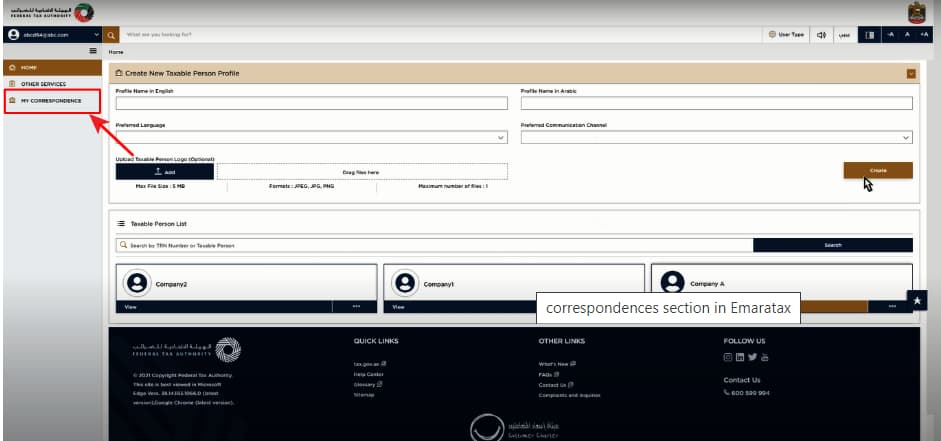
      2. Navigate to the dashboard and locate the VAT registration certificate in the “My Correspondences” section of your Taxable Person account.

      3. Click on the certificate and download it in PDF format.

      For detailed guidance, watch this video: [VAT Registration on EmaraTax https://www.youtube.com/watch?v=bvb3AQLFXv4.

      Note: If your tax registration certificate wasn’t previously accessible in PDF format on the system, it won’t appear on your EmaraTax dashboard.

      How to Download VAT Return in EmaraTax?

      The FTA allows you to download an acknowledgement exclusively for submitted returns in EmaraTax. Here’s how to download a VAT certificate in UAE:

      1. Log in to EmaraTax.

      2. Submit your VAT Returns, ensuring all required documents are included.

      3. Complete the payment process.

      4. After submitting your VAT return, find the acknowledgement screen.

      5. Click to download the acknowledgement screen.

      Additionally, the FTA will send an email to confirm the submission of your refund in EmaraTax.

      How do you get a VAT Registration Certificate for newly registered taxpayers?

      After registering for VAT in EmaraTax, you can view the payment in your Transaction History and download the receipt. Follow these steps to obtain a hard copy of the VAT Certificate:

      1. File an application: Apply form through the FTA VAT Certificate service.
      1. Receive Request Number: The FTA will provide you with a Request Number, which you’ll use to pay the fees on the EmaraTax portal.
      1. Pay the Service Fee: The FTA service fee for a VAT Certificate is AED 250. Pay this fee through the EmaraTax portal using an E-Dirham or debit/credit card. Obtain a payment reference number.
      1. Payment Confirmation: After you make the payment, you’ll receive a confirmation email. The FTA will print and mail your VAT Certificate to your registered company address.

      Alternatively, you can get the VAT Certificate service from Dubai Customs for AED 100 plus additional charges.

      How do you download a VAT registration certificate for previous taxpayers?

      Below are the points which will help you download the VAT registration certificate for the previous taxpayers:

      1. Access the EmaraTax platform using your Emirates ID, UAE Pass, or taxpayer account credentials.
      1. In the dashboard, find your VAT registration certificate under “My Correspondences” in your Taxable Person account.
      1. Click on the certificate and download it as a PDF.
      VAT registration certificate

      Note: If you are a previous user and your tax registration certificate was unavailable as a PDF document in your old account’s dashboard, you cannot find it in your EmaraTax dashboard.

      How to Register for VAT in UAE

      VAT registration is optional for businesses in the UAE. However, businesses must register for VAT if their taxable supplies and imports exceed AED 375,000. Additionally, businesses can voluntarily register for VAT if their taxable supplies and imports surpass AED 187,500.

      According to the UAE Federal Tax Authority (FTA), taxable supplies are defined as:

      “Goods or services provided by a business in the UAE, taxable at either 5% or 0%, including imports under similar taxable conditions.

      Businesses gather VAT from customers and remit it to the government. VAT-registered businesses can also reclaim any VAT paid to their suppliers from the government.

      Required Documents and Forms for VAT Registration in UA

      When applying for VAT registration in the UAE, make sure you compile the following information in the appropriate format for your online application:

      1. Valid trade license(s)
      1. Passport/Emirates ID of the authorised signatory(s)
      1. Proof of authorisation for the authorised signatory(s)
      1. Contact information
      1. A bank letter confirming the applicant’s bank account details

      Additional documents may be required based on the nature of your registration:

      For Taxable Supplies (excluding Federal and Emirate Government)

      1. Audit report (audited or non-audited financial statement)
      1. Self-prepared calculation sheet detailing taxable/zero-rated supplies based on financial records
      1. Projected revenue with supporting documents such as a Local Purchase Order or Contract
      1. Monthly turnover declaration for specified periods, signed and stamped by the authorised signatory on the entity’s printed letterhead
      1. Supporting financial documents (e.g., invoices, LPOs, contracts, title deeds, tenancy contracts)

      For Taxable Expenses (excluding Federal and Emirate Government)

      1. Audit report (audited or non-audited financial statement)
      1. Expense budget report

      Additional Documents

      1. Articles of Association/Partnership Agreement (if applicable)
      1. Certificate of Incorporation (if applicable for Legal Person)
      1. Documents showing ownership information of the business
      1. Customs details (if applicable)
      1. Power of Attorney documents (if applicable)
      1. Club, charity, or association registration documents and supporting evidence (if applicable for “Legal person – Club, Charity, or Association”)
      1. Copy of the Decree (if applicable for “Legal person – Federal UAE Government Entity” or “Legal person – Emirate UAE Government Entity”)
      1. Other relevant documents providing information about your organisation, its activities, and size (if applicable for “Legal person – Other”)
      1. Scanned copies of the Emirates ID and passport for the manager, owner, and senior management
      1. Scanned copy of the land/property title deed (if applicable for “Legal Person – Incorporate/Legal Person – Club or Association/Legal Person – Charity/Legal Person – Federal UAE Government Entity/Legal person – Emirate UAE Government Entity/Natural Person”)

      Read more: Tax Residency Certificate in UAE

      Shuraa Tax in UAE

      Shuraa Tax sets the standard for VAT registration services in the UAE, utilising FTA FTA-registered tax agents with direct access to EmaraTax. Our expert team is well-versed in guiding clients through VAT registration and obtaining VAT Certificates via the EmaraTax portal.

      Do you need assistance downloading your VAT Certificate from EmaraTax? Shuraa Tax Dubai is here to help! Call +971 50 891 2062 or email info@shuraatax.com today.

      FAQs

      Q1. What are the Consequences of Operating Without VAT Certification in Dubai?

      Operating without VAT certification in Dubai can lead to severe penalties, including hefty fines, suspension of services, and even business closure. It also risks damaging your reputation and losing customer trust.

      Q2. How to Get VAT Certified in Dubai?

      To get a VAT certification in Dubai, businesses need to:

      1. Register for VAT with the FTA.

      2. Ensure compliance with VAT regulations.

      3. Maintain accurate financial records.

      4. Undergo periodic audits.

      Q3. Who Needs VAT Certification in Dubai?

      Any business operating in Dubai or the UAE that meets the mandatory VAT registration threshold must obtain VAT certification to legally conduct taxable activities and comply with tax regulations.

    • Value Added Tax (VAT) Exemptions in the UAE

      Value Added Tax (VAT) Exemptions in the UAE

      Value Added Tax (VAT) is a consumption tax levied on goods and services at each stage of the supply chain. It was introduced in the United Arab Emirates (UAE) on January 1, 2018, as part of the GCC (Gulf Cooperation Council) countries’ agreement to diversify their revenue sources. The standard VAT rate in the UAE is currently set at 5%.

      One important concept to understand when it comes to VAT in the UAE is exemptions. VAT exemption UAE refers to goods and services not subject to VAT. This is different from zero-rated supplies in UAE, which are still taxable at 0% but are considered outside the scope of VAT. Understanding the difference between exempt supplies in UAE and zero-rated supplies in UAE is crucial for both businesses and consumers in the UAE.

      What is VAT Exemption in UAE?

      VAT stands for Value Added Tax. It’s a tax levied on the consumption of goods and services in the United Arab Emirates. The standard VAT rate in UAE is 5%. This applies to most goods and services sold within the country. However, there are exceptions:

      Zero-rated supplies in UAE: These goods and services have a VAT rate of 0%. This includes exports outside the GCC (Gulf Cooperation Council) countries, international transportation, certain educational and healthcare services, and the first supply of residential property.

      Exempt supplies in UAE: These goods and services are not subject to VAT at all. This includes financial services, local passenger transport, and bare land supply

      How VAT is Calculated in the UAE?

      Curious about how VAT is calculated in the UAE? Here’s a simple breakdown to help you understand.

      VAT amount = Price of good or service x VAT rate (5%)

      For instance, let’s say a product costs AED 100. To calculate the VAT amount, you would do: VAT amount = AED 100 x 5% = AED 5

      The VAT amount in this case would be AED 5. Total price with VAT = Price of good or service + VAT amount

      Following the example above, the total price with VAT would be: Total price = AED 100 + AED 5 = AED 105

      So, the final price you pay for the product would be AED 105, which includes the AED 5 VAT.

      VAT Rates in the UAE: A Breakdown

      The UAE applies Value Added Tax (VAT) under three distinct categories:

      Standard Rate (5%)

      This applies to most goods and services, including consumer electronics, fashion, dining, and entertainment.

      Zero-Rated Supplies (0%)

      These transactions are taxable but at a 0% rate, allowing businesses to reclaim input VAT. Key examples include exports, international transportation, and specific healthcare and education services.

      Exempt Supplies

      These are entirely outside the VAT system, meaning VAT isn’t charged, and businesses cannot recover input VAT on related expenses. Examples include residential leases, sales of bare land, and certain financial services.

      Understanding these distinctions is crucial for businesses to manage VAT exemption UAE compliance and optimize tax recovery.

      UAE VAT Exemption List

      Below are the UAE VAT exemption list:

      Category VAT Percentage
      Healthcare (specific services) 0% (Exempt)
      General goods and services 5%
      Education (specific services) 0% (Exempt)
      Residential properties (first sale) 0% (Exempt)
      Export of goods and services 0% (Exempt)
      Local passenger transport 0% (Exempt)
      Residential rentals 0% (Exempt)
      Oil and gas industry 5%
      Precious metals (specific conditions) 0% (Exempt)
      Commercial properties 5%

      List of Common VAT-Exempt Goods and Services in UAE

      The list of common VAT- exempt good and services in UAE are as follows:

      Residential Properties

      Sales and rentals of residential buildings after the first supply are VAT-exempt in UAE. Commercial properties, however, are subject to the standard VAT rate. The first supply of residential properties is zero-rated, which means the developer can recover input VAT.

      Financial Services

      Services that do not involve an explicit fee or return, such as interest on loans and certain insurance policies, are VAT-exempt. However, financial services that charge a clear fee, such as banking and investment advisory services, may be subject to VAT.

      Transportation

      Domestic passenger transport, including intra-city flights, metro services, buses, and local public transport, is VAT-exempt in UAE. However, international transportation, including air and sea travel, falls under zero-rated supplies in UAE.

      Bare Land

      Transactions involving undeveloped land are VAT-exempt. However, sales of developed land or land with commercial buildings are subject to VAT.

      Healthcare and Education

      Specific healthcare services, such as preventative care, treatments, and essential medical supplies, are VAT-exempt. However, elective and cosmetic procedures are subject to VAT. Government-provided education services are also VAT-exempt, while private education services are typically zero-rated under specific conditions.

      Understanding Partial VAT Exemption

      In certain cases, a business transaction can include both taxable and exempt components. When this happens, VAT cannot be fully recovered on all associated costs, requiring a fair method of apportionment.

      For example, if you sell a package that includes a training course (taxable) and a book (exempt), you must divide the VAT accordingly. One simple way to do this is based on the price of each item.

      Let’s say the training costs AED 1,000 and the book costs AED 100. Since 90% of the total value is taxable, you can recover 90% of the VAT.

      Exception from VAT Registration UAE

      Some businesses may qualify for exception from VAT registration UAE if their supplies are mostly VAT-exempt or fall below the registration threshold of AED 375,000. Voluntary registration is possible for businesses with turnover above AED 187,500, allowing them to reclaim input VAT where applicable.

      How VAT Affects Businesses and Consumers

      For businesses, understanding VAT rules is important for managing costs.

      • Exempt supplies in UAE: Businesses cannot claim back VAT on these, making expenses higher.
      • Zero-rated supplies in UAE: Businesses can claim back VAT, helping them save money.

      For consumers, VAT exemptions and zero-rated goods mean lower prices on things like healthcare, education, and rent. Businesses engaged in VAT-exempt activities must carefully track their expenses and VAT obligations to ensure compliance with Federal Tax Authority (FTA) regulations.

      How to Apply for VAT Exemptions in the UAE

      If your business activity falls under the UAE VAT exemption list, the exemption applies automatically. You don’t need to register or apply for anything specific.

      However, businesses must maintain detailed records to prove their qualification for VAT exemption in UAE during audits by the Federal Tax Authority (FTA). Proper bookkeeping and VAT compliance are crucial to avoid penalties and ensure seamless tax operations.

      Shuraa Tax: Your Total UAE VAT Solution

      Understanding VAT exemptions in the UAE is essential for both businesses and consumers. Key VAT exemption list in UAE includes healthcare services, educational services, certain real estate transactions, financial services, and local passenger transport. Each category has specific rules that need to be followed to qualify for the exemption.

      Because VAT regulations can be complicated sometimes, it’s a good idea to consult with a tax professional. At Shuraa Tax, our team is ready to help with all your tax and accounting needs. Our tax consultants in Dubai will analyze your current financial situation and assist with tax planning, VAT compliance, and bookkeeping services.

      Shuraa Tax offers the best VAT consultancy services in Dubai, including VAT return filing, VAT registration, tax advisory, and complete support for UAE VAT exemptions.

      Get expert assistance today

      📞 Call: +(971) 44081900
      💌 WhatsApp: +(971) 508912062
      📧 Email: info@shuraatax.com

    • How is Corporate Tax Different from Value-Added Tax in UAE?

      How is Corporate Tax Different from Value-Added Tax in UAE?

      In Dubai’s bustling business landscape, the differences between corporation tax vs VAT are key pillars shaping companies’ fiscal strategies. While corporation tax levies a percentage on a company’s profits, VAT operates as a consumption tax applied at every stage of the supply chain. Going deeper into these variances is essential for businesses to guide the UAE’s tax framework efficiently. At the intersection of these intricacies lies Shuraa Tax, offering easy solutions to facilitate compliance and optimise financial outcomes. Join us as we examine the differences between corporation tax and VAT, disclosing insights to certify businesses in Dubai’s ever-evolving economic terrain.

      How Is Corporate Tax Different from Value Added Tax In UAE?

      The UAE serves as a central hub and preferred location for conducting business, offering its own unique set of regulations. It is essential for any entrepreneur aiming to establish a company in this vibrant environment to grasp the local laws, especially those related to taxation. Two significant taxes demand attention in the UAE: corporate tax and VAT. This blog aims to illuminate the definitions and disparities between these taxes, providing clarity for businessmen navigating the UAE’s intricate tax landscape.

      Introducing Corporate Tax

      In the past, the UAE operated as a tax haven, offering companies exemption from corporate tax. However, a significant change is underway as the UAE government prepares to implement corporate tax on business profits. This shift is heralded by the issuance of the Corporate Tax Decree Law by the Federal Tax Authority on December 9, 2022.

      The primary aim of this tax reform is to diversify the UAE economy away from its reliance on oil revenues. The government intends to achieve this transformative objective through substantial investments in technology and innovation, along with the introduction of corporate tax in Dubai and nationwide. 

      By expanding revenue sources beyond oil-related income, the introduction of corporate taxation is expected to boost state revenues, fostering greater economic stability and resilience.

      Additionally, the system includes exemptions for: 

      • Profits from intra-group transactions.
      • Profits from group re-organization.
      • Dividends from UAE companies.
      • Tips from foreign companies.

      Proposed Corporate Tax Rates and Regulations

      In the updated corporate tax framework, the proposed tax rates are outlined as follows:

      • If the net profit in one financial year is up to AED 375,000 the company is subject to a 0% tax rate.
      • If the net profit in one financial year is overreaching AED 375,000 then it is subject to a 9% tax rate.
      • Furthermore, Multinational Enterprises (MNEs) falling under Pillar 2 of the BEPS 2.0 framework will adhere to relevant authorities’ OECD Base Erosion and Profit-Sharing Rules.

      Understanding Value Added Tax (VAT) in UAE

      Value Added Tax (VAT) is a consumption-based tax levied on goods and services, operating as a standard fiscal tool adopted by over 150 countries worldwide. Introduced in the UAE on January 1, 2018, VAT applies to most transactions at a standard rate of 5%. Businesses are mandated to register for VAT if their taxable supplies and imports surpass the specified threshold of AED 375,000.

      VAT-registered businesses must file periodic VAT returns to the Federal Tax Authority (FTA). By diversifying revenue streams, VAT contributes to the government’s financial objectives outlined in the national budget.

      Specific sectors are exempt from Value Added Tax (VAT), including:

      • Specific financial services as outlined in VAT legislation
      • Residential properties
      • Bare land
      • Local passenger transport

      Difference between VAT and Corporate Tax

      The difference between corporation tax vs VAT lies in their tax structures. Corporate tax operates as a profit-oriented tax, while VAT functions as a consumption-based levy.

      Corporate tax is imposed on companies and settled by them directly, whereas consumers ultimately bear VAT by purchasing goods and services.

      VAT computation involves accumulating value at each production stage, whereas corporate tax in Dubai is computed based on profits.

      In corporate tax, businesses must report their profits and fulfill tax obligations based on the corporate tax scheme mandated by the government. Conversely, in the VAT system, companies are tasked with levying VAT on sales to customers and remitting it to the Federal Tax Authority (FTA).

      In summary, efficient business operations in the UAE necessitate a comprehensive grasp of diverse tax structures. Corporate taxes are set on profits, whereas value-added taxes are consumption-based, impacting consumers’ expenditures on goods and services.

      How Shuraa Tax Can Support You 

      Shuraa Tax has delivered exceptional tax advisory, accounting, and auditing services to clients for over a decade. With our seasoned team of experts well-versed in VAT and corporate tax laws, we can assist you in accessing tax benefits and ensuring the timely filing of VAT returns.

      Our dedicated team at Shuraa Tax offers comprehensive tax consultation to help you steer clear of tax evasion and its associated penalties. To explore our services further, reach out to our team today. Contact us at +971508912062 or email us at info@shuraatax.com.

    • How to Apply for UAE VAT Reconsideration

      How to Apply for UAE VAT Reconsideration

      If you run a business in the UAE, you’re probably already familiar with VAT (Value Added Tax). Introduced in 2018, VAT is a 5% tax applied to most goods and services in the country. It’s managed by the Federal Tax Authority (FTA), and staying compliant is a must for all registered businesses. 

      But what happens if the FTA makes a decision you don’t agree with – like rejecting your VAT registration, imposing a fine, or assessing tax incorrectly? That’s where UAE VAT Reconsideration comes in. It’s a process that allows you to formally ask the FTA to review and possibly reverse a decision. 

      Knowing how VAT reconsideration works can really help protect your business. Whether you’re facing unexpected penalties or think a mistake was made on your tax status, applying for reconsideration could make all the difference. 

      However, timely and accurate submission of a reconsideration request is essential, as the FTA stipulates specific procedures and deadlines for such appeals. 

      What is VAT Reconsideration in the UAE? 

      VAT Reconsideration enables taxpayers to challenge specific decisions made by the FTA concerning VAT issues. This could include disagreements over VAT registration rejections, penalties imposed, or assessments made. By submitting a reconsideration request, the taxpayer seeks a re-evaluation of the FTA’s decision, providing justifications and supporting documents to substantiate their case. 

      The FTA is responsible for reviewing reconsideration requests submitted by taxpayers. Upon receiving a valid request, the FTA examines the details, assesses the justifications provided, and determines whether the original decision should be upheld or amended. 

      Legal Basis for UAE VAT Reconsideration 

      The right to request a VAT reconsideration is grounded in the UAE’s tax legislation. Specifically, Article 27 of the Federal Decree-Law No. 7 of 2017 on Tax Procedures allows any person to submit a reconsideration request to the FTA regarding decisions issued by the Authority. This provision ensures that taxpayers have a legal avenue to seek redress and promotes accountability within the tax system. 

      When Can You Apply for VAT Reconsideration? 

      You may consider applying for UAE VAT Reconsideration in the following scenarios: 

      1. VAT Registration Issues 

      If your application for VAT registration or deregistration is rejected—despite meeting the threshold or fulfilling the required conditions, you can request the FTA to review its decision. This is common for new businesses or those closing operations.

      2. Penalties and Fines

      If you have been issued penalties for late submission of returns, failure to pay VAT on time, or other compliance issues—and you believe these penalties were applied unfairly or due to reasonable circumstances, you can apply for reconsideration. 

      3. Tax Assessments 

      If the FTA has assessed a higher VAT liability than expected—perhaps due to misunderstanding or errors in your submitted returns, you can request a reassessment with supporting documents.

      4. VAT Refund Claims

      If your claim for a VAT refund has been partially or fully rejected and you believe you’re entitled to the full amount, a reconsideration request allows you to challenge the decision. 

      5. Voluntary Disclosure Rejections 

      If you’ve tried to correct an earlier VAT return using a Voluntary Disclosure and the FTA rejected it or imposed a penalty, you can request a review if you have valid justifications or supporting evidence.

      6. Errors in Administrative Decisions

      Sometimes the FTA may issue decisions that are based on misinterpretation, incomplete data, or technical errors. If you believe any administrative decision has been made unfairly or incorrectly, you have the right to appeal.

      7. Input Tax Rejections

      If the FTA has disallowed part or all of your input tax claim (for example, claiming VAT on expenses), and you believe the expenses were eligible, you can file for reconsideration with clear documentation and reasoning. 

      8. Tax Grouping Application Denied 

      If your request to form a VAT tax group with other related companies has been rejected by the FTA, despite fulfilling the conditions, you can seek a review of this decision. 

      Timeframe for Filing 

      It’s crucial to act promptly. You must submit your reconsideration request within 40 business days from the date you received the FTA’s decision. Missing this deadline may result in your request being rejected. 

      This extension from the previous 20 business days was implemented through amendments to the UAE Tax Procedures Law. After receiving your reconsideration request, the FTA is required to review and issue a decision within 40 business days, and notify you of the outcome within 5 business days of issuing the decision.  

      If you remain dissatisfied with the FTA’s decision, you may escalate the matter to the Tax Disputes Resolution Committee (TDRC) within 40 business days of receiving the reconsideration decision. 

      Eligibility Criteria for UAE VAT Reconsideration 

      To apply for VAT reconsideration in the UAE, certain conditions must be met. The Federal Tax Authority (FTA) only accepts requests from individuals or businesses that are directly impacted by a tax-related decision. Here’s who can apply:

      1. Registered Taxpayers

      Any individual or business that is registered for VAT with the FTA. 

      2. Applicants Affected by an FTA Decision 

      If the FTA has issued a decision that directly impacts you or your business, such as a rejected registration, a fine, or a denied refund—you are eligible to apply. 

      3. Authorized Representatives 

      A tax agent or legal representative authorized to act on behalf of the taxpayer may also file the reconsideration request. 

      Requirements for Filing a Reconsideration Request 

      To submit a reconsideration request, the following criteria must be met: 

      Timeframe 

      The request must be filed within 40 business days from the date of notification of the FTA’s decision. 

      Language 

      All applications and supporting documents must be submitted in Arabic. 

      Documentation 

      Provide all relevant documents supporting the request, such as factual and legal grounds, tax advice received, and any other pertinent evidence. 

      Submission Platform 

      Requests should be submitted through the FTA’s e-services portal. Registered users can access the “Registered Reconsideration” tab, while non-registered users should use the “Non-Registered Reconsideration” tab. 

      How to Apply for UAE VAT Reconsideration? 

      If you disagree with a decision made by the Federal Tax Authority (FTA) regarding VAT matters, you can request a reconsideration. Here’s how: 

      Step 1: Log in to the FTA e-Services Portal 

      • Visit the official FTA website: www.tax.gov.ae 
      • Click on “e-Services” and log in with your registered username and password. 
      • If you don’t have an account, you will need to register first to access the services. 

      Step 2: Access the Reconsideration Section 

      Navigate to the “Reconsideration” tab on your dashboard. 

      Choose the appropriate option: 

      • Registered Reconsideration: For VAT-registered users. 
      • Non-Registered Reconsideration: For users not registered for VAT. 

      Step 3: Initiate a New Reconsideration Request 

      Click on “New Reconsideration Request.” 

      Fill in the required details, including: 

      • The FTA decision reference number. 
      • The category of your request (e.g., penalty, registration). 
      • A detailed explanation of why you believe the decision should be reconsidered. 

      Step 4: Attach Supporting Documents 

      Prepare and upload the necessary documents, such as: 

      • A formal letter explaining your case (must be written in Arabic). 
      • A copy of the FTA’s original decision you’re disputing. 
      • Business trade license, Emirates ID, or any other identification documents if applicable. 
      • Additional documents supporting your position (e.g., payment proof, VAT returns, invoices, or any correspondence with the FTA). 

      Step 5: Review and Submit 

      Carefully review all entered information and attached documents. Confirm that all details are accurate. Submit the reconsideration request. 

      Step 6: Await FTA’s Response 

      The FTA will review your application and typically respond within 45 business days. You will be notified of the outcome via your registered email or through the e-Services portal. 

      For a hassle-free process, consider using professional VAT reconsideration services in UAE to ensure everything is submitted correctly and on time. 

      Documents Required for VAT Reconsideration Application 

      When submitting a VAT reconsideration request to the UAE Federal Tax Authority (FTA), it’s essential to provide specific documents to support your application. 

      Detailed Explanation Letter: 

      A comprehensive letter in Arabic outlining the reasons for requesting reconsideration. Include factual and legal grounds, referencing relevant laws or FTA guidelines.  

      Supporting Evidence: 

      Documents that substantiate your claim, such as: 

      • Contracts or agreements related to the transaction. 
      • Invoices, payment receipts, or bank statements. 
      • Correspondence with the FTA or other relevant parties. 
      • Any other documentation that supports your case. 

      Copy of the FTA Decision: 

      The official decision issued by the FTA that you are contesting.  

      Identification Documents: 

      • For individuals: A copy of a valid passport or Emirates ID. 
      • For businesses: Trade license, VAT registration certificate, and any other relevant business documents. 

      Authorization Letter (if applicable): 

      If a representative is submitting the request on your behalf, include a notarized Power of Attorney or authorization letter. 

      Translation of Documents: 

      All documents must be submitted in Arabic. If original documents are in another language, provide certified Arabic translations. 

      Make VAT Reconsideration Simple with Professional Support 

      Filing for UAE VAT reconsideration is essential if you disagree with a decision from the Federal Tax Authority (FTA), such as a fine, penalty, or VAT registration issue. It’s essential to submit your application on time and make sure everything is accurate to avoid any delays or problems. 

      Getting professional help can make the process a lot easier. Tax consultants like Shuraa Tax can help you write your justification letter in Arabic, ensure all your documents are in order, and present your case clearly to the FTA. With the right support, you’ll have a better chance of resolving your issue quickly. 

      If you need assistance with VAT reconsideration, feel free to reach out to Shuraa Tax. Our team of experts is ready to guide you and make sure everything is handled properly so you can focus on running your business. 
      Contact us today for personalised assistance: 

      📞 Call: +(971) 44081900 

      💌 WhatsApp: +(971) 508912062 

      📧 Email: info@shuraatax.com 

      Frequently Asked Questions 

      1. What are VAT penalties and reconsiderations in Dubai? 

      VAT penalties are fines imposed by the Federal Tax Authority (FTA) for non-compliance, such as late returns or payments. Reconsideration is the process of requesting the FTA to review and possibly reverse a decision or penalty. 

      2. Can I apply for VAT penalty reconsideration in Dubai? 

      Yes. Both registered and non-registered individuals or businesses affected by an FTA decision can apply for reconsideration within 40 business days of receiving the decision. 

      3. How do I apply for VAT reconsideration? 

      Submit your request through the FTA’s e-Services portal. Registered users should use the “Registered Reconsideration” tab, while non-registered users can access the “Non-Registered Reconsideration” section. 

      4. What is the deadline to submit a reconsideration request? 

      You must file the reconsideration request within 40 business days from the date you were notified of the FTA’s decision. 

      5. Can I request a penalty waiver along with the reconsideration? 

      Yes. You can submit a penalty waiver request alongside your reconsideration application if you believe the penalty was unjust or due to valid circumstances. 

      6. What happens if I’m not satisfied with the FTA’s reconsideration decision? 

      If you’re dissatisfied with the outcome, you can escalate the matter to the Tax Disputes Resolution Committee (TDRC) within 40 business days of receiving the reconsideration decision.