Category: Tax Registration

  • Tax Clearance Certificate in UAE

    Tax Clearance Certificate in UAE

    Suppose you’re wrapping up your business in the UAE, applying for a tax refund, or even transferring ownership. Everything seems in place, but then you realize—there’s one crucial document missing: the Tax Clearance Certificate (TCC). Without it, your process could hit an unexpected roadblock, causing delays, fines, or rejected applications.

    So, what exactly is a Tax Clearance Certificate? Simply put, it’s an official document issued by the Federal Tax Authority (FTA) confirming that you have no outstanding tax liabilities. It’s proof that you’ve met all your tax obligations, whether it’s VAT, corporate tax, or any other applicable taxes.

    Why is it important? Think of it as your financial clean slate. If you’re closing a business, applying for government approvals, or even restructuring your company, having a TCC ensures a smooth transition.

    What is a Tax Clearance Certificate in the UAE?

    A Tax Clearance Certificate (TCC) is an official document issued by the Federal Tax Authority (FTA) in the UAE. It confirms that an individual or business has met all their tax obligations and has no outstanding tax liabilities, such as VAT or corporate tax. This certificate serves as proof of tax compliance and is often required in various financial and legal transactions.

    Who Needs a Tax Clearance Certificate?

    A Tax Clearance Certificate is essential for both businesses and individuals in specific situations. It is commonly required by:

    • Business owners: When closing or liquidating a company.
    • Companies undergoing mergers or acquisitions: To prove tax compliance before a business transfer.
    • Individuals and businesses applying for tax refunds: To ensure there are no pending tax dues.
    • Companies transferring ownership: To confirm that all tax obligations have been fulfilled.
    • Businesses applying for government approvals or contracts: As part of regulatory compliance.

    Situations Where a Tax Clearance Certificate is Required

    A company tax clearance certificate in Dubai or UAE is often needed in the following scenarios:

    1. Company Liquidation or Closure

    Before shutting down a business, owners must settle all tax obligations and obtain a TCC to complete the deregistration process.

    2. Change of Business Ownership

    If a company is being sold or transferred, the new owners may require a TCC as proof that there are no tax liabilities.

    3. Applying for Tax Refunds

    If a business or individual is eligible for a tax refund, the FTA may require a TCC to confirm compliance.

    4. Government or Banking Transactions

    Some official processes, such as securing government contracts or financial transactions with banks, may require a TCC.

    5. Restructuring or Merging a Business

    Companies going through mergers or restructuring may need to present a TCC to confirm that all tax payments have been made.

    Eligibility Criteria for Obtaining a Tax Clearance Certificate

    To qualify for a Tax Clearance Certificate (TCC) in the UAE, businesses and individuals must meet certain requirements set by the Federal Tax Authority (FTA). Below are the key eligibility criteria:

    1. Compliance with Tax Obligations

    The applicant must have no pending tax liabilities related to VAT, corporate tax, or any other applicable taxes. All tax returns must be filed accurately and on time with the FTA.

    2. No Outstanding Penalties or Fines

    There should be no unpaid tax penalties or fines imposed by the FTA due to late filings, incorrect tax submissions, or other violations. Any outstanding dues must be settled before applying for a TCC.

    3. Business Closure or Liquidation (if applicable)

    If a company is closing or liquidating, it must first cancel its tax registration with the FTA. A VAT deregistration certificate may be required as part of the application process.

    4. Tax Refund Applicants (if applicable)

    Individuals or businesses applying for a tax refund may need a TCC to confirm that they have cleared all tax obligations.

    5. Valid Trade License (for Businesses)

    Businesses applying for a TCC must have a valid or recently expired trade license (depending on the reason for obtaining the certificate).

    If the company has been liquidated, proper liquidation documents must be submitted.

    How to Apply for a Tax Clearance Certificate in UAE?

    Applying for a Tax Clearance Certificate in the UAE involves several steps to ensure all tax obligations are cleared with the FTA. Below is a simple guide to help you through the process:

    1. Ensure All Tax Obligations Are Met

    Check that all tax returns (VAT, corporate tax, etc.) have been filed correctly. Ensure there are no outstanding tax payments, fines, or penalties with the FTA. If there are pending dues, they must be cleared before proceeding.

    2. Gather the Required Documents

    Prepare the necessary documents based on your status (business or individual). These may include:

    • Trade license (for businesses)
    • VAT registration certificate (if applicable)
    • Emirates ID and passport copy (for individuals)
    • Tax payment receipts and audit reports (if required)
    • Liquidation documents (if applying for business closure)

    3. Submit the Application via FTA Portal

    You can apply for a tax clearance certificate online.

    1. Log in to the Federal Tax Authority (FTA) e-Services portal.
    2. Navigate to the Tax Clearance Certificate section.
    3. Fill out the application form with accurate details.
    4. Upload all required documents.

    4. Pay Any Applicable Fees

    Some cases may require payment of processing fees to complete the application. If there are any outstanding dues, they must be settled before the application is processed.

    5. Verification and Approval by FTA

    The FTA will review the application and verify all documents. If any information is missing or incorrect, the application may be delayed or rejected.

    The processing time may vary depending on the complexity of the case.

    6. Receive the Tax Clearance Certificate

    Once approved, the Tax Clearance Certificate will be issued and sent via email or can be downloaded from the FTA portal.

    You can use this certificate for business closure, ownership transfer, or any official purpose as required.

    Documents Required for Tax Clearance Certificate

    To apply for a TCC in the UAE, you need to submit the following documents to the FTA:

    For Businesses:

    • Trade license copy
    • Tax Registration Number (TRN) Certificate
    • VAT and corporate tax return filings
    • Tax payment receipts
    • No outstanding dues confirmation
    • Company liquidation documents (If applicable)
    • Bank statements, if needed

    For Individuals:

    • Emirates ID copy
    • Passport copy
    • Tax payment receipts
    • No outstanding tax dues statement

    Having all the necessary documents prepared in advance ensures a smooth and hassle-free process when applying for a Tax Clearance Certificate in the UAE.

    Fees for Tax Clearance Certificate in UAE

    The company Tax Clearance Certificate (TCC) application in the UAE requires a submission fee of AED 50. Additional charges may apply depending on the applicant’s tax registration status. It is always advisable to check the latest fees with the Federal Tax Authority (FTA) or tax advisor at Shuraa Tax before applying.

    Importance of a Tax Clearance Certificate in the UAE

    A Tax Clearance Certificate is an essential document that proves an individual or business has no outstanding tax liabilities with the FTA. Here’s why obtaining a TCC is important in the UAE:

    1. Ensures Compliance with Tax Laws

    A TCC confirms that all tax obligations, including VAT and corporate tax, have been met, ensuring full compliance with UAE tax regulations.

    2. Required for Business Closure or Liquidation

    If a company plans to shut down, a TCC is mandatory to prove that all pending taxes have been cleared before finalizing the business closure.

    3. Avoids Penalties and Legal Issues

    Failing to settle outstanding taxes before applying for a TCC can lead to fines, penalties, and delays in legal processes related to your business or personal financial matters.

    4. Smooth Business Ownership Transfers

    When selling or transferring business ownership, a TCC is often required to confirm that the company has no pending tax liabilities.

    5. Essential for Visa and Residency Applications

    In some cases, individuals may need a TCC for visa or residency renewal, especially if they have been involved in business activities in the UAE.

    6. Enhances Business Credibility

    For businesses, having a TCC demonstrates financial transparency and tax compliance, which helps in building trust with partners, investors, and authorities.

    How Shuraa Tax Can Help?

    Getting a Tax Clearance Certificate in the UAE is essential to confirm that you have no pending tax dues. Whether you need it for closing a business, transferring ownership, or any other official reason, it’s essential to ensure all tax payments are cleared. The process can sometimes be tricky, so getting help from tax experts can make things easier.

    Shuraa Tax is here to assist you with your TCC application, making sure your documents are correct, and you meet all tax requirements. We also offer VAT registration services, corporate tax registration, and other tax services in the UAE. Contact Shuraa Tax today for a hassle-free tax clearance process.
  • A Guide to VAT Registration in the UAE

    A Guide to VAT Registration in the UAE

    In the UAE, products and services supplies are subject to a tax known as the value-added tax (VAT). According to Federal Tax Authority (FTA) regulations, companies with yearly revenues of more than AED 375,000 must register for VAT on a mandatory basis.

    FTA registration or VAT registration in UAE is mandatory for businesses that meet certain criteria, such as exceeding a specific annual turnover threshold. By registering for VAT, businesses can reclaim the VAT they have paid on purchases, improve their financial transparency, and enhance their credibility with customers. The process of VAT registration in the UAE involves submitting various documents and information to the Federal Tax Authority (FTA) and obtaining a unique Tax Registration Number (TRN).

    But sometimes, the process of obtaining a VAT certificate in the UAE can feel overwhelming. Therefore, we are here to assist you with the VAT registration process, in this blog we will help you understand the importance of VAT registration for businesses in the UAE and provide an overview of the registration process.

    VAT Registration Thresholds in the UAE

    The general VAT registration threshold in the UAE is AED 375,000 (approximately USD 102,000) per year. This means businesses with an annual turnover exceeding this amount must register for VAT. However, voluntary registration threshold is AED 187,500.

    Circumstances that May Trigger Early Registration

    In certain circumstances, businesses may be required to register for VAT in UAE even if their annual turnover is below the general threshold. These circumstances may include:

    1. Voluntary Registration

    Businesses may voluntarily register for VAT if they wish to claim input tax credits on their purchases or if they believe it will benefit their business operations.

    2. Importation of Goods

    Businesses importing goods into the UAE are generally required to register for VAT, regardless of their annual turnover.

    3. Supply of Goods or Services to VAT-Registered Persons

    If a business supplies goods or services to another VAT-registered person, it may be required to register for VAT, even if its annual turnover is below the threshold.

    4. Government Contracts

    Businesses awarded government contracts may be required to register for VAT, regardless of annual turnover.

    How to Register for VAT in the UAE for a New Company

    Registering for VAT in the UAE is a straightforward process if you follow these steps:

    Step 1: Check Eligibility

    • Determine if your business meets the criteria for VAT registration.

    • Check if your annual taxable turnover exceeds the mandatory registration threshold set by the UAE VAT law.

    Step 2: Document Preparation

    Gather all required documents, including:

    • Trade license
    • Memorandum of Association (if applicable)
    • Emirates IDs or passports of authorized signatories
    • Bank account details and proof of bank account
    • Business contact information (address, PO Box, etc.)

    Step 3: Create an e-Services Account with the FTA

    • Visit the Federal Tax Authority website at tax.gov.ae.

    • Click “Register” to set up an e-Services account.

    • Enter your email address and create a secure password.

    • Verify your email by clicking the link sent to your inbox.

    • Once verified, log in to your account using your credentials.

    Step 4: Fill Out the VAT Registration Form

    • Log in to your e-Services account.
    • Select the option for VAT registration.

    • Provide accurate details about your business, including:

      • Business name and contact details

      • Bank account information

      • Estimated annual taxable sales and purchases

    • Upload necessary documents, such as:

      • Trade license

      • Memorandum of Association (if applicable)

      • Emirates IDs or passports of authorized signatories

    Step 5: Submit Your Application

    • Review the information you entered to ensure it is correct.

    • Submit your VAT registration form online through the FTA portal.

    Step 6: Pay the Registration Fee

    • The FTA will calculate your VAT registration fee based on your estimated taxable sales and imports.

    • Choose a payment method, such as online banking or credit card, and complete the payment.

    Step 7: Receive Your VAT Certificate

    • The FTA will review your application and documents.

    • Once approved, you will receive your VAT certificate, which includes your unique Tax Registration Number (TRN).

    Step 8: Start Collecting and Reporting VAT

    • After registration, charge VAT on all taxable sales and issue VAT-compliant invoices.

    • Use the FTA portal to file VAT returns within the specified deadlines.

    Step 9: Claim Input Tax Credits

    • If you pay VAT on business-related purchases, you can claim input tax credits.

    • File claims through the FTA portal as part of your VAT returns.

    Step 10: Maintain Proper Records

    • Keep detailed records of all sales, purchases, and VAT transactions.

    • These records will help you file accurate returns and prepare for any FTA audits.

    VAT Registration Fees in the UAE

    Smaller businesses with an annual turnover of less than AED 100,000 are charged a flat rate of AED 1,500. Larger businesses may have to pay up to AED 10,000 depending on their turnover. It’s essential to note that these fees are subject to change. For the most accurate and up-to-date information, you should consult with our tax professional.

    By following these steps, you can ensure a smooth VAT registration process and compliance with UAE tax regulations.

    Related Insights: UAE VAT Changes: Key Amendments and Updates Explained

    How to Pay VAT in UAE?

    VAT payments in the UAE are typically made through electronic means. This ensures efficiency and transparency in the tax collection process.

    1. Calculate Your VAT Liability

    Calculate your VAT liability as a first step. To accomplish this, sum up the VAT you charged for your taxable supply and subtract the VAT you paid for your business costs and purchases.

    2. Submit Your VAT Return

    You must file your VAT return after determining your VAT responsibility. With the FTA’s e-Services platform, you may submit your VAT return online. Details such as your VAT registration number, taxable supplies, input VAT, and output VAT must be included.

    3. Check Your Tax Liability

    Review the VAT return to determine your net tax liability. If you have a refund due, the FTA will process it accordingly.

    4. Make Payment (if applicable)

    If you have a net VAT liability, you’ll need to make the payment.

    The FTA portal provides various payment options, including:

    • Credit Card: You can use a credit card to pay your VAT liability directly through the portal.
    • Electronic Funds Transfer (EFT): You can initiate an EFT from your bank account to the FTA’s designated account.
    • Direct Debit: Set up a direct debit mandate to allow the FTA to automatically withdraw the VAT liability from your bank account.

    5. Obtain Payment Confirmation

    Once you’ve made the payment, you’ll receive confirmation from the FTA. This confirmation serves as proof of payment.

    6. Keep Records

    Maintain records of your VAT payments, including payment confirmations and bank statements. These records will be useful for audits and future references.

    It’s crucial to remember that in the UAE, VAT returns and payments are due every three months. After the conclusion of each tax period, you have 28 days to file your VAT return and pay your VAT bill. You risk fines and penalties if you don’t file your VAT return or pay your VAT liability on time. Hence, it’s crucial to make sure you adhere to all VAT requirements in the UAE.

    Who Should Register for VAT in the UAE?

    In the UAE, a company’s ability to register for VAT is determined by the amount of taxable supplies it makes. Standard-rated supplies, zero-rated supplies, received reverse charges, and imported items are all examples of taxable supplies.

    1. Mandatory Registration

    If a company’s total value of taxable imports and supplies inside the UAE reaches the statutory registration level of AED 375,000 within the preceding 12 months or within the next 30 days, then the company required mandatory registration for VAT. This indicates that once a company reaches this threshold, it must register for VAT; otherwise, penalties may apply.

    2. Voluntary Registration

    If a company’s total value of taxable imports and supplies inside the UAE surpasses the voluntary registration level of AED 187,500 within the past 12 months or during the next 30 days, it may elect to register for VAT voluntarily.

    If a company’s vatable costs surpass the voluntary registration level, it may also decide to register voluntarily. This implies that even if a company does not exceed the level required for registration, it may still opt to register for VAT voluntarily. This may have certain advantages, such as the ability to deduct or reclaim input VAT.

    3. Non-resident Registration

    Regardless of the aforementioned thresholds, non-resident companies that make taxable supplies in the UAE are required to register for VAT. This implies that regardless of the amount of their taxable supply, a non-resident firm that offers taxable products or services to non-VAT registrant in the UAE must register for VAT.

    What are the VAT Exemptions in the UAE?

    Zero-Rated Supplies

    Certain goods and services are subject to a 0% VAT rate, including:

    Exports outside the GCC

    • International transportation
    • Supply of crude oil and natural gas
    • First supply of residential real estate
    • Specific areas like healthcare and education

    Exempted Supplies

    Some goods and services are entirely exempt from VAT, such as:

    • Certain financial services
    • Residential properties
    • Bare land
    • Local passenger transport

    VAT Calculation and Reporting Methods

    Businesses must calculate VAT on their sales and purchases accurately. The VAT rate in the UAE is currently 5%.

    Sales: VAT is calculated as 5% of the total sales value.

    Purchases: Businesses can claim input tax credits for VAT paid on purchases used for business purposes.

    VAT returns must be filed electronically through the FTA portal. The returns should include details of sales, purchases, input tax credits, and the net VAT liability or refund.

    Record-Keeping Requirements

    Businesses are required to maintain detailed records of all VAT-related transactions. These records should include:

    • Sales invoices: Invoices issued to customers, including the date, value of goods or services, and VAT amount.
    • Purchase invoices: Invoices received from suppliers, including the date, value of goods or services, and VAT amount.
    • Input tax credit claims: Documentation supporting input tax credit claims, such as purchase invoices and bank statements.
    • VAT returns: Copies of filed VAT returns.
    • General ledger: A general ledger recording all business transactions, including VAT-related entries.

    Tax Group Registration for VAT in UAE

    Tax group registration is a mechanism that allows a group of related companies to be treated as a single entity for VAT purposes. This can simplify compliance and reduce administrative burdens for the group. 

    The following requirements must be satisfied to qualify for Tax Group registration in the UAE:  

    Related Companies

    All members of the group must be related companies, meaning they have a common controlling shareholder or group of shareholders.

    No Third-Party Interference

    There should be no third-party interference in the management or control of the group.

    Same Tax Period

    The financial year for each company in the group must be the same. This implies that each company in the group must have the same financial year-end dates.

    Consistent Accounting System

    A uniform accounting system must be used by all the group’s businesses. They must thus employ the same accounting procedures and tools.

    UAE VAT Executive Regulations

    The UAE VAT Executive Regulations are a set of detailed rules and guidelines that provide further clarification and guidance on the implementation of the Value-Added Tax (VAT) law in the United Arab Emirates (UAE). These regulations cover various aspects of VAT, including:

    VAT Registration:

    The Executive Regulations offer comprehensive instructions on the VAT registration procedure, which also includes the registration threshold, the necessary paperwork, and the registration deadlines.

    VAT Calculation:

    The methods for calculating VAT on sales and purchases, including the treatment of goods and services, and the applicable VAT rates.

    Input Tax Credits:

    The rules for claiming input tax credits, which are deductions for VAT paid on purchases used for business purposes.

    Record-Keeping:

    The types of records that businesses must maintain to support their VAT returns and to demonstrate compliance with VAT regulations.

    Exemptions and Zero-Rated Supplies:

    The goods and services that are exempt from VAT or subject to a zero VAT rate.

    Penalties and Interest:

    The penalties and interest that may be imposed for non-compliance with VAT regulations.

    Key Takeaways for VAT Registration

    Registering for VAT in the UAE is an important step for every business to stay compliant with local tax laws. By understanding the steps involved, getting all the required documents ready, and carefully filling out the registration form, you can complete the VAT registration process without any hassle. Make sure to double-check all information, meet deadlines, and follow the rules to avoid any fines or penalties.

    If you find the process confusing or need help, it’s always a good idea to get professional advice. At Shuraa Tax, we have a team of friendly and experienced tax agents, accountants, auditors, and financial advisors based in Dubai who are ready to help you with all your tax needs. We can guide you through the VAT registration process and ensure your business meets all the necessary requirements.

    Contact us today at +971508912062 or by email at info@shuraatax.com and make VAT registration in the UAE easy and stress-free.

    Frequently Asked Questions

    1. How to Register for VAT in the UAE?

    1. Visit the Federal Tax Authority (FTA) website and submit an online application.
    1. Provide necessary documents such as trade license, passport copies, and bank statements.
    1. The FTA will review your application and notify you of the decision.

    2. How to Maintain Compliance Post-Registration?

    • Record Keeping: Maintain accurate records of all transactions, invoices, and VAT calculations. 
    • Periodic Returns: Submit VAT returns quarterly or monthly, depending on your turnover. 
    • Payments: Pay any VAT due to the FTA within the specified deadline. 
    • Audits: Be prepared for potential audits by the FTA to ensure compliance. 

    3. How to Deregister from VAT in the UAE?

    To deregister from VAT in the UAE, follow these steps: 

    1. Submit a deregistration application to the FTA, providing reasons for the deregistration. 
    1. Ensure all VAT liabilities are settled before deregistration is approved. 
    1. Submit a final VAT return to account for any outstanding amounts. 

    4. What Happens if I Don’t Register for VAT When Required?

    Failure to register for VAT when obligated can result in penalties, including fines and potential legal action. 

    5. Can a Sole Proprietor Register for VAT in the UAE?

    Yes, sole proprietors can register for VAT if their business activities meet the required turnover threshold or other criteria. 

    6. Can I Claim Input Tax Credit in the UAE?

    Yes: Businesses can claim input tax credit (ITC), which is the VAT paid on purchases of goods and services used for business purposes. This reduces the amount of VAT payable on their sales.

  • TRN Verification in UAE: Process to Verify VAT Number in UAE

    TRN Verification in UAE: Process to Verify VAT Number in UAE

    The introduction of Value Added Tax (VAT) in the UAE in 2018 marked a significant shift, as the country had never previously applied a federal tax on goods and services. This led to understandable confusion among businesses and residents about how VAT works and what compliance involves. Since then, one of the most common queries has been about the Tax Registration Number (TRN), what it is, how to obtain it, and how TRN verification in Dubai or the UAE works for checking a business’s VAT status.

    A TRN is issued once a business successfully completes VAT registration with the Federal Tax Authority (FTA). After approval, the FTA assigns the TRN, which is required for VAT invoicing, return filings, and official documentation. It also enables TRN verification in the UAE through the FTA’s system, allowing businesses and individuals to confirm a company’s VAT registration status.

    What is TRN in the UAE?

    A Tax Registration Number (TRN) in the UAE is a unique identification number issued by the Federal Tax Authority (FTA) to businesses and individuals after successful VAT registration. Introduced alongside VAT in 2018, the TRN became a key component of the UAE’s first nationwide tax system. It confirms that a business or individual is officially registered with the FTA and authorised to charge, collect, and remit VAT.

    Once VAT registration is approved, the TRN is automatically generated through the FTA portal and is mandatory for issuing VAT-compliant invoices, filing returns, and dealing with tax authorities. The TRN also supports transparency, as clients, suppliers, and regulators can conduct TRN verification in Dubai or across the UAE to confirm a business’s VAT registration status and ensure compliance with tax regulations.

    What is the TRN Format in the UAE?

    The Tax Registration Number (TRN) format in the UAE follows a standard structure set by the Federal Tax Authority (FTA) to uniquely identify every VAT-registered business or individual.

    A UAE TRN is a 15-digit numeric code, with no letters, symbols, or spaces.

    UAE TRN Format Example

    TRN: 123456789012345

    Key Points About the TRN Format

    • Always 15 digits long
    • Numeric only (no alphabets or special characters)
    • Issued only after successful VAT registration
    • Unique to each VAT-registered entity
    • Remains the same unless the VAT registration is cancelled or amended by the FTA

    Where Is the TRN Used?

    The TRN must be clearly mentioned on:

    • VAT tax invoices
    • Credit notes and debit notes
    • VAT returns filed with the FTA
    • Official tax-related communications

    Why the Correct TRN Format Matters?

    Using the correct TRN format ensures:

    • Valid VAT invoices
    • Smooth VAT return filing
    • Easy TRN verification in the UAE via the FTA portal
    • Accurate TRN verification in Dubai for customers and suppliers

    Any error in the TRN format can lead to invoice rejection, compliance issues, or penalties under UAE VAT law.

    The UAE TRN format is simple but critical, a 15-digit number that confirms your VAT registration and legal tax status in the UAE

    Penalties & Risks of Using Invalid TRNs in the UAE

    Below are the penalties and risks of using invalid TRNs in the UAE:

    Penalty / Risk    What It Means  Penalty Amount / Impact
    Using an Incorrect or Invalid TRN   Mentioning a wrong, fake, or inactive TRN on tax invoices or documents.    AED 5,000 per incorrect TRN
    VAT Non-Compliance   Charging or reclaiming VAT without a valid TRN.   AED 10,000 for first offence, AED 50,000 for repeat offences  
     Input VAT Claim Rejection Claiming VAT using invoices with invalid TRNs.   Input VAT denied, resulting in direct financial loss  
    Submission of Incorrect VAT Details    Providing inaccurate VAT or TRN-related information to the FTA.  AED 3,000–5,000 per incorrect submission
    Tax Evasion (Intentional Misuse)   Deliberate use of fake or misleading TRNs to evade VAT.    Up to 5 times the VAT amount involved, plus legal action
     Legal & Regulatory Action Serious or repeated VAT violations linked to invalid TRNs.   Business suspension, licence risk, or prosecution  
    Bank & Audit Issues    Banks and auditors are rejecting documents with invalid TRNs.  Account freezes, audit failures, delayed approvals
    Business Reputation Damage   Clients verify TRN through TRN verification in Dubai / UAE.   Loss of contracts, delayed payments, and credibility damage  

    Important Note

    Penalty amounts are based on FTA administrative penalty guidelines and may vary depending on:

    • Nature of the violation
    • Whether it’s a first or a repeat offence
    • Intent (error vs. deliberate misuse)

    What is TRN’s Significance?

    TRN registration is a productive, time-efficient, and cost-saving process for both the public and private sectors. It can assist with:

    • Reclaiming previously paid taxes on the purchase, production, and processing of a product or merchandise.
    • Offering a refund to businesses that have registered for VAT and acquired a valid TRN.
    • Recoupment of business purchases through VAT by the purchaser.
    • Tax registration number strengthens the credibility and profile of the Company.

    According to the UAE’s VAT Law, TRN Verification of all tax documents is required for businesses, including the following:

    • Tax Invoice
    • VAT Return Tax
    • Credit notes
    • Other relevant tax documents

    Who Needs to Register for a TRN in the UAE?

    Businesses in the UAE must assess their turnover to determine whether they are required to register for VAT and obtain a TRN. The Federal Tax Authority (FTA) has set clear thresholds to guide this process and ensure smooth TRN verification with the FTA, especially for businesses operating in Dubai and across the UAE.

    Mandatory VAT Registration

    VAT registration becomes compulsory once a business’s taxable supplies and imports cross AED 375,000.

    If your company’s revenue or taxable imports exceeded AED 375,000 in the past 12 months or are expected to cross this limit within the next 30 days, you must register for VAT and complete TRN verification to stay compliant and avoid fines.

    It’s important to note that this threshold does not apply to foreign businesses, which may be required to register regardless of turnover, depending on their taxable activities in the UAE.

    Voluntary VAT Registration

    Businesses with taxable turnover between AED 187,500 and AED 375,000 have the option to register voluntarily.

    Voluntary registration allows businesses to obtain a TRN and proceed with TRN verification in Dubai, helping them recover input VAT and improve credibility with clients and suppliers, even if registration isn’t legally mandatory yet.

    Exempt from VAT Registration

    If a company’s annual taxable revenue and imports remain below AED 187,500, VAT registration is not required, and TRN verification with the FTA is not applicable.

    Understanding where your business stands help ensure timely TRN verification, avoids compliance issues, and keeps your operations fully aligned with UAE VAT regulations.

    How to Verify a TRN in the UAE?

    TRN verification is a simple online process that helps you confirm whether a business is VAT-registered with the Federal Tax Authority (FTA). Whether you’re validating a supplier or doing a routine compliance check, TRN verification in the UAE can be done by anyone in just a few minutes.

    Here’s how to complete a TRN check smoothly:

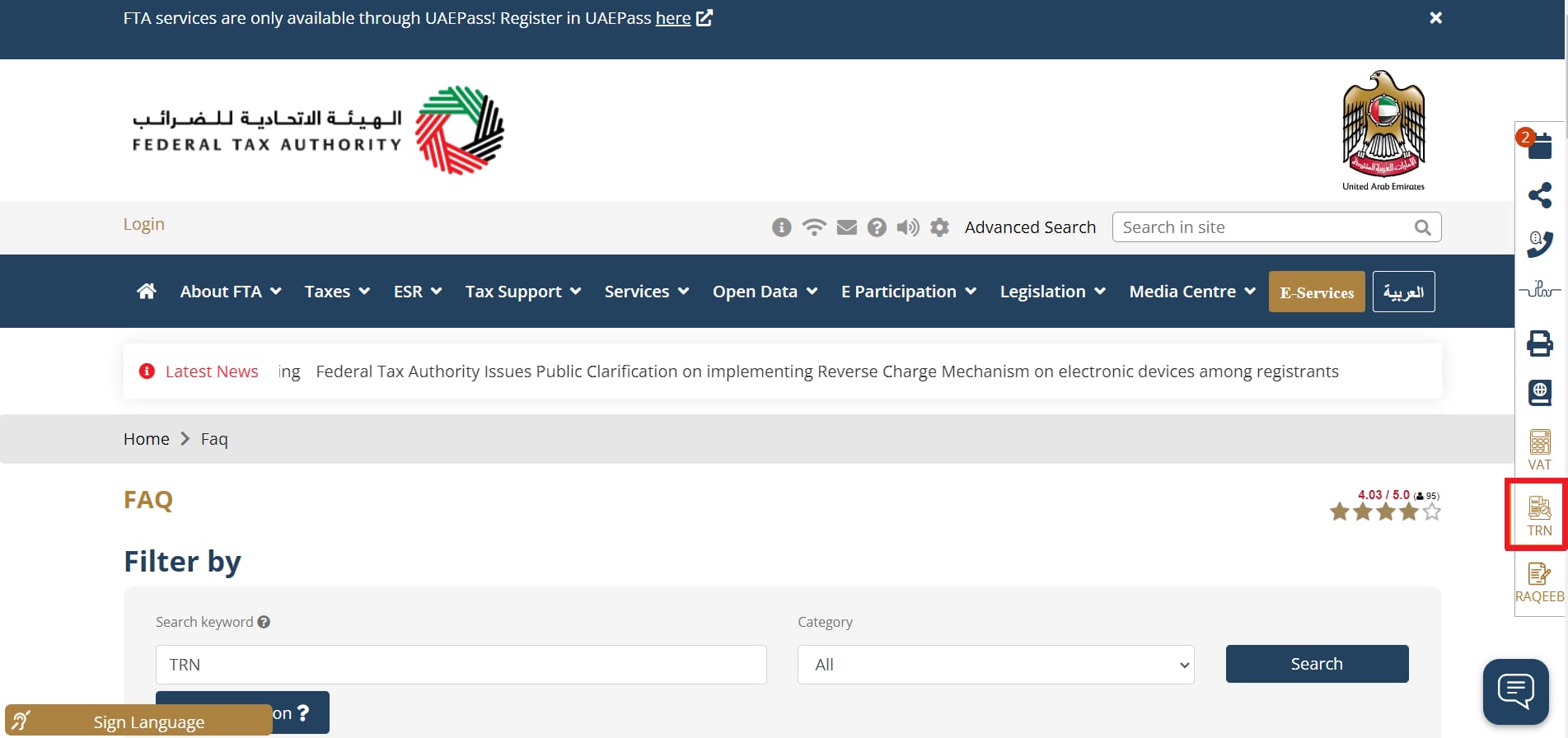
    Step 1: Access the FTA Portal

    Visit the official Federal Tax Authority website. On the homepage, locate and select the “TRN” option from the side panel.

    Access the FTA Portal

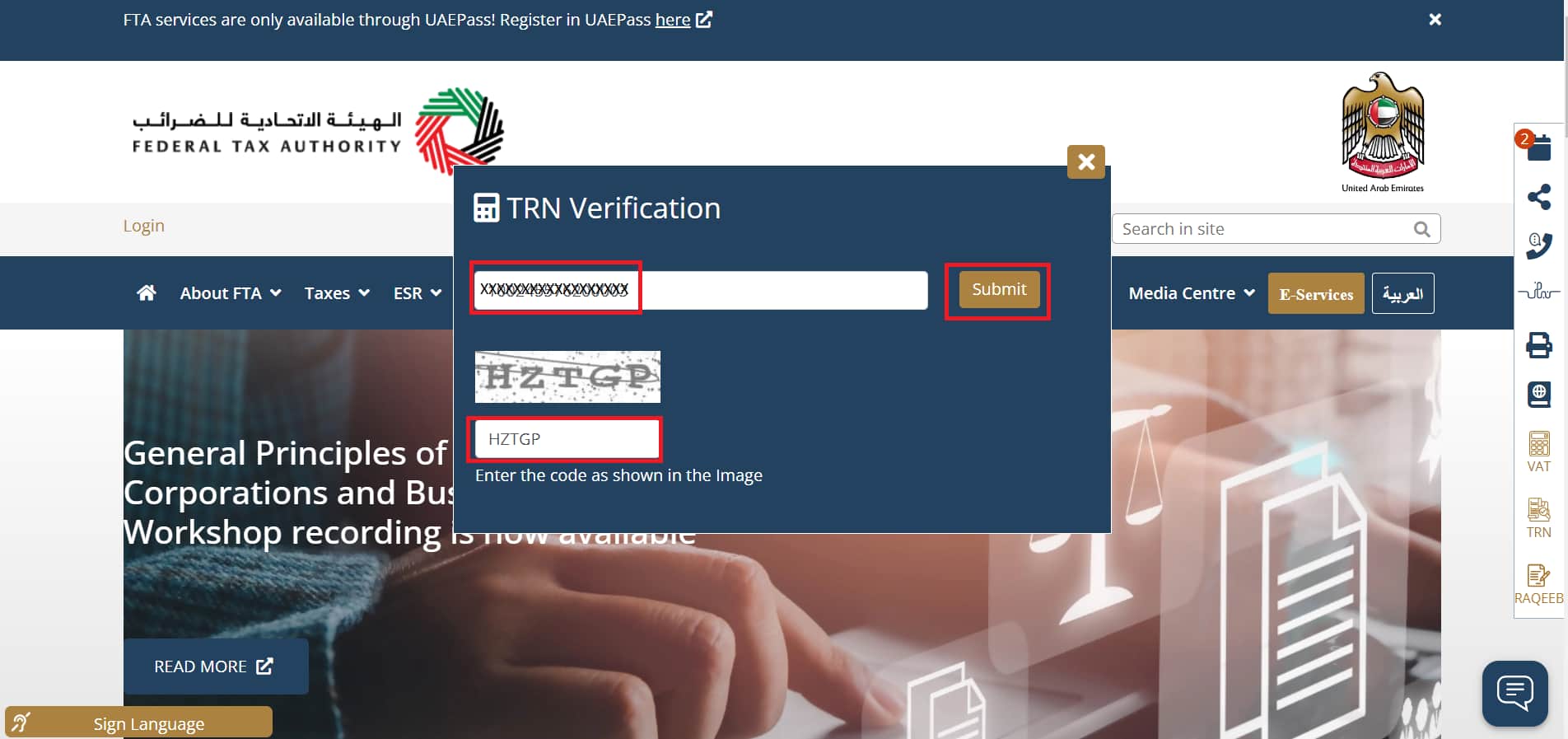
    Step 2: Enter TRN Details

    Input the Tax Registration Number in the required field, complete the captcha for security verification, and click Search.

    Enter TRN Details

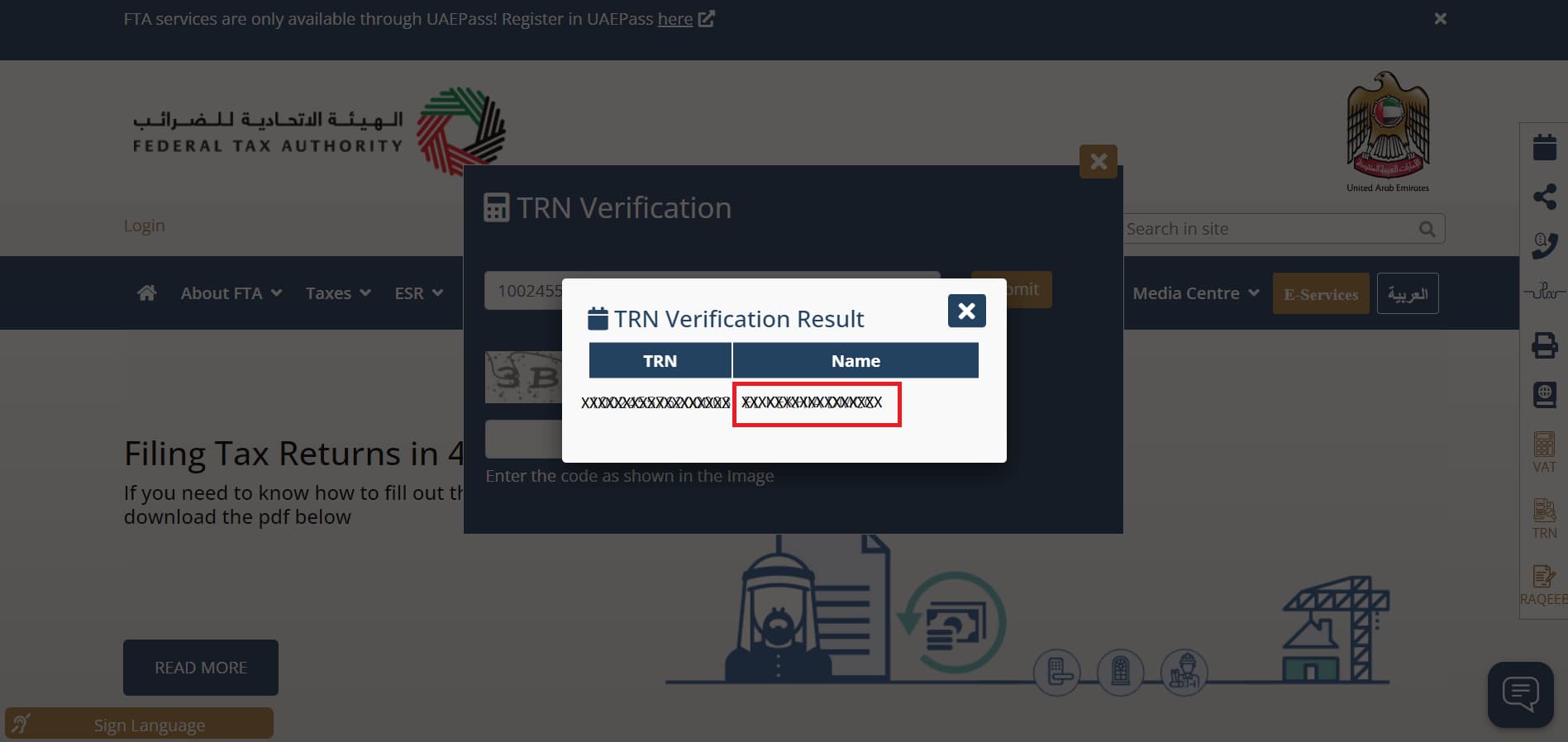
    Step 3: Confirm Business Information

    The system will display the registered business name associated with the TRN. Match these details with your records to ensure accuracy.

    Confirm Business Information

    This process applies nationwide and is commonly used for TRN verification in Dubai and other emirates. Regular TRN verification helps businesses avoid errors, ensure VAT compliance, and maintain transparent transactions.

    What Is the Purpose of a TRN and VAT in the UAE?

    After a business successfully completes VAT registration, the Federal Tax Authority (FTA) issues a Tax Registration Number (TRN) along with an official TRN certificate. This certificate authorises the company to file VAT returns within the timelines set by the FTA and confirms its legal status as a VAT-registered entity.

    Holding a valid TRN allows a business to:

    • Build trust with large corporations and government entities, as many prefer working only with TRN-registered vendors
    • Strengthen its banking profile when opening or maintaining corporate bank accounts
    • Officially represent the company before foreign authorities, partners, and international institutions

    How can Shuraa Tax support you?

    To avoid penalties, you can employ a reputable consulting firm that can provide end-to-end solutions for TRN registration, from assessment to procurement.

    For a better grasp of the TRN requirements, Shuraa Tax can assist your business in navigating the extensive guidelines of the UAE’s new tax law. With our assistance, you can establish a tax structure for your business that will save you time, mitigate risks, and safeguard your assets.

    📞 Call: +(971) 44081900

    💬 WhatsApp: +(971) 508912062

    📧 Email: info@shuraatax.com

  • Documents Required for VAT registration in Dubai

    Documents Required for VAT registration in Dubai

    Documents required for VAT registration will be submitted to the Federal Tax Authority (FTA) via a web portal. To obtain the Tax Registration Number (TRN) for the firm, several conditions for VAT registration in the UAE must be met.  

    If a company’s taxable supply and imports surpass the statutory registration level of AED 375,000, it must register for VAT. Furthermore, a company may voluntarily register for VAT if the total amount of its taxable supplies and imports (or taxable costs) exceeds the AED 187,500 voluntary registration threshold.  

    Penalties may apply for non-compliance with the UAE VAT Executive Regulations and law. There is also the risk of a firm losing its legal position and consumer confidence due to noncompliance with regulatory requirements.   

    What is VAT in the UAE? 

    Value Added Tax (VAT) in the UAE is an indirect tax applied to most goods and services at each stage of the supply chain. Simply put, it’s a small percentage added to the price of products or services when they’re sold. Introduced on January 1, 2018, VAT is currently charged at a standard rate of 5%. Businesses collect this tax on behalf of the government and later remit it to the Federal Tax Authority (FTA). 

    VAT plays a crucial role in supporting the UAE’s vision to reduce its reliance on oil revenue and build a sustainable economy. While it may seem like a small addition, VAT helps fund essential public services such as healthcare, education, and infrastructure, ultimately contributing to the country’s long-term growth and stability. VAT in the UAE ensures that everyone contributes a fair share to the nation’s development while maintaining a transparent and balanced tax system. 

    What is VAT Registration? 

    VAT registration is the official process through which a business becomes recognised by the Federal Tax Authority (FTA) as a taxpayer in the UAE. Once registered, the company is authorised to collect VAT from customers on taxable goods and services and remit it to the government. In simpler terms, VAT registration gives a business its Tax Registration Number (TRN), a unique ID used for all VAT-related transactions, invoices, and filings. 

    Businesses in the UAE must register for VAT if their annual taxable turnover exceeds AED 375,000, which is the mandatory registration threshold. However, those with turnover above AED 187,500 but below the required limit can register voluntarily to claim input tax and enhance business credibility. Registering for VAT ensures compliance with UAE tax laws and builds trust with clients and authorities, a key step for any business operating in the country’s evolving financial landscape. 

    Mandatory vs Voluntary VAT Registration in the UAE 

    When it comes to understanding VAT registration requirements in the UAE, it’s essential to know that businesses can either register mandatorily or voluntarily depending on their turnover and taxable activities. Let’s break down the two types and why they matter for your business. 

    1. Mandatory VAT Registration in the UAE 

    If your business is growing rapidly, this part concerns you. Mandatory VAT registration applies when your total taxable supplies and imports in the past 12 months exceed AED 375,000

    Alternatively, if you expect your business turnover to cross this threshold within the next 30 days, you must register as well. This rule ensures that all qualifying businesses remain compliant with the VAT registration requirements set by the Federal Tax Authority (FTA) in the UAE

    However, it’s important to note that this threshold doesn’t apply to foreign businesses operating in the UAE; they follow different VAT obligations. 

    2. Voluntary VAT Registration in the UAE 

    Not hitting the mandatory limit doesn’t mean you’re out of the VAT system. In fact, smaller businesses can still register voluntarily, and there are good reasons to do so. 

    If your taxable supplies and imports or even taxable expenses over the past 12 months exceed AED 187,500, or if you expect to cross that in the next 30 days, you can apply for voluntary VAT registration

    This gives startups and small enterprises a strategic edge by allowing them to claim VAT refunds on business purchases and establish credibility in the market. 

    Why does VAT Registration Matters Businesses in the UAE? 

    Whether your registration is mandatory or voluntary, completing your VAT registration is not just about compliance; it’s about building business credibility. 

    Here’s why it’s so important: 

    • It ensures your business complies with the UAE’s tax laws. 
    • You can reclaim VAT paid on business expenses, reducing operational costs. 
    • Being VAT-registered boosts your company’s image, showing you operate transparently and professionally. 
    • It allows seamless transactions with other VAT-registered companies in the UAE. 

    Ignoring VAT registration can be costly. Businesses that fail to register or file VAT returns face a fine of AED 10,000, plus AED 1,000 per tax period for missed returns. Additionally, non-registered companies lose input tax credits, directly affecting their profits. 

    Documents Required for VAT Registration in the UAE 

    Businesses must complete the required documentation to register for VAT in the UAE. VAT registration and fee payment (for paid services) will be completed online. The documents listed below are necessary for VAT registration in the UAE.  

    • Business Trade License or Commercial License   
    • Passport copies of the owner or partners of the company mentioned on the license 
    • Emirates ID of the owners/ partners of companies (as per the business license)  
    • Memorandum of Association (MOA)  
    • Complete Company Address  
    • Authorised Signatory’s Contact with email, number  
    • Company Bank Details, including IBAN letter 
    • Details of branch (if any)  
    • Turnover Declaration (Signed & Stamped by the owner or the manager)  
    • Amount of the expected revenue, turnover, and taxable expense for the next 30 days   
    • To specify if the Company does GCC export or import   
    • Provide the custom code along with a copy of the Dubai Customs letter (if any) 
    • Specify if your company would like to be registered as a tax group   
    • As per the Federal Tax Authority, you may also require additional documents or authorisation depending on your business activity, the jurisdiction of your business and other such factors.  

    What is the Timeline for VAT Registration? 

    The materials will be submitted electronically. Upon completing online VAT registration, you will receive your Tax Registration Number (TRN) from the Federal Tax Authority (FTA). The Processing time is 20 business working days from the date of sharing complete information with FTA. The application may take longer if additional details are required.   

    What is the Significance of VAT Registration in Dubai?   

    Paying taxes is viewed by some business owners as an expense. They have no idea that registering their businesses for VAT might bring several benefits.   

    • It raises the company’s profile. Companies may, of course, show their VAT registration to key stakeholders and business associates, thereby enhancing their credibility and customer preference. Customers are more inclined to prefer a company that has registered for VAT than one that does not.   
    • Tax avoidance is sometimes considered a crime, and if found guilty, the corporation may face severe financial penalties in case of non-compliance or delayed compliance. Registering your business for VAT in Dubai avoids these situations and ensures your firm grows while also benefiting society. 
    • It should be underlined that VAT is not intended to burden enterprises. VAT refunds are available in certain instances. 
    • Overall, it helps the company capture a broader market and boost its reputation, thereby expanding its client base.  

    Required Documents for Tax Group Registration  

    Businesses in the UAE can make a tax group registration application. Several enterprises of various types can also form a tax group. According to the Federal Tax Authority (FTA), if entities are related to parties with a common ownership of 50% or more, then all those companies can be combined into one tax group. The FTA will issue a single TRN for the entire group of companies. Group structure, no objection letter, and turnover declaration need to be submitted.  

    How do I register for VAT in Dubai?  

    Online registration for VAT is available. To register for VAT, individuals or businesses must first create an account on the Federal Tax Authority (FTA) website.  

    Several official documents are needed for VAT registration. Before submitting a VAT registration application to the FTA, a few crucial documents must be attached to the application. After the Tax Registration Number (TRN) has been approved, a VAT Certificate will be issued. A distinctive, specific Tax Registration Number (TRN) will be assigned to each VAT certificate.  

    How to Register a Tax Group in the UAE? 

    Only the group’s representative company may apply for tax group registration. A representative firm of the group must apply for VAT registration. Each potential member of the Tax Group is required to:  

    • Being a person of law (not a natural person)  
    • Be a UAE resident who is not a part of another Tax Group.  
    • Must have a place of establishment or a fixed establishment in the UAE  
    • Must be a related party of the group members and the representative  
    • One or more persons conducting business in a partnership must control the others  

    How to Register for a Tax Registration Number in the UAE? 

    If you’re running a business in the UAE, one of the first steps after understanding VAT is getting your Tax Registration Number (TRN). This number is issued by the Federal Tax Authority (FTA) and acts like your business’s unique tax identity; it’s what officially makes your company recognized for VAT purposes. 

    Getting a TRN might sound complicated, but the process is actually straightforward if you know what to expect. Here’s a simple, step-by-step guide to help you through it: 

    Step 1: Create an FTA e-Services Account 

    Start by visiting the Federal Tax Authority’s official website — https://tax.gov.ae
    Click on “Sign Up” to create your e-Services account. You’ll need to provide basic details like your email address and set a password. Once you confirm your email, you can log in and start your tax registration journey. 

    Step 2: Begin Your VAT Registration Application 

    After logging in, head to the “VAT Registration” section. This is where you’ll fill out the form to apply for your TRN. Make sure you have all your business details ready, including: 

    • Your trade license number and copy 
    • Owner’s Emirates ID or passport copy (for non-residents) 
    • Contact details (email, phone, address) 
    • Bank account details 
    • Financial records showing your turnover 

    These details help the FTA verify your eligibility for VAT registration. 

    Step 3: Fill Out the VAT Application Form 

    Now comes the main part, completing the VAT registration form. The form will ask for information about your business structure (LLC, sole establishment, etc.), business activities, and financial data. You’ll also need to specify whether your registration is mandatory or voluntary, based on your annual taxable supplies. 

    Note: Be careful here; any incorrect information could delay your TRN approval. 

    Step 4: Submit the Application 

    Once you’ve filled everything out and attached all required documents, review the form carefully. After double-checking, click “Submit for Approval.” 

    The FTA will then review your application, which can take anywhere between 5 to 20 working days, depending on the accuracy of your submission and current processing times. 

    Step 5: Receive Your TRN Certificate 

    If your application is approved, you’ll receive your Tax Registration Number (TRN) via email. You can also download your VAT Certificate from your FTA account. 

    Your TRN will be a 15-digit number; this is what you’ll need to include on your invoices, tax returns, and official documents related to VAT. 

    Why Shuraa tax?  

    Businesses must create an online account on the FTA website and complete the VAT registration form to register for VAT in the UAE. The documents mentioned above can be uploaded, and the procedure can be completed while registering for VAT on the website. Contact Shuraa Tax Consultants if you are confused about how to proceed or if you have any questions concerning the paperwork necessary for VAT registration in Dubai.  

    Shuraa Tax Consultants provides a complete solution for UAE VAT registration services, including the documentation required for VAT registration in Dubai and throughout the UAE, as well as assistance with the online registration process. Our tax consultants guarantee that the VAT registration procedure is simple. We provide comprehensive counselling in terms of FTA VAT registration online, tax accounting services, financial record keeping, bookkeeping services, corporate taxation, and so forth. Contact Shuraa Tax Consultants right away for UAE VAT implementation! All you need to do is reach out to us at:

    📞 Call: +(971) 44081900
    💬 WhatsApp: +(971) 508912062
    📧 Email: info@shuraatax.com