Category: Tax Invoice

  • E-invoicing In Saudi Arabia: Step-by-step Guide

    E-invoicing In Saudi Arabia: Step-by-step Guide

    Saudi Arabia is going through a major digital change as part of its Vision 2030 plan, and one important step in this journey is the move to e-invoicing. To make business transactions more transparent and efficient, the Zakat, Tax and Customs Authority (ZATCA) has introduced new rules that require businesses to switch from paper invoices to electronic ones.

    If you’re a business owner in Saudi Arabia, it’s important to understand how this system works and what you need to do to stay compliant.

    What is E-invoicing in Saudi Arabia?

    In Saudi Arabia, e-invoicing, commonly known as Fatoorah, is a government-mandated process that replaces traditional paper invoices with fully digital ones. Instead of printing and manually storing invoices, businesses must now generate, issue, and keep them electronically.

    The Zakat, Tax and Customs Authority (ZATCA) introduced e-invoicing in two key phases. Phase 1, which began on December 4, 2021, focuses on the digital creation and storage of invoices. Phase 2, launched on January 1, 2023, goes a step further by requiring businesses to integrate their e-invoicing systems directly with ZATCA’s Fatoora platform for real-time reporting and validation.

    Traditional vs. Electronic Invoicing

    Let’s understand at how electronic invoicing (e-invoicing) compares to the old way of issuing paper invoices.

    Traditional Invoicing

    • Invoice Creation: Invoices are created manually, often on paper or simple digital files like PDFs or Word Documents.
    • Format and Structure: No standard structure; format varies by business, which can cause errors or inconsistencies.
    • Delivery Method: Invoices are sent via email or printed and mailed physically.
    • Government Integration: No integration with government tax systems.
    • Reporting: Reporting is manual and usually delayed, making tax audits and compliance slower.

    Electronic Invoicing

    • Invoice Creation: Invoices are generated electronically in a standardised digital format specified by ZATCA.
    • Authentication: Invoices are digitally signed to ensure authenticity and integrity.
    • System Integration: During Phase 2, businesses must integrate their invoicing system with ZATCA’s Fatoora platform for real-time invoice submission and validation.
    • Reporting: Reporting to tax authorities is automatic and immediate, improving accuracy and compliance.

    Legal Framework and ZATCA’s E-invoicing Mandate

    The Zakat, Tax and Customs Authority (ZATCA) is the governing body responsible for implementing and overseeing the e-invoicing system in Saudi Arabia. Its primary objectives include:

    • Enhancing Transparency: By digitizing invoices, ZATCA aims to reduce the shadow economy and ensure accurate reporting of transactions.
    • Improving Compliance: E-invoicing facilitates real-time monitoring, making it easier for businesses to adhere to tax regulations.
    • Reducing Fraud: Electronic records are harder to manipulate, thereby minimizing fraudulent activities,

    Key Regulations and Compliance Requirements

    The e-invoicing in Saudi Arabia mandate is structured into two main phases, each with specific requirements:

    Phase 1: Generation Phase

    Effective Date: December 4, 2021

    Requirements: 

    • Businesses must generate and store electronic invoices and notes using compliant systems.
    • Inclusion of QR codes on invoices, particularly for B2C transactions.
    • Optional features include XML formatting, digital signatures, and unique invoice identifiers.

    Phase 2: Integration Phase

    Effective Date: January 1, 2023

    Requirements: 

    • Integration of the business’s e-invoicing system with ZATCA’s Fatoora platform for real-time invoice validation and reporting.
    • Mandatory use of XML format for invoices, incorporating elements like QR codes and digital signatures.
    • Implementation of security features to prevent tampering and ensure data integrity.

    Phases of Implementation (Phase 1: Generation; Phase 2: Integration)

    Phase 2 is being implemented in waves, targeting taxpayers based on their annual VAT-subjected revenues. ZATCA notifies each group at least six months prior to their integration deadline. Key waves include:

    • Wave 15: Taxpayers with revenues exceeding SAR 4 million during 2022 or 2023; integration by 1 March 2025.
    • Wave 16: Revenues over SAR 3 million; integration by 1 April 2025.
    • Wave 17: Revenues over SAR 2.5 million; integration by 31 July 2025.
    • Wave 19: Revenues over SAR 1.75 million; integration by 30 September 2025.
    • Wave 21: Revenues over SAR 1.25 million; integration by 30 November 2025.
    • Wave 22: Revenues over SAR 1 million; integration by 31 December 2025.

    Each wave’s criteria are based on revenues from 2022, 2023, or 2024. ZATCA continues to announce subsequent waves, progressively encompassing businesses with lower revenue thresholds.

    Who Must Comply with E-invoicing in Saudi Arabia?

    E-invoicing is mandatory for the following entities under the VAT system:

    • VAT-Registered Businesses: All businesses registered for VAT in Saudi Arabia must issue e-invoices.
    • Entities Required to Register for VAT: If your business meets the VAT registration threshold, you must also comply with e-invoicing rules.
    • Third Parties: Agents or service providers issuing invoices on behalf of VAT-registered businesses must follow e-invoicing regulations.
    • Resident Taxable Persons: Individuals or businesses residing in Saudi Arabia and conducting taxable activities are included.

    Who Is Exempt? Non-Resident Taxable Persons: Foreign businesses that are not residents in Saudi Arabia are currently exempt.

    Which Transactions Are Covered? 

    • B2B, B2C, and B2G: E-invoicing applies to sales between businesses, businesses and consumers, and businesses and government entities.
    • Also applies to credit and debit notes.

    Types of E-invoices in Saudi Arabia

    Under the e-invoicing regulations by ZATCA, there are two main types of electronic invoices that businesses must issue:

    1. Standard Tax Invoice

    The Standard Tax Invoice is used for business-to-business (B2B) and business-to-government (B2G) transactions. It includes detailed information such as the seller and buyer’s VAT numbers, invoice number, VAT amount, and more. This type of invoice allows the buyer to claim input VAT and, in Phase 2, must be issued in a specific XML format embedded within a PDF/A-3 file.

    2. Simplified Tax Invoice

    The Simplified Tax Invoice is designed for business-to-consumer (B2C) transactions. It contains basic details like the seller’s information, total amount, VAT charged, and a QR code. This invoice is usually issued at the point of sale and is simpler than the standard invoice, making it suitable for retail and consumer-facing businesses.

    How to Implement E-invoicing in Your Business in Saudi Arabia?

    Implementing e-invoicing in Saudi Arabia may seem complex at first but breaking it down into steps can make the process much easier.

    Step 1: Understand the Regulations

    Start by familiarizing yourself with ZATCA’s e-invoicing rules, including the two phases:

    • Phase 1 (Generation): You need to generate and store invoices electronically.
    • Phase 2 (Integration): Your system must be integrated with ZATCA’s Fatoora portal.

    Step 2: Assess Your Current Invoicing System

    Check if your current billing or ERP system supports e-invoicing. If not, you’ll need to upgrade or switch to an approved solution that meets ZATCA’s technical specifications.

    Step 3: Choose a Compliant E-invoicing Solution

    Select an e-invoicing software or service provider that is registered with ZATCA and supports invoice generation, digital signatures, QR codes, and integration with the Fatoora portal.

    Step 4: Implement Security and Data Accuracy Measures

    Ensure each invoice is digitally signed with a UUID and cryptographic stamp to prevent tampering. Store e-invoices securely for a minimum of six years, as mandated by ZATCA.Implement validation checks to ensure the accuracy of invoice details before submission.

    Step 5: Prepare Your Team

    Train your finance and operations team on how to use the new e-invoicing system, including how to issue standard and simplified tax invoices.

    Step 6: Configure and Test Your System

    Work with your IT team or service provider to configure the system according to ZATCA’s requirements. Run test invoices to ensure everything, from formatting to QR codes, is correct.

    Step 7: Go Live and Stay Updated

    Once your system is ready, begin issuing e-invoices as per the mandated timeline. Keep monitoring updates from ZATCA, as new waves of Phase 2 integration are rolled out progressively.

    Get Your Business E-invoice Ready Today

    E-invoicing in Saudi Arabia is not just a rule, it’s part of the country’s move toward a smarter, digital future. If your business hasn’t started yet, now is the right time. Getting on board early means you’ll avoid last-minute rush, stay fully compliant with ZATCA, and enjoy long-term benefits like better record-keeping, fewer errors, and faster processing.

    But we understand it can feel confusing at first and that’s where Shuraa Tax can help.

    Our experts will guide you through the entire e-invoicing process, from choosing the right ZATCA-approved software to setting it up and keeping you updated with the latest rules.

    Need help with e-invoicing? 

    Reach out to Shuraa Tax today, we’re here to make the process simple and stress-free.

    📞 Call: +(971) 44081900
    💬 WhatsApp: +(971) 508912062
    📧 Email: info@shuraatax.com
  • E-Invoicing in United Arab Emirates

    E-Invoicing in United Arab Emirates

    In today’s digital era, businesses worldwide are transitioning to electronic invoicing (e-invoicing) to streamline operations and ensure compliance with evolving tax regulations. The United Arab Emirates (UAE) is no exception. e invoicing UAE aims to modernise invoicing, reduce fraud, and enhance tax transparency.

    With a structured e-billing system, companies, whether small business owners or large corporations, can automate invoicing, minimise errors, and improve efficiency.

    Understanding UAE e-invoicing is crucial to complying with the Federal Tax Authority (FTA). This guide will provide an in-depth look into E-invoicing in the UAE, covering everything from its timeline and legal background to implementation, challenges, and expert assistance.

    What is E-Invoicing in UAE?

    E invoicing UAE refers to the electronic generation, authentication, and exchange of invoices in a standardised digital format. Unlike traditional paper-based invoices, E-invoices ensure a seamless, automated process that enhances tax compliance and reduces manual intervention.

    The UAE E-invoicing system follows a structured approach where businesses generate invoices in a predefined format, ensuring transparency and efficiency in financial transactions. This system helps businesses:

    • Maintain accurate records
    • Streamline financial operations
    • Reduce invoice processing times
    • Meet the regulatory requirements set by the Federal Tax Authority (FTA)

    Businesses can improve cash flow and operational efficiency by eliminating human errors and automating invoicing processes.

    E-Invoicing in UAE Timeline

    The UAE government has been progressively moving towards digital transformation in taxation. Below is a timeline highlighting key milestones in the UAE E-invoicing journey:

    • 2021: Initial discussions and framework planning for implementing E-invoicing UAE began.
    • 2022: The UAE explored adopting structured E-invoicing regulations aligned with global best practices.
    • 2023: The Federal Tax Authority (FTA) announced a phased implementation of E-invoicing in the UAE’s business requirements.
    • 2024 & Beyond: Full-scale adoption and mandatory compliance expected for all taxable entities.

    Businesses must stay informed about these phases to ensure timely compliance and avoid penalties.

    Recent Update on E-Invoicing UAE

    The latest update on UAE e-invoicing includes the Federal Tax Authority (FTA) ‘s announcement of the gradual implementation of E-invoicing requirements. Businesses must comply with specific E-invoicing guidelines, including the format, authentication methods, and reporting standards set by the FTA.

    The UAE is also working towards integrating E-invoicing with VAT reporting systems to enhance tax compliance and improve revenue collection efficiency. The transition towards a mandatory E-invoicing system demonstrates the UAE’s commitment to financial transparency and technological innovation in taxation.

    UAE Adopts 5-Corner PEPPOL Model for E-Invoicing

    The UAE has adopted the 5-Corner PEPPOL model for e-invoicing, aligning with global standards to enhance tax compliance and digital transformation. This model facilitates the secure exchange of invoices between businesses and the Federal Tax Authority (FTA), ensuring real-time tax reporting. The five key components include the supplier, sender access point (ASP), receiver ASP, buyer, and the FTA data platform.

    The UAE’s e-invoicing mandate will be phased in by July 2026, initially applying to VAT-registered businesses engaged in B2B and B2G transactions. This move will reduce invoice processing costs, improve compliance, and enable seamless cross-border transactions.

    E-Invoicing Framework in UAE

    The UAE E-invoicing framework is structured to facilitate seamless digital transactions between businesses and the FTA. The framework consists of:

    • Mandatory digital invoicing for taxable entities to ensure compliance
    • Standardised invoice formats to maintain uniformity across industries
    • Electronic authentication and secure storage of invoices to prevent tampering or loss
    • Integration with VAT reporting and tax collection systems

    This structured framework reduces tax evasion, enhances financial transparency, and automates tax-related documentation. By adopting e invoicing UAE, businesses can ensure regulatory compliance while optimising their financial processes.

    Scope of e-Invoicing in UAE

    E-invoicing applies to all businesses operating within the UAE’s tax framework, including:

    • VAT-registered businesses
    • Suppliers of goods and services
    • Entities involved in cross-border transactions
    • Businesses engaged in e-commerce
    • Freelancers and self-employed professionals are subject to VAT

    As the UAE moves towards an utterly digitised tax system, compliance with UAE E-invoicing regulations will become necessary for all taxable businesses.

    Implementing Authority for UAE e-Billing System

    The Federal Tax Authority (FTA) is the primary governing body overseeing E invoicing UAE compliance. The FTA ensures:

    • Proper implementation of UAE e-invoicing standards
    • Adherence to VAT regulations
    • Digital authentication and security measures to prevent fraud
    • Real-time tax reporting and transparency

    What is the required format for e-invoices in the UAE?

    E-invoices in the UAE must follow a structured format, ensuring consistency and compliance. The key elements include:

    • Unique Invoice Reference Number (IRN)
    • Supplier & buyer details, including VAT registration numbers
    • Transaction date & invoice issue date
    • Breakdown of VAT charges, including tax rates and amounts
    • QR Code for authentication and verification by authorities
    • Digital signature or secure electronic stamp

    This standardized format ensures that UAE e-invoicing remains transparent and easily verifiable by tax authorities, preventing tax evasion and fraud.

    Legal and Background for E-Invoicing in the UAE

    The legal framework for E-invoicing in the UAE is built upon VAT laws and digital tax initiatives. The FTA’s decision to implement UAE e-invoicing aligns with global tax trends aimed at:

    • Reducing tax fraud and ensuring financial transparency
    • Complying with VAT laws and preventing fraudulent transactions
    • Enhancing the efficiency of tax collection and enforcement
    • Aligning with international best practices in digital taxation

    Failure to comply with E-invoicing regulations in the UAE may result in penalties, making it essential for businesses to stay updated with legal requirements.

    Steps to Prepare Your Business for E-Invoicing in the UAE

    To comply with UAE E-invoicing regulations, businesses should:

    1. Assess Readiness: Evaluate existing invoicing processes and determine required changes.
    2. Adopt Digital Invoicing Software: Implement an FTA-approved e invoicing UAE system.
    3. Train Employees: Ensure staff are well-trained in UAE e-invoicing requirements and procedures.
    4. Integrate with VAT Compliance Systems: Align e-invoicing UAE processes with VAT reporting.
    5. Monitor Compliance: Regularly check for updates from the FTA to ensure ongoing compliance.
    6. Test and Validate: Conduct test runs before full implementation to ensure your system generates invoices correctly.

    How Shuraa Tax Can Help Your Business with e-Invoicing in UAE

    At Shuraa Tax, we specialise in helping businesses seamlessly transition to E-invoicing in the UAE. Our team offers:

    • Expert consultation on UAE E-invoicing compliance
    • Implementation of automated E-invoicing UAE solutions
    • VAT compliance guidance and support
    • Integration with tax and accounting systems
    • Training and support for staff and financial teams

    Whether you are a startup or an established business, our experts ensure that your invoicing system aligns with the latest FTA regulations on E-invoicing UAE.

    Challenges of E-Invoicing for Businesses in UAE

    While UAE E-invoicing offers numerous benefits, businesses may face challenges such as:

    • Initial implementation costs for software and training
    • Technical complexities in integrating new systems
    • Adapting to regulatory changes and compliance updates
    • Ensuring data security and avoiding cyber threats

    Overcoming these challenges requires expert guidance and the proper technological support.

    Conclusion

    E invoicing UAE is a significant step towards digital transformation, ensuring tax compliance, reducing fraud, and improving business efficiency. As the FTA continues implementing structured UAE E-invoicing regulations, businesses must stay updated and adopt the right solutions to ensure seamless compliance.

    For expert assistance in implementing UAE E-invoicing solutions, contact Shuraa Tax today:

    📞 Call: +(971) 44081900
    💬 WhatsApp: +(971) 508912062
    📧 Email: info@shuraatax.com
    FAQs

    1. Is e-invoicing required in the UAE?

    E-invoicing is not mandatory in the UAE, but businesses are encouraged to adopt it for better compliance and efficiency.

    2. What should a tax invoice include in the UAE?

    A UAE tax invoice must include the supplier’s and buyer’s names, TRN, invoice date, VAT amount, and total payable amount.

    3. What are the advantages of using e-invoicing in the UAE?

    E-invoicing enhances accuracy, speeds up transactions, reduces errors, and ensures compliance with VAT regulations.

    4. Why is digital billing crucial in the UAE?

    Digital billing simplifies tax reporting, reduces paperwork, and helps businesses comply with VAT regulations efficiently.

    5. What is Peppol FTA in the UAE?

    Peppol FTA (Federal Tax Authority) is a global e-invoicing network that standardises invoice exchange between businesses and tax authorities in the UAE.

    6. How does Peppol e-invoicing benefit UAE businesses?

    Peppol e-invoicing ensures secure, automated, seamless transactions while improving tax compliance and efficiency.

    7. How can companies adopt Peppol e-invoicing in the UAE?

    Businesses can implement Peppol e-invoicing by partnering with an accredited service provider and integrating their invoicing system with the Peppol network.

  • Tax Invoice Under VAT in UAE

    Tax Invoice Under VAT in UAE

    The Tax invoice in Dubai is important for businesses and tax authorities. It serves as a clear record of transactions. It ensures that VAT regulations are followed and makes it easier to manage tax payments. A well-prepared tax invoice not only helps in claiming VAT refunds but also keeps your financial records organised and transparent.

    Understanding the key elements to include on a tax invoice, such as VAT amounts and business details. It can simplify your accounting processes and reduce the risk of errors. By mastering the format and requirements of a tax invoice, businesses can move the VAT system smoothly and maintain smooth operations.

    What is Tax Invoice in UAE?

    A tax invoice in UAE is a formal document issued by a seller to a buyer that details the goods or services provided and the amount of Value Added Tax (VAT) charged. It serves several essential functions:

    • Record-Keeping: It provides a detailed transaction record, including the date, description of items or services, quantity, price, and VAT amount.
    • VAT Compliance: It ensures that the VAT charged is documented correctly, helping the seller and buyer comply with tax regulations.
    • Tax Refunds: For businesses, a tax invoice is essential for claiming VAT refunds or credits, as it acts as proof of the tax paid.
    • Financial Transparency: It aids in maintaining transparent financial records for both parties involved, which is crucial for audits and financial reporting.

    In essence, a tax invoice is a key component of VAT administration, helping businesses manage their tax obligations and maintain accurate financial records.

    When should you issue a tax invoice in Dubai?

    A tax invoice in the UAE must be issued in the following situations:

    • When Goods or Services Are Supplied: A tax invoice should be issued when a sale of goods or services occurs. This applies to both B2B (business-to-business) and B2C (business-to-consumer) transactions.
    • Within 14 Days: The invoice must be issued within 14 days of the date the goods or services are supplied. This ensures timely documentation of the transaction for VAT purposes.
    • Upon Request: If a customer requests a tax invoice, it should be provided promptly, even if the transaction occurred earlier.
    • For Payments Received in Advance: If a business receives payment before supplying the goods or services, a tax invoice should be issued at the time of receipt.

    Issuing a tax invoice in these scenarios ensures compliance with VAT regulations and helps businesses and customers manage their tax obligations effectively.

    Who Must Issue a Tax Invoice?

    In the UAE VAT system, the seller typically issues a tax invoice, but there are exceptions where the buyer or an agent may take on this task.

    • Seller: Typically, the supplier of goods or services is responsible for issuing the tax invoice. However, in some cases, the buyer or an agent may issue it.
    • Buyer: If it’s easier for the buyer to identify the details of the goods, they can issue the tax invoice, provided the seller agrees in writing not to issue it.
    • Timing: A tax invoice must be issued within 14 calendar days of the supply date.
    • Agent: An agent selling on behalf of a supplier can issue the tax invoice, including their details and the principal supplier’s information.
    • Summary Invoice: A single tax invoice can be issued for multiple supplies to the same buyer within a month.

    Mandatory Fields in a Tax Invoice

    Here’s a table outlining the mandatory fields to be mentioned in a tax invoice according to VAT law:

    Mandatory FieldDescription
    Tax InvoiceThe words “Tax Invoice” prominently displayed
    Supplier InformationName, TRN, and address of the supplier
    Recipient InformationName, TRN, and address of the recipient
    Unique IdentifierA unique or sequential identifying number
    Invoice DateThe date when the invoice is issued
    Date of SupplyThe date when the supply occurred (if different from the invoice date)
    Description of Goods/ServicesDetails of the goods or services supplied
    Unit Price, Quantity, Tax Rate, AmountUnit price, quantity supplied, tax rate, and total amount payable
    Discounts OfferedAny discounts applied to the invoice
    Gross Value PayableTotal amount payable before VAT
    VAT Amount PayableThe VAT amount payable
    Reverse Charge DeclarationDeclaration of reverse charge if applicable

    Types of Tax Invoices in the UAE

    There are two types of tax invoices in the UAE: full tax invoice and simplified tax invoice.

    1. Full Tax Invoice: Required for most transactions and includes detailed information.
    1. Simplified Tax Invoice: A simplified tax invoice is a shorter version of a standard one, requiring fewer details.

    Full Tax Invoice

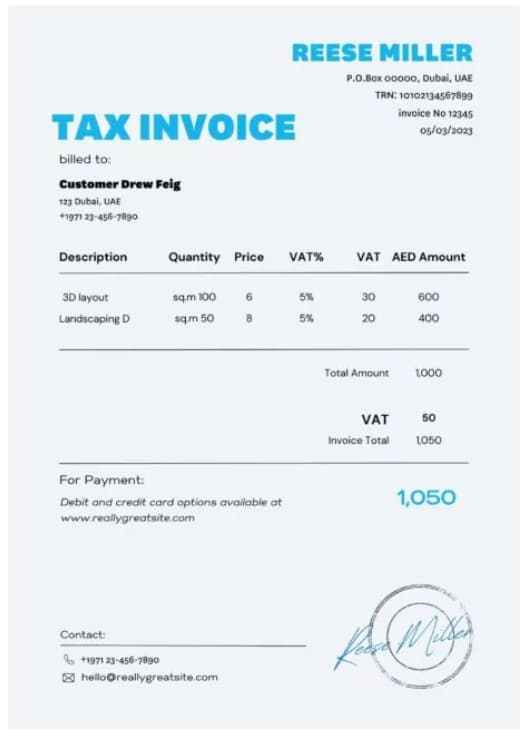
    tax invoice uae

    A valid full tax invoice must include:

    • The words “Tax Invoice” clearly displayed
    • Seller’s name, TRN, and address (P.O. Box at minimum)
    • Buyer’s name, address, and TRN (if VAT registered)
    • A sequential or unique tax invoice number
    • The date of issuing the invoice
    • The supply date (if different from the invoice date)
    • Description of goods or services supplied
    • For each item, the unit price, quantity, VAT rate, and amount payable (in AED)
    • Any discounts offered
    • The gross amount payable (in AED)
    • The VAT amount payable (in AED) and exchange rate if invoiced in foreign currency
    • If the buyer must account for VAT (e.g., reverse charge), a statement noting this and referencing the relevant law provision

    Simplified Tax Invoice in UAE

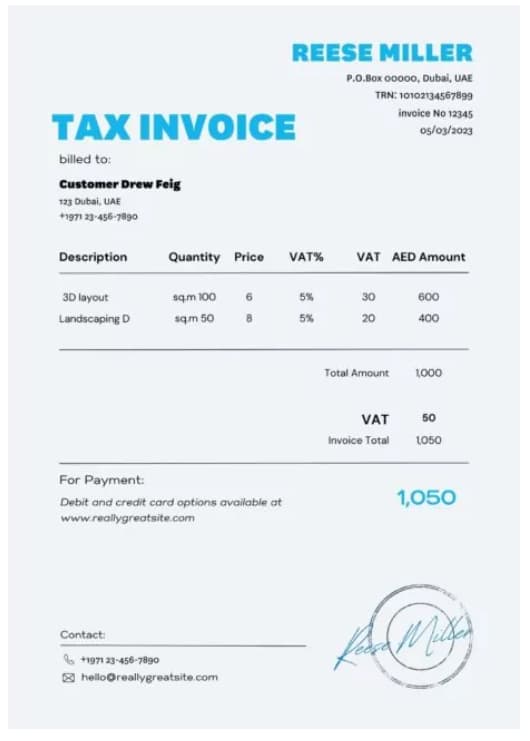
    VAT Invoice UAE

    It can be issued in two situations

    1. The recipient is not VAT-registered in UAE.
    1. The recipient is VAT-registered, but the transaction is below AED 10,000.

    Simplified tax invoices are typically issued to end consumers or small business transactions under AED 10,000.

    Mandatory Fields in a Simplified Tax Invoice

    A simplified tax invoice in the UAE must include the following details:

    • The words “Tax Invoice” prominently displayed
    • Name, TRN, and address of the supplier
    • Date of the invoice
    • Description of the goods or services
    • Total amount payable
    • Total VAT payable

    Read more: Tax Invoice Format UAE

    Simplify your Taxation with Shuraa

    In Dubai, tax invoices are vital for businesses and tax authorities. They provide a clear record of transactions and ensure VAT compliance. They help manage tax payments, claim VAT refunds, and maintain organised and transparent financial records. Understanding and including key elements like VAT amounts and business details on a tax invoice can simplify accounting processes and reduce errors.

    Businesses can turn to Shuraa Tax for expert assistance with VAT compliance, ensuring smooth operations within the VAT system. Call +971 50 891 2062 or email us at info@shuraatax.com today.

  • Tax Invoice Format UAE – FTA VAT Invoice Format

    Tax Invoice Format UAE – FTA VAT Invoice Format

    A tax invoice is a written or electronic document that documents the occurrence and specifics of a taxable supply and is defined as such by the UAE VAT Law.  Article 65 of the VAT Law requires the tax registrants making taxable supplies to issue an original Tax Invoice Format in the UAE and send it to the recipients of the goods and services. In cases where the provisions exceed AED 10,000, all tax registrants must produce tax invoices on taxable deliveries to other registrants with all mandatory details.

    Businesses that don’t send out tax invoices are subject to administrative fines. The UAE VAT Law has established several requirements for issuing tax invoices. Businesses in the UAE must strictly adhere to these requirements to avoid administrative VAT penalties.

    Requirements for Tax Invoice Format UAE

    Understanding the Tax Invoice Format in UAE is essential for businesses. To comply with the requirements, a UAE tax invoice must include the following details:

    1. Title: The words “Tax Invoice” must be displayed.
    1. Invoice Number: A unique sequential number for each invoice.
    1. Date of Issuance: The date the invoice was issued.
    1. Seller Information:
    • Name
    • Address
    • Tax Registration Number (TRN)
    1. Buyer Information:
    • Name
    • Address
    • TRN (if applicable)
    1. Description of Goods/Services: Detailed description of the goods or services provided.
    1. Quantity and Unit Price: Breakdown of the quantity and unit price of the supplies.
    1. Tax Details:
    • Applicable Tax rate
    • The exact amount of Tax charged

    Meeting these requirements ensures that your tax invoices are clear, comprehensive, and legally compliant, facilitating accurate VAT calculation and reporting. This helps protect businesses from potential penalties and legal issues in the UAE.

    UAE Requirements for Issuing Tax Invoices

    To issue a tax invoice in the UAE, businesses must meet certain requirements according to Article 59 of the Executive Regulations. Here are the key points:

    Tax Invoice Requirement:

    • Companies must provide a tax invoice whenever a supply is made.
    • The recipient of the supply must receive the tax invoice.

    Simplified Tax Invoice:

    • Only eligible suppliers can issue a simplified tax invoice.
    • A simplified tax invoice does not require a net value (amount excluding tax).

    Full Tax Invoice:

    • Each line item’s tax value and net value must be displayed.
    • Gross value is not required.

    Mandatory Details:

    • Date of issuance.
    • Unique invoice number.
    • Description of the goods or services supplied.

    VAT Amount:

    • Indicate the amount of VAT being charged.
    • This should be separate from the total amount being charged.

    Zero-Rated or Exempt Supplies:

    • Clearly state that no VAT is charged for zero-rated or exempt supplies.

    Record Keeping:

    • Keep a record of all VAT invoices issued and received.
    • Helps in staying on top of VAT reporting requirements.

    Compliance:

    • Ensure the VAT invoice format complies with UAE VAT regulations.
    • The format should include all mandatory information and be easy to understand.

    Proper Signing and Dating:

    • Ensure VAT invoices are properly signed and dated to avoid disputes.

    Following these guidelines ensures your tax invoices comply with UAE regulations and helps avoid potential issues.

    UAE’s Issuance of a Simplified Tax Invoice for VAT

    The Federal Tax Authority permits the tax invoice’s contents to contain less information than is customary in certain circumstances. In the United Arab Emirates, these invoices are simplified tax invoices, which are permitted by Article 59(5) of the Executive Regulations. It is possible to issue a simplified tax invoice in the following situations:

    • If the recipient is a VAT-registered party and the supply’s consideration is AED 10,000 or less.

    VAT Invoice Format UAE

    VAT invoice Format in UAE is an important activity for all organisations registered for VAT. When a taxable supply of goods or services is made, a registrant must issue a tax invoice, a crucial document.

    All firms must adhere to the VAT invoice format established by the FTA to avoid VAT fines and penalties in the UAE. For all organisations, knowing how to create a tax invoice in the UAE is a crucial duty and question.

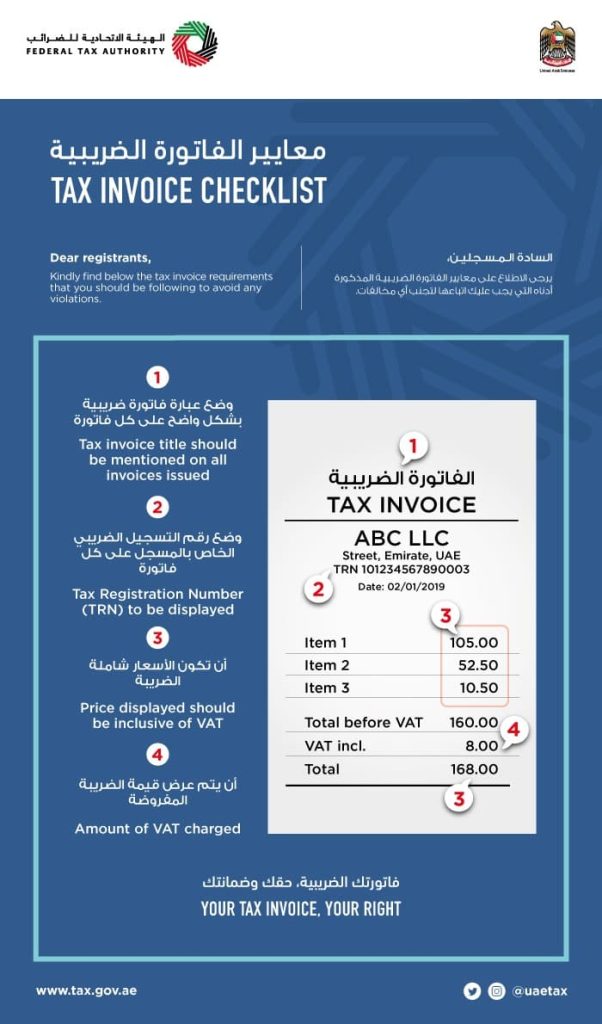
    VAT Invoice Format UAE
    Source: www.tax.gov.ae

    UAE FTA Tax Invoice Format

    Maintaining the correct VAT invoice format in the UAE is important for complying with the UAE VAT regulations. The Federal Tax Authority (FTA) has specific requirements for VAT invoices that businesses must follow. These requirements help ensure accurate reporting and payment of VAT.

    Why Proper VAT Invoice Format is Important

    • Compliance: Avoid penalties and fines from the FTA for non-compliance.
    • Accurate Record-Keeping: Helps businesses track VAT transactions and calculate VAT liabilities accurately.

    Types of Tax Invoices

    • Simplified Tax Invoice
    • Full Tax Invoice

    By following the FTA’s requirements, businesses can stay compliant and manage their VAT transactions effectively.

    Simplified Tax Invoice

    Line items will be displayed at the gross value in a streamlined tax invoice.

    The following information must be included in a simplified tax invoice format UAE:

    • The invoice plainly states that it is a “Tax Invoice”.
    • The supplier’s name, address, and Tax Registration Number (TRN).
    • The day the tax invoice was sent out.
    • A summary of the products or services offered.
    • The total consideration was received, and the taxes were paid.
       

    The whole consideration (or total gross value) is displayed at the bottom of the simplified tax invoice, and the tax included in that value is shown on a separate line.

    Full Tax Invoice

    Businesses are typically required to provide a complete tax invoice. The following information should be included in a comprehensive tax invoice format UAE:

    • A clear depiction of the text Tax Invoice.
    • The supplier’s name, address, and tax identification number.
    • The recipient’s name, address, and tax identification number.
    • Tax invoice number in order.
    • When the invoice was first issued.
    • Supply date.
    • A summary of the products or services.
    • Total amount due in AED.
    • Each line must contain net value and tax amount

    Tax Invoices Issued in Foreign Currencies

    When issuing a tax invoice in a foreign currency, the following details are required:

    1. Tax Amount: The tax amount payable must be expressed in AED.
    1. Exchange Rate: The exchange rate applied, as per the rates published by the UAE Central Bank on the date of supply, must be included.

    Tax Invoice Rounding

    When a tax invoice must be made, and the tax owed on the supply is expressed as a fraction of a Fils, the amount may be rounded mathematically to the closest Fils.

    As previously stated, the tax amount should be calculated line by line. In practice, any rounding should also be done line by line.

    Mathematical logic should be used to round the tax value on the tax invoice to the closest whole Fils or two decimal places. This is meant by “rounding the value on a mathematical basis.”

    For instance: 9.862 AED would change to 9.86, while 2.357 AED would become 2.36.

    VAT for Discounted Bills

    VAT will be applied to the value that is calculated after taking the discount into account. After the discount, VAT will be added to the pricing.

    Only if the following requirements, which are outlined in UAE VAT Executive regulations, are satisfied will the discount be permitted to be deducted from the value of supply:

    • The price drop has been advantageous to the buyer.
    • The discount was funded by the supplier.

    For example, if the supply value is 10,000 AED and the discount is 500 AED. In this instance, after considering the discount value, the value of the supply is determined to be AED 9,500. VAT will be applied to AED 9,500.

    Tax Invoice-Related Administrative Penalties format

    The UAE Tax Procedures Law makes it illegal to disregard tax invoice standards. According to the amended VAT penalties regime, firms that fail to produce a tax invoice when making any supply will receive an AED 2,500 fine for each case.

    Businesses that issue tax invoices electronically, if they do not follow the rules and regulations for the UAE’s issue of electronic tax invoices, will be subject to a fine of AED 2,500. Dubai’s VAT advisors can help companies avoid fines.

    FTA Approved Tax Agents in the UAE

    Businesses that fail to send tax invoices will be subject to severe fines, but VAT consultants in Dubai, like Shuraa Tax Consultants, can help you avoid the penalty. One of the top FTA-approved tax agents in the UAE, our knowledgeable staff can assist you with requirements such as UAE VAT registration, VAT deregistration, VAT compliance / VAT Return, excise tax services, and services linked to VAT reconsideration, Corporate Tax filing, etc. Get in touch today at +971508912062. You can also email us at info@shuraatax.com.