
Category: Dubai Tax System

  • VAT on Educational Services in the UAE

    VAT on Educational Services in the UAE

    The UAE introduced Value Added Tax (VAT) on 1 January 2018, with a standard rate of 5% on most goods and services. The main aim was to create a new source of government revenue and reduce reliance on oil income. Under this system, businesses charge VAT on their sales and can also recover the VAT they pay on their purchases.

    When it comes to VAT on educational services in the UAE, the rules are slightly different. The UAE government has given special treatment to this sector to make sure learning stays affordable. For example, many core education services provided by qualifying institutions, like tuition fees, exams, and curriculum-related books, are zero-rated. This means no VAT is charged to parents, but schools can still claim back the VAT they spend on their costs.

    On the other hand, some services, such as student transport, are exempt, which means no VAT is charged, but schools cannot recover the VAT they pay on related expenses. There are also cases where the standard 5% VAT applies, like on school uniforms, electronic devices (laptops, tablets), canteen food, and extracurricular activities that require extra fees.

    What Is a “Qualifying Educational Institution”?

    In the UAE, not every school or training centre automatically gets special VAT treatment. To fall under the zero-rated category, an institution must be considered a “qualifying educational institution.

    This includes:

    • Nurseries and preschools
    • Schools (primary and secondary)
    • Higher education institutions such as colleges and universities

    For an institution to qualify, it must meet two key conditions:

    • It should be owned by the federal or local government or receive at least 50% of its funding from them.
    • It must provide a recognised curriculum approved by the relevant authorities.

    If these conditions are met, many of the services offered by the institution, such as tuition fees and curriculum-related materials, can be treated as zero-rated under VAT.

    Zero-Rated VAT on Educational Services in the UAE

    Zero-rated educational services are those where VAT is applied at 0%. This means the institution does not charge VAT on the service, but it can still recover any VAT paid on its expenses. To qualify, the service must be provided by a Qualifying Educational Institution (nurseries, preschools, schools, or higher education institutions that are licensed and recognised by the UAE authorities).

    Examples of Zero-Rated Educational Services:

    • Tuition fees for nursery, primary, and secondary education.
    • Tuition fees for higher education programs (colleges, universities, and similar institutions).
    • Educational services that form part of a recognised curriculum approved by the relevant authority (KHDA, MOE, ADEK, or similar).

    Key Conditions:

    • The institution must be licensed by the competent authority in the UAE.
    • The service must relate directly to the delivery of the recognised curriculum.
    • Additional services (like school transport, uniforms, or extracurricular activities) do not qualify as zero-rated and are usually subject to 5% VAT.

    VAT Exempt Educational Services

    Not all education-related services qualify for the zero-rated VAT category. Some are treated as exempt, which means no VAT is charged to parents, but at the same time, the institution cannot recover the VAT it pays on its related costs.

    What Qualifies as Exempt:

    • Services that are not directly connected to the recognised curriculum.
    • Activities or offerings that go beyond the core purpose of education.

    Examples of Exempt Services:

    • Certain extracurricular activities (such as after-school clubs or hobby classes) if they are not an essential part of the curriculum.
    • Student transport services (home-to-school and back).
    • Student accommodation in dormitories or hostels.

    Difference Between Zero-Rated and Exempt:

    • Zero-rated services (0%): No VAT is charged, but the institution can still claim back the VAT it has paid on expenses.
    • Exempt services: No VAT is charged, but the institution cannot reclaim input VAT on related costs, which could increase overall expenses.

    Standard-Rated (Taxable) Educational Services in the UAE

    Even when an institution is recognised as a Qualifying Educational Institution, not all of its supplies fall under the zero-rated category. Certain goods and services provided by schools, colleges, or universities are treated as standard-rated, meaning they are subject to 5% VAT.

    Examples of Standard-Rated Educational Services:

    • School uniforms and clothing (including sports kits).
    • Electronic devices such as laptops, tablets, or calculators provided by the school.
    • Canteen services, including food and beverages sold to students.
    • Private tutoring or extra classes that are not part of the recognised curriculum.
    • Extracurricular activities that are charged separately and not directly linked to the curriculum.
    • Non-curriculum field trips (e.g., leisure outings).

    Commercial Activities Run by Institutions:

    If a school, university, or training centre operates commercial activities outside its core curriculum (e.g., renting out its facilities, hosting events, or selling non-educational products), those activities are also subject to 5% VAT.

    This distinction ensures that only the essential, curriculum-based educational services benefit from zero-rating, while all other commercial or supplementary services are treated like standard business activities under VAT law.

    VAT on Related Goods and Services

    In addition to tuition and core education, many schools and universities provide related goods and services. These can fall under different VAT categories depending on whether they are part of the recognised curriculum or additional offerings.

    1. Books and Printed Materials

    Zero-rated if the books or learning materials are directly related to the approved curriculum. For example, textbooks and required reading materials supplied by the school are zero-rated.

    2. Extracurricular Activities & After-School Programs

    Usually standard-rated (5%), unless they are an essential part of the approved curriculum. For example, sports clubs, music lessons, or hobby classes offered for an extra fee.

    3. Boarding School Accommodation & Meals

    Accommodation in student dormitories is generally exempt (like residential housing).

    Meals and food services provided separately (e.g., cafeteria, dining halls) are standard-rated (5%).

    So, if the goods or services are directly tied to the formal curriculum, they may be zero-rated. Otherwise, they are either exempt or taxable at the standard 5% rate.

    VAT Registration & Input Tax Recovery

    Educational institutions in the UAE must carefully assess whether they need to register for VAT, as this directly impacts their ability to charge VAT and recover input tax.

    Mandatory Registration:

    An institution must register for VAT if the value of its taxable supplies (standard-rated + zero-rated) exceeds AED 375,000 in the past 12 months, or if it expects to cross this amount in the next 30 days.

    Voluntary Registration:

    Institutions can also register voluntarily if their supplies or expenses exceed AED 187,500. This can be useful for recovering input VAT on purchases.

    Exemption from Registration:

    If a school or university makes only zero-rated supplies (e.g., tuition fees, curriculum books), it may apply for an exemption from VAT registration. However, this comes with a trade-off: the institution will not be able to reclaim input VAT on its expenses (like utilities, equipment, or maintenance).

    Input VAT Recovery Rules:

    Institutions that are VAT-registered can reclaim input VAT on most qualifying purchases.

    Exceptions:

    • Costs related to exempt supplies (e.g., student transport, accommodation).
    • Blocked expenses, such as entertainment services or vehicles used for personal purposes.

    How Shuraa Tax Can Assist

    VAT has a big impact on the education sector in the UAE, but the rules are designed to keep essential learning affordable. Tuition fees and curriculum-related books are usually zero-rated, while things like uniforms, meals, and transport are charged at 5% VAT. Some services, like extracurricular activities, may even be exempt. Knowing the difference helps schools, universities, and parents plan better and avoid surprises.

    That said, VAT on the education sector in the UAE can sometimes feel confusing. This is where expert support makes all the difference.

    At Shuraa Tax, we help schools and other educational institutions with everything related to VAT – from registration and filing to figuring out which services are zero-rated, exempt, or taxable. With our guidance, you can stay compliant, avoid penalties, and keep your operations stress-free.

    Reach out to Shuraa Tax, and we’ll make it simple for you.

    Commonly Asked Questions

    1. Is there VAT on educational services in the UAE?

    Yes. VAT applies differently depending on the type of service – some are zero-rated, some are exempt, and others are charged at the standard 5% rate.

    2. Are school fees subject to VAT in the UAE?

    Tuition fees charged by qualifying schools (nurseries, primary, secondary) are usually zero-rated if the school is licensed by the competent authority.

    3. Is VAT charged on university tuition fees?

    Yes, but if the university is a qualifying institution licensed by the Ministry of Education (MOE) or another authority, tuition fees are zero-rated.

    4. Do parents pay VAT on school transport and uniforms?

    School transport (home to school and back) is exempt from VAT. Uniforms are subject to 5% VAT regardless of the provider.

    5. Are books and learning materials subject to VAT?

    Books and printed or digital materials that are directly related to the official curriculum and supplied by a qualifying institution are zero-rated. Other materials not tied to the curriculum are subject to 5% VAT.

    6. Are extracurricular activities subject to VAT?

    Extracurricular activities offered for a separate fee are standard-rated (5%). If they’re part of the curriculum and offered without extra charge, they may be zero-rated.

  • What is a Credit Note?

    What is a Credit Note?

    A credit note is an essential financial document used in business to correct or adjust the value of a transaction without altering the original invoice. Typically issued by a seller to a buyer, a credit note acknowledges that the buyer is entitled to receive a refund, replacement, or a reduction in the amount payable due to reasons such as product returns, damaged goods, overcharging, or service discrepancies.

    Beyond serving as proof of the adjustment, a credit note also helps maintain accurate accounting records, ensures compliance with tax regulations, and build trust between businesses and their customers. In modern trade and accounting systems, credit notes have become an integral tool to maintain transparency and streamline financial settlements.

    What is a Tax Credit Note?

    A credit note is a document issued by a supplier to a buyer to adjust or reduce the value of an invoice that has already been issued. It typically comes into play when goods are returned, services are cancelled, or an overcharge occurs. In the UAE, under Value Added Tax (VAT) regulations, this document is referred to as a UAE Tax Credit Note.

    It must follow specific guidelines set by the Federal Tax Authority (FTA). A UAE Tax Credit Note not only corrects the value of the original taxable supply but also ensures that both the supplier and the recipient properly account for the revised VAT amount in their records. This helps maintain transparency, prevents discrepancies in tax reporting, and ensures compliance with UAE VAT laws.

    Latest VAT Law Updates on Tax Credit Notes in the UAE

    The UAE Federal Tax Authority (FTA) has rolled out important updates to VAT rules governing tax credit notes, changes that every business must keep on their radar. Under the revised law, companies are no longer required to disclose every detail of the original transaction before issuing a tax credit note.

    Another major shift: businesses now have the flexibility to cancel a tax credit note at any time, provided it’s done before filing their VAT return. Any such cancellations must be recorded in the company’s books or electronic records to maintain transparency and avoid conflicts with the FTA’s data.

    With these new provisions, compliance becomes simpler, but the stakes remain high. Missteps can still lead to significant penalties. Businesses should review their current VAT procedures, update internal controls, and ensure their teams are fully aligned with the latest requirements.

    Understanding the New UAE VAT Rules on Credit Notes

    The UAE’s VAT framework has taken another step forward with a key amendment impacting how businesses issue credit notes. The latest changes demand not only timely action but also smarter internal processes to ensure full compliance.

    1. The New 14-Day Rule – Why It Matters

    Under the updated law, companies now have a strict 14-day deadline to issue a UAE Tax Credit Note once an adjustment becomes necessary. Whether it’s the wrong VAT rate applied or an overcharged customer, organisations must respond quickly. This means upgrading accounting systems to automatically flag incorrect transactions and generate a credit note invoice without delay. Proactive firms will integrate these checks directly into their billing workflows rather than relying on manual reviews.

    2. Effective from Day One

    This isn’t a change to prepare for “someday.” The amendment has been in force since January 1, 2023, and businesses are expected to comply immediately. Late or incorrect issuance of a credit note could expose companies to penalties, so getting professional VAT advice in Dubai is now more critical than ever.

    3. What a Tax Credit Note Must Contain

    The Federal Tax Authority has outlined a clear checklist to avoid invalid or incomplete notes. Every valid credit note invoice in the UAE must:

    • Include the supplier’s name, address, and Tax Registration Number (TRN).
    • Provide enough information to link back to the original supply or supplier.
    • Display the title “Tax Credit Note.”
    • State the date of issue.
    • Explain why the invoice note was issued.
    • Show the original invoice value, the corrected amount, and the VAT difference.
    • Include the recipient’s details and TRN if they are VAT-registered.

    4. What Businesses Should Do Now

    This isn’t just about paperwork; it’s about maintaining credibility with the tax authorities and avoiding expensive disputes. Companies should:

    • Update ERP or accounting software to comply with the new rules.
    • Audit their current invoicing processes.
    • Train finance teams to recognise when a UAE Tax Credit Note is required.
    • Seek ongoing advice from VAT consultants to handle complex cases.

    By treating credit notes as more than a correction tool, but as a core compliance requirement, businesses can stay ahead of regulatory changes while ensuring smooth VAT reporting.

    Tax Credit Note Example in the UAE

    A Tax Credit Note under VAT is issued by a supplier when the value of an original supply is reduced due to reasons such as product returns, discounts, or errors in the invoice. It ensures that the supplier adjusts the VAT charged and the buyer claims the correct tax amount.

    Credit invoice example:

    Suppose a company in Dubai sells goods worth AED 10,000 plus 5% VAT (AED 500), making the total invoice value AED 10,500. Later, the customer returns goods worth AED 2,000. The supplier must issue a Tax Credit Note to reduce the taxable value:

    • Original invoice amount: AED 10,000 + AED 500 VAT = AED 10,500
    • Returned goods value: AED 2,000 + AED 100 VAT = AED 2,100
    • Tax Credit Note issued: AED 2,100 to adjust the VAT and supply value

    This process ensures both parties remain VAT compliant while maintaining accurate records.

    When is a Tax Credit Note Issued?

    In the UAE, a Tax Credit Note is issued when a business needs to adjust or reduce the value of a previously issued tax invoice under VAT law. This usually happens when:

    1. The customer returns goods: e.g., faulty or unwanted items.
    2. Services are cancelled or reduced: e.g., the scope of work changes after invoicing.
    3. An error in the original tax invoice, such as overcharging or applying the wrong VAT rate.
    4. Post-supply discounts are given: if a discount was not reflected in the original invoice.

    According to UAE VAT regulations, a Tax Credit Note must be issued within 14 days from the date the business becomes aware of the need for adjustment. This ensures VAT records remain accurate and compliant.

    Tax Credit Note Format

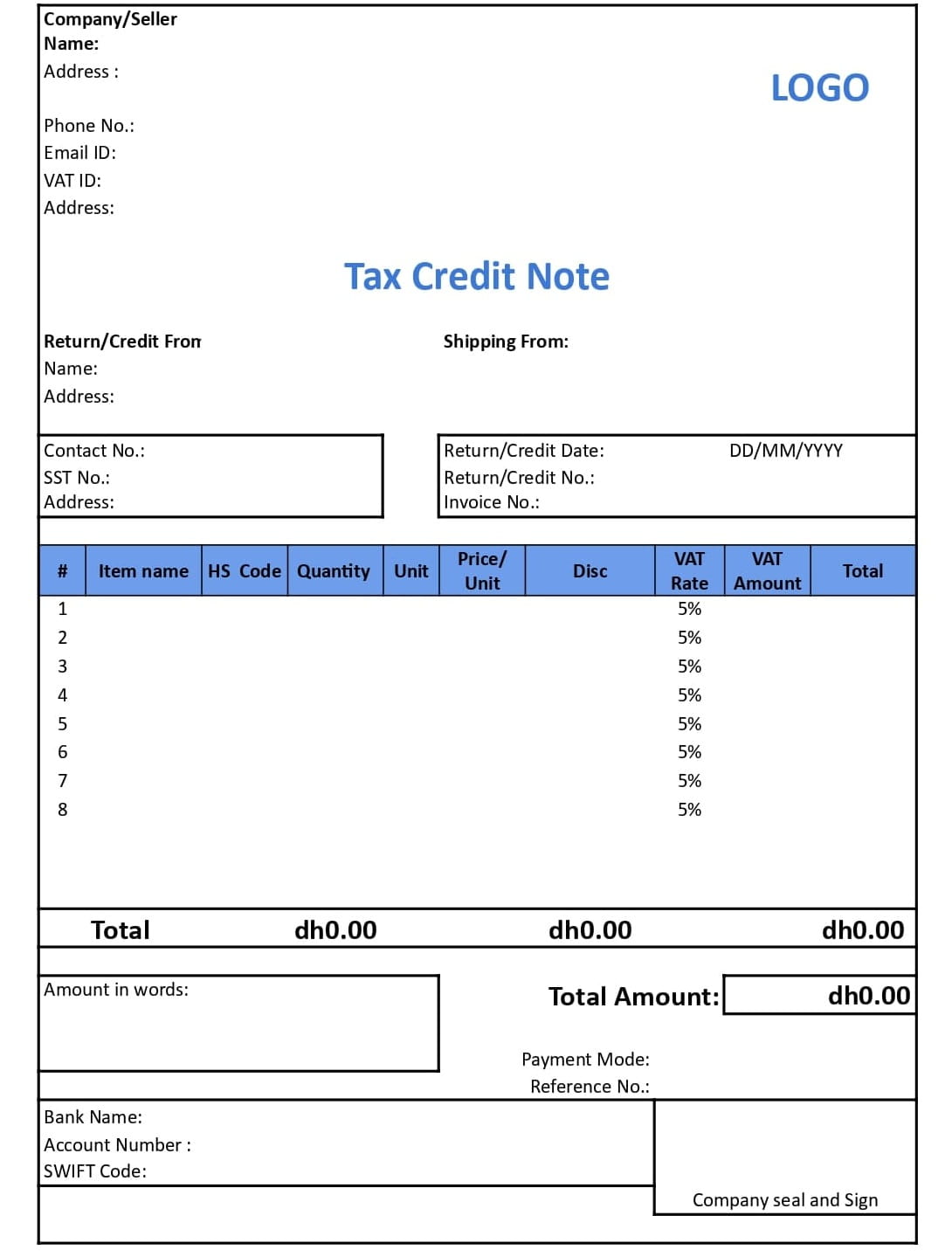
    Here’s a sample tax credit note from the UAE, fully aligned with VAT regulations.

    credit note format

    Benefits of Tax Credit Notes under UAE VAT

    Below are the benefits of tax credit notes under UAE VAT:

    1. Reduction in VAT Liability for Suppliers

    Tax Credit Notes allow suppliers to correct previously issued invoices by reducing the VAT amount owed to the Federal Tax Authority (FTA). These adjustments might arise due to product returns, post-sale discounts, or invoice errors. This correction ensures businesses don’t overpay VAT.

    2. Input Tax Adjustment Benefit for VAT-Registered Recipients

    If the recipient is also VAT-registered, the Tax Credit Note enables them to decrease their claimed input tax, aligning with the corrected taxable amount.

    3. Improved Cash Flow

    By avoiding overpayment of VAT, businesses can retain funds that would otherwise be held until refunds are processed or adjustments confirmed—enhancing liquidity.

    4. Enhanced Accuracy and Error Reduction

    Tax Credit Notes serve as a clean and systematic way to amend billing errors, such as overcharges or wrong VAT calculations, without generating new invoices or complicated manual adjustments.

    5. Regulatory Compliance and Audit Readiness

    Using Tax Credit Notes in alignment with FTA rules ensures proper documentation and reduces the risk of penalties during audits.

    6. Customer Trust & Satisfaction

    For returns or price adjustments, Tax Credit Notes provide transparency and fairness, reinforcing trust between businesses and their customers.

    7. Supports Electronic Record-Keeping & E-Invoicing

    Electronic Tax Credit Notes are encouraged, when issued via approved digital systems, they’re secure, tamper-evident, and seamlessly integrated into accounting workflows.

    8. Simplifies Complex Transactions

    Under Cabinet Decision No. 81 of 2023, businesses can combine tax invoices and credit notes within a single document labelled “Tax Invoice/Tax Credit Note,” reducing administrative burden without compromising clarity.

    How Shuraa Tax Ensures Compliance with Credit Notes and UAE Tax Credit Notes

    A credit note, whether a simple adjustment tool or a formal UAE Tax Credit Note under VAT is far more than just an invoice note issued against errors or returns. It safeguards accurate financial records, ensures VAT compliance, and maintains transparency in every business transaction. Whether you’re issuing a credit note invoice, reconciling a credit note against invoice, or referring to a credit invoice example, precision and timely action are non-negotiable under UAE law.

    With the Federal Tax Authority’s updated 14-day rule and evolving VAT framework, businesses can no longer rely on manual checks or outdated processes. Non-compliance, even if unintentional, can trigger penalties and disrupt cash flow. That’s why proactive measures, like automating credit note workflows, training finance teams, and auditing VAT processes, are critical.

    Shuraa Tax can help you navigate these requirements with ease. From ensuring every Tax Credit Note under VAT meets FTA standards to streamlining your accounting systems for error-free reporting, their experts make compliance seamless. Whether you need guidance on issuing a credit note invoice, structuring a credit note against invoice, or understanding a detailed credit invoice example, Shuraa Tax offers the clarity and precision your business deserves.

    Get expert VAT support today:
    Call: +(971) 44081900
    WhatsApp: +(971) 508912062
    Email: info@shuraatax.com

    By treating credit notes as a compliance asset not just a correction tool you’ll protect your business, improve liquidity, and build lasting trust with both customers and regulators.

    FAQs

    1. What is a Tax Credit Note under UAE VAT?

    A Tax Credit Note is a document issued by a supplier to adjust or reduce the value of a previously issued tax invoice. It is typically used when goods are returned, services are cancelled, discounts are applied after invoicing, or errors are found in the original invoice. The note ensures VAT adjustments are correctly reflected in both supplier and buyer records.

    2. When can a Tax Credit Note be issued in the UAE?

    As per Federal Tax Authority (FTA) regulations, a Tax Credit Note must be issued within 14 days from the date the supplier becomes aware of the adjustment requirement. This ensures VAT records remain accurate and compliant with UAE law.

    3. What details must a valid UAE Tax Credit Note contain?

    A valid Tax Credit Note must include:

    • Supplier’s name, address, and Tax Registration Number (TRN).
    • Recipient’s details and TRN (if VAT registered).
    • Title “Tax Credit Note.”
    • Date of issue.
    • Reason for issuing the note.
    • Original invoice value, corrected amount, and VAT adjustment.
    • Reference to the original supply or invoice.

    4. What are the benefits of issuing a Tax Credit Note?

    Tax Credit Notes ensure:

    • Reduction in VAT liability for suppliers.
    • Correct input tax adjustment for buyers.
    • Improved cash flow by avoiding VAT overpayment.
    • Error-free records for audits and compliance.
    • Transparency and stronger customer trust.

    5. What happens if a Tax Credit Note is not issued correctly or on time?

    Failure to issue a Tax Credit Note within the 14-day deadline, or providing incomplete details, may result in FTA penalties, incorrect VAT reporting, and potential disputes with customers. Businesses should upgrade their accounting systems and train finance teams to avoid such risks.

  • Crypto Taxes in Dubai: Are Digital Assets Really Tax-Free?

    Crypto Taxes in Dubai: Are Digital Assets Really Tax-Free?

    Cryptocurrency has been gaining popularity all over the world, and Dubai is no exception. From buying property and booking flights to investing in new-age businesses, people in the UAE are using crypto more than ever. And it’s not just individuals. Big companies and even the government are taking steps to make Dubai a global hub for digital assets.

    With dedicated zones like DMCC and DIFC welcoming crypto firms, and a special regulator (VARA) to manage virtual assets, Dubai is clearly serious about becoming a leader in this space. But with all this growth and support, one big question still comes up: Dubai Crypto Tax. Is crypto really tax-free here, or are there hidden conditions that investors and businesses should know about?

    That’s what we’re here to explore.

    Overview of Crypto Landscape in Dubai

    Dubai sees crypto as an opportunity rather than a threat. It’s working hard to create a safe and supportive environment for crypto investors, startups, and global companies. Doesn’t matter if you’re an individual looking to trade Bitcoin or a business planning to launch a blockchain-based platform, Dubai has made it easier to operate legally and confidently.

    Is Crypto Legal in Dubai?

    Yes, crypto is legal in Dubai. You can own, buy, sell, and trade cryptocurrencies like Bitcoin and Ethereum. Crypto mining is also allowed, though it must be done within regulatory boundaries and with the right approvals. However, using crypto as a regular currency (like to pay for everyday things) is still limited, though it’s gradually becoming more accepted in areas like real estate and travel.

    The Role of VARA

    A big part of this framework is VARA, the Virtual Assets Regulatory Authority. Established in 2022, VARA is the world’s first independent regulator specifically set up for virtual assets. It oversees licensing, compliance, and operations for crypto-related businesses in Dubai (outside the financial free zones).

    VARA’s main goal is to protect investors while encouraging innovation in the virtual asset space. So, if you’re starting a crypto exchange, offering NFTs, or managing digital wallets, you’ll need to register with VARA.

    Is Crypto Tax-Free in Dubai?

    Dubai doesn’t impose personal income tax (or capital gains tax) on crypto profits earned by individuals. So, if you buy, sell, or trade crypto for personal investment, your gains are entirely tax‑free. That applies even to income from staking or mining, as long as it’s on a personal level, not part of a registered business.

    What It Means for Individuals Trading Crypto?

    If you’re simply holding or trading crypto for your own investment, you don’t owe any tax to the UAE. You won’t need to file or pay taxes on those profits. However, if you live in Dubai but are a tax resident elsewhere, you might still have to report these gains to your home country’s tax authority (e.g., U.S. citizens reporting to the IRS).

    When Does Crypto Become Taxable in Dubai, UAE?

    While individual crypto investors enjoy tax-free gains in Dubai, there are certain situations where crypto becomes taxable, especially when it’s tied to business activity. Here’s when Dubai crypto tax applies:

    1. When You’re Running a Business Using Crypto

    If you’re using crypto as part of your business operations, your income may be subject to 9% corporate tax if your net profit exceeds AED 375,000 annually.

    • Taxable Crypto Business Activities Include:
    • Running a crypto exchange
    • Operating a mining business
    • Providing staking-as-a-service
    • Offering crypto trading or advisory services
    • Receiving crypto payments for goods/services as a registered business
    • Earning regular profits from active trading as a company

    In these cases, crypto earnings are considered business income, not personal investment, making them taxable under the UAE Corporate Tax Law.

    2. If You’re a Freelance Crypto Trader Acting Like a Business

    Even if you’re not incorporated, but you’re trading crypto frequently and systematically, authorities may view this as self-employment or business activity. If so:

    • You may need to register a trade license
    • Profits may fall under corporate tax scope once you formalise or exceed thresholds

    3. If You’re in a Free Zone but Non-Qualifying

    Some Dubai Free Zones (like DMCC, DIFC, DWTC) offer tax exemptions, but only to qualifying activities and entities. If your crypto activity doesn’t qualify, you may still be liable for:

    • Corporate tax
    • VAT (5%) on applicable services

    4. Commercial Mining vs. Personal Mining

    Personal mining (hobby-level activity) remains untaxed. But if mining is conducted on a commercial scale, it’s treated as a business activity, subject to corporate tax and potentially VAT.

    5. NFTs & Digital Asset Services

    Buying/selling NFTs as an individual is tax-free. But if you’re a studio or business minting and selling NFTs, that income counts as corporate profit and may be taxed under the 9% rule, and VAT could apply too.

    In short, individuals trading, holding, mining, or collecting NFTs for personal use remain tax-free, with no corporate tax, no VAT. Once your crypto activity counts as a business, especially with revenues over AED 375,000, you enter the realm of corporate tax (9%) and possibly VAT (5%), depending on the service.

    Does Dubai Offer Any Crypto-Friendly Zones?

    Yes, Dubai is home to multiple crypto-friendly free zones that cater to startups, investors, and enterprises in the virtual assets space.

    1. Dubai Multi Commodities Centre (DMCC) – Crypto Centre

    DMCC launched its Crypto Centre to support blockchain and crypto innovation. The freezone offers licenses for crypto trading, blockchain development, and more. Partners with global firms like Binance to boost infrastructure. 0% personal income tax, and businesses may benefit from 0% corporate tax if they qualify under the UAE’s Free Zone rules.

    2. IFZA (International Free Zone Authority)

    IFZA is growing as a crypto-friendly zone offering flexible company setups. It supports blockchain-based service providers and technology firms. Cost-effective and suitable for smaller businesses or consultants in the digital asset space.

    3. Dubai World Trade Centre (DWTC)

    In 2021, DWTC was designated as a special crypto zone focused on virtual assets. The freezone works closely with VARA to issue licenses for exchanges, custodians, and blockchain platforms. It is ideal for large-scale exchanges and token projects seeking credibility and compliance.

    4. Dubai International Financial Centre (DIFC)

    DIFC is a leading financial free zone with its own independent legal framework. Home to FinTech and blockchain companies regulated by the DFSA (Dubai Financial Services Authority). Suitable for firms offering crypto investment services, tokenised assets, and financial products.

    Why Do Crypto People Move to Dubai?

    Dubai is a popular place for crypto enthusiasts, traders, entrepreneurs, and blockchain companies from around the world, and for good reason. Here’s why:

    1. Zero Personal Income Tax

    Dubai doesn’t tax individuals on their income or capital gains, including crypto gains. That means if you trade or invest in crypto personally, your profits are 100% tax-free.

    2. Crypto-Friendly Regulations

    Dubai was one of the first cities to establish a dedicated crypto regulator – VARA (Virtual Assets Regulatory Authority). This gives crypto businesses a clear and legal framework to operate in, with proper licensing and compliance rules.

    3. Escape from Regulatory Crackdowns

    In the US, UK, India, and other regions, governments are tightening crypto laws or even banning certain activities. Dubai offers a safe and stable environment where crypto isn’t seen as a threat, but as a tech opportunity.

    4. Affordable Compared to Other Crypto Hubs

    Places like London, Singapore, or New York can be very expensive to live and run a business. Dubai offers zero income tax, zero capital gains tax, and relatively lower operational costs for setting up your company.

    5. High Digital Acceptance

    Crypto isn’t just tolerated, it’s being adopted. You can buy real estate with crypto, book flights, and pay for services. There’s even growing infrastructure for Web3 payments, wallets, and DeFi use cases.

    Want to Stay Tax-Free? Shuraa Tax Can Help

    So, is crypto really tax-free in Dubai? Yes, for personal investors, it mostly is. You don’t pay tax on your trading or investment profits if it’s for personal use. But if you’re running a crypto business or offering related services, some taxes like corporate tax or VAT can apply.

    As Dubai becomes a global hotspot for crypto, it’s important to understand the rules and stay on the safe side. The last thing you want is to run into tax trouble just because you weren’t aware of the laws.

    If you’re unsure where you stand, don’t worry – Shuraa Tax can help. Whether you’re an individual investor or a business owner, our team is here to guide you on Dubai crypto tax, corporate tax, VAT, and more. Reach out to us for expert advice and make your crypto journey in Dubai stress-free and compliant.

    Commonly Asked Questions

    1. Is there any personal income tax on crypto gains in Dubai?

    No, Dubai does not impose personal income tax, so individuals don’t pay tax on profits from trading or holding cryptocurrency.

    2. Are crypto services subject to VAT in the UAE?

    Not all. Most crypto transactions are VAT-exempt, but some crypto-related services like mining, wallet management, or consultancy may attract VAT at 5%.

    3. Is mining crypto taxable in Dubai?

    Personal mining is not taxed. But if you mine on a commercial scale, it may be considered a business and subject to corporate tax and possibly VAT.

    4. Can foreigners set up a crypto business in Dubai?

    Yes, foreigners can fully own and operate crypto businesses in Dubai, especially through designated free zones with crypto-friendly policies.

    5. Are NFTs (Non-Fungible Tokens) taxed in Dubai?

    Buying or selling NFTs personally is not taxed. However, if you’re running an NFT business or creating them commercially, corporate tax and VAT may apply.

    6. How can Shuraa Tax help with crypto tax in Dubai?

    Shuraa Tax provides expert guidance on crypto taxation, business licensing, VAT compliance, and helps individuals and companies stay fully compliant with UAE laws.

  • Understanding Property Tax in Dubai: What Investors Need to Know

    Understanding Property Tax in Dubai: What Investors Need to Know

    Investing in Dubai’s real estate market is a popular choice for both local and international investors, thanks to its tax-friendly environment and booming property sector. However, understanding the nuances of Dubai property tax is essential for making informed decisions.

    While the emirate does not levy a traditional real estate tax, investors should be aware of other financial obligations such as VAT on property in Dubai, registration fees, and maintenance charges. This guide breaks down the key aspects of real estate tax in Dubai, helping you navigate the legal and financial landscape before making your next property investment.

    Understanding the Property Tax System in Dubai

    Thinking of buying a property in Dubai? Dubai is one of the most tax-friendly places in the world when it comes to real estate. Unlike many other big cities, you don’t have to pay a yearly property tax just for owning a home or apartment. That’s one big reason why so many people love investing here.

    But wait — while there’s no yearly tax, there are a few one-time costs you should know about:

    • When you buy a property, you’ll need to pay a 4% fee to the Dubai Land Department. It’s kind of like a transfer fee for making the deal official. You only pay this once, at the time of purchase.

    Also, depending on the type of property you’re buying, VAT (value-added tax) may or may not apply:

    • Residential properties (like apartments or villas for living): No VAT after the first sale. So if you’re buying a home that’s already been sold once before, there’s no VAT.
    • Commercial properties (like office spaces or shops): You’ll pay 5% VAT when buying or renting these kinds of places.

    Benefits of Dubai’s Property Tax System

    One of the most compelling reasons investors are drawn to Dubai’s property market is its tax-friendly framework. The city offers a uniquely favourable environment for both residential and commercial property buyers, contributing to its status as a global investment hub.

    Here are some of the key benefits of the Dubai real estate tax system: 

    1. No Annual Property Tax

    Unlike many major cities around the world, Dubai does not impose an annual property tax on owned real estate. This significantly reduces long-term ownership costs, allowing investors to retain more of their returns.

    2. Zero Dubai Real Estate Corporation Tax

    At present, Dubai real estate corporation tax does not apply to most property investors. Companies or individuals who own property in their name typically do not pay corporate income tax on rental income or capital gains, unless they are engaged in another taxable business activity under the UAE’s corporate tax regime.

    3. No Capital Gains Tax

    Profits earned from selling a property are not subject to capital gains tax in Dubai, which is a significant advantage for investors and flippers looking to grow their portfolios.

    4. Transparent One-Time Fees

    Instead of hidden annual levies, Dubai applies clear, one-time charges like the 4% transfer fee to the Dubai Land Department. These upfront costs make the financial planning process more predictable.

    5. Simplified Commercial Property Tax in Dubai

    While there is no recurring commercial property tax in Dubai, 5% VAT is applied on commercial property transactions. This is a one-time tax at the point of sale or lease and is regulated under the UAE VAT law. However, this system is far more straightforward and transparent compared to corporate real estate taxation models in other countries.

    6. Investor Confidence and Market Stability

    The clarity and consistency of Dubai’s tax rules inspire investor confidence. With no surprise tax hikes or hidden property levies, Dubai continues to attract global property buyers looking for reliable returns.

    In summary, the lack of recurring property and corporate real estate taxes, combined with a clear structure around commercial property tax in Dubai, makes the emirate’s property market one of the most lucrative and stable in the world.

    Types of Property-Related Fees in the UAE

    Investing in real estate in the UAE involves several property-related fees that buyers, sellers, and landlords should be aware of. Although there is no direct Dubai property tax like in other global cities, there are still several mandatory charges to consider:

    1. Value Added Tax (VAT) on UAE Property Tax

    • VAT on property in Dubai applies under specific conditions:
    • Residential properties are generally exempt or zero-rated.
    • Commercial properties are subject to 5% VAT on the sale or lease.
    • VAT is also applicable to services related to real estate transactions, such as brokerage and legal fees.

    2. Dubai Land Department (DLD) Fees

    • A 4% transfer fee is paid to the Dubai Land Department when a property changes hands.
    • This fee is usually split equally between the buyer and the seller unless agreed otherwise.

    3. Registration Fees

    • Oqood registration for off-plan properties: AED 5,250.
    • For ready properties, a registration fee is often AED at 4,000 or 0.25% of the property value, whichever is higher.

    4. Agency Commission

    • Typically, 2% of the purchase price is paid by the buyer to the real estate agent or broker.

    5. Service Charges and Maintenance Fees

    • Property owners pay annual fees for the upkeep of common areas.
    • These charges vary by location and developer and are based on the RERA service charge index.

    6. Mortgage Registration Fee

    • If purchased with a mortgage, a 0.25% mortgage registration fee (plus AED 290 admin fee) is paid to the DLD.

    Common Misconceptions About Dubai Real Estate Taxes

    Dubai’s real estate market has gained global recognition for its investor-friendly tax regime, but with popularity comes confusion. Many buyers and potential investors misunderstand how Dubai property tax and related charges work. Below, we separate fact from fiction and break down the real costs of property ownership in the emirate.

    Common Myths About Dubai Property Taxes 

    Myth 1: Dubai has zero taxes on real estate.

    While it’s true that there’s no annual property tax in Dubai, this doesn’t mean real estate is entirely tax-free. One-time fees and indirect taxes do apply depending on the type of property and transaction.

    Myth 2: No VAT applies to any property in Dubai.

    False. VAT on property in Dubai does not apply to most residential property sales after the first supply. However, 5% VAT is charged on commercial property transactions, including sales and leases, as per UAE VAT laws.

    Myth 3: There are no hidden real estate taxes.

    While Dubai avoids traditional recurring taxes, owners still pay service charges, maintenance fees, and sometimes municipality housing fees (in the case of tenants or owner-occupiers). These are not technically real estate taxes in Dubai, but they are recurring ownership costs.

    Myth 4: Corporations pay the same taxes as individuals.

    Not exactly. Though Dubai real estate corporation tax currently does not apply in most cases, companies involved in taxable business activities or earning above specific thresholds might be subject to the UAE’s new corporate tax regulations.

    Rates & Fees for Property Owners in Dubai

    Here’s a snapshot of the main charges associated with owning property in Dubai:

    Type of Fee/Tax  Applicable To  Rate / Amount 
    Property Transfer Fee  All property buyers 4% of property value (paid to DLD)
    VAT on Commercial Property  Commercial property buyers & tenants 5% on sale or lease
    VAT on Residential Property  First sale of new residential property only 5% (developer charged, usually included)
    Annual Service Charges  All property owners Varies (AED 10–30+ per sq. ft. annually)
    Municipality Housing Fee  Tenants / owner-occupiers 5% of annual rent (billed monthly)
    Commercial Property Tax Dubai  Indirectly through VAT See above (5% VAT)
    Dubai Real Estate Corporation Tax  Corporate investors Not applicable in most property cases*

    *Corporate tax may apply if the property is part of a broader taxable business activity. 

    Dubai’s tax landscape is among the most transparent and investor-oriented in the world. By understanding the reality behind Dubai property tax, the impact of VAT on property in Dubai, and distinctions like commercial property tax Dubai vs. Dubai real estate corporation tax, buyers can make informed decisions and avoid being misled by common myths.

    Commercial Property Tax in Dubai vs. Dubai Real Estate Corporation Tax

    When investing in Dubai’s real estate market, it’s important to distinguish between commercial property tax and real estate corporation tax. While both relate to property ownership and transactions, they apply in different contexts and under different legal frameworks.

    1. Commercial Property Tax in Dubai

    Despite the term “tax,” Dubai doesn’t impose a traditional recurring property tax, even on commercial real estate. However, there is an indirect tax that functions similarly:

    • What it means: In Dubai, commercial property tax primarily refers to the 5% Value Added Tax (VAT) applied to the sale or lease of commercial properties.
    • Who pays: Buyers or tenants of offices, warehouses, retail units, and other non-residential spaces.
    • When it applies: At the time of purchase or lease, whether freehold or leasehold.
    • Regulation: Governed under the UAE Federal Tax Authority’s VAT Law.

    Key Point: This is a transaction-based tax, not a recurring annual fee like in many other countries.

    2. Dubai Real Estate Corporation Tax

    This refers to the potential application of UAE’s corporate tax on companies involved in property ownership or investment.

    • What it means: As of 2023, the UAE introduced a 9% corporate tax on business profits exceeding AED 375,000. If a company earns rental income, capital gains, or trading profits through real estate, it may be subject to this tax.
    • Who pays: Only corporate entities are involved in real estate as part of a business activity. This does not apply to individuals holding property for investment.
    • When it applies: When income from real estate exceeds the corporate tax threshold and is part of a taxable business activity.

    Key Point: This is not a property-specific tax, but a corporate income tax on real estate-related profits earned by registered businesses.

    Summary Comparison Table

    Aspect  Commercial Property Tax (Dubai)  Dubai Real Estate Corporation Tax 
    Nature  Indirect tax (VAT) on property transactions Corporate income tax on business profits
    Applies to  Buyers/tenants of commercial properties Corporations earning real estate income
    Tax Rate  5% VAT on sale or lease 9% on taxable income above AED 375,000
    Recurring?  No (charged at point of transaction) Yes, based on annual profits
    Individual Investors Affected?  Yes, if buying/using commercial property No, unless operating as a business entity
    Legal Basis  UAE VAT Law UAE Corporate Tax Law (2023)

    While commercial property tax in Dubai refers to a one-time VAT applied during transactions, Dubai real estate corporation tax may affect companies earning profits from property.

    Understanding the difference helps investors choose the proper ownership structure—whether as an individual, corporate entity, or through an offshore setup.

    Navigate Dubai’s Property Tax System with Shuraa Tax

    In conclusion, Dubai offers one of the most attractive and transparent property tax environments in the world. With no annual Dubai property tax, zero capital gains tax, and no Dubai real estate corporation tax for most investors, the emirate remains a hotspot for real estate investment. However, understanding associated charges such as VAT on property in Dubai, registration fees, and service charges is crucial for making informed decisions.

    Whether you are investing in residential or commercial property, knowing the difference between commercial property tax in Dubai (typically the 5% VAT) and corporate obligations under the Dubai real estate corporation tax regime can help you structure your investments wisely and avoid unnecessary costs.

    At Shuraa Tax, we specialise in guiding property investors through Dubai’s tax and compliance framework with clarity and confidence. From clarifying your real estate tax obligations in Dubai to helping structure corporate ownership effectively, we’re here to help every step of the way.

    📞 Call: +(971) 44081900
    💬 WhatsApp: +(971) 508912062
    📧 Email: info@shuraatax.com

    Contact Shuraa Tax today for personalised tax and real estate advisory services tailored to your investment goals.

  • Non-Recoverable Tax on Entertainment Services in UAE

    Non-Recoverable Tax on Entertainment Services in UAE

    The UAE’s taxation system is one of the most favorable tax systems in the world. In fact, it levies no federal income tax – a fact that may come as a surprise to you. This is also one of the significant reasons that draw hundreds and thousands of expats to this region.

    However, all businesses in the UAE must levy VAT (Value Added Tax) on all taxable goods. The good part is that the VAT paid on purchases of products and services used for business activities in the UAE can be recovered by registered companies. Unfortunately, this is not for all services. VAT on some special services expenses cannot be recovered by the companies. For instance, entertainment service expenses.

    Entertainment services include a wide range of activities, including concerts, live performances, movie screenings, and more. Understanding how non-recoverable tax applies to these services is crucial for businesses operating in the entertainment industry, as it can have a significant impact on their bottom line.

    What is Non-Recoverable Tax?

    Non-recoverable tax refers to the portion of Value Added Tax (VAT) paid by a business that cannot be claimed back as a credit against the VAT charged to customers. Essentially, it’s a tax expense that directly impacts the business’s profitability.

    In contrast, recoverable tax is the VAT paid on purchases directly related to the business’s taxable supplies. This amount can typically be offset against the VAT collected from customers, effectively neutralizing the tax burden.

    Common examples of non-recoverable VAT in the UAE include: 

    • VAT paid on entertainment expenses (e.g., tickets to events, lavish meals)
    • VAT on personal use of company vehicles
    • VAT on goods and services used for exempt supplies

    A non-recoverable tax directly impacts a business’s profitability. As it cannot be offset against the VAT collected, it increases the overall cost of operations. Consequently, it can reduce profit margins if not managed effectively. 

    What are Entertainment Services Under UAE Law?

    Under UAE VAT law, entertainment services are broadly defined as any service that primarily aims to provide pleasure, diversion, or amusement. Here are some common examples of entertainment services: 

    • Restaurants and cafes
    • Cinemas, theatres, and concert venues
    • Nightclubs, bars, and lounges
    • Sports events
    • Amusement parks and theme parks
    • Gaming and betting activities

    Non-Recoverability of Tax on Entertainment Services

    The UAE VAT law explicitly states that input tax incurred on entertainment services is generally non-recoverable. This means that businesses cannot claim back the VAT they paid on entertainment expenses as a credit against the VAT they charge their customers.

    Article 53 of the UAE VAT Executive Regulations outlines the specific provisions for non-recoverable tax on entertainment services. Primarily, it states that VAT paid on entertainment services provided to anyone other than the business’s employees is non-recoverable. This includes

    • Customers
    • Potential customers
    • Officials
    • Shareholders
    • Owners

    When Can VAT on Entertainment Services Offered to Employees Be Recovered?

    While the general rule is that VAT on entertainment services is non-recoverable, there are specific circumstances where VAT on entertainment services provided to employees can be recovered.

    To claim back the VAT on entertainment services offered to employees, a business must demonstrate that:

    • The employer has a legal or contractual obligation to provide the services to employees.
    • Providing the services is considered a normal business practice within the industry or specific role.
    • The entertainment services are directly linked to the employee’s well-being, motivation, or performance.

    For example, a company provides lunch for its employees during mandatory training sessions. This could be considered a recoverable expense if it can be demonstrated that the meals are directly related to the training and are not excessive in cost.

    However, the taxable entity will not be reimbursed for taxes paid on events such as Iftar parties given to staff members and employees, goodbye celebrations, staff birthday parties, music festivals, gala dinners, birthday parties, wedding parties, etc.

    It’s essential to note that even if the VAT on entertainment services provided to employees is recoverable, it doesn’t automatically mean that the entire cost is deductible for tax purposes. Other tax rules and regulations may apply.

    Circumstances Under Which Tax on Entertainment Services Might Be Recoverable

    There are specific exceptions where businesses can claim back the tax paid:

    Business Meetings 

    If a business meeting includes a meal or refreshments as a necessary part of the meeting, the VAT on these expenses may be recoverable. The primary purpose of the gathering should be conducting business, and the entertainment element should be incidental. 

    Staff Training and Development 

    If entertainment is directly linked to a staff training or development program and is essential for achieving the program’s objectives, the associated VAT might be recoverable. 

    Employee Welfare 

    VAT on entertainment services provided to employees can be recovered if it’s considered a normal business practice or a legal or contractual obligation. Examples include meals provided in a company canteen, refreshments during working hours, or health and wellness activities directly linked to employee performance.

    Conditions for Claiming Recoverability: 

    • The expenses must have a direct and necessary link to the business’s core activities.
    • Detailed records, including invoices, receipts, and expense reports, should be maintained to support the claim.
    • The claim should adhere to all relevant VAT laws and regulations. 

    It’s essential to note that the burden of proof lies with the business to demonstrate that the VAT on entertainment services is recoverable. Tax authorities may scrutinize these claims, and businesses should be prepared to provide detailed evidence to support their position. 

    How Businesses Can Identify Non-Recoverable Expenses 

    Accurately identifying non-recoverable expenses is crucial for effective tax planning. 

    • Clearly classify all expenses into categories such as direct costs, operating expenses, and entertainment expenses.
    • Stay updated with the latest VAT rules and guidelines regarding entertainment services.
    • Scrutinize expense claims to ensure they align with VAT regulations and business objectives.
    • Utilize software or tools to track and categorize expenses efficiently. 

    Most Importantly – Seek expert advice! 

    Understanding non-recoverable tax on entertainment services in the UAE is important for any business. Knowing what counts as non-recoverable expenses and how they affect your cash flow and profits helps you manage your finances better. Keeping good records and tracking expenses carefully can save you from penalties and legal issues. 

    Given how complex VAT and tax rules can be, it’s smart to get expert help. At Shuraa Tax, we take care of all your business tax needs in the UAE, including VAT. Our experienced, in-house tax agents are ready to assist you in every way necessary. Let us handle your tax management, so you can focus on growing your business. 

    All you need to do is get in touch with us on info@shuraatax.com or call us on +971508912062.

  • Tax Residency Certificate in UAE

    Tax Residency Certificate in UAE

    Tax Residency Certificates (TRCs) are essential documents for individuals and businesses in the UAE. A TRC is a certificate issued by the UAE government that confirms an individual’s tax residency status in the country. This document is crucial for those looking to take advantage of Double Taxation Avoidance Agreements (DTAAs) between the UAE and other countries.

    These agreements ensure that individuals and businesses are not taxed on the same income in both their home country and the UAE.

    Therefore, it is important for you to understand the importance of TRCs in the UAE, how to obtain one, and why they are vital for those looking to understand the complex world of international taxation.

    What is a Tax Residency Certificate in UAE?

    A Tax Residency Certificate (TRC) in the UAE or Tax Domicile Certificate (TDC) is an official document issued by the Federal Tax Authority (FTA) that verifies your tax residency status to claim benefits under Double Tax Avoidance Agreements (DTAAs).

    But what exactly is DTAA?

    Imagine you’re an Indian citizen working in the UAE. You earn a salary in the UAE.

    Normally, you might have to pay taxes on that income in both India (because you’re a citizen) and the UAE (because you’re earning there). This is called double taxation.

    However, if India and the UAE have a DTAA in place, the agreement will determine which country has the right to tax your income. This could be based on factors like your residency status, the source of the income, or specific articles within the agreement.

    Tax Residency Certificates (TRCs) allow applicants to take benefits of Double Tax Avoidance Agreements (DTAA) on income signed by the UAE.

    The UAE has signed DTAAs with many countries to avoid residents being taxed on the same income in both countries. A TRC can help you get reduced or eliminated tax rates on certain types of income earned in another country, depending on the specific DTAA in place.

    Types of Tax Residency Certificate in the UAE

    There are two main types of UAE Tax Residency Certificates (TRCs):

    1. Domestic TRC

    This certificate is primarily used within the UAE. It can be helpful for various purposes, but it doesn’t directly relate to international tax treaties.

    2. TRC for DTA purposes (Double Tax Avoidance)

    This specific type of TRC is crucial for claiming benefits under agreements the UAE has signed with other countries to avoid double taxation. It proves your tax residency in the UAE for these international transactions.

    Who Can Apply for a Tax Domicile Certificate in the UAE?

    The eligibility to apply for a TRC or TDC in the UAE depends on whether you’re applying for a domestic TRC or a TRC for DTA purposes:

    Domestic TRC: Any resident or business entity in the UAE can apply, but it’s recommended to consult the Federal Tax Authority (FTA) for specific details on its purpose and uses.

    TRC for DTA purposes:

    Individuals:

    • Must have resided in the UAE for at least 183 days during the requested financial year.
    • Should have a valid UAE residence visa and Emirates ID.

    Businesses:

    An applicant applying for a tax residency certificate for treaty purposes must have established a business in the UAE for at least one year.

    Offshore companies generally cannot apply for a TRC as they aren’t considered established within the UAE’s tax system.

    Documents Required for Tax Residency Certificate

    The documents required for a TRC in the UAE vary depending on whether you’re applying as an individual or a business:

    For Individuals:

    • Passport copy
    • Valid UAE residence visa copy
    • Emirates ID copy
    • A certified copy of your residential lease agreement (Ejari or similar)
    • Latest salary certificate (if employed)
    • Latest & validated 6-month bank statement (stamped by the bank)
    • Entry and exit report from the Federal Authority of Identity and Citizenship (FAIC) or a local competent government entity (demonstrating at least 183 days of residence in the UAE)

    For Business:

    • Valid company trade license copy
    • Establishment contract certified by official authorities (if not a Sole Proprietorship)
    • Shareholders & manager passport copies
    • Shareholders & manager residence visa copies
    • Shareholders & manager Emirates ID copies
    • Certified copy of the latest audited financial statements/Audit Report
    • Latest and validated 6-month company bank statement (stamped by the bank)
    • Certified copy of company lease agreement or tenancy contract

    How to Apply for a TRC in the UAE

    Applying for a Tax Domicile Certificate or Tax Residency Certificate in the UAE involves a series of steps to verify your residency status for tax purposes. This includes:

    1. Registration

    Register with the Federal Tax Authority (FTA) through their online portal. Create an account if you do not already have one.

    1. Choose the relevant Tax Registration Number (TRN) or select “No TRN” if you don’t have one. (TRN might pre-fill details if available)
    1. Select “Type of Requested Certificate” and choose “Tax Residency Certificate.”
    1. Complete the online application form accurately.

    2. Submission of Documents

    Upload all the required documents to the FTA portal. Ensure all documents are clear and legible.

    3. Payment and Processing

    Once your application is complete, you’ll need to pay a processing fee online. The FTA will review your application and documents.

    4. Issuance of Tax Residency Certificate

    Once your application is approved, the TRC will be issued. You will be notified via the FTA portal, and you can download the certificate from there.

    The TRC submission fess is generally AED 50 for all applicants, regardless of their tax registration status.

    Consider seeking guidance from a tax professional like Shuraa tax if you have any complexities or require assistance throughout the application process.

    The processing time for a TRC application typically ranges from 2 to 4 weeks, but it can take longer depending on the completeness of your application and the FTA’s workload.

    Validity and Renewal of TRC

    The validity of a Tax Residency Certificate (TRC) in the UAE is typically one year from the date it’s issued.

    You’ll need to re-apply for a new TRC if you want to continue claiming tax residency benefits beyond the initial one-year validity period.

    The renewal process generally involves following the same steps as the initial application, including submitting updated documents and paying any applicable fees.

    Benefits of Getting Tax Domicile Certificate in the UAE

    There are several benefits to obtaining a Tax Residency Certificate (TRC), also referred to as a Tax Domicile Certificate, in the UAE:

    1. Avoiding Double Taxation

    A key advantage is the ability to claim benefits under Double Tax Avoidance Agreements (DTAAs) that the UAE has signed with over 76 countries. These agreements prevent you from being taxed on the same income in both the UAE and another country.

    2. Streamlining Import-Export Processes

    The TRC can be helpful for businesses involved in importing and exporting goods. It can assist in obtaining exemptions or reduced rates on import and export duties in specific situations.

    3. Legal Recognition of Tax Residency

    The TRC serves as an official document from the Federal Tax Authority (FTA) that confirms your tax residency status in the UAE. This can be valuable for various purposes, such as banking procedures or compliance requirements.

    4. Streamlining International Business

    The TRC can facilitate smoother cross-border business activities by providing evidence of your tax residency and potentially reducing tax hurdles. This can be beneficial for companies operating in multiple jurisdictions.

    5. Reduced Withholding Tax Rates

    Some countries levy withholding taxes on dividends, interest, and royalties paid to non-residents. With a TRC proving your UAE residency, you might qualify for reduced withholding tax rates under DTAAs.

    6. Improved Business Reputation

    Having a TRC demonstrates your commitment to tax compliance in the UAE, which can portray your business positively to potential partners, investors, and clients.

    Expert Guidance from Shuraa Tax

    Getting a Tax Residency Certificate in the UAE is very important for both individuals and businesses. It helps you benefit from tax treaties and avoid paying taxes twice. While the process is simple, you need to make sure you have all the right documents and meet the eligibility requirements.

    If you find this process challenging, it’s a good idea to consult with tax professionals. At Shuraa Tax, we are a team of experienced and qualified tax agents, accountants, auditors, and finance advisors based in Dubai, UAE. We help you with everything from evaluating your current finances to planning your taxes and keeping your books in order. We can assist you in gathering the necessary paperwork for your UAE Tax Residency Certificate and guide you through the application process.

    Trust Shuraa Tax to make the process of getting your Tax Residency Certificate easy and stress-free. Contact us today at +971508912062 or info@shuraatax.com.

    Frequently Asked Questions

    1. What is a Tax Residency Certificate (TRC) in the UAE?

    A TRC is an official document issued by the Federal Tax Authority (FTA) that verifies your tax residency status in the UAE. This can be helpful for claiming benefits under Double Tax Avoidance Agreements (DTAAs) signed by the UAE with other countries.

    2. How many days does it take to get the UAE Tax Residency Certificate?

    Processing times can vary, but typically it takes 2-4 weeks to receive your TRC after a complete application is submitted to the FTA.

    3. What is a Double Tax Avoidance Treaty (DTT)?

    A DTT (also known as Double Tax Avoidance Agreement) is an international treaty signed between two countries to prevent a situation where the same income gets taxed in both countries. A TRC can help you prove your residency for tax purposes under a DTT.

    4. Is a Tax Domicile Certificate the same as a TRC?

    Yes, in the UAE, the terms “Tax Residency Certificate” (TRC) and “Tax Domicile Certificate” are generally used interchangeably. They serve the same purpose of verifying your tax residency status in the UAE.

  • VAT For E-Commerce Businesses in UAE

    VAT For E-Commerce Businesses in UAE

    E-commerce in the UAE has been growing at lightning speed. Back in 2019, there were around 4.5 million online shoppers, and by the last year, this number jumped to 6.5 million (roughly a 20% increase). The retail sector itself is now worth about AED 306.6 billion. In 2024, the UAE’s e-commerce market reached AED 32.3 billion and is expected to cross AED 50.6 billion by 2029. A young, tech-savvy population, reliable internet, and fast delivery services are all driving this boom.

    But with this growth comes responsibility. Since January 1, 2018, the UAE has applied Value Added Tax (VAT) at a standard 5% rate, managed by the Federal Tax Authority (FTA). For e-commerce businesses, whether you sell products, digital services, or operate through marketplaces, it’s essential to know if there’s a VAT for e-commerce businesses in the UAE.

    This includes when you need to register, how to charge VAT, and how to handle cross-border sales.

    Staying VAT compliant protects your business from penalties, builds customer trust, and shows that you’re running a professional setup.

    VAT for E-commerce Businesses in the UAE

    E-commerce businesses in the UAE are fully covered under VAT regulations. Doesn’t matter if you’re selling physical products or digital services; VAT applies in most cases. Therefore, it’s important to know how it works in different situations.

    1. Online sales to UAE residents (B2C transactions)

    If you sell goods or services directly to individual customers in the UAE, you must charge the standard 5% VAT at checkout (once your business is registered for VAT). This applies to everything from clothing and electronics to subscriptions and e-learning platforms.

    2. Online sales to businesses (B2B transactions)

    For B2B e-commerce transactions within the UAE, the standard 5% VAT rate generally applies. The business selling the goods or services charges VAT to the business customer. The purchasing business, if it is VAT-registered, can typically reclaim this VAT as input tax in its own VAT return.

    The key difference in B2B transactions often comes into play in cross-border scenarios where the reverse charge mechanism may apply.

    3. Cross-border transactions (imports/exports)

    The VAT treatment for cross-border e-commerce depends on whether the transaction is an import or an export.

    • Imports into the UAE: Goods imported for sale online are subject to VAT at the point of import. The seller is responsible for accounting for this VAT, which may later be recovered if the goods are resold.
    • Exports outside the UAE: Sales to customers abroad are generally zero-rated, meaning VAT is not charged, but you must keep proper documentation to prove that the goods or services were exported.

    Who Needs to Register for VAT?

    Not every e-commerce business in the UAE has to register for VAT right away. It depends on your turnover (the total value of your taxable supplies and imports) in a 12-month period.

    1. Mandatory VAT Registration

    If your taxable turnover is AED 375,000 or more, you must register for VAT. This applies whether you’re an online store, marketplace seller, or even a freelancer running a digital service business.

    2. Voluntary VAT Registration

    If your turnover is AED 187,500 or more, you can choose to register voluntarily. This is useful for small e-commerce businesses that want to look more professional and be able to claim back VAT on business expenses.

    3. Marketplace Operators

    If you sell through online platforms or marketplaces, you should check whether VAT collection is your responsibility or handled by the platform. In most cases, the seller is responsible for VAT compliance, not the platform.

    4. Freelancers and Small Businesses

    Even if you’re just offering services online (like digital design, tutoring, or software subscriptions), the same VAT thresholds apply.

    VAT on E-commerce Transactions

    VAT applies differently depending on the type of product or service being sold online. Here’s a breakdown to make it simple:

    1. VAT on Sales of Goods Online:

    If you’re selling physical goods (like clothes, electronics, or home items) to customers in the UAE, you must charge 5% VAT at the point of sale. The same applies whether you’re selling through your own website, social media, or an online marketplace.

    2. VAT on Digital Services:

    Digital products and services are also taxable. This includes things like:

    • Online subscriptions (music, streaming platforms, etc.)
    • Software and mobile apps
    • Online courses and e-learning platforms
    • Digital consulting services
    • If your business offers these, you must add 5% VAT for UAE customers.

    VAT on Imported Goods Sold Online:

    When goods are imported into the UAE for online sale, VAT is charged at the point of import. The seller pays this VAT to customs but can often reclaim it later as input tax when filing returns. For the customer, the price they pay should already include the VAT.

    For Non-Registered Businesses: A business that is not VAT-registered must still pay the 5% VAT on the imported goods at customs before the goods are released. Since they are not VAT-registered, they cannot reclaim this tax.

    How VAT is Charged at Checkout:

    For e-commerce transactions within the UAE, VAT is usually added to the final bill at checkout. For example, if an item costs AED 100, the customer will pay AED 105 (including 5% VAT). Businesses must clearly show the VAT amount on the invoice or receipt to stay compliant.

    VAT Compliance Requirements for E-commerce Businesses

    Running an e-commerce business in the UAE means following certain VAT rules set by the Federal Tax Authority (FTA). Here’s what you need to keep in mind:

    VAT Registration:

    If your sales cross the mandatory threshold of AED 375,000, you must register for VAT. Registration is done online through the FTA portal.

    Issuing VAT-Compliant Invoices:

    Every sale must be supported by a proper VAT invoice. Invoices should clearly show:

    • Seller and buyer details
    • A unique invoice number
    • Item/service description

    Net price, VAT amount, and total price (including 5% VAT)

    Record Keeping:

    Keep detailed records of all sales, purchases, imports, and exports for at least 5 years (in some cases, 15 years for real estate). Proper bookkeeping helps in case of FTA audits.

    Filing VAT Returns:

    Most businesses need to file VAT returns quarterly (every 3 months). Returns must show total sales, VAT collected, and VAT paid on purchases (input VAT). Returns are submitted online through the FTA portal, and payment must be made before the deadline.

    Accounting for Cross-Border Sales:

    Ensure correct treatment for exports (usually zero-rated) and imports (VAT charged at customs). Keep proof of export to claim zero-rating.

    Note: VAT rules can change, especially for e-commerce and digital services. Regularly check FTA updates or work with a tax consultant to avoid mistakes.

    Penalties for Non-Compliance

    For e-commerce businesses, mistakes can quickly become costly. Here are some key penalties to be aware of:

    • Late VAT Registration: If you fail to register for VAT on time after crossing the mandatory threshold, the penalty can start from AED 10,000.
    • Late VAT Return Filing: Missing the VAT return deadline can result in penalties starting at AED 1,000 for the first time, and AED 2,000 for repeated delays within 24 months.
    • Late VAT Payments: If you don’t pay VAT on time, a percentage-based fine is applied (2% of unpaid tax immediately, 4% monthly, and up to 300% maximum).
    • Incorrect or Incomplete Records: Not keeping proper invoices, sales records, or import/export documents can lead to fines of AED 10,000 – AED 50,000, depending on the violation.

    How Shuraa Tax Can Help

    E-commerce is booming in the UAE, and following VAT rules is a big part of running a successful online business. Registering for VAT, VAT return filing on time, and keeping proper records not only helps you avoid fines but also shows customers that you run a trustworthy business.

    If you’re unsure where to start, don’t worry, you don’t have to do it alone. Shuraa Tax can guide you through the entire process, from VAT registration and compliance support to bookkeeping and VAT return filing. Reach out to Shuraa Tax today and let us make VAT simple for your business.

    Frequently Asked Questions

    1. Is VAT applicable to e-commerce businesses in the UAE?

    Yes. VAT for e-commerce business in the UAE applies just like traditional businesses. Most online sales and digital services are subject to 5% VAT.

    2. Do I need to charge VAT on digital services like subscriptions or e-learning?

    Yes, digital services are considered taxable supplies. If your business is VAT-registered and sells digital products to a customer in the UAE, you must charge the standard 5% VAT on the sale.

    3. Do freelancers or small online sellers need to register for VAT?

    Yes, if their turnover crosses AED 375,000. Below this, registration is voluntary but can still be beneficial.

    4. Do I need to charge VAT on online sales to customers in the UAE?

    Yes, VAT on online sales to UAE residents (B2C) is 5%, which must be added to the product or service price at checkout.

    5. How is VAT handled on imported goods sold online?

    A VAT-registered business pays the 5% VAT on imported goods at customs but can then reclaim this tax as input tax in its VAT return. The business then charges 5% VAT on the final sale to the customer.

  • UAE VAT Amendment Highlights w.e.f 1.1.2023

    UAE VAT Amendment Highlights w.e.f 1.1.2023

    The President of the UAE issued Federal Decree-Law No. 18 of 2022, amending the VAT Law. A new article on the Statute of Limitations is included in the VAT Law amendment, which also updates 25 other existing articles. On January 1, 2023, the revised provisions are supposed to go into effect. 

    It is noteworthy that various Articles of the VAT Law have been revised. Some of these will significantly affect how businesses are currently handling their VAT obligations. The addition of a new article on the statute of limitations, the deadline for the issuance of a tax credit note, the deadline for the issuance of an invoice for continuous supplies, the definition of hydrocarbons, the valuation of a deemed supply in the case of related parties, etc. are a few of these. 

    Although some amendments will not have a significant impact on the VAT positions previously adopted, they are included to add clarity. These amendments relate to wording changes, incorporating all relevant provisions in one place, etc., which are irrelevant to many businesses. 

    UAE VAT amendment highlights w.e.f 1st Jan 2023

    The following is a summary of some significant amendments and their significance for taxpayers to be aware of: 

    Definitions

    New definitions for Relevant Charitable Activity, Pure Hydrocarbons, Tax Evasion, Tax Audit, Tax Assessment, and Voluntary Disclosure were added to the new Decree-Law. 

    Supplies explicitly regarded as outside the scope of VAT

    A new clause has been added to Article 7 that states the Executive Regulations may specify any other supplies (aside from the provision of vouchers and the transfer of business). 

    VAT registration exemption

    Both registered and non-registered individuals are covered by Article 15’s exception to registration requirements. 

    Date of supply in special cases

    According to Article 26(1), one of the events used to determine the date of supply in special cases is the day one year has passed since the day the goods or services were provided. 

    Place of supply in special cases

    Article 30(8) now specifies that the location where transportation begins will serve as the location of supply of services related to transportation. 

    Place of residence of a principal

    According to Article 33, a principal’s residence is where the agent resides. The place of residence of the agent must be the same as the principal’s, according to the current VAT Law. 

    Value of supply

    Article 37 will now take precedence over Article 36, which deals with the specific anti-avoidance rule for the value of supply or import of goods and services between related parties (value of deemed supply). 

    Goods subject to zero-rate VAT

    Additional goods are listed in article 45 (clauses 4, 5, and 6) as being subject to zero-rate VAT. This covers the import of vehicles, the import of accessories for vehicles, and the import of rescue ships and planes. 

    Reverse charge

    Clause 3 of Article 48 states that Pure Hydrocarbons (defined in the new Decree-Law as “any kind of different pure combinations of a chemical equation made only of hydrogen and carbon”) are subject to the domestic reverse charge. 

    Recovery of Input VAT

    Two new clauses that outline the requirements for the taxable person to recover VAT paid or declared on the import of goods or services have been added to Article 55 regarding the recovery of input VAT. 

    Recovery of Input VAT by Government Entities and Charities

    Article 57 now mentions that government entities are permitted to recover Input VAT incurred for the performance of sovereign activities. Similarly, charitable organisations may claim input VAT paid for qualifying charitable activities. 

    Output VAT adjustment

    The scenario where the taxable person applies an incorrect tax treatment is now covered by the output VAT adjustment mentioned in Article 61(1). The taxable person should now issue a tax credit note to modify the output tax in such circumstances. 

    Timeframe for issuing a tax credit note

    Article 62(2) pertaining to the output VAT adjustment mechanism now includes a requirement that the taxable person issue a tax credit note within 14 days of the date that any of the occurrences listed in Article 61(1) occur. 

    Tax payment

    Under Article 65(4), a taxable person who issues a tax invoice with a VAT declaration or who receives money marked up as VAT is required to pay the VAT to the Federal Tax Authority (FTA)

    Timeline for issuing a tax invoice

    According to Article 67(1), a tax invoice issued in accordance with Article 26 (date of continuous supply) must be issued no later than 14 days after the date of the supply. 

    Adding a New Article on the Statute of Limitations 

    Along with the changes, a new article (Article 79 bis) was also included in the VAT Law. This section is comparable to the one about the statute of limitations that was recently added to the Excise Tax Decree-Law. 

    The following topics are covered in the new article on statute of limitations: 

    •  If the FTA has given the taxable person a notice to be audited, the 5-year statute of limitations will not apply if the audit is finished within 4 years of the notice’s issuance date. 
    • The statute of limitations will be extended by one year if the taxable person makes a voluntary disclosure within five years of the conclusion of the applicable tax period. 
    • The taxable person cannot submit a voluntary disclosure after five years have passed since the conclusion of the pertinent tax period. 

    The article also states that these prolonged periods may be modified further through a separate Cabinet Decision. 

    Final Words 

    By the start date of January 1, 2023, taxpaying entities must review any changes to the VAT Decree-Law and ensure that they are prepared for implementation. This would entail a change in how VAT is applied for specific supplies (such as the supply of hydrocarbons and the importation of transportation equipment), the timing of the issuance of tax invoices and tax credit notes, and the practises for maintaining books and records for a longer period.

    Our in-house FTA registered tax agents are well-equipped and proficient to assist you in all necessary ways. All you need to do is get in touch with us on info@shuraatax.com or call us on +971 508912062.

  • Accounting Outsourcing Checklist for Startups

    Accounting Outsourcing Checklist for Startups

    Starting a business in Dubai or the UAE is a dream come true for many. And why not? The UAE is touted as one of the best places globally to start a business, all thanks to the advanced infrastructure, seamless connectivity to the rest of the world, access to the national and international market, high standards of living, and more. The list could go on and on.

    In fact, the International Monetary Fund (IMF) has recently revised its forecast for the UAE. According to the latest reports and revisions, the United Arab Emirate’s GDP is forecasted to grow at 5.1% this year. The earlier forecast predicted it to grow at 4.2%. But why are these figures so important? That’s because this is UAE’s highest growth in the past 7 years! That’s quite something, isn’t it? 

    Although the booming economy of the UAE entices thousands of entrepreneurs and businessmen – new and already established- you must take care of several things as a business owner. And one of them is accounting. 

    Typically, maintaining accounts and books is a tedious process. Not to forget the daunting tasks like filing returns and paying taxes. Unfortunately, one cannot simply let it be. You must be on top of your accounts and bookkeeping to ensure you have a viable financial plan for your business. 

    Although you could do it within the company, why not outsource it to an expert while you focus on other activities that directly impact your income? Want to know how? Keep reading. This blog will walk you through all you need to know about outsourcing your accounting.

    Why Must Startups Pay More Attention to Accounting?

    Any business’s survival depends on accurate bookkeeping and accounting, but you might need to keep more records as a startup. But Why? 

    Because your investors may need to see the records for evaluation. Furthermore, potential investors may need it to make an educated decision about investing in your business. Finally, a transparent and simple-to-read financial record will play a significant role in helping you get a loan if needed. 

    While you may manage accounting and bookkeeping in-house by hiring accountants and related individuals, outsourcing the job will give your team more time to proactively work on other productive activities. For instance, marketing, sales, customer retention, enhancing customer experience, product launches, and more.

    What Should You Do To Make Accounting and Bookkeeping Simple?

    1. Always Transact via a Bank 

    All of your commercial dealings should be done regularly through the bank. It is simple to keep track of spending when the transactions are being recorded. You can track inflows and outflows using your bank statement. You can use this to compute your taxes and file them. Follow practice of mentioning transaction descriptions during online banking.  

    2. Leverage Technology 

    Utilizing technology to simplify your company’s accounting procedures is a must-do. You can leverage software like Xero, Zoho, QuickBooks, and Tally for assistance in tracking and monitoring your financial actions. Additionally, you can use cloud-based applications. 

    They not only reduce the mundane nature of the job but also eliminate human error. Additionally, since the data is stored in the cloud, it is accessible from anywhere worldwide, making it flexible to work with. 

    3. Stick to a Schedule 

    Make a schedule for the computation and audit of taxes. Experts may also be recruited to perform tax audits and examine other paperwork, like certifications and bills. Furthermore, the financial checks should take place without prior notice. This allows you to check economic activity and ensure that there are no fraudulent actions within the company.

    Also, sticking to a schedule will help keep your books updated. The FTA can barge into your office at any moment for a check. As a result, you should be ready to give them your tax returns and other related documentation.

    4. Plan for the Future

    Any unclear circumstances could jeopardize the success of your business and significantly slow down sales, manufacturing, and other business operations. Getting ready for such events is absolutely essential. 

    Therefore, ensure to assess the dangers. You may want to set out an emergency fund to keep your company in operation for 3-6 months rather than investing everything into future projects. And for this, you must have a proper accounting process with complete financial analysis tools. 

    How To Choose an Outsourcing Partner?

    Deciding to outsource your accounting process is in itself a huge step. Another big step is to decide who to outsource it to because this is the decision that will make or break your accounting process. But worry not. 

    Here is a checklist to help you choose the best outsourcing partner for accounting – 

    1. They Fit Your Scope of Outsourcing 

    To determine whether a certain accounting firm or consultancy meets your scope, you will first have to list down all the tasks you want to outsource. Next, ask yourself – is this a part of my expertise? If not, it’s best to outsource it. 

    Then match it with the services your accounting partner is offering to you. Do these tasks fall under their area of expertise? If yes, they are likely to be a good fit. 

    2. They Are Highly Recommended

    Ask your friends and business competitors about the accounting firm they have partnered with. Discuss the firm you are planning to partner with. Collect as much information as you can about the prospective firm. You may even ask your prospective partner about their testimonials and the companies they are currently or have worked with. Contact these listed companies and discuss their experience. If there is consistency between the recommendations and reviews, they may be a good fit. 

    3. Ask Questions 

    Your accounting partner must be well-versed in accounting principles. Furthermore, they should know how to overcome complex accounting issues and loopholes. And to know about their expertise, it’s best to ask as many questions as possible. Following are some of the questions you can ask – 

    • Will you thoroughly reconcile payroll, sales tax, bank, and other items?
    • Do you accept customer records in any format?
    • Will you provide me with a thorough analysis to inspect the accounts?
    • Will you review the accounts to look for inaccurate income/expenditure calculations made by my clients? 
    • How do you safeguard data while adhering to rules?

    4. Check If They Are Using the Latest Technology and Infrastructure

    Looking at the outsourcing partner’s software, employment, and infrastructural skills is always a good idea. They must be able to find the resources required to complete your assignment. 

    Spending a couple of weeks with your partner could be beneficial to understand their work ethics and culture firsthand. Participate in their activities, attend staff meetings, and communicate with your wider team. 

    5. Know Your Service Provider 

    It’s vital to know your service provider in and out. Ensure you check the corporate profile, experience and qualification of the key personnel and whether they have experience in handling your industry’s financials. Finally, check if they are updated with the latest tax and legal compliances in the UAE. 

    Outsource Your Accounting to Shuraa 

    To summarize, it’s important to see whether your accounting outsourcing partner meets your needs, has a good reputation, is skilled and well-versed in the field, and is up to date with the latest practice. With Shuraa Tax Consultancy, you won’t have to worry about all this. 

    Our tax accountants are the best in the field and will meet all your needs. We are also well-equipped to ensure that your company is tax and accounts-compliant. Our in-house tax-registered tax agents will offer your overall support, including filing your VAT returns. All you need to do is reach out to us at info@shuraatax.com or call us at +971 508912062

  • UAE Tax Penalties: 2022 Guide with Latest Updates

    UAE Tax Penalties: 2022 Guide with Latest Updates

    Everyone knows that UAE used to follow a no-tax policy. However, the UAE government introduced Excise tax in 2017 and VAT in 2018. Ever since then, there has been a 5% VAT applicable to most goods and services. There are certain goods and services subject to a 0% rate or exemption from VAT. And just like any other country, you are entitled to pay the penalty if you delay the tax payment or violate any regulations.  

    Recently, the UAE government has made a few amendments to the Tax penalties. According to the new updates, each fine or penalty will be no less than AED 500 and can be no more than triple the tax value of the transaction in question. This blog will cover all the tax penalties with the latest updates and their benefits for taxpayers.  

    The UAE Tax Penalties with Latest Updates 

    Below mentioned is a detailed list of UAE tax penalties with the latest updates: 

    1. Fixed Penalties for Voluntary Disclosure  

    Trigger Old Amount New Amount 
    First Voluntary Disclosure AED 3,000 AED 1,000 
    Subsequent Voluntary Disclosure AED 5,000 AED 2,000 

    2. Late Payment Penalty for Under-Paid VAT as Per the Voluntary Disclosure or Tax Assessment 

    As per the new rules, taxpayers in the UAE will now be given up to 20 days to settle any unpaid or underpaid tax before any late payment tax penalties apply. The due dates for the calculation of the late payment penalty can be done this way: 

    1. 20 business days following the submission of a voluntary disclosure 

    2. 20 business days following the receipt of a Tax Assessment 

    Trigger Amount 
    Taxpayers fail to pay within the 20 days 2% 
    One Month from the Due Date 4% per month 
    CAP 300% 

    3. Variable penalty where a voluntary disclosure is submitted before the taxpayer is notified of an audit by the Federal Tax Authority (FTA) 

    As per the update, the penalty now ranges from 5% to 40%. However, that totally depends on when taxpayers submit the voluntary disclosure. 

    Year in which the error is disclosed New Amount Old Amount 
    Year 1 5% of the underpaid tax 5% of the underpaid tax 
    Year 2 10% of the underpaid tax 
    Year 3 20% of the underpaid tax 
    Year 4 30% of the underpaid tax 
    Year 5 or more 40% of the underpaid tax 
       

    4. Late payment penalty for failure to settle the stated VAT in the submitted VAT return 

    Trigger Old Amount New Amount 
    Day After Due Date 2% 2% 
    One Week After Due Date 4% 2% 
    One Month After Due Date  1% per day 4% per month 
    CAP 300% 300% 

    5. Variable penalty where a voluntary disclosure is submitted/tax assessment is received after the taxpayer is notified of an audit by the FTA 

    Here, the government has declared a significant increase in the penalties if the error is corrected after the taxpayer is notified of an audit. The previous penalty was 30% and 50% of the underpaid tax upon error discovered during an FTA audit. However, as per the new penalty, the taxpayer will now be charged 50% of the underpaid tax. Moreover, they will have to pay 4% of the underpaid tax per month from the due date of the VAT return till the payment of tax liability.

    Apart from these, the UAE government has extended the redetermination period of administrative penalties to 31st December 2022. Moreover, Non-UAE businesses can now claim a refund of VAT raised in the UAE under the business visitor refund scheme. This offers refunds to foreign businesses that do not have a place of establishment or a fixed establishment in the UAE, subject to the fulfillment of certain conditions. However, this refund is available only to foreign business visitors from an approved list of countries that provide the same reciprocal refunds. The minimum refund claim is AED 2,000 and can cover a period of twelve calendar months. 

    Other UAE Tax Penalties Reductions 

    In order to offer some relief to the taxpayers, the UAE government has imposed reductions in a few more tax penalties. They are as follows: 

    1. The penalty for late registration: reduced from AED 20,000 to AED 10,000. 

    2. The penalty for failing to submit a deregistration application on time:  reduced from AED 10,000 to AED 1,000 per month (capped at AED10,000). 

    3. The penalty for failing to display prices inclusive of VAT: brought down to AED 5,000 from AED 15,000. 

    4. The penalty for failing to issue a tax invoice or tax credit note: reduced from AED 5,000 to AED 2,500 

    How Do These Tax Penalties’ Amendments Benefit Businesses in The UAE? 

    These amendments in the tax penalties offer an incentive to businesses to review their overall filling positions. Moreover, they get the time to reveal any errors before they are notified of an audit.  

    The best part is that now taxpayers who have been subject to penalties can request a waiver or installment of penalties. Furthermore, they can choose between either disputing tax penalties through the TDRC and the Federal Courts or appealing for installment. 

    Partner With Shuraa for Tax Compliances 

    Although we are optimistic that after reading this blog, you’ve got a fair idea of all the tax penalties, we understand that it might get overwhelming. Since you already have a lot on your plate as an entrepreneur, keeping up with the legal stuff too can be challenging. But you cannot ignore the fact how important it is to comply with the tax regime. Therefore, we suggest that you get in touch with a tax agency

    Legal experts at Shuraa Tax Consultants and Accountants can advise and assist you. We ensure that your company follows all its obligations by filing your return on time. Also, we efficiently communicate with the FTA and legally represent you wherever and whenever required. 

    We have cordial ties with the ministry that enable us to stay in step with many commercial legislation and tax regulations applicable to the UAE. Moreover, we guarantee that your company is ready for potential economic repercussions. We will take care of everything for you. All you need to do is reach out to us on info@shuraatax.com or call us on +971 508912062 and focus on other important business matters at hand.