Author: Sadiqa Afreen

  • What is the VAT number in the UAE?

    What is the VAT number in the UAE?

    The VAT number in UAE plays a key role in helping businesses operate legally within the country’s tax system. Once a company registers for VAT, it is issued a VAT number, which must be included on invoices and official documents. 

    This number helps track tax payments and makes it easier for businesses to claim VAT refunds when needed. Whether setting up a new business or managing an existing one, knowing how the VAT number works is essential to staying compliant with UAE tax laws. 

    In this blog, we will tell you more about the VAT number in the UAE; continue to read more about it! 

    What is a VAT number in UAE? 

    A VAT number in UAE, often called a Tax Registration Number (TRN), is a unique 15-digit code assigned to businesses registered under VAT. It helps identify the business and track its VAT obligations. The breakdown of the VAT number is as follows: 

    • The first digit is the country code, “9,” representing the UAE.
    • The next two digits specify the type of organisation: “01” for corporations and “02” for sole proprietors.
    • The following three digits represent the business or individual’s Tax Registration Number.
    • The next six digits indicate the registration date of the business for VAT purposes.
    • The final digit is a check digit, calculated using a specific formula to ensure the number’s validity.

    This structure ensures that each VAT number is unique and accurately reflects the registration details of the business or individual. 

    Why is VAT number important in UAE? 

    A VAT number is important in the UAE as it helps to conduct business legally.  

    Without it: 

    • You cannot charge VAT to customers
    • You risk penalties for non-compliance
    • Your business reputation may suffer

    Getting a VAT number lets you legally charge VAT, claim VAT refunds, and avoid significant fines. This number also boosts customer confidence in your business operations. 

    Benefits of VAT number in UAE 

    The benefits of having a VAT number in the UAE include: 

    Legal Compliance 

    A VAT number ensures your business complies with UAE tax laws. It helps to avoid penalties or legal issues. 

    Tax Collection and Reporting 

    It allows businesses to collect customer VAT and report it to the Federal Tax Authority (FTA) as required. 

    VAT Refunds 

    Registered businesses can claim refunds on VAT for business expenses. It reduces their overall tax liability. 

    Improved Business Credibility 

    Having a VAT number increases the credibility and professionalism of your business, especially when dealing with clients and suppliers. 

    Eligibility for Government Contracts 

    Many government contracts require businesses to be VAT-registered. It helps to make a VAT number essential for bidding on such projects. 

    International Trade Facilitation 

    A VAT-registered business can conduct international trade more smoothly, as many global suppliers and partners prefer or require VAT-registered entities. 

    VAT Registration Requirements in UAE 

    To register for VAT in the UAE, you need: 

    • Tax Identification Number: Obtain this with the certificate of incorporation from the Trade Register.
    • Business License: A copy of the trade or commercial license.
    • Passport Copies: For the owner and shareholders.
    • Memorandum and Articles of Association
    • Company Representative Details: Contact information and proof of the registered UAE address.
    • Bank Account Information: Including IBAN.
    • Income Statement: For the last 12 months, if available.
    • Revenue Estimates: Expected revenue, turnover, and expenses for the next 30 days.
    • Import-Export Information: If applicable.
    • Customs Code: Including a copy of the Dubai Custom Code Certificate, if available.
    • GCC Trade Information: Details of trade activities in Gulf Cooperation Council countries.
    • Business History: If available, describe the company’s experience over the past five years.
    • Tax Group Details: If the company is part of a tax group.
    • Identification Papers: For natural persons, including visas.

    These documents ensure compliance and facilitate the VAT registration process. 

    Other VAT Requirements 

    VAT registration is mandatory for businesses with annual incomes exceeding AED 375,000. Companies earning below AED 187,500 may opt for voluntary registration.  

    The main benefit of VAT registration is the ability to claim refunds on VAT paid. VAT returns must be filed electronically either monthly or quarterly, depending on the income level: 

    • Monthly: For companies with annual income over AED 150 million.
    • Quarterly: For companies with annual income below AED 150 million. 

    Non-resident companies or individuals involved in activities in the UAE must also register for VAT. 

    All VAT invoices must be retained for five years. For assistance with VAT registration, local companies can consult our accountants in Dubai

    Steps to get a VAT Registration Number in the UAE 

    To obtain a VAT registration number in the UAE, follow these steps: 

    Determine VAT Registration Eligibility 

    Check if your business meets the VAT registration threshold. Businesses with annual taxable supplies over AED 375,000 are required to register for VAT. Voluntary registration is also available for businesses with taxable supplies over AED 187,500. 

    Prepare Required Documents 

    Gather all necessary documents, such as your trade license, passport copies, financial statements, and other documents specified by the Federal Tax Authority (FTA). 

    Register Online 

    Access the FTA online portal and complete the VAT registration process by providing the required details. 

    Pay Registration Fee 

    A non-refundable fee applies for VAT registration, which must be paid during application.  

    Once registered, your business will be issued a VAT registration number, allowing you to charge and report VAT legally. 

    VAT Exemptions in the UAE 

    Certain goods and services in the UAE are subject to a 0% VAT rate, which means they are exempt from VAT. These include: 

    • Exports: Goods and services sold outside the UAE.
    • International Transportation: Services related to transporting goods and passengers internationally.
    • Aircraft and Sea Transport: Services for operating and maintaining aircraft and ships.
    • Investments in Precious Materials: Transactions involving gold, silver, and platinum.
    • Residential Properties: The sale and lease of residential real estate.
    • Education Services: Educational services provided by accredited institutions.
    • Healthcare Services: Medical services provided by licensed healthcare providers.

    These exemptions support key sectors and reduce the tax burden on essential services. 

    Importance of Your VAT Number and How Shuraa Tax Can Help 

    The VAT number in the UAE is crucial for businesses to operate legally within the country’s tax framework. This unique 15-digit code ensures compliance with UAE VAT laws, facilitates accurate tax reporting, and enables companies to claim VAT refunds.  

    Understanding and properly managing your VAT number is essential for staying compliant and benefiting from VAT-related advantages. 

    Whether setting up a new business or managing an existing one, going through the VAT requirements can be complex. Shuraa Tax is here to assist you through every step of the VAT registration process.  

    Shuraa Tax helps you meet all requirements and optimise your tax management. For more information and personalised support, Get in touch today at +971508912062. You can also drop us an email at info@shuraatax.com

    Frequently Asked Questions

    Q1. Who issues the VAT registration number in UAE? 

    After verifying your application, the Federal Tax Authority (FTA) issues the VAT registration number. 

    Q2. How many digits make up the VAT registration number? 

    The VAT registration number is a unique 15-digit identifier. 

    Q3. What is the validity period of the VAT registration number? 

    The VAT number remains valid indefinitely if the business maintains its registration status. 

    Q4. Is mentioning the VAT number in VAT returns mandatory? 

    Yes, mentioning the VAT number in all VAT returns is mandatory for identification purposes. 

    Q5. What Happens if You Don’t Have a VAT Number in the UAE? 

    Businesses without a VAT number may face penalties, fines, and legal action by the FTA. 

    Q6. What is the purpose of a VAT number in UAE? 

    The VAT number is used for tax invoicing, VAT returns, and payments, ensuring compliance with VAT regulations. It helps the FTA track VAT collected and verify tax returns. 

    Q7. Can You Check a VAT Number in the UAE? 

    Yes, you can check a VAT number in the UAE through the Federal Tax Authority (FTA) website.  

    Q8. Who needs a VAT number? 

    • Businesses with taxable supplies exceed the registration threshold.
    • Entities engaged in VAT-registered activities (goods or services).
    • Companies wanting to reclaim VAT on expenses.
    • Importers and exporters of goods. 

    Q9. How to Get a VAT Number in the UAE? 

    1. Register on the FTA Portal: Create an account on the Federal Tax Authority website.
    2. Fill in Details: Enter your business name, trade license, and contact information.
    3. Submit Application: Complete and submit your application.
    4. Receive VAT Number: The FTA will issue your VAT number upon approval.

          These steps will ensure your business complies with UAE tax regulations. 

          Q10. Can Freelancers Get a VAT Number? 

          Yes, freelancers can get a VAT number in the UAE. If your freelance business meets the VAT registration threshold and engages in taxable activities, you can apply for a VAT number.  

          This allows you to charge VAT on your services, claim VAT refunds, and comply with UAE tax regulations.
        1. How to Claim VAT Refund in UAE 2026?

          How to Claim VAT Refund in UAE 2026?

          You can reclaim 85% of the VAT you paid through the VAT Refund in Dubai and the UAE. Importantly, this process does not incur the AED 4.80 fee per Tax-Free Dubai Tag. Furthermore, the VAT Refund Procedure automatically calculates the total refund amount, which helps ease the process for travellers and businesses. Overall, this scheme is designed to make it easier for visitors and residents to recover a significant portion of their expenses.

          Moreover, understanding the intricacies of this procedure can maximise your refund potential and ensure compliance with UAE regulations. In this blog, Shuraa Tax will provide a comprehensive guide to claiming your VAT refund in the UAE for 2026.

          From the eligibility criteria and documentation requirements to the step-by-step process of filing your claim. Stay informed and fully utilise the VAT Refund Scheme to recover your expenses effectively.

          What is VAT?

          Dubai VAT (Value Added Tax) is a 5% consumption tax introduced in the UAE on January 1, 2018, and is applied to most goods and services at every stage of production or distribution as part of the country’s move to diversify revenue beyond oil.

          While many items fall under the standard rate, some, like exports and international transportation, are zero-rated, and others, including certain financial services and residential properties, are exempt. Businesses must register for VAT if their taxable supplies and imports exceed AED 375,000 annually, with voluntary registration available from AED 187,500, making VAT a key component of building a more sustainable and stable economic model for the UAE.

          How to Claim a VAT Refund in UAE for Tourists?

          Tourists can claim a VAT Refund in UAE through a system developed by the Federal Tax Authority (FTA) in collaboration with global operator Planet. The Planet VAT Refund system is fully automated, allowing tourists to get their VAT refunds quickly. To use this service, tourists must shop at one of the 13,800.

          It can also participate in retailers and request a Tax-Free tag when purchasing. This electronic system connects various entry and exits points across the UAE. It includes 13 airports, land borders, and seaports.

          When departing from the UAE, tourists can visit a refund kiosk at the airport, border, or port and present their purchases for a refund. This will help them receive their VAT refund. This efficient process ensures that tourists can quickly recover the VAT they paid on their purchases.

          Related Insights: VAT Refund Dubai for Tourists

          Eligibility Criteria for VAT Refund

          If you’re visiting the UAE and planning to claim a VAT refund before you fly out, here’s what actually makes you eligible. These are the rules tourists must meet:

          1. You Must Be a Visitor, not a Resident

          Only genuine tourists can claim a refund.

          • If you don’t live in the UAE, you’re good to go.
          • GCC nationals can also claim a refund, provided they are not UAE residents.
          • UAE nationals who live abroad for studies may not always qualify; it depends on their residency status.

          2. You Must Be 18 or Older

          The VAT refund system is meant for adult travellers. Anyone below 18 or anyone working as crew on flights or ships leaving the UAE cannot apply.

          3. The Shop Must Be Registered in the Tourist Refund System

          Not every store in the UAE offers VAT refunds. Your purchases must be from a retailer that officially participates in the Tax Refund for Tourists Scheme. Look for the sign at the store or ask before you buy it.

          4. Minimum Spend Rule: AED 250

          To submit a VAT refund claim, your total bill must be AED 250 or more from participating retailers.

          5. Items Must Leave the UAE With You

          You can’t claim a refund on products you already used in the UAE.
          This means:

          • The goods must be unused.
          • They must be with you at the airport when you depart.
          • Some items are never eligible, including vehicles, boats, aircraft, services, and anything you’re not physically carrying when leaving.

          How to Request a VAT Refund in Dubai, UAE  

          To request and claim a VAT Refund in UAE, log in to the EmaraTax portal and request a VAT Refund form. Fill in the necessary details on the form and submit the required documents. Following these steps will help you request a VAT refund in the UAE:

          1: Sign in to EmaraTax

          • Access your EmaraTax account using your login credentials or UAE Pass.
          • If you do not have an EmaraTax account, click the signup button to create one.
          • Upon successful login. You will be directed to your User Dashboard.

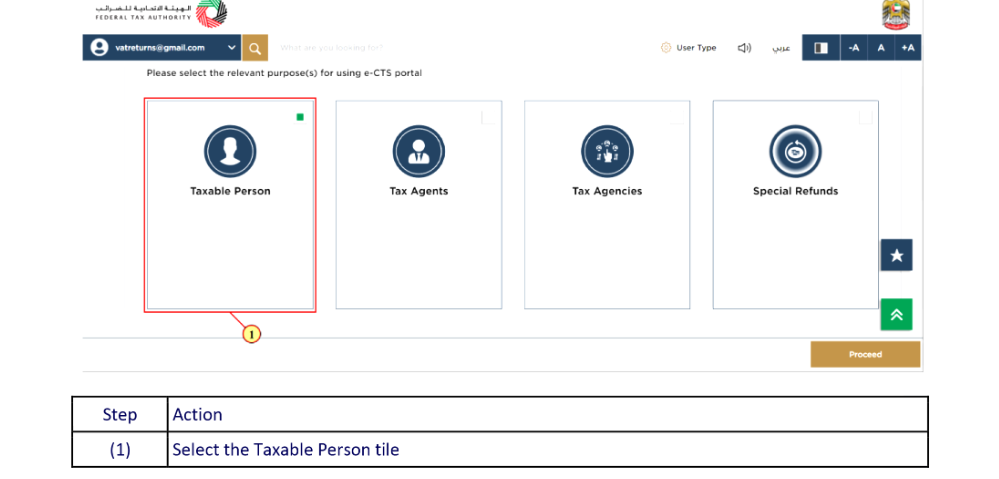
              2: Request the VAT Refund form

              Request the VAT Refund form
              • Choose the user type as Taxable Person.
              • Then click on the proceed button to access the Home page by clicking the View button.
              • You can select ‘Tax Agents’, ‘ Tax Agencies’, and ‘Special Refunds’ if applicable.
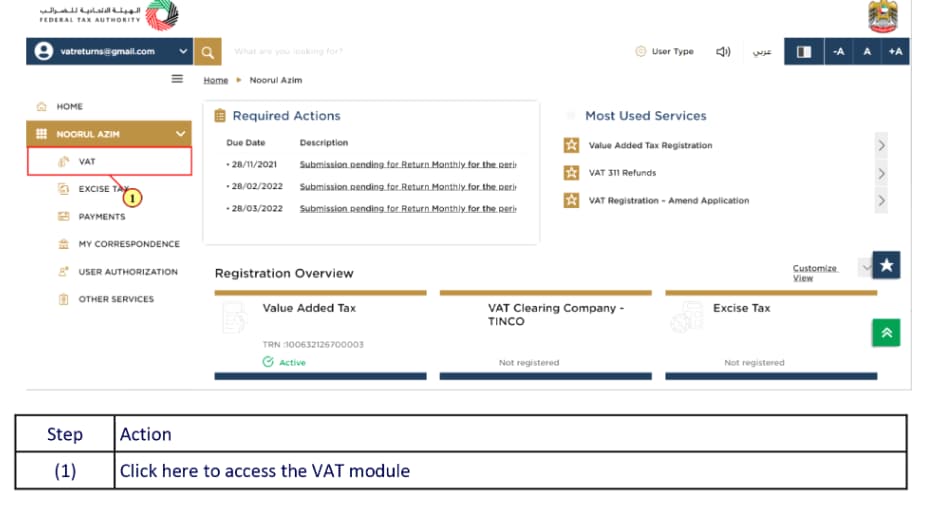
              • Direct to the VAT Module in the left sidebar.
                    click on VAT
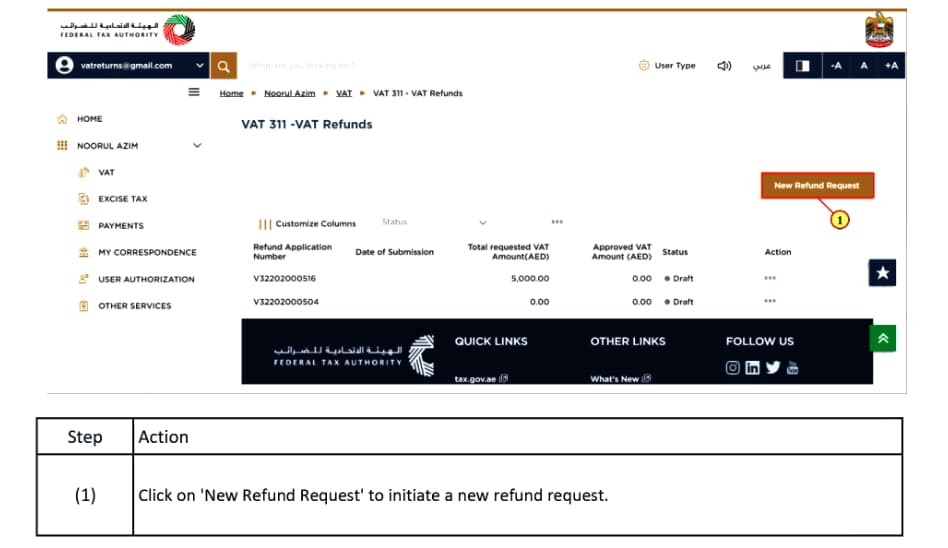
                    • Click on “New” to create a new VAT Refund Request. You can view your previous VAT 311 refund requests.
                    • Use the ellipsis icon to edit the Refund request.
                    • Initiate your refund by clicking the “New Refund Request” button.
                    • Confirm your understanding of the instructions and guidelines by clicking ‘Next’.
                    • Initiate the Refund request process by clicking on the Start button.
                            initiate vat refund by clicking new refund request button

                            3: Fill in the necessary VAT Refund in UAE

                            • Verify your bank details before submitting the form.
                            • Enter the refund amount, ensuring it does not exceed the “Excess Refundable VAT Amount.”
                            • Click on ‘Add Supporting Details’ to view the corresponding VAT refund.
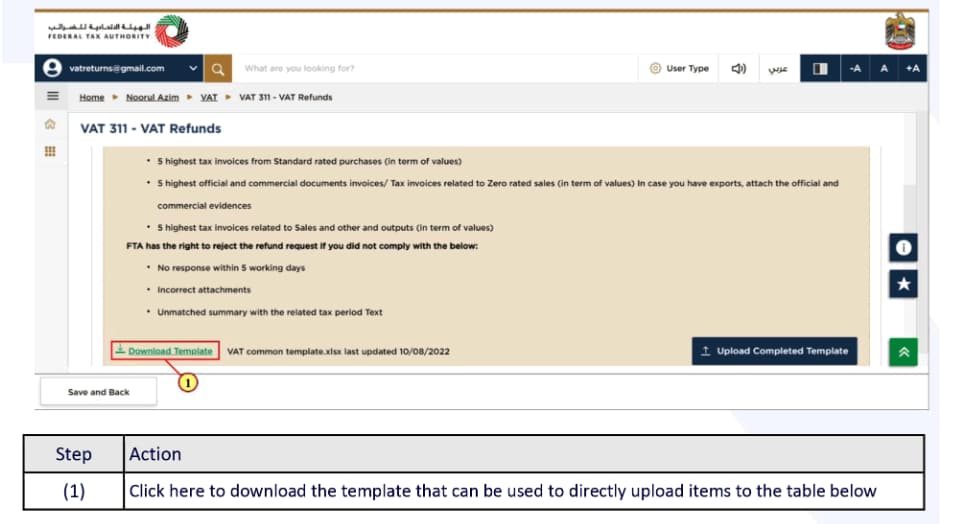
                            • Tap on the download button to download the template. Fill it out.
                            • Then upload the completed template.
                                    tap on the download button to download the template
                                    • Use the edit button to enter contact information and VAT supplies.
                                    • Click on the add button to upload the required document.
                                    • It will turn green upon successful upload.
                                        upload bank details
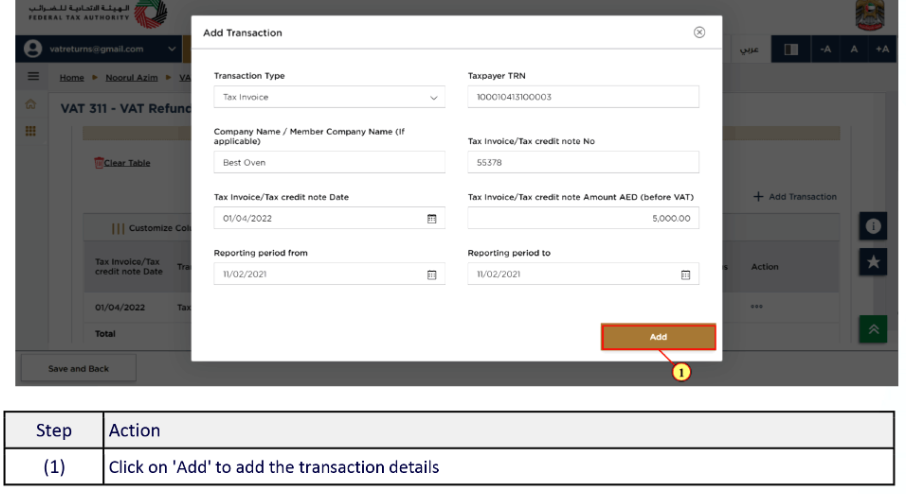
                                        • Click the “Add Transaction” button to input transaction details.
                                        • Then click “Add Transaction” to confirm.
                                          • Use the ‘Save and Back’ button to save your progress.
                                          • Click ‘Next’ to proceed to the completed Refund Request. You can review it before submission.
                                          • Review each section by clicking on the respective step.

                                              After filling out the VAT refund form. Mark the checkbox to confirm your agreement with the terms and conditions before submitting it using the ‘Submit’ button. Make sure to note down the application number provided upon submission for future reference.

                                              Once successfully submitted, you can conveniently access and manage your refund request. This process makes sure that your VAT refund application is processed efficiently and by UAE tax regulations, allowing you to track its progress and manage any further actions as needed.

                                              Documents Required for Claiming VAT Refund in UAE

                                              The documents required for claiming a VAT Refund in UAE include:

                                              • Top five tax invoices for outputs, sales, and other transactions.
                                              • Supporting evidence for excess credit refunds or erroneous payments.
                                              • Top five tax invoices for standard-rated purchases.
                                              • Bank account validation letter (for foreign banks).
                                              • Top five tax invoices for untaxed sales (with export evidence if applicable).

                                                      Steps to Update the Bank Details in VAT Refund Request

                                                      To update bank details in your VAT refund request:

                                                      • Follow the initial steps for applying for a VAT refund on the EmaraTax dashboard up to Step
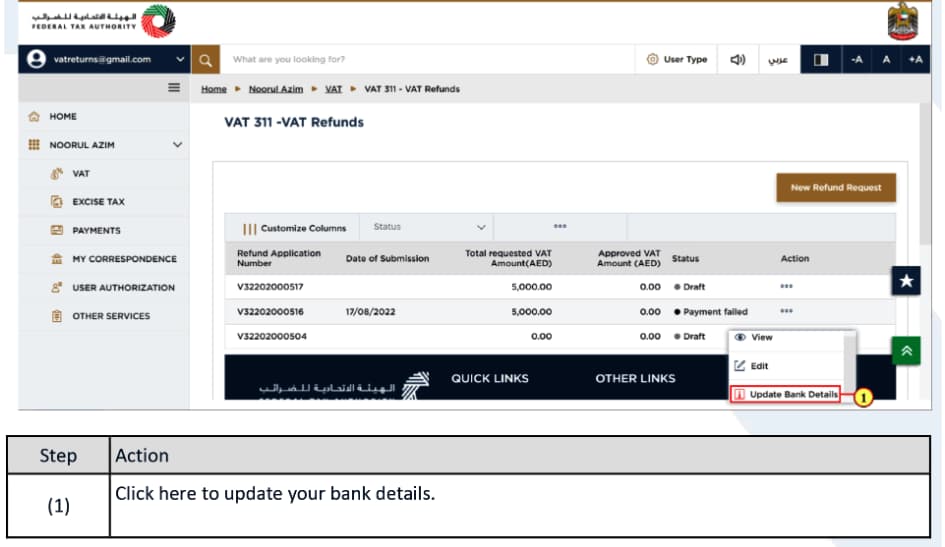
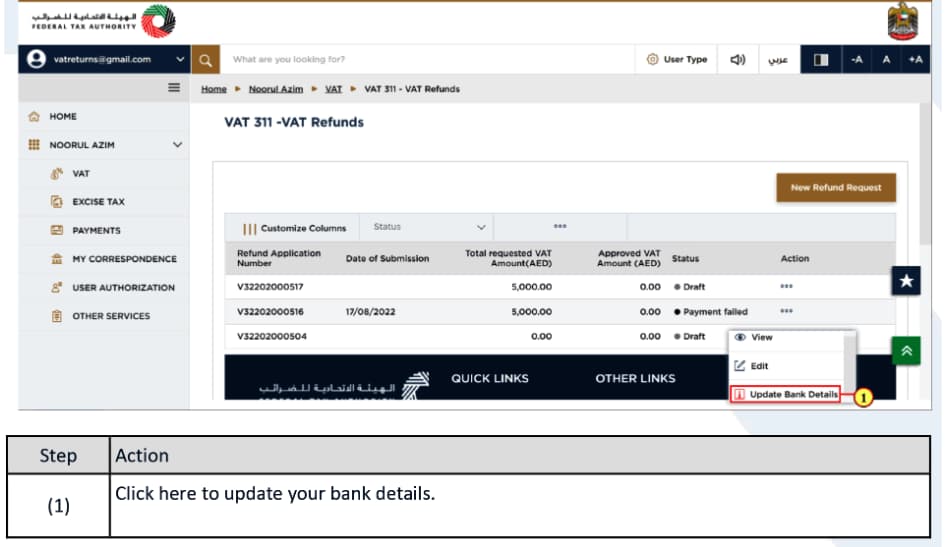
                                                      • Identify the application entry marked with the status ‘Payment Failed’.
                                                      • Click on the ellipsis (…) and choose the ‘Update Bank Details’ option.
                                                      • Select “Enable Editing” to make the bank details section editable.
                                                            update bank details
                                                            • Enter all required bank details.
                                                            • Upload the necessary document.
                                                            • Click the “Next Step” button to proceed.
                                                            • Follow the same application steps as when applying for a VAT refund on EmaraTax.

                                                                  VAT Refunds for Non-Tax Residents in the UAE

                                                                  VAT refunds for non-tax residents of the UAE are available at Abu Dhabi International Airport. The UAE Federal Tax Authority announced this initiative on November 18, 2018. Current regulations allow GCC nationals and other non-residents of the UAE to benefit from Tax-Free Shopping.

                                                                  This includes purchasing goods in the UAE for export, subject to specific limits and conditions. Customers who comply with regional regulations and authenticate their purchases may qualify for refunds on eligible goods.

                                                                  Process of VAT Refund for Non-Tax Residents in the UAE

                                                                  The process of VAT Refund for Non-Tax Residents in the UAE is as follows:

                                                                  • Present a valid passport to make a tax-free purchase as a tourist.
                                                                  • Shop employees record tourist information using the system.
                                                                  • Affix the Tax-Free sticker to the back of the sales receipt.
                                                                  • Visitors must authenticate the purchase at the airport, where a Tax-Free digital form has been prepared.

                                                                        What is the Refund Period?

                                                                        You must validate your tax-free tag within 90 days from the date of purchase. For example, a form issued on January 1 remains valid until April 1. Kindly validate within this period to avoid the expiration of the Tax-Free tag, which will make you ineligible to claim the VAT refund.

                                                                        Collecting Your VAT Refund in UAE

                                                                        To collect your VAT refund in UAE, follow these steps:

                                                                        • Bring the items and the receipt to the airport with you.
                                                                        • Visit a validation station where your purchases and receipts will be verified.
                                                                        • Choose your preferred refund method. You may undergo a secondary validation check and must present your goods for inspection.
                                                                        • Each traveller can receive a maximum of 10,000 AED in cash for cash refunds. Amounts exceeding this limit must be refunded via credit or debit card.

                                                                              Terms and Conditions for VAT Refund

                                                                              To claim a VAT refund:

                                                                              • You must be at least 18 years old and not a UAE resident.
                                                                              • You must enter the UAE with a tourist visa.
                                                                              • Have your tax invoice, tax-free tags, and purchased items ready if requested by Planet staff.
                                                                                  • Validate your tax-free transactions within 90 days of receiving the tax invoice before leaving the UAE.
                                                                                  • Retailers must be registered with the tourist refund scheme.
                                                                                  • You can request a refund within one year of validating your tax-free transactions for export. With a maximum cash refund limit of AED 35,000.
                                                                                  • VAT refunds apply only to items under the Tourist Refund Scheme.
                                                                                  • The minimum purchase amount eligible for a refund is AED 250.
                                                                                  • Ensure purchased items are not consumed fully or partially while in the UAE.
                                                                                  • Perishable items used in the UAE.
                                                                                              1. Services.
                                                                                              2. Items used within the UAE are not in the original packaging.
                                                                                              3. Items not in possession upon departure.
                                                                                              4. Motor vehicles, watercraft, and aeroplanes.
                                                                                              5. Internet purchases.

                                                                                              Goods For Which VAT is Not Refundable Include:

                                                                                              • Products consumed, either wholly or partially, within the UAE.
                                                                                              • Items such as cars, boats, airplanes, and other goods intended solely for use within the UAE, are left behind by tourists before departing the country.

                                                                                                VAT Refund Point Locations in the UAE

                                                                                                VAT refund points are available at various locations across the UAE when exiting the country, including airports, seaports, and land borders. Visit Planet’s self-service kiosks at the following locations:

                                                                                                Seaports

                                                                                                • Zayed Port, Abu Dhabi
                                                                                                • Port Rashid, Dubai

                                                                                                  Airports

                                                                                                  • Dubai Airport (Terminals 1, 2, 3, and 3 Business)
                                                                                                  • Abu Dhabi Airport (common area between all terminals)
                                                                                                  • Al Maktoum Airport
                                                                                                  • Ras Al Khaimah Airport
                                                                                                  • Sharjah Airport
                                                                                                  • Al Ain Airport

                                                                                                            Land Borders

                                                                                                            • Hatta (border with Oman)
                                                                                                            • Al Ain (border with Oman)
                                                                                                            • Al Ghuwaifat (border with Saudi Arabia)

                                                                                                                VAT Refund Services in UAE with Shuraa Tax

                                                                                                                Shuraa Tax is one of the experienced VAT consultants in Dubai. This focuses on providing VAT refund services to businesses and business tourists across the UAE. Our team assists companies in identifying eligible expenses and preparing the required documentation for VAT refund claims.

                                                                                                                Claiming a VAT refund can often be intricate and time-consuming, but with our expertise, businesses can be assured of a streamlined and accurate process. Contact us today at +971508912062 or info@shuraatax.com to learn more about how we can help with your VAT refund needs.

                                                                                                                Frequently Aksed Questions

                                                                                                                Q1. When Should Validation be Done?

                                                                                                                You must validate your tax-free tags within 90 days of receiving them. Additionally, you must depart from the UAE within 6 hours of validation. Failure to do so will result in the validation of approval being cancelled, requiring you to restart the process.

                                                                                                                Q2. Who Can Validate the Process?

                                                                                                                Only the individual whose name appears on the registered passport or GCC national identity card can initiate or complete the validation process. No third party is permitted to do this on their behalf.

                                                                                                                Q3. What if I Don’t Receive the Refund in 9 Days?

                                                                                                                If you have not received your refund within nine calendar days, it is advisable to contact your card issuer or bank promptly to inquire about its status.

                                                                                                                Q4. Which Cards Can Receive Refunds?

                                                                                                                Refunds can be credited to Visa, MasterCard, American Express, and UnionPay cards. Refunds are typically processed in the local currency (AED), with the exchange rate determined by your bank or card issuer.

                                                                                                                Q5. How to Claim a VAT Refund in the UAE for a Business?

                                                                                                                Businesses registered for VAT in the UAE can claim refunds through the FTA (Federal Tax Authority) portal.

                                                                                                                Steps:

                                                                                                                1. Log in to your FTA account (eservices.tax.gov.ae).
                                                                                                                2. Go to VAT → VAT Refunds → VAT Refund Request.
                                                                                                                3. Fill out the VAT Refund Form 311.
                                                                                                                4. Upload supporting documents (VAT returns, tax invoices, audit files if needed).
                                                                                                                5. Submit the request and wait for FTA approval.
                                                                                                                6. Once approved, the refund is transferred to your registered bank account.

                                                                                                                Q6. How to Claim a VAT Refund in UAE for Tourists?

                                                                                                                Tourists can claim VAT refunds on eligible purchases made from retailers participating in the Planet Tax Refund system.

                                                                                                                Steps:

                                                                                                                1. Shop at stores with the “Tax Free Shopping” logo.
                                                                                                                2. Ask the cashier to generate a Tax-Free Tag using your passport.
                                                                                                                3. Before departure, go to the Planet kiosk at the airport, border, or port.
                                                                                                                4. Scan your passport and receipts.
                                                                                                                5. Choose a refund method: cash or credit/debit card.
                                                                                                                6. Tourists must export the goods within 90 days of purchase.

                                                                                                                Q7. How to Claim VAT Refund in UAE?

                                                                                                                VAT refunds depend on whether you are a business, a tourist, or engaged in specific activities (e.g., imports, special cases).

                                                                                                                General process:

                                                                                                                • Businesses: File refund via FTA portal (Form 311).
                                                                                                                • Tourists: Claim via Planet kiosks during departure.
                                                                                                                • Special categories (e.g., diplomats, mission offices): Apply through dedicated FTA procedures.

                                                                                                                Q8. How to Get a Tax Refund at Dubai Airport?

                                                                                                                To claim VAT refund at Dubai Airport as a tourist:

                                                                                                                1. Keep the purchased goods with you (unused).
                                                                                                                2. Go to the Planet Tax-Free kiosk before checking in.
                                                                                                                3. Scan your passport and receipts.
                                                                                                                4. Present goods for verification if asked.
                                                                                                                5. Choose a refund via cash or card.
                                                                                                                6. Cash refunds have a limit; higher amounts are processed via card.

                                                                                                                Q9. How to Claim VAT Refund for a Company in UAE?

                                                                                                                Companies can claim refunds on input VAT that exceeds their output VAT.

                                                                                                                Steps:

                                                                                                                1. Ensure that VAT return filing is complete and accurate.
                                                                                                                2. Log in to the FTA portal.
                                                                                                                3. Submit a VAT Refund Form 311.
                                                                                                                4. Provide IBAN letters, bank details, and supporting invoices.
                                                                                                                5. Wait for FTA review and approval.

                                                                                                                If the FTA requests clarification, respond promptly to avoid delays.

                                                                                                                Q10. How to Claim VAT Refund in the UAE for Imports?

                                                                                                                If businesses pay VAT at customs for imports, they can reclaim it through their VAT return.

                                                                                                                Steps:

                                                                                                                1. Confirm that your Import Declaration is linked to your TRN.
                                                                                                                2. Check the VAT amount in Box 6 of your VAT return (Import VAT).
                                                                                                                3. Report the same VAT amount as recoverable input tax in Box 10.
                                                                                                                4. Submit a return; the import VAT is automatically refunded or adjusted against dues.

                                                                                                                If the TRN is not linked to customs, you must correct it through FTA before claiming.

                                                                                                                Q11. How long do I have to claim my VAT refund in the UAE?

                                                                                                                You have 90 days from the date of purchase to validate your Tax-Free tag and start the refund process.

                                                                                                                Q12. What happens if I don’t validate my Tax-Free tag within 90 days?

                                                                                                                Your Tax-Free tag automatically expires, and you will no longer be eligible to claim a VAT refund for that purchase.

                                                                                                                Q13. Can you give an example of the 90-day validity period?

                                                                                                                Yes. If your Tax-Free form was issued on January 1, it will remain valid until April 1. After this date, the refund cannot be processed.

                                                                                                                Q14. Can I extend the 90-day VAT refund period?

                                                                                                                No. 90 days are fixed and cannot be extended under any circumstances.

                                                                                                                Q15. What if I leave the UAE before validating my Tax-Free tag?

                                                                                                                If you fail to validate it at an official Tax-Free kiosk before departure, you lose eligibility for the refund, no exceptions.

                                                                                                                Q16. Does the 90-day period apply to all purchases?

                                                                                                                Yes, the rule applies to every eligible Tax-Free purchase, regardless of value or store.

                                                                                                                Q17. How Much VAT Do Tourists Actually Get Back?

                                                                                                                When claiming VAT refunds in the UAE, tourists don’t receive the full VAT amount; they get up to 87% of the tax they paid. A small processing fee of AED 4.80 is charged for every tax-free tag linked to a receipt. There’s also a limit on cash refunds, capped at AED 35,000.

                                                                                                                Anything beyond that can still be refunded but only through cards or digital methods. Tourists can choose how they want to receive their refund, cash (within the limit), credit/debit card, or digital wallets like WeChat, offering flexibility based on what’s most convenient for them.

                                                                                                              • TRN Verification in UAE: Process to Verify VAT Number in UAE

                                                                                                                TRN Verification in UAE: Process to Verify VAT Number in UAE

                                                                                                                The introduction of Value Added Tax (VAT) in the UAE in 2018 marked a significant shift, as the country had never previously applied a federal tax on goods and services. This led to understandable confusion among businesses and residents about how VAT works and what compliance involves. Since then, one of the most common queries has been about the Tax Registration Number (TRN), what it is, how to obtain it, and how TRN verification in Dubai or the UAE works for checking a business’s VAT status.

                                                                                                                A TRN is issued once a business successfully completes VAT registration with the Federal Tax Authority (FTA). After approval, the FTA assigns the TRN, which is required for VAT invoicing, return filings, and official documentation. It also enables TRN verification in the UAE through the FTA’s system, allowing businesses and individuals to confirm a company’s VAT registration status.

                                                                                                                What is TRN in the UAE?

                                                                                                                A Tax Registration Number (TRN) in the UAE is a unique identification number issued by the Federal Tax Authority (FTA) to businesses and individuals after successful VAT registration. Introduced alongside VAT in 2018, the TRN became a key component of the UAE’s first nationwide tax system. It confirms that a business or individual is officially registered with the FTA and authorised to charge, collect, and remit VAT.

                                                                                                                Once VAT registration is approved, the TRN is automatically generated through the FTA portal and is mandatory for issuing VAT-compliant invoices, filing returns, and dealing with tax authorities. The TRN also supports transparency, as clients, suppliers, and regulators can conduct TRN verification in Dubai or across the UAE to confirm a business’s VAT registration status and ensure compliance with tax regulations.

                                                                                                                What is the TRN Format in the UAE?

                                                                                                                The Tax Registration Number (TRN) format in the UAE follows a standard structure set by the Federal Tax Authority (FTA) to uniquely identify every VAT-registered business or individual.

                                                                                                                A UAE TRN is a 15-digit numeric code, with no letters, symbols, or spaces.

                                                                                                                UAE TRN Format Example

                                                                                                                TRN: 123456789012345

                                                                                                                Key Points About the TRN Format

                                                                                                                • Always 15 digits long
                                                                                                                • Numeric only (no alphabets or special characters)
                                                                                                                • Issued only after successful VAT registration
                                                                                                                • Unique to each VAT-registered entity
                                                                                                                • Remains the same unless the VAT registration is cancelled or amended by the FTA

                                                                                                                Where Is the TRN Used?

                                                                                                                The TRN must be clearly mentioned on:

                                                                                                                • VAT tax invoices
                                                                                                                • Credit notes and debit notes
                                                                                                                • VAT returns filed with the FTA
                                                                                                                • Official tax-related communications

                                                                                                                Why the Correct TRN Format Matters?

                                                                                                                Using the correct TRN format ensures:

                                                                                                                • Valid VAT invoices
                                                                                                                • Smooth VAT return filing
                                                                                                                • Easy TRN verification in the UAE via the FTA portal
                                                                                                                • Accurate TRN verification in Dubai for customers and suppliers

                                                                                                                Any error in the TRN format can lead to invoice rejection, compliance issues, or penalties under UAE VAT law.

                                                                                                                The UAE TRN format is simple but critical, a 15-digit number that confirms your VAT registration and legal tax status in the UAE

                                                                                                                Penalties & Risks of Using Invalid TRNs in the UAE

                                                                                                                Below are the penalties and risks of using invalid TRNs in the UAE:

                                                                                                                Penalty / Risk    What It Means  Penalty Amount / Impact
                                                                                                                Using an Incorrect or Invalid TRN   Mentioning a wrong, fake, or inactive TRN on tax invoices or documents.    AED 5,000 per incorrect TRN
                                                                                                                VAT Non-Compliance   Charging or reclaiming VAT without a valid TRN.   AED 10,000 for first offence, AED 50,000 for repeat offences  
                                                                                                                 Input VAT Claim Rejection Claiming VAT using invoices with invalid TRNs.   Input VAT denied, resulting in direct financial loss  
                                                                                                                Submission of Incorrect VAT Details    Providing inaccurate VAT or TRN-related information to the FTA.  AED 3,000–5,000 per incorrect submission
                                                                                                                Tax Evasion (Intentional Misuse)   Deliberate use of fake or misleading TRNs to evade VAT.    Up to 5 times the VAT amount involved, plus legal action
                                                                                                                 Legal & Regulatory Action Serious or repeated VAT violations linked to invalid TRNs.   Business suspension, licence risk, or prosecution  
                                                                                                                Bank & Audit Issues    Banks and auditors are rejecting documents with invalid TRNs.  Account freezes, audit failures, delayed approvals
                                                                                                                Business Reputation Damage   Clients verify TRN through TRN verification in Dubai / UAE.   Loss of contracts, delayed payments, and credibility damage  

                                                                                                                Important Note

                                                                                                                Penalty amounts are based on FTA administrative penalty guidelines and may vary depending on:

                                                                                                                • Nature of the violation
                                                                                                                • Whether it’s a first or a repeat offence
                                                                                                                • Intent (error vs. deliberate misuse)

                                                                                                                What is TRN’s Significance?

                                                                                                                TRN registration is a productive, time-efficient, and cost-saving process for both the public and private sectors. It can assist with:

                                                                                                                • Reclaiming previously paid taxes on the purchase, production, and processing of a product or merchandise.
                                                                                                                • Offering a refund to businesses that have registered for VAT and acquired a valid TRN.
                                                                                                                • Recoupment of business purchases through VAT by the purchaser.
                                                                                                                • Tax registration number strengthens the credibility and profile of the Company.

                                                                                                                According to the UAE’s VAT Law, TRN Verification of all tax documents is required for businesses, including the following:

                                                                                                                • Tax Invoice
                                                                                                                • VAT Return Tax
                                                                                                                • Credit notes
                                                                                                                • Other relevant tax documents

                                                                                                                Who Needs to Register for a TRN in the UAE?

                                                                                                                Businesses in the UAE must assess their turnover to determine whether they are required to register for VAT and obtain a TRN. The Federal Tax Authority (FTA) has set clear thresholds to guide this process and ensure smooth TRN verification with the FTA, especially for businesses operating in Dubai and across the UAE.

                                                                                                                Mandatory VAT Registration

                                                                                                                VAT registration becomes compulsory once a business’s taxable supplies and imports cross AED 375,000.

                                                                                                                If your company’s revenue or taxable imports exceeded AED 375,000 in the past 12 months or are expected to cross this limit within the next 30 days, you must register for VAT and complete TRN verification to stay compliant and avoid fines.

                                                                                                                It’s important to note that this threshold does not apply to foreign businesses, which may be required to register regardless of turnover, depending on their taxable activities in the UAE.

                                                                                                                Voluntary VAT Registration

                                                                                                                Businesses with taxable turnover between AED 187,500 and AED 375,000 have the option to register voluntarily.

                                                                                                                Voluntary registration allows businesses to obtain a TRN and proceed with TRN verification in Dubai, helping them recover input VAT and improve credibility with clients and suppliers, even if registration isn’t legally mandatory yet.

                                                                                                                Exempt from VAT Registration

                                                                                                                If a company’s annual taxable revenue and imports remain below AED 187,500, VAT registration is not required, and TRN verification with the FTA is not applicable.

                                                                                                                Understanding where your business stands help ensure timely TRN verification, avoids compliance issues, and keeps your operations fully aligned with UAE VAT regulations.

                                                                                                                How to Verify a TRN in the UAE?

                                                                                                                TRN verification is a simple online process that helps you confirm whether a business is VAT-registered with the Federal Tax Authority (FTA). Whether you’re validating a supplier or doing a routine compliance check, TRN verification in the UAE can be done by anyone in just a few minutes.

                                                                                                                Here’s how to complete a TRN check smoothly:

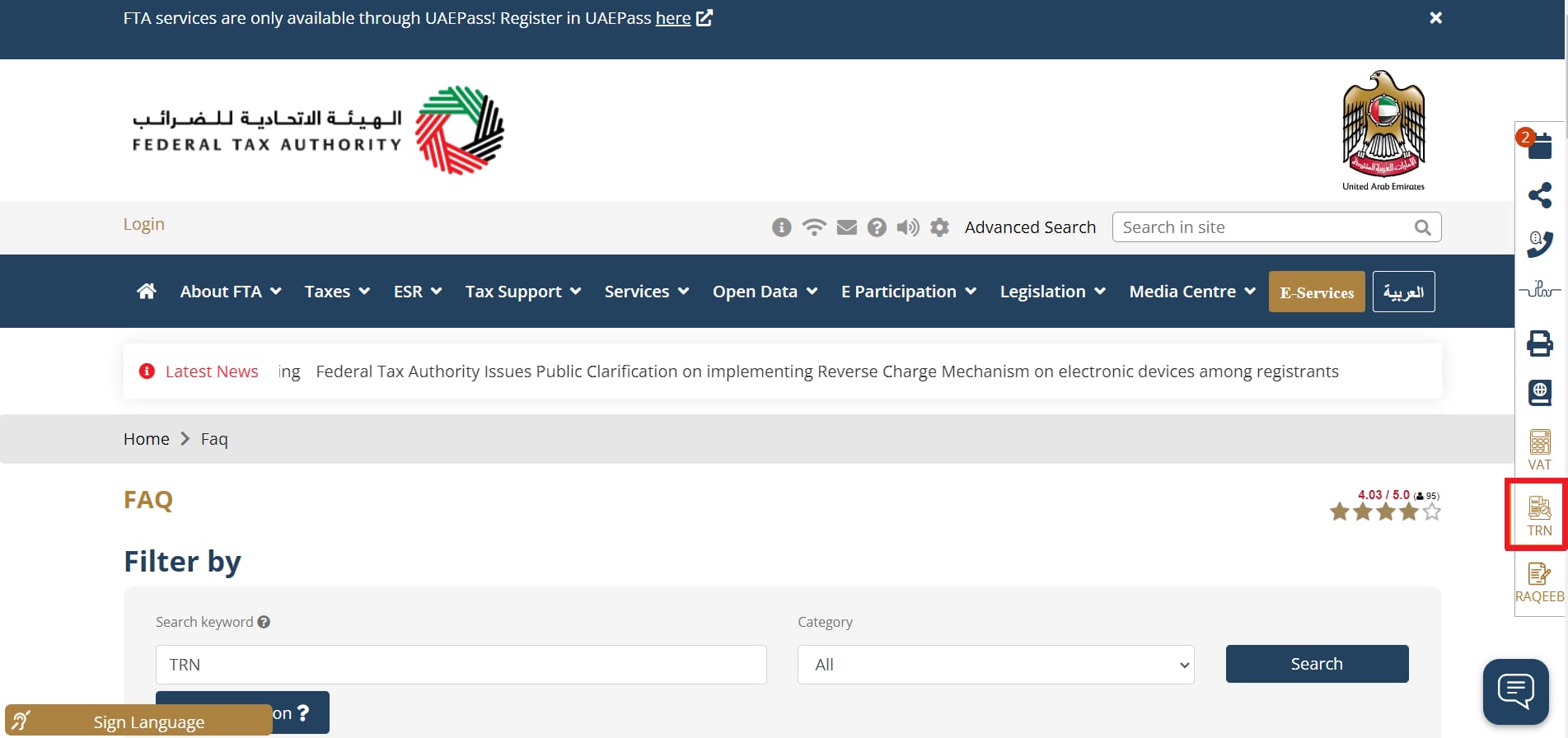
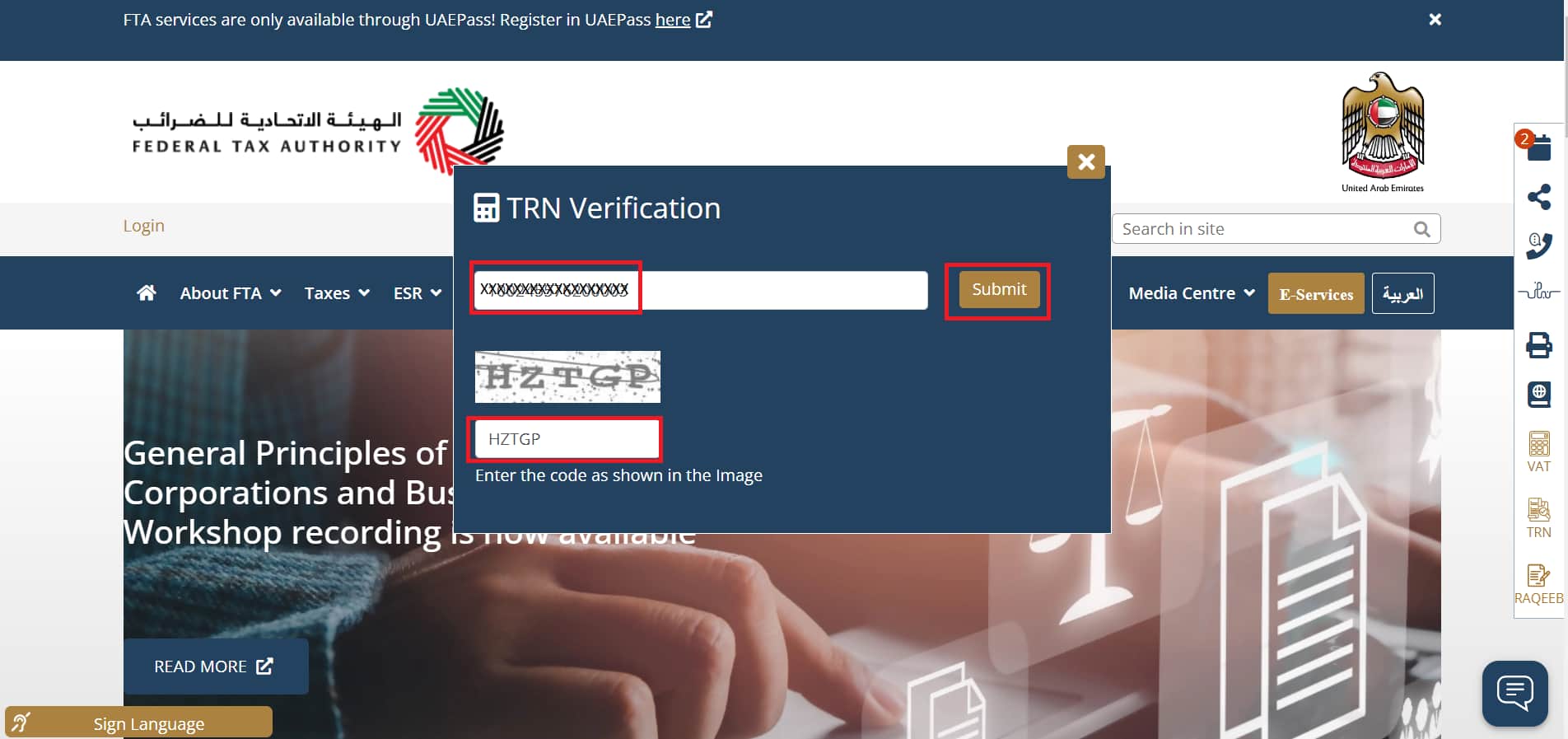
                                                                                                                Step 1: Access the FTA Portal

                                                                                                                Visit the official Federal Tax Authority website. On the homepage, locate and select the “TRN” option from the side panel.

                                                                                                                Access the FTA Portal

                                                                                                                Step 2: Enter TRN Details

                                                                                                                Input the Tax Registration Number in the required field, complete the captcha for security verification, and click Search.

                                                                                                                Enter TRN Details

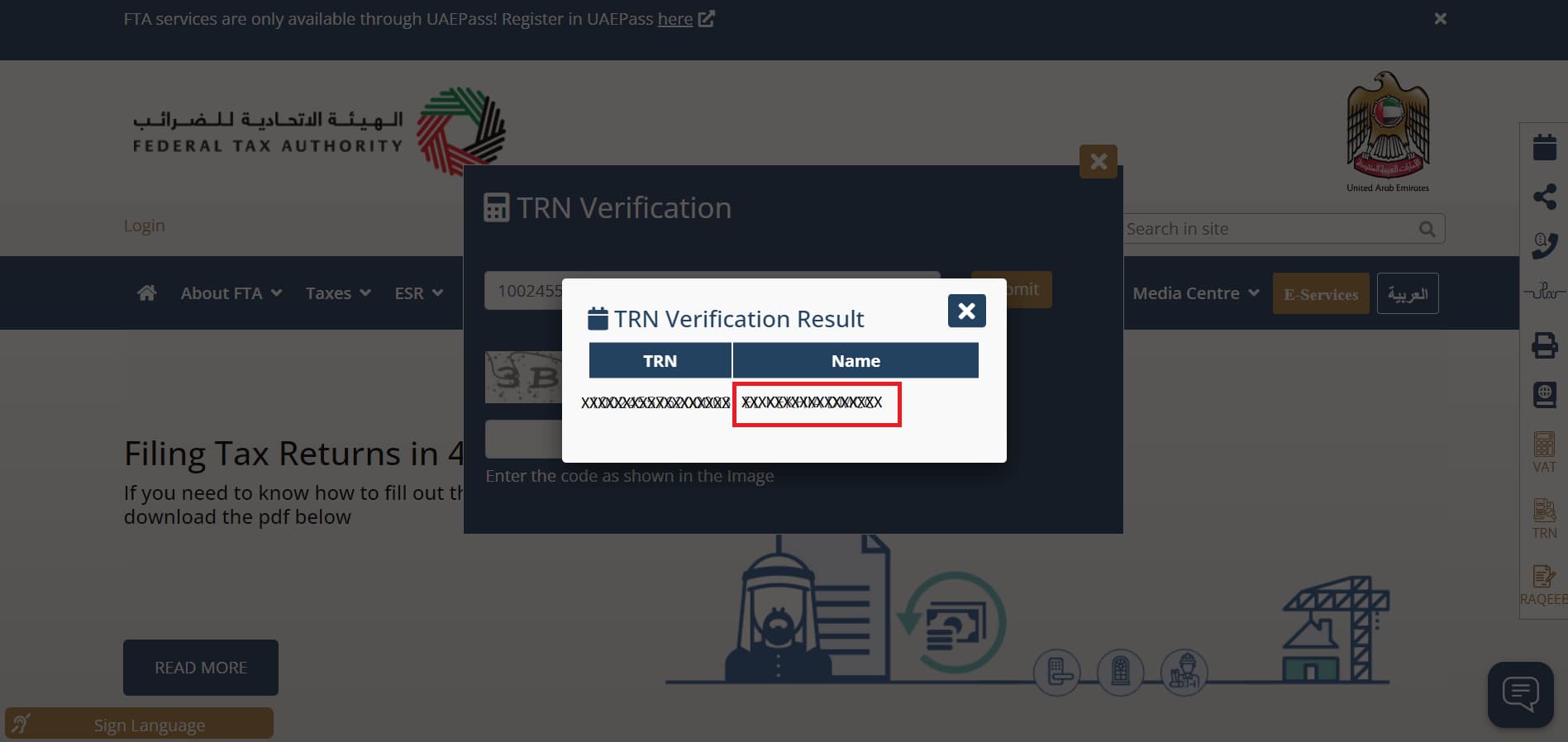
                                                                                                                Step 3: Confirm Business Information

                                                                                                                The system will display the registered business name associated with the TRN. Match these details with your records to ensure accuracy.

                                                                                                                Confirm Business Information

                                                                                                                This process applies nationwide and is commonly used for TRN verification in Dubai and other emirates. Regular TRN verification helps businesses avoid errors, ensure VAT compliance, and maintain transparent transactions.

                                                                                                                What Is the Purpose of a TRN and VAT in the UAE?

                                                                                                                After a business successfully completes VAT registration, the Federal Tax Authority (FTA) issues a Tax Registration Number (TRN) along with an official TRN certificate. This certificate authorises the company to file VAT returns within the timelines set by the FTA and confirms its legal status as a VAT-registered entity.

                                                                                                                Holding a valid TRN allows a business to:

                                                                                                                • Build trust with large corporations and government entities, as many prefer working only with TRN-registered vendors
                                                                                                                • Strengthen its banking profile when opening or maintaining corporate bank accounts
                                                                                                                • Officially represent the company before foreign authorities, partners, and international institutions

                                                                                                                How can Shuraa Tax support you?

                                                                                                                To avoid penalties, you can employ a reputable consulting firm that can provide end-to-end solutions for TRN registration, from assessment to procurement.

                                                                                                                For a better grasp of the TRN requirements, Shuraa Tax can assist your business in navigating the extensive guidelines of the UAE’s new tax law. With our assistance, you can establish a tax structure for your business that will save you time, mitigate risks, and safeguard your assets.

                                                                                                                📞 Call: +(971) 44081900

                                                                                                                💬 WhatsApp: +(971) 508912062

                                                                                                                📧 Email: info@shuraatax.com

                                                                                                              • Tax Compliances in UAE: Latest Updates

                                                                                                                Tax Compliances in UAE: Latest Updates

                                                                                                                Tax compliance in the UAE has become an important part of running a business. Over the years, the country has introduced structured tax systems such as VAT, Corporate Tax, and Excise Tax. Even though the UAE is still known as a business-friendly destination, companies are now expected to follow clear tax rules and meet regular reporting requirements.

                                                                                                                Staying compliant helps businesses avoid penalties, reduce risks, and keep their operations running without interruptions. Simple mistakes like late filings, incorrect returns, or missing updates can create unnecessary problems. Understanding how UAE taxes work and what’s currently required can save both time and money in the long run.

                                                                                                                UAE tax regulations are updated from time to time, with new rules, clarifications, and compliance deadlines announced by the Federal Tax Authority (FTA). These changes can affect how you file returns, keep records, or calculate taxes.

                                                                                                                What are the Different Kinds of Taxes Applicable in the UAE?

                                                                                                                Over the past few years, the UAE has introduced new tax laws to align with global standards while maintaining its position as an attractive place to do business. Knowing which taxes apply to you is the first step toward staying compliant.

                                                                                                                1. Corporate Tax (CT)

                                                                                                                Corporate Tax is a direct tax on business profits. While the 9% rate is low by global standards, the rules around who pays what are becoming more detailed.

                                                                                                                The 9% Threshold:

                                                                                                                You only pay the 9% rate on profits above AED 375,000. If your profit is below this, your rate is 0%, but you still must register and file a return.

                                                                                                                Small Business Relief (SBR):

                                                                                                                If your annual revenue (total sales, not just profit) is AED 3 million or less, you can elect to be treated as having zero taxable income until the end of 2026. This means no tax and much simpler paperwork.

                                                                                                                Free Zone Rules:

                                                                                                                Companies in Free Zones can keep their 0% tax status on “Qualifying Income.” However, they must now maintain “Substance” (having a real office and employees in the zone) and have their accounts audited by a certified firm.

                                                                                                                2. Value Added Tax (VAT)

                                                                                                                VAT is a consumption tax charged on most goods and services in the UAE. Businesses that cross the mandatory registration threshold must register for VAT, charge it on taxable supplies, and file regular VAT returns with the Federal Tax Authority. Some supplies are zero-rated or exempt, depending on the nature of the activity.

                                                                                                                The Mandatory Limit:

                                                                                                                You must register for VAT if your taxable sales/imports hit AED 375,000 over the last 12 months.

                                                                                                                3. Excise Tax

                                                                                                                Excise Tax is applied to specific goods that are considered harmful to health or the environment, such as tobacco products, energy drinks, and sugary beverages. Businesses involved in manufacturing, importing, or storing excise goods must comply with strict registration, reporting, and payment requirements.

                                                                                                                Sugar-Based Tiers: Instead of a flat 50% tax on all sweet drinks, the tax is now based on grams of sugar per 100ml:

                                                                                                                • High Sugar (8g+): AED 1.10 per litre.
                                                                                                                • Medium Sugar (5g–8g): AED 0.80 per litre.
                                                                                                                • Low/Zero Sugar: 0% tax (though artificial sweeteners must still be registered).

                                                                                                                The 100% Club: Tobacco products, electronic smoking devices, and energy drinks remain taxed at a flat 100% of their retail price.

                                                                                                                4. Withholding Taxes (WHT)

                                                                                                                Withholding tax is a tax collected by the payer (like a business) on behalf of the recipient (like a foreign supplier). Currently, the UAE has set the WHT rate at 0%. This is a major advantage for companies that hire foreign consultants or pay royalties abroad, as it keeps cash flow moving freely.

                                                                                                                For very large multinational groups (earning over €750 million globally), a new Domestic Minimum Top-up Tax ensures they pay at least a 15% effective tax rate in the UAE, aligning with global efforts to prevent tax avoidance.

                                                                                                                5. Other Relevant Levies

                                                                                                                While not always called taxes, these fees are part of your ‘cost of doing business’ in the UAE:

                                                                                                                • Customs Duties: Most goods imported from outside the GCC face a 5% duty. Note that many Free Zone companies are exempt from this unless they sell their goods into the local UAE market.
                                                                                                                • Property Transfer Fees: In Dubai, for example, there is a 4% fee on the sale value of property. This is usually split 50/50 between the buyer and seller, though contracts can vary.
                                                                                                                • Digital Transformation Fees: The FTA has cancelled fees for paper certificates. Tax Registration Certificates are now issued as free digital copies with QR codes for instant verification.

                                                                                                                Recent Corporate Tax Updates in the UAE (As of 2026)

                                                                                                                The UAE’s corporate tax system has been rapidly evolving since its introduction in 2023.

                                                                                                                The First Major Filing Deadlines are Here:

                                                                                                                For many businesses, 2026 is the year the first tax return is actually due. The deadline is strictly nine months after the end of your financial year.

                                                                                                                • January–December Financial Year: If your first tax period ended on December 31, 2025, your filing and payment deadline is September 30, 2026.
                                                                                                                • April–March Financial Year: If your period ends March 31, 2026, your deadline is December 31, 2026.

                                                                                                                Note: Even if your profit is zero or you qualify for relief, you must still file a return.

                                                                                                                Small Business Relief (SBR):

                                                                                                                The Small Business Relief remains the most vital tool for startups, but it has a built-in expiration date. Resident businesses with revenue of AED 3 million or less can elect to be treated as having “zero taxable income.” This relief is currently set to apply only for tax periods ending on or before December 31, 2026.

                                                                                                                If you choose SBR, you cannot carry forward any tax losses or net interest expenses to future years. Businesses expecting high growth in 2027 should weigh whether it’s better to pay a little tax now to save their losses for later.

                                                                                                                Latest VAT Compliance Changes in the UAE (As of 2026)

                                                                                                                The UAE has introduced a set of important updates to its Value Added Tax (VAT) rules to make compliance clearer, strengthen enforcement, and align the system with international standards.

                                                                                                                Five-Year Deadline for VAT Credits & Refunds:

                                                                                                                A major compliance update is the introduction of a five-year limitation period to claim or use excess VAT credits and refunds. After this period, any unused VAT credit will expire permanently if not claimed or offset.

                                                                                                                This means that VAT refunds must be claimed within 5 years from the end of the relevant tax period. Legacy VAT credits that will expire soon may need immediate action.

                                                                                                                Launch of the E-Invoicing System (EIS):

                                                                                                                The UAE is moving away from PDFs and paper. Starting in July 2026, the government will begin testing a national e-invoicing system. Invoices will be sent to the FTA in real-time as they are issued, making manual errors much riskier. If an invoice is not issued through the approved system once it becomes mandatory for your tier, it may be considered invalid, and the buyer will be denied the right to recover input VAT.

                                                                                                                No More Self-Invoicing for Reverse Charge:

                                                                                                                Under the updated rules, businesses applying the reverse charge mechanism no longer need to issue internal self-invoices for these transactions. This reduces a significant administrative step, especially for importers and companies receiving cross-border services.

                                                                                                                Stronger Anti-Evasion Controls:

                                                                                                                To protect the tax base, the FTA now has clearer powers to deny input tax deductions that are linked to fraudulent or artificial transactions. This aligns with global efforts to tighten anti-avoidance measures and promotes honest reporting.

                                                                                                                Updates on Excise Tax in the UAE (As of 2026)

                                                                                                                Excise Tax in the UAE continues to evolve in 2026, with key changes aimed at improving public health outcomes, tightening compliance, and making the tax system more transparent and predictable for businesses.

                                                                                                                Introduction of a Tiered Sugar-Based Excise Tax:

                                                                                                                As of January 1, 2026, the old 50% flat tax on all sweetened drinks has been replaced. The tax is now volumetric, meaning it is charged as a fixed amount of Dirhams per litre, depending on how many grams of sugar are in the drink.

                                                                                                                Category Sugar Content (per 100ml) 2026 Tax Rate
                                                                                                                 High Sugar  8 grams or more AED 1.10 per litre
                                                                                                                 Moderate Sugar  5 to 7.99 grams  AED 0.80 per litre
                                                                                                                 Low / Zero Sugar  Less than 5 grams 0% (Exempt)

                                                                                                                Artificial sweeteners (like Stevia or Aspartame) do not count as sugar in this calculation. If a drink uses only artificial sweeteners and has 0g of real sugar, it qualifies for the 0% tax rate.

                                                                                                                Category Shift for Carbonated Drinks:

                                                                                                                In a big change for 2026, Carbonated Drinks are no longer a separate excise category. Previously, all sodas were taxed at 50% just for being bubbly. But now, they are simply treated as Sweetened Drinks. If a brand reformulates a soda to have less than 5g of sugar, it can now be sold excise-free, even if it is still carbonated.

                                                                                                                Mandatory Lab Certification:

                                                                                                                You can no longer just claim your drink is low sugar. To benefit from the lower tax tiers, businesses must:

                                                                                                                • Obtain a Lab Report: All products must be tested by a MOIAT-accredited laboratory (such as Dubai Central Lab or SGS).
                                                                                                                • Register the Certificate: This report must be uploaded to the FTA’s EmaraTax portal.

                                                                                                                Transitional Relief and Excise Tax Deductions:

                                                                                                                The UAE’s tax authorities have also introduced specific provisions under FTA Decision No. 11 of 2025 that allow businesses to claim limited deductions where excise tax was previously paid under the old rules, but the new tiered model results in a lower tax amount – provided certain conditions are met (e.g., products remain unsold and proper documentation is supplied).

                                                                                                                Tips for Smooth Tax Compliance in the UAE

                                                                                                                Here are some expert-backed tips to help you stay on track.

                                                                                                                1. Don’t Treat Compliance as a One-Time Task: Tax and regulatory compliance is ongoing, not something you handle only at year-end. Track deadlines throughout the year for VAT, Corporate Tax, and UBO. Review compliance requirements whenever there’s a business change (new activity, revenue growth, expansion).
                                                                                                                2. Maintain Accurate and Updated Records: Clean and well-organised records form the backbone of tax compliance. Keeping proper invoices, contracts, bank statements, and accounting records makes filings smoother and protects businesses during audits or reviews.
                                                                                                                3. Use the Right Accounting and Compliance Tools: Reliable accounting software helps businesses track transactions accurately, prepare tax returns efficiently, and meet deadlines with confidence. With digital initiatives such as e-invoicing gradually rolling out, preparing systems early can save time and prevent disruptions later.
                                                                                                                4. Conduct Periodic Internal Reviews: Regular internal reviews help identify gaps or errors before they become serious issues. Reviewing tax returns, compliance filings, and supporting documents from time to time allows businesses to correct mistakes proactively and stay aligned with regulatory expectations.

                                                                                                                Bonus Tip: Get Professional Support to Stay Fully Compliant

                                                                                                                Even with the best internal processes, tax compliance in the UAE can become complex, especially with regular updates to Corporate Tax, VAT, Excise Tax, UBO, and reporting requirements. This is where professional support can make a real difference. Shuraa Tax supports businesses with end-to-end taxation services in the UAE. From Corporate Tax and VAT registration to return filing, compliance reviews, advisory, and audit support, the team helps businesses stay aligned with UAE tax laws at every stage.

                                                                                                                With expert guidance, businesses can avoid costly mistakes, stay updated with regulatory changes, and focus more on growth instead of compliance stress.