Author: Kajol Kanojia

  • Top VAT Consultants in Abu Dhabi (2026)

    Top VAT Consultants in Abu Dhabi (2026)

    The Federal Tax Authority (FTA) gathers and manages taxes. It furnishes comprehensive laws, guidance, and explanations to aid commercial entities. The UAE government presented Tax (VAT) on January 1st, 2018. VAT consultants in Abu Dhabi constitutes an indirect tax imposed on the utilisation of products and services, knowingly influencing business operations. The keen risk, quantity, and difficulty of transactions must be better for taxpayers to fulfil tax compliance obligations.

    Since the inception of VAT in the UAE, Shuraa Tax has remained committed to delivering committed professional assistance to taxpayers. Our services include supporting businesses in their transactions, guaranteeing correct tax procedures, and undertaking conflicts. In this blog post, we aim to point you towards the leading VAT consultants in Abu Dhabi for 2026.

    How do Abu Dhabi’s VAT consultants assist businesses?

    VAT consultants are crucial partners for businesses directing the involved landscape of Value Added Tax regulations. These professionals offer services to safeguard compliance, provide expert advice, and optimise VAT-related processes. From assisting with initial registration and filing VAT returns to providing direction on complex transactions and pricing strategies, VAT consultants play a key role in helping businesses understand and manage their VAT obligations effectively. They provide custom-made solutions to ease risks, implement internal controls, and develop VAT strategies that align with the unique needs of each business.

    Moreover, VAT consultants keep well-informed of changes in VAT laws and regulations, guaranteeing that companies stay informed and adapt to growing requirements seamlessly. With their skill, businesses can confidently steer the difficulties of VAT, minimising tax liabilities and maximising compliance.

    Abu Dhabi’s Shuraa VAT Consultant Services

    VAT consulting services in Abu Dhabi boast expertise and exercise in the details of value-added tax in the region. The imposition of VAT on goods and services in Abu Dhabi falls under the jurisdiction of the Federal Tax Authority. In Abu Dhabi, businesses must register for VAT and submit VAT returns once their annual sales surpass AED 375,000. VAT consultants in Abu Dhabi offer a range of services, including:

    • VAT return filing
    • VAT audits
    • VAT consultations
    • Representation services

    Following to VAT regulations necessitates businesses to file monthly returns and furnish an audit report. VAT consultants in Dubai offer complete VAT legislation services.

    Top VAT Consultants in Abu Dhabi

    The foremost VAT consultants in Abu Dhabi include:

    Shuraa Tax

    Shuraa Tax is broadly recognised as a leading authority among VAT Consultant Services in Abu Dhabi, setting the industry’s standard for quality and reliability. With an established track record of excellence, they have established themselves as trusted advisors to numerous businesses across various sectors.

    What sets Shuraa Tax apart is its thorough understanding of the details of VAT law and its proactive approach towards helping businesses steer the difficulties of agreement. By staying well-informed of the latest developments and updates in VAT regulations, they guarantee that their clients are always well-informed and prepared to meet their legal obligations.

    Shuraa Tax is more than just a service provider; it is a trusted partner committed to empowering businesses to flourish in an ever-evolving regulatory landscape. With their firm dedication to excellence and client satisfaction, it’s no wonder they are consistently ranked among the top VAT consultants in Abu Dhabi.

    Deloitte & Touche

    Deloitte’s VAT consultants stand out for their deep understanding of the complex tones of VAT law. They possess a complete grasp of the legal framework and an acute awareness of the broader industry dynamics. By combining legal expertise with industry insight, they are uniquely positioned to offer custom-made solutions that address the specific needs and challenges businesses in Abu Dhabi face. Moreover, Deloitte’s VAT consultants recognise the growing importance of technology in determining the landscape of tax compliance.

    They leverage cutting-edge tools and methodologies to streamline processes, improve accuracy, and guarantee compliance with evolving regulatory requirements. This forward-thinking approach enables them to stay ahead of the curve and provide clients with innovative solutions that drive efficiency and effectiveness.

    In addition to their technical proficiency, Deloitte’s VAT consultants are known for their competence and professionalism. With a proven track record of bringing results, they see confidence in their clients and inspire trust through their dedication to excellence. As trusted advisors, they go above and beyond to provide personalised service and strategic leadership that helps businesses quickly steer the complexities of VAT compliance.

    KPMG

    KPMG, well-known as one of the top VAT consultants in Abu Dhabi, differentiates itself through its proactive leadership and meticulous execution in ensuring compliance with VAT regulations. Their approach goes beyond mere advisory services; they take the reins in supervisory businesses through the complexities of VAT compliance, offering comprehensive support at every stage of the process.

    By leveraging their extensive expertise and resources, KPMG assists businesses in steering the complicated web of VAT laws and regulations, thereby minimising the risk of legal issues arising from non-compliance. Their thorough understanding of the legal landscape allows them to identify and proactively address potential pitfalls, safeguarding businesses against costly penalties and disputes.

    In essence, KPMG’s role as a top VAT consultant in Abu Dhabi extends beyond mere compliance; they serve as strategic partners dedicated to supporting businesses in achieving their objectives while minimising risks and maximising opportunities in VAT. Their proactive approach and solid commitment to excellence make them a trusted ally for businesses seeking to direct the intricate landscape of VAT regulations with confidence and peace of mind.

    PricewaterhouseCoopers

    PricewaterhouseCoopers (PwC) stands at the forefront of driving change in tax laws, leveraging its significant influence to engage in discussions with tax officials and governments actively. Their proactive approach towards shaping tax legislation reflects their deep commitment to serving as thought leaders and catalysts for positive change in the tax landscape.

    PwC’s expertise in tax matters extends far beyond mere compliance; they possess an in-depth understanding of the intricacies of tax laws and regulations, allowing them to offer strategic insights and direction to their clients. By staying well-informed of the latest developments and trends in tax policy, PwC can anticipate changes and provide timely advice to help businesses adapt and thrive in an ever-developing regulatory environment.

     In essence, PwC’s proactive approach, coupled with its unmatched expertise and influence in the field of tax, makes it a trusted partner for businesses seeking to direct the intricacies of VAT compliance and taxation in Abu Dhabi. By easing up their insights and resources, PwC helps companies stay ahead of the curve and achieve their strategic objectives in a rapidly changing regulatory landscape.

    Ernst & Young

    Ernst & Young (EY), recognised as one of the foremost VAT consultants in Abu Dhabi, distinguishes itself through its innovative approach to VAT compliance. EY goes beyond traditional advisory services by leveraging cutting-edge practices and technologies to help clients transform legal compliance into a strategic advantage.

    EY’s innovative practices are designed to ensure adherence to VAT regulations and reveal hidden value within businesses. By adopting a forward-thinking mindset, EY helps clients identify opportunities to optimise their VAT strategies and improve overall business performance.

    EY’s commitment to innovation and client-centric approach sets them apart as a trusted advisor in VAT consultancy. By harnessing the power of innovative practices, EY enables clients to meet their legal obligations and seize opportunities for growth and innovation in an ever-changing business landscape.

    Reasons to Engage VAT Consultant Services in Abu Dhabi:

    • Employing top-tier methodologies for precise VAT calculations.
    • Making bespoke consulting solutions tailored to clients’ specific requirements.
    • Representative professionalism and proficiency in directing VAT regulations.
    • Conducting thorough reviews to assess the effects of VAT implementation on businesses.
    • Scrutinising business operations to ensure compliance with VAT regulations in Dubai, UAE.
    • Provided support during VAT audits and represented clients in dealings with VAT officials.
    • Supervising clients through VAT processes to streamline operations and ensure compliance with ease.

    Services Offered by Shuraa Tax VAT Consultants

    Below is the list of services that Shuraa Tax offers:

    1. VAT Advisory Services

    Providing tailored advisory services to address industry-specific needs, offering guidance on transactions and their tax implications. 

    2. VAT Return Filing Service

    Supporting UAE businesses in completing and filing VAT Return Form 201, including direction on reconciliation input and output VAT and computing tax liability. Leading reviews of previously submitted VAT returns to identify and rectify errors or omissions.

    3. VAT Registration

    We assist businesses in the VAT registration process, ensure compliance with regulations, and facilitate a smooth transition into the tax system.

    4. VAT Deregistration

    Supporting businesses in applying for VAT deregistration within the required timeframe to avoid potential penalties. Ensuring a seamless process for cancelling tax registration numbers.

    5. VAT Training

    Presenting customised training sessions for individuals and corporate entities on VAT laws and regulations. Leveraging the expertise of our professionals to provide complete training custom-made to specific business needs.

    6. VAT Transactions Advisory

    Providing guidance on industry-specific transactions, particularly for businesses with complex operations, products, or branches. Keeping abreast of recent developments to offer informed advice on VAT matters.

    Concluding Thoughts with Shuraa Tax

    This overview of leading VAT consultants has assisted you in determining the ideal VAT consultancy for your needs. For further insights into VAT consultancy or any tax and accounting inquiries, please don’t hesitate to contact us. Reach out today at +971508912062 or via email at info@shuraatax.com. We look forward to assisting you!

    Frequently Asked Questions

    Q1. What taxes apply to companies in Abu Dhabi?

    In Abu Dhabi, Value Added Tax (VAT) applies to most goods and services, while excise tax is levied on specific goods. Individual income tax is not imposed, but oil companies and foreign banks are subject to corporate tax.

    Q2. What services do tax consultants offer in Abu Dhabi?

    Tax consultants, well-versed in tax laws, act as advisors to clients, aiding in tax planning, compliance, and reporting.

    Q3. What factors should be considered when hiring a tax consultant? 

    When selecting a tax consultant, measuring their expertise in the relevant tax laws, cost-effectiveness, and industry-specific knowledge relevant to the business activities is essential.

    Q4. What are the key features of a tax accounting application?

    Choosing a tax accounting application hinges on ensuring compliance with applicable tax laws and enhancing efficiency in tax processes.
  • How is Corporate Tax Different from Value-Added Tax in UAE?

    How is Corporate Tax Different from Value-Added Tax in UAE?

    In Dubai’s bustling business landscape, the differences between corporation tax vs VAT are key pillars shaping companies’ fiscal strategies. While corporation tax levies a percentage on a company’s profits, VAT operates as a consumption tax applied at every stage of the supply chain. Going deeper into these variances is essential for businesses to guide the UAE’s tax framework efficiently. At the intersection of these intricacies lies Shuraa Tax, offering easy solutions to facilitate compliance and optimise financial outcomes. Join us as we examine the differences between corporation tax and VAT, disclosing insights to certify businesses in Dubai’s ever-evolving economic terrain.

    How Is Corporate Tax Different from Value Added Tax In UAE?

    The UAE serves as a central hub and preferred location for conducting business, offering its own unique set of regulations. It is essential for any entrepreneur aiming to establish a company in this vibrant environment to grasp the local laws, especially those related to taxation. Two significant taxes demand attention in the UAE: corporate tax and VAT. This blog aims to illuminate the definitions and disparities between these taxes, providing clarity for businessmen navigating the UAE’s intricate tax landscape.

    Introducing Corporate Tax

    In the past, the UAE operated as a tax haven, offering companies exemption from corporate tax. However, a significant change is underway as the UAE government prepares to implement corporate tax on business profits. This shift is heralded by the issuance of the Corporate Tax Decree Law by the Federal Tax Authority on December 9, 2022.

    The primary aim of this tax reform is to diversify the UAE economy away from its reliance on oil revenues. The government intends to achieve this transformative objective through substantial investments in technology and innovation, along with the introduction of corporate tax in Dubai and nationwide. 

    By expanding revenue sources beyond oil-related income, the introduction of corporate taxation is expected to boost state revenues, fostering greater economic stability and resilience.

    Additionally, the system includes exemptions for: 

    • Profits from intra-group transactions.
    • Profits from group re-organization.
    • Dividends from UAE companies.
    • Tips from foreign companies.

    Proposed Corporate Tax Rates and Regulations

    In the updated corporate tax framework, the proposed tax rates are outlined as follows:

    • If the net profit in one financial year is up to AED 375,000 the company is subject to a 0% tax rate.
    • If the net profit in one financial year is overreaching AED 375,000 then it is subject to a 9% tax rate.
    • Furthermore, Multinational Enterprises (MNEs) falling under Pillar 2 of the BEPS 2.0 framework will adhere to relevant authorities’ OECD Base Erosion and Profit-Sharing Rules.

    Understanding Value Added Tax (VAT) in UAE

    Value Added Tax (VAT) is a consumption-based tax levied on goods and services, operating as a standard fiscal tool adopted by over 150 countries worldwide. Introduced in the UAE on January 1, 2018, VAT applies to most transactions at a standard rate of 5%. Businesses are mandated to register for VAT if their taxable supplies and imports surpass the specified threshold of AED 375,000.

    VAT-registered businesses must file periodic VAT returns to the Federal Tax Authority (FTA). By diversifying revenue streams, VAT contributes to the government’s financial objectives outlined in the national budget.

    Specific sectors are exempt from Value Added Tax (VAT), including:

    • Specific financial services as outlined in VAT legislation
    • Residential properties
    • Bare land
    • Local passenger transport

    Difference between VAT and Corporate Tax

    The difference between corporation tax vs VAT lies in their tax structures. Corporate tax operates as a profit-oriented tax, while VAT functions as a consumption-based levy.

    Corporate tax is imposed on companies and settled by them directly, whereas consumers ultimately bear VAT by purchasing goods and services.

    VAT computation involves accumulating value at each production stage, whereas corporate tax in Dubai is computed based on profits.

    In corporate tax, businesses must report their profits and fulfill tax obligations based on the corporate tax scheme mandated by the government. Conversely, in the VAT system, companies are tasked with levying VAT on sales to customers and remitting it to the Federal Tax Authority (FTA).

    In summary, efficient business operations in the UAE necessitate a comprehensive grasp of diverse tax structures. Corporate taxes are set on profits, whereas value-added taxes are consumption-based, impacting consumers’ expenditures on goods and services.

    How Shuraa Tax Can Support You 

    Shuraa Tax has delivered exceptional tax advisory, accounting, and auditing services to clients for over a decade. With our seasoned team of experts well-versed in VAT and corporate tax laws, we can assist you in accessing tax benefits and ensuring the timely filing of VAT returns.

    Our dedicated team at Shuraa Tax offers comprehensive tax consultation to help you steer clear of tax evasion and its associated penalties. To explore our services further, reach out to our team today. Contact us at +971508912062 or email us at info@shuraatax.com.

  • Withholding Tax in the UAE: A Guide for Business Owners in 2026

    Withholding Tax in the UAE: A Guide for Business Owners in 2026

    For entrepreneurs and business owners in the UAE, grasping the intricacies of withholding tax within the broader spectrum of corporate taxation is indispensable for adhering to the nation’s evolving tax laws. In December 2022, the UAE Federal Tax Authority made substantial progress by releasing a decree that specified the obligations related to withholding tax within the corporate tax framework of the United Arab Emirates.

    This exhaustive guide by Shuraa Tax aims to demystify corporate taxes, focusing on withholding tax. It delves into the latest legislation and its ramifications for business operations in the UAE. Whether navigating tax liabilities or aiming to optimise your tax strategy, this blog provides valuable insights and addresses any inquiries concerning the prevailing corporate tax landscape, particularly on withholding tax in UAE.

    Understanding Withholding Tax in the UAE

    Withholding tax in the UAE involves deducting a portion of an employee’s or contractor’s income at the source, typically by their employer or business entity. This deducted amount is an advance payment towards the individual’s annual income tax liability. If too much is withheld, the individual may be eligible for a tax refund, while insufficient withholding may lead to owing taxes when filing returns.

    Tax regulations and rates vary between countries, affecting collection methods. Globally, withholding tax rates typically range from 15% to 25%, applying to various income sources such as dividends, interest payments, and royalties. This practice ensures timely revenue collection for governments worldwide.

    Implications of Withholding Tax Regulations for UAE Businesses

    On December 9, 2022, the Ministry of Finance (MoF), working in conjunction with the Federal Tax Authority (FTA), introduced Federal Decree-Law No. 47, which outlines the current guidelines governing corporate tax (CT) and withholding tax in UAE. According to the decree, withholding tax is now set at 0%. These changes came into effect on June 1, 2023, and apply to all subsequent financial years.

    Income Sources Exempt from Withholding Tax

    Presently, withholding tax exemptions in the UAE encompass the following income sources:

    1. Income generated by a foreign company within the UAE that is not attributed to its Permanent Establishment (PE) in the country.
    1. Mainland-sourced income benefits from the Free Zone’s 0% corporate tax regime, excluding transactions conducted through an onshore branch.
    1. Dividends or other profit distributions issued by a Free Zone Person are subject to zero taxation for mainland shareholders. For instance, if a DMCC company distributes dividends to a resident of the JAFZA free zone, withholding tax is waived at a rate of 0%.

    Withholding Tax Versus Value-Added Tax (VAT)

    Certainly, here’s a comparison table between Withholding Tax and Value-Added Tax (VAT) in the UAE:

    Aspect Withholding Tax Value-Added Tax (VAT)
    Implementation Introduced earlier than VAT Implemented in 2018
    Taxation Scope Levied on certain types of income payments Charged on the sale of goods and services
    Collection Method Deducted at the source of income Added to the price of goods and services
    Taxpayer Responsibility Businesses pay tax on behalf of employees Companies collect tax from customers
    Government Role Ensures tax compliance and collection Collects tax revenue from businesses
    Tax Rate Variable, depending on income type and rate Fixed rate of 5%
    Registration Requirement Not applicable to most businesses Mandatory for companies exceeding the threshold
    Impact on Businesses Directly affects income payments and cash flow Affects pricing and profit margins

    This table outlines key differences between Withholding Tax and Value-Added Tax (VAT) in terms of implementation, scope, collection method, taxpayer responsibility, government role, tax rate, registration requirement, and business impact.

    Understanding Corporate Tax in the UAE

    Corporate Tax in the UAE has transformed its taxation landscape, positioning it as a leading jurisdiction with a progressive tax framework. This legislation profoundly influences business operations within the country. While all businesses and commercial activities in the United Arab Emirates are subject to corporate tax, various exceptions exist, notably for industries engaged in natural resource extraction, which remain subject to emirate-level taxation. Below, you’ll find detailed information on corporate tax regulations applicable to businesses and individuals.

    Related Insights: Withholding Tax in Saudi Arabia

    Entities Subject to Corporate Tax in the UAE

    Under UAE Tax Law, entities liable for corporate tax, referred to as “taxable persons,” encompass the following:

    • UAE companies and other corporate entities established and operated within the UAE.
    • Individuals conducting business or commercial activities within the UAE, subject to forthcoming Cabinet Decision regulations.
    • Foreign legal entities with a Permanent Establishment in the UAE are known as non-resident juridical persons.

    Entities Exempted from Corporate Tax in the UAE

    Specific business sectors or organisations are exempt from corporate tax owing to their significant societal and economic contributions to the UAE. These entities, known as Exempt Persons, include:

    • Government bodies.
    • Extractive and non-extractive natural resource businesses, subject to specific regulations.
    • Qualifying public benefit entities as defined in Article 9 of the CT Law.
    • Public or private Pension and Social Security funds.
    • Qualifying investment funds as specified in Article 10 of the CT Law.
    • Wholly owned UAE subsidiaries of governing organisations, government entities, qualifying investment funds, or public/private pension/social security funds are eligible for zero income tax under Article 18 of the CT Law.
    • Free zone persons meeting certain conditions outlined in Article 18.

    Types of Exempt Income

    When determining taxable income, the following expenses are exempt:

    • Dividends and other distributions received from either resident individuals or foreign holdings.
    • Participating interests, as Article 23 of the CT Law defines.
    • Income obtained by non-resident individuals from operating aircraft or ships during international transport, provided it meets the conditions specified in Article 25 of the CT Law.
    • Revenue generated from a permanent foreign establishment, following Article 24 of the CT Law.

    Corporate Tax Structure in the UAE

    The corporate tax regime in the UAE mandates that companies and commercial entities pay taxes on their net income. Here’s how the rates are structured:

    • A 0% tax rate is implemented on business profits up to AED 375,000. This measure is designed to bolster support for small businesses and startups.
    • For-profits exceeding AED 375,000 from their inaugural financial year onward, companies are subject to a 9% tax rate. This rate has been uniformly applied to all companies since June 1st, 2023.

    Advantages of Withholding Tax Implementation

    Tax regulations offer numerous advantages for governments and businesses, contributing to financial stability and regulatory compliance. Here’s a closer look at the key benefits:

    Regulatory Compliance Assurance

    Withholding tax ensures businesses adhere to local laws and regulations, shielding them from potential fines or penalties arising from non-compliance.

    Enhanced Accountability

    It holds foreign individuals accountable for income earned within the UAE’s borders, promoting transparency and tax adherence.

    Prevention of Double Taxation

    Withholding tax mechanisms efficiently monitor and collect taxes from non-residents, averting the risk of double taxation and related conflicts.

    Combatting Tax Evasion

    By deterring tax evasion, withholding tax contributes to additional government revenue and bolsters fiscal sustainability.

    Flexible Tax Management

    Withholding taxes often replaces income taxes, offering businesses greater flexibility in managing their tax obligations.

    Employee Incentives

    Withholding tax can serve as an employee incentive, allowing companies to deduct taxes from salaries and rewarding staff with bonuses or additional benefits.

    Benefits of Business Operations in the UAE

    Below are the benefits of Business Operations in the UAE:

    Business-Friendly Environment

    The UAE offers a conducive environment for business growth, characterised by pro-business policies and a vibrant economic culture, setting it apart globally.

    Favorable Tax Regime

    The introduction of a low corporate tax rate and exemptions for specific businesses and organisations demonstrates the UAE’s commitment to attracting entrepreneurs and companies worldwide.

    Tax Incentives

    These tax incentives reduce financial burdens on businesses, enhance profitability, and create opportunities for reinvestment, making the UAE an attractive destination for businesses.

    Strategic Geographical Location

    Situated as a gateway between Europe, Africa, and Asia, the UAE provides unparalleled access to international trade routes and global markets, bolstering opportunities for business expansion.

    World-Class Infrastructure

    The UAE boasts state-of-the-art infrastructure, including advanced transportation, logistics, and telecommunications facilities, facilitating seamless business operations and global connectivity.

    Investor Protection

    The UAE’s legal framework safeguards the interests of foreign investors, offering them security and confidence in their investments that contribute to a stable business environment.

    Stable Political Environment

    With a stable political environment and progressive regulatory policies, the UAE further enhances its attractiveness as a business hub, fostering growth and innovation.

    Economic Reputation

    These benefits collectively contribute to the UAE’s reputation as a leading global business destination, with low corporate tax rates and targeted exemptions playing a crucial role in its economic allure, driving growth and diversification.

    Expert Guidance for Your Business with Shuraa Tax

    The UAE government supports business growth through various initiatives, offering an ideal environment for expansion. To ensure compliance, stay informed on corporate tax law changes, including withholding tax rules in UAE. Reach out to our experienced accounting professionals for assistance.

    Shuraa Tax consultants simplify Dubai business setup and tax compliance. We provide comprehensive support from registration to obtaining licenses and securing tax residency certificates. Contact us at +971508912062 or info@shuraatax.com for expert advice and peace of mind in tax matters.

    FAQs

    Q1. What is withholding tax?

    Withholding tax is a form of income tax collected by the government from individuals receiving payments such as salaries, wages, commissions, dividends, interest, or royalties. It’s deducted at the source before payment to the recipient, depending on their earnings, tax requirements, and available exemptions.

    Q2. Is there a withholding tax in the UAE?

    Businesses in the UAE aren’t subject to withholding taxes, as their corporate income and profits are taxed at a 0% rate. For specific exemptions applicable to your business, seek advice from a corporate tax consultant or accountant.

    Q3. What are the Compliance requirements for withholding tax?

    Based on current guidance from the Federal Tax Authority, UAE-sourced income paid to non-residents may qualify for a 0% withholding tax rate, eliminating the need for tax withholding or related paperwork for UAE businesses or foreign recipients. For further compliance guidance, contact our team of specialist accountants.

    Q4. How is withholding tax calculated?

    Non-residents without a permanent UAE presence may be exempt from withholding tax if they receive no UAE-derived revenue related to their establishment. Withholding tax is standard for cross-border payments like dividends, royalties, and interests. UAE resident individuals are exempt from withholding tax for transactions among themselves.

  • Reverse Charge Mechanism under VAT in UAE

    Reverse Charge Mechanism under VAT in UAE

    The reverse charge mechanism in UAE VAT is a vital yet often overlooked aspect of VAT compliance. Unlike the conventional VAT process, where the seller collects VAT from the buyer and remits it to the Federal Tax Authority (FTA) the reverse charge mechanism shits this responsibility to the buyer.

    This is particularly relevant for cross-border transactions or supplies from foreign vendors, where the buyer in the UAE is required to account for VAT directly to the FTA. Ignoring this mandatory requirement can lead to significant compliance issues for businesses. In this blog, you’ll get a clear understanding of what the reverse charge mechanism in UAE VAT entails, when it applies, and how to ensure your business remains compliant.

    What is the Reverse Charge Mechanism in VAT?

    The reverse charge mechanism in UAE VAT plays an important role in cross-border transactions by exempting foreign businesses from registering for VAT within the country. Instead of the traditional VAT process where the supplier collects tax from the customer, the reverse charge mechanism in UAE VAT shifts the responsibility to the buyer.

    This means the buyer directly accounts for and pays the VAT to the UAE government. The supplier, particularly if based outside the UAE, is exempt from VAT and does not charge VAT on imported goods or services. In such cases, UAE residents receiving these goods or services must report and pay VAT under the reverse charge mechanism, ensuring accurate input and output VAT entries in their quarterly VAT returns.

    What is the Need for Reverse Charge?

    The need for the reverse charge mechanism (RCM) arises primarily to ensure VAT compliance in cross-border transactions and prevent tax evasion. Here’s a clear breakdown of why it’s necessary:

    1. Simplifies Compliance for Foreign Suppliers

    • Without RCM, foreign businesses would have to register for VAT in every country where they supply goods or services, resulting in increased administrative burdens.
    • The reverse charge removes this burden by shifting the tax obligation to the local buyer, making it easier for non-resident suppliers.

    2. Ensures VAT Is Collected on Imports

    • When goods or services are imported, the UAE government still needs to collect VAT.
    • RCM ensures this by making the local recipient responsible for accounting and paying VAT, even if the supplier is outside the UAE.

    3. Reduces Tax Evasion

    • Since the responsibility is on the local buyer, the government has better oversight and control over VAT collection.
    • It helps in tracking taxable transactions more efficiently, especially those involving international vendors.

    4. Streamlines VAT Reporting

    • Local businesses record both input and output VAT in their VAT returns, allowing for accurate and transparent reporting.
    • Often, if the buyer is eligible for input VAT recovery, the VAT under RCM may be fully reclaimable, resulting in no net tax liability.

    5. Supports Fair Market Practices

    • It levels the playing field for UAE-based businesses by ensuring that imports are taxed at the same rate as domestic supplies, thereby preventing unfair advantages for foreign suppliers.

    Application of Reverse Charge Mechanism in UAE VAT Law

    The reverse charge mechanism (RCM) in the UAE is applicable in specific scenarios where the recipient of goods or services — rather than the supplier — is required to account for and pay VAT to the government. Here’s when reverse charge is applicable under UAE VAT law:

    1. Import of Goods into the UAE

    When goods are imported from a supplier outside the UAE, the local recipient (importer) must apply the reverse charge mechanism and pay 5% VAT directly to the UAE Federal Tax Authority (FTA).

    2. Import of Services

    If a UAE-based business receives services from a foreign supplier (who has no place of residence in the UAE), it must apply reverse charge and account for VAT on that service.

    Example: Purchasing software licenses or consultancy services from abroad.

    3. Supply of Certain Goods or Services Within UAE (in specific cases)

    RCM also applies to specific domestic transactions involving:

    • Gold and diamonds
    • Hydrocarbons for resale
    • Crude or refined oil
    • Natural gas or energy

    In these cases, VAT responsibility is shifted from the supplier to the registered buyer (if both are VAT registered).

    4. Supply Between Designated Zones

    If goods move between designated free zones and certain conditions aren’t met, reverse charges may apply to ensure proper VAT treatment.

    5. Supply of Electronic Services

    Suppose a non-resident supplier provides electronic or digital services (such as software, streaming, or cloud hosting) to a UAE-based business or end-user. In that case, VAT must be applied by the recipient under the reverse charge mechanism.

    6. Agency Transactions (In Some Cases)

    If an agent acts on behalf of a non-resident and supplies goods or services to a UAE resident, RCM may apply, depending on the contractual terms and structure.

    What is the Purpose of VAT Reverse Charge Mechanism?

    The VAT Reverse Charge Mechanism is implemented to guarantee the collection of VAT on the supply of goods or services when the supplier is not a taxable person, and the supply occurs within the UAE. This concept designates the recipient or buyer as a party making taxable supplies to themselves, making them responsible for remitting VAT to the government.

    How Does the Reverse Charge Mechanism on Services Work?

    The reverse charge mechanism on services is a VAT concept that shifts the responsibility of tax payment from the service provider to the recipient. This mechanism is particularly relevant in cross-border transactions where the supplier is based outside the UAE and the recipient is a UAE-registered business.

    Under the reverse charge mechanism in UAE VAT, when a foreign supplier provides services to a UAE-based company, the local business must account for VAT as if it had supplied the service itself. This means the UAE recipient reports both the input and output VAT in their VAT return, resulting in no net VAT liability, provided the service is for business purposes and input VAT is recoverable.

    Example of VAT reverse charge mechanism UAE

    An Italian company, XYZ, dispatched goods valued at AED 8,500.0 to ABC, a VAT-registered entity in the UAE. As this constitutes a taxable supply of goods, VAT must be addressed. Since the goods were imported from Italy, XYZ does not impose VAT on ABC, as it is not registered in the UAE. ABC pays only the goods’ cost, with the VAT liability settled directly with the government.

    During VAT return filing, ABC asserts the 5% VAT-liable amount as input tax, offsetting it against the output tax liability. The reverse charge mechanism UAE VAT simply shifts the responsibility to pay VAT from the supplier (ABC) to the recipient (XYZ).

    What are the Requirements for Reverse Charge Mechanism?

    To apply the reverse charge mechanism UAE VAT, specific requirements must be met:

    1. Recipient Must Be VAT-Registered in the UAE: Only businesses registered under the UAE VAT regime are eligible to apply for the reverse charge.
    2. Supplier Must Be Outside the UAE: The service provider should not have a fixed place of establishment or residency in the UAE.
    3. Import of Services Must Be for Business Use: The services acquired must be used for taxable business activities in the UAE.
    4. Proper Invoicing and Record-Keeping: The UAE recipient must maintain appropriate records of the imported services and account for the VAT accordingly in their tax filings.
    5. No VAT Charged by Supplier: The foreign service provider should not include VAT on the invoice, as the responsibility for VAT payment shifts to the UAE recipient.
    6. Compliance with Article 48 of the UAE VAT Decree-Law: This article outlines the legal basis for applying the reverse charge mechanism in the UAE.

    In summary, the reverse charge mechanism UAE VAT simplifies compliance for international service transactions by placing the onus on the recipient to report and pay VAT. It ensures that UAE businesses are taxed fairly on imported services, aligning with the principles of local VAT regulations.

    What conditions must be met for the reverse charge mechanism?

    Below are the conditions that must be met for the reverse charge mechanism, UAE VAT:

    1. The recipient of the goods or services must be VAT registered.
    2. Every registered business owner is obligated to maintain accurate records of supplies subject to reverse charge.
    3. Invoices, receipt vouchers, and refund vouchers must explicitly indicate whether the tax payable for a specific transaction is through reverse charge.

    Why Engage a Trusted Tax Firm for Handling Reverse Charge Mechanism Transactions?

    Engaging a reputable tax firm is advisable to ensure accurate and successful handling of transactions subject to the reverse charge mechanism of UAE VAT. This involves organising and collecting import records, maintaining precise VAT filing for such transactions, and correctly claiming VAT using the appropriate forms.

    Our in-house FTA-registered tax agents are highly skilled and ready to assist you in every aspect.

    Feel free to contact us:
    📞 Call: +(971) 44081900
    💬 WhatsApp: +(971) 508912062
    📧 Email: info@shuraatax.com

  • Corporate Tax Registration in UAE

    Corporate Tax Registration in UAE

    The introduction of corporate tax in the UAE is scheduled for June 1, 2023. According to the law, individuals and businesses subject to taxation will face a 9% corporate tax from their initial fiscal year starting on or after June 1, 2023. They must acquire a corporate tax registration number.

    Since the initial announcement, businesses and tax experts have extensively deliberated on this development. This move positions the UAE as the fourth GCC nation to implement a federal business tax.

    Incorporating a corporate tax registration number aligns with the UAE’s commitment to enhancing its status as a premier global hub for commerce and investment, furthering its strategic growth and transformation goals. Additionally, corporate tax deters unfavourable tax practices and ensures compliance with international standards for tax transparency.

    Corporate Tax Registration UAE

    As per FTA’s Federal Decree Law 47, every taxable entity, including Free Zone Persons, must register for Corporate Tax and obtain a Registration Number. 

    • The Federal Tax Authority explicitly requires exempt persons to register for Corporate Tax. 
    • Taxable persons must submit corporate tax returns within nine months of the end of the specified tax period. 
    • This deadline covers settling all Corporate Taxes owed for the respective Tax Period covered by the filed return. 
    • In cases of exclusion permitted by the Minister, a Taxable Person must adhere to a specific timeline and format to register for Corporate Tax with the Federal Tax Authority. 
    • The Authority mandates that Taxable Persons or Independent Partnerships register for Corporate Tax and acquire the Tax Registration Number. 
    • Corporate Tax registration with the Tax Authority should be promptly completed when an individual becomes a Taxable Person. 
    • Upon successful registration, entities are subject to a standard Corporate Tax rate of 9% on taxable income exceeding AED 375,000, with a 0% charge on taxable income up to AED 375,000. 

    How to register corporate tax in UAE?

    • The Federal Tax Authority has introduced a pre-registration process for corporate tax on the EmaraTax platform.
    • EmaraTax is an online portal consolidating tax-related tasks, including registrations, returns, refunds, deregistrations, and payments.
    • The platform’s user-friendly interface facilitates easy VAT payments and corporate tax management. 
    • To get started, individuals can create an account on EmaraTax or migrate their existing FTA Account to the platform.
    • Successful registration for corporate tax requires the submission of all necessary documents as outlined in the UAE corporate tax regulations.
    • Utilising the EmaraTax Login guide simplifies the process of creating an account or transitioning an FTA Account, ensuring a smooth registration experience for corporate tax in the UAE. 

    Eligibility for Corporate Tax Registration in UAE and Applicable Rates

    Businesses in the UAE are required to register for corporate tax, which is imposed on taxable income at the following rates:

    • A corporate tax rate of 0% is applicable to taxable income up to AED 375,000, and this rate applies to all qualifying income generated by the person in the free zone.
    • A 9% corporate tax rate is imposed on taxable income surpassing AED 375,000, and it applies to all non-qualifying income generated by the individual in the free zone.
    • Multinational corporations falling under OECD Base Erosion and Profit-Sharing laws within Pillar 2 of the BEPS 2.0 framework, with combined worldwide revenues exceeding AED 3.15 billion, the Ministry of Finance announced that the UAE will not implement Pillar Two rules before 2025.

    Essential Documentation for UAE Corporate Tax Registration

    For Corporate Tax registration in the UAE, businesses must provide specific documents. The entire process is online, and the required documents include:

    • Copy of the valid Trade License.
    • Passport copies of the owners/partners/shareholders associated with the license (valid and unexpired).
    • Emirates ID copies of the owners/partners/shareholders holding the license (valid and unexpired).
    • Memorandum of Association (MOA) or Article of Association (AOA).
    • Contact details of the person concerned, including mobile number and email address.
    • Comprehensive company contact details, encompassing the complete address and P.O. Box.
    • Information specifying the Corporate Tax Period.

    Exempt and Taxable Persons for UAE Corporate Tax

    Given their significance and contribution to the social fabric and economy of the UAE, several types of companies or organisations are exempt from corporate tax. So, these are referred to as Exempt Persons and consist of:

    Automatically Exempted  Government entities Government-controlled entities specified by the cabinet decisions  
    Exempted if notified to the Ministry of Finance (subject to certain conditions)  Extractive Business Non-Extractive Natural Resource Business  
    Exempt if listed in a cabinet decision  Qualifying Public Benefit Entities (PBE)  
    Exempt if applied to and approved by the Federal Tax Authority (subject to certain conditions)  Public or private pension and social security funds. Qualifying Investment Funds Wholly owned & controlled UAE subsidiaries of a government entity  

    Government entities, government-controlled entities, and extractive and non-extractive natural resource businesses may be exempt from corporate tax filing, compliance, and registration requirements unless involved in taxable activities per the Corporate Tax Law.

    Exclusions from Corporate Tax: What Falls Outside the Corporate Tax Scope?

    • Individual Income Exemption:

    Corporate tax does not apply to individual income unassociated with a trade or business in the UAE. This includes income from employment such as salary, real estate, interest income, share investments, and other personal income sources. 

    • Foreign Investors: 

    Foreign investors not engaged in business activities within the UAE are exempt from corporate tax obligations.

    • Free Zone Businesses:

    Businesses operating within free zones, provided they adhere to all regulatory criteria, will maintain corporate tax advantages.

    • Capital Gains and Dividends:

    Corporate tax does not apply to capital gains or dividends earned by UAE corporations or individuals from qualifying shareholdings.

    • Intragroup Transactions:

    Intragroup transactions meeting the criteria for tax grouping are not subject to corporate tax.

    Understanding the Corporate Tax registration in UAE: Rates and Qualifications

    • Corporate Tax Rate Overview: 

       Enterprises in the UAE must pay a fixed percentage of their net profit as corporation tax if the taxable profit (net) surpasses AED 375,000. 

    • Corporate Tax Rates for UAE Businesses and Taxable Persons: 

       – 0% for taxable income up to AED 375,000. 

       – 9% for taxable income exceeding AED 375,000. 

    • Corporate Tax Rates for Entities in Qualifying Free Zones: 

       – 0% on qualifying income. 

       – 9% on income other than qualifying income. 

    • Qualifying Free Zone Person’s Net Profit: 

      The profit earned by a Qualifying Free Zone Person from international or UAE Free zone business is labelled as “Qualifying Income.”

    The Importance of Corporate Tax Assessment Before Registration

    Before registering for corporate tax, it’s vital to assess the risks thoroughly and legal factors related to the business, pre- and post-implementation.This approach ensures compliance with the country’s tax regime. Failure to properly assess may lead to corporate tax fines and penalties. 

    The assessment before corporate tax registration encompasses three key components: impact assessment, document assessment, and tax compliance assessment. Consider engaging professional corporate tax consultants or specialized firms for high-quality corporate tax assessment services.

    Empower Your Business with Shuraa Tax

    Shuraa Tax offers top-notch corporate tax services, accounting solutions, and audit services to help your business navigate everyday challenges, such as navigating corporate tax laws and transfer pricing regulations, addressing compliance issues, managing resource constraints, and enhancing accounting system compliance. For detailed information on UAE Corporate Tax Registration, contact Shuraa Tax Consultants & Accountants. Contact us via phone or text at +971 508912062 or email info@shuraatax.com.

  • Corporate Tax in UAE Free Zone

    Corporate Tax in UAE Free Zone

    Recently, the eagerly awaited Corporate Tax-Free Zone rulings have been unveiled. Specifically, on 30 May 2023, Cabinet Decision No. 55 of 2023 was enacted, aiming to determine the Qualifying Income for the Qualifying Free Zone Person in accordance with Federal Decree-Law No. 47 of 2022 on the Taxation of Corporations and Businesses (referred to as the “CT Law”). 

    In addition, on 1 June 2023, the Ministry of Finance released Ministerial Decision No. 139 of 2023, which outlines the Qualifying Activities and Excluded Activities for the purposes of the CT Law. One should read this decision in conjunction with Cabinet Decision No. 55 of 2023 and CT Law to fully grasp the proposed regulations. 

    However, This blog post will delve into the details for those interested in learning more about UAE corporate tax-free zones. So, let’s continue reading to understand the subject comprehensively. 

    What is Corporate Tax UAE Free Zone?

    The UAE corporate tax-free zone Law specifies the taxation rates for a Qualifying Free Zone Person (“QFZP”) as follows: 

    1. So, Qualifying Income is taxed at 0% (zero per cent). 

    2. Taxable Income that is not considered Qualifying Income is taxed at 9% (nine per cent). 

    Definition of Qualifying Income in UAE Corporate Tax-Free Zone

    The much-anticipated clarification on Qualifying Income within the corporate tax UAE free zone has been provided, encompassing the following aspects: 

    • Therefore, Income generated from transactions with other Free Zone Persons, except for income arising from Excluded Activities. 
    • So, Income derived from transactions with a Non-Free Zone Person; Applicable solely to Qualifying Activities that do not fall under the category of Excluded Activities. 
    • However, Any other income will be considered Qualifying Income, provided the QFZP meets the de minimis requirements. 

    Activities Excluded from UAE Corporate Tax-Free Zone

    The following activities are considered Excluded Activities; Are not eligible for the benefits of the Corporate Tax UAE Free Zone: 

    • Transactions with natural persons (with exceptions in Qualifying Activities such as shipping and aircraft operations, fund, wealth, and investment management). 
    • Moreover, Regulated banking, finance, leasing, and insurance activities. 
    • So, Ownership or exploitation of intellectual property assets. 
    • Therefore, Ownership or exploitation of immovable property; Except for transactions with Free Zone Persons related to commercial property within a Free Zone. 

    Qualifying Activities within UAE Corporate Tax-Free Zone

    The Qualifying Activities eligible for the Corporate Tax UAE Free Zone include: 

    • Manufacturing and processing of goods or materials. 
    • Holding of shares and other securities. 
    • Ownership, management and operation of ships. 
    • Regulated reinsurance and fund/wealth management, investment management. 
    • Headquarters, treasury and  financing services to related parties. 
    • Financing and leasing of aircraft  
    • Logistics. 
    • Distribution of goods in or from a designated zone 
    • Ancillary activities related to above 

    Note: To qualify as a Qualifying Activity within Dubai Airport Freezone, the distribution of goods within or from a designated zone must adhere to specific conditions.

    Qualifying Free Zone Person Eligibility and Tax Benefits

    So, Being a Qualifying Free Zone Person enables a Free Zone entity to enjoy a 0% Corporate Tax rate exclusively on their Qualifying Income. To qualify as a Qualifying Free Zone Person, the following criteria must be met by the taxable free zone person: 

    1.”Maintain Adequate UAE Presence: The Free Zone Person must have a substantial operational presence in the UAE.” It can be proven with adequate number of employees, assets and office space in UAE free zone. 

    2. Derive Qualifying Income: The Free Zone Person’s income must be Qualifying Income, either in full or in part.

    3. No Election for Standard Corporate Tax: Therefore, The Free Zone Person cannot choose the standard Corporate Tax rates. 

    4. Comply with Transfer Pricing Requirements: The Free Zone Person must comply with Corporate Tax Law’s transfer pricing regulations.

    The Minister may prescribe additional conditions for Qualifying Free Zone Person status. 

    If a Qualifying Free Zone Person doesn’t meet conditions or opts for regular Corporate Tax; they’ll face standard Corporate Tax rates from the Tax Period they fail to comply.

    De Minimis Requirements for Qualifying Free Zone Person Status

    To be recognized as a Qualifying Free Zone Person, certain de minimis requirements must be met. So, These requirements encompass the following points: 

    1. Threshold for Non-Qualifying Revenue: The de minimis requirements are satisfied if non-qualifying revenue constitutes at most 5% of the total revenue or AED 5,000,000, whichever amount is lower. 

    2. Definition of Non-Qualifying Revenue: Non-qualifying revenue includes income generated from Excluded Activities or activities that do not fall under Qualifying Activities. Non-qualifying income of Qualifying Free Zone Person is taxable @9% 

    3. Exclusions from Revenue Calculation: Specific revenue components are excluded from both the non-qualifying and total revenue calculations. So, This includes revenue attributable to certain immovable property located within a Free Zone (excluding commercial property transactions with Non-Free Zone Persons). So, Revenue related of Foreign Permanent Establishment or Domestic Permanent Establishment is also exempt subject to certain conditions 

    Consequences of Failing to Meet Qualifying Conditions

    The implications of failing to meet the qualifying conditions set forth in the UAE Corporate Tax Law and these Decisions are as follows:

    1. Taxable Person Status: If a Free Zone Person does not satisfy any of the qualifying conditions, they will be considered a Taxable Person at standard rate

    2. Corporate Tax Rate: As a Taxable Person, the non-qualifying Free Zone entity will be subject to standard rate of 9% on taxable revenue more than AED 375,000.

    3. Minimum Duration: The Taxable Person will lose their qualifying free zone status and won’t be eligible for a minimum of 5 years, starting from the tax year of disqualification.

    Free Zone Persons must adhere to the qualifying conditions to maintain their status and benefits as Qualifying Free Zone Persons under the UAE Corporate Tax Law. 

    Domestic Permanent Establishment

    The Decisions introduce the concept of a Domestic Permanent Establishment (“PE”), which comes into play when a Qualifying Free Zone Person establishes a place of business or any other form of presence outside the Free Zone within the State. 

    The income attributable to the Domestic PE will be calculated as if it were a distinct and independent entity, subjecting it to Corporate Tax at standard rate of 9% on taxable income more than AED 375,000. Additionally, this Domestic PE status will not disqualify the Qualifying Free Zone Person from enjoying the 0% Corporate Tax rate on Qualifying Income. As mentioned previously, it will not be considered in the de minimis test. 

    In most cases, a mainland branch, workshop, or management office of a Qualifying Free Zone Person will be considered a Domestic PE, resulting in the PE income being taxed at a rate of 9%.

    Ensuring Adequate Substance in the Free Zone

    To ensure adequate substance as a Qualifying Free Zone Person, the following guidelines must be followed: 

    1. Generating Activities in the Free Zone: The Qualifying Free Zone Person should conduct its primary income-generating activities within or from the Free Zone. 

    2. Maintaining Adequate Assets & Qualified Employees: It is essential to possess sufficient assets and have an adequate number of qualified employees in proportion to the level of activities carried out within the Free Zone. 

    3. Meeting Adequate Operating Expenditures: The Qualifying Free Zone Person should incur adequate operating expenditures that align with the extent of its operations and revenue within the Free Zone. 

    Therefore, A Qualifying Free Zone Person can outsource activities to a Related Party or a third party if these activities remain supervised. This provision allows businesses to streamline operations efficiently while maintaining the necessary substance to comply with the Free Zone regulations. 

    Key Takeaway and Next Steps!

    The recently released Decisions significantly shift the UAE CT framework for Free Zones. So, Implementing a de minimis threshold could potentially result in Free Zone entities facing full taxation under the new regulations. 

    So, With the Corporate Tax regulations for Free Zones clarified, companies should promptly evaluate their readiness for registration. However, Shuraa Tax Consultants, with a team of skilled chartered accountants, is ready to address any UAE corporate tax-free zone inquiries.

    For further tax assistance, CT impact analysis, CT registration and CT return filing; feel free to contact us via email at Call +971 508912062 or send an email to info@shuraatax.com get in touch with us. We are here to support you throughout the process.

  • Corporate Tax Consultants in Dubai

    Corporate Tax Consultants in Dubai

    With the UAE rolling out its Corporate Tax Law, businesses must now pay close attention to compliance and tax planning. This is where experienced corporate tax consultants in Dubai play a vital role.

    Whether you’re a mainland company or operating in a Free Zone, the best corporate tax consultants in Dubai, like Shuraa Tax, can help you assess your tax obligations, prepare the necessary documentation, and navigate complex regulations with ease.

    From understanding exemptions to calculating liabilities, corporate tax consultants in Dubai provide expert guidance to ensure you’re fully compliant while optimising your tax strategy. By working with the best corporate tax consultants in Dubai, businesses can avoid penalties, stay ahead of deadlines, and build more substantial investor confidence.

    Now is the time to stay informed, stay prepared, and partner with the right experts to thrive in the UAE’s evolving tax landscape.

    Corporate Tax Consultancy Services in UAE

    As the UAE advances with its federal corporate tax regime, businesses must ensure they remain compliant, efficient, and informed. Corporate tax consultancy services in the UAE are designed to help companies navigate this evolving landscape, right from tax registration to complex audits and transfer pricing regulations.

    Whether you’re operating on the mainland or within a Free Zone, working with an experienced corporate tax consultant in Dubai ensures that your business remains compliant and tax-efficient.

    Key Corporate Tax Services

    1. Corporate Tax Registration

    The first step in compliance is registering your business for UAE Corporate Tax. A qualified corporate tax consultant in Dubai can handle the complete registration process and ensure your business meets all requirements set by the Federal Tax Authority (FTA).

    2. Corporate Tax Assessment

    Understanding your taxable income, applicable rates, and exemptions is essential. Expert corporate tax consultants in Dubai provide precise tax assessments, enabling you to plan more effectively and avoid potential legal issues.

    3. Corporate Tax Return Filing

    Filing tax returns accurately and on time is mandatory. A consultancy like Shuraa Tax ensures proper documentation and timely submissions, reducing the risk of penalties and errors.

    4. Corporate Tax Audit

    A corporate tax audit can be daunting without professional help. Reliable consultants assist in preparing audit-ready reports and liaising with tax authorities if needed.

    5. Transfer Pricing Compliance

    For companies involved in cross-border or related-party transactions, complying with the UAE’s transfer pricing regulations is crucial. The best corporate tax consultants in Dubai offer in-depth support in transfer pricing documentation and reporting.

    Objective of Corporate Tax Consulting in Dubai, UAE

    The main objective of corporate tax consulting is to ensure that businesses operate within the legal framework while optimising their tax liabilities. It involves strategic planning, risk assessment, and ensuring compliance with local and international tax laws.

    By working with trusted firms like Shuraa Tax, businesses gain access to experienced advisors, the latest regulatory updates, and a personalised approach to corporate tax management.

    Suppose you’re looking for the best corporate tax consultants in Dubai. In that case, Shuraa Tax brings a team of seasoned experts who specialise in corporate tax law, FTA compliance, and financial efficiency, making them a trusted name in the UAE’s tax consulting landscape.

    Exceptions and Tax Benefits in the UAE Corporate Tax Regime

    The UAE Corporate Tax regime offers various exceptions and tax benefits that can significantly impact businesses and individuals.

    • Some individuals are exempt from corporate tax in the UAE
    • Companies earning income outside the UAE can claim tax credits for taxes paid in other jurisdictions, effectively exempting them from UAE tax on those profits.

    Who is Included in the UAE Corporate Tax Bracket?

    1. Natural Persons: The UAE corporate tax regime includes sole establishments, proprietorships, and individual partners in unincorporated businesses. However, personal income remains tax-free.
    2. Legal Persons: Legal Persons include UAE companies and entities incorporated in the UAE, as well as foreign entities with a permanent establishment or earning income in the UAE. This category encompasses Limited Liability Companies (LLCs), Private Shareholding Companies (PSCs), Public Joint Stock Companies (PJSCs), and other legally established entities. Businesses can consult corporate tax consultants in Dubai to understand corporate tax implications on their profits.

    Navigating UAE Corporate Tax Filing Deadlines

    Adhering to corporate tax filing deadlines is a vital part of corporate tax compliance. Missing deadlines can lead to penalties that affect your business’s finances and reputation. Timely and accurate filing is essential to avoid these risks.

    Corporate tax consultants in Dubai specialise in keeping businesses on track with tax filings. They manage everything from preparing tax returns to submitting them on time. Their understanding of local and international tax laws ensures that your business stays compliant and avoids unnecessary fines. Working with a corporate tax advisory in the UAE provides peace of mind, knowing that all filing deadlines are met efficiently.

    Financial Year-End   Deadline to Submit the Return  
    30 June   31st Dec 2026
    31 December   30th Sep 2026
    31 March   31st Dec 2026

    Benefits of Hiring Corporate Tax Consultants in Dubai

    Hiring corporate tax consultants in UAE brings several benefits to businesses, especially with the new corporate tax regulations. These professionals provide personalised tax solutions, ensuring that your business optimises its tax liabilities while complying with the law.

    Here are some key advantages:

    1. Regulatory Expertise: Stay compliant with evolving UAE tax laws, including the latest corporate tax requirements. This ensures your business avoids penalties.
    2. Custom Tax Strategies: Develop tailored strategies to optimise tax liabilities and maximise deductions.
    3. Increased Efficiency: Outsource tax tasks to focus on core business operations.
    4. Risk Mitigation: Identify and reduce potential tax risks and avoid costly mistakes.
    5. Support for International Operations: Helps with international tax treaties and compliance for cross-border business.
    6. Stay Updated: Keep informed about changes in tax legislation and new opportunities.
    7. Financial Planning: Improve cash flow management through effective tax planning.
    8. Dispute Representation: Get support in tax disputes with authorities.
    9. Networking Opportunities: Gain access to valuable industry connections.
    10. Cost-Effectiveness: Save on taxes and penalties, making it a wise investment.

    Corporate tax consultants enhance compliance, reduce liabilities, and support business growth in Dubai’s competitive market.

    Corporate Tax Consulting Service in UAE

    Shuraa Tax Auditing offers a comprehensive suite of corporate tax services in the UAE to meet the diverse needs of businesses. Our specialised services cover all aspects of corporate tax management, ensuring accurate handling of tax liabilities.

    Our expert tax consultants assist with the following:

    • Corporate tax provisions and rates
    • Exempt persons and businesses
    • Taxable income calculations
    • Corporate tax relief and deductions
    • Related party transactions
    • Tax loss and group provisions
    • Corporate tax registration and deregistration
    • Filing tax returns and addressing clarifications
    • Compliance with anti-abuse rules and transitional provisions

    Trust Shuraa Tax Auditing for a thorough and compliant approach to corporate tax services in the UAE.

    Corporate Tax Compliance in Dubai

    Corporate tax, introduced in the UAE in 2023, is a direct tax on the income of corporations. It applies to most businesses across the Emirates.

    Corporate Tax Rates:

    • 9%: Applies to taxable profits over AED 375,000 (approx. $102,000).
    • 0%: Applies to taxable income up to AED 375,000, providing relief for small businesses.

    Exceptions

    • Foreign banks: A flat rate of 20% applies under specific emirate decrees.
    • Oil & Gas companies: Subject to individual tax agreements.
    • Multinational Enterprises: Different rates apply to those under the OECD’s BEPS 2.0 framework with global revenue exceeding AED 3.15 billion (approximately $860 million).

    Taxable Persons include

    • Resident Persons: UAE companies, foreign firms managed in the UAE, and individual businesses with over AED 1 million turnover annually.
    • Non-Resident Persons: Companies with a UAE presence or UAE-sourced income.

    For expert guidance, consider hiring a corporate tax consultant in Dubai to navigate these regulations.

    How to Choose the Right Corporate Tax Consultant?

    Choosing the right corporate tax consultant is essential for compliance and optimising tax strategy. Start by evaluating their qualifications and experience in your industry, ensuring they are well-versed in UAE tax laws and recent changes.

    Consider the range of services they offer, such as tax planning and audit support, to ensure they meet all your needs. Request client references, read reviews to gauge their reputation, and look for strong communication skills to clearly explain complex issues.

    Inquire about their fee structure to ensure transparency and verify that they utilise modern tax software for efficiency. Lastly, choose a consultant who provides ongoing support throughout the year. Considering these factors, you can select a corporate tax consultant who will effectively enhance your business’s tax compliance and strategy.

    Top 10 Corporate Tax Consultants in Dubai, UAE

    The top 10 corporate tax consultants in Dubai, UAE, are as follows:

    1. Shuraa Tax

    Shuraa Tax is a leading corporate tax consultancy firm in Dubai, recognised for its expertise in navigating the complexities of the UAE’s tax landscape. Established to provide comprehensive tax services, Shuraa aims to help businesses ensure compliance while optimising their tax liabilities.

    Services: Corporate Tax Advisory, Tax Compliance, VAT Consulting, Tax Planning, Tax Audit Support, Transfer Pricing Services, Risk Management, Training and Workshops

    2. Farahat & Co.

    Known for its expert knowledge and professional assistance, Farahat & Co. offers a range of tax services, including corporate tax and VAT advisory services.

    Services: Auditing, Accounting, VAT Consulting, Liquidation, Trademark Registration, Payroll & HR Services.

    3. A&A Associate LLC

    Renowned for tax advisory and dispute resolution, they create effective tax strategies for clients.

    Services: Accounting, Audit, Advisory, Legal Services, Assurance.

    4. Taxman Tax Consultancy

    This consultancy features a team of tax experts providing VAT implementation and compliance services.

    Services: VAT, Financial Management, Legal Advisory, Accounting Software Consultancy, Corporate Tax.

    5. BMS Auditing

    Guides UAE’s tax system, focusing on compliance and planning.

    Services: Audit, Accounting, Corporate Tax, VAT Services, Mergers & Acquisitions.

    6. Accruon Consultant LLC

    It offers extensive tax-related services, including VAT and corporate tax assistance, and has a strong reputation in the UAE.

    Services: Corporate Tax, VAT Audit, Economic Substance Regulations, Management Consultancy.

    7. Mazars

    A prominent firm that assists clients in navigating the UAE’s complex taxation, including transfer pricing and corporate tax planning.

    Services: Audit, Business Advisory, Financial Advisory, Tax Compliance.

    8. Charles and Darwish Associates (CDA)

    Offers various accounting and auditing services to achieve favourable tax outcomes.

    Services: Accounting, Audit, VAT, Payroll Services.

    9. Sajjad Haider & Co.

    Established in 1998, this firm is well-regarded for its advisory services and has strong international connections.

    Services: Audit, Tax, Advisory.

    10. Deloitte

    A global leader in tax consultancy, offering comprehensive services, including audits and VAT compliance.

    Services: Audit, Consulting, Financial Advisory, Tax.

    These firms provide a range of services tailored to meet diverse corporate tax needs, ensuring compliance and supporting strategic planning.

    Corporate Tax Advisory Services in Dubai

    As UAE’s business income taxes undergo continuous reforms, staying well-informed and compliant is crucial. Seeking guidance from a tax professional firm is the best way to navigate this evolving landscape.

    Ready to ensure your business is compliant with the UAE’s corporate tax laws? Trust Shuraa Tax for comprehensive and reliable corporate tax consulting services in Dubai. Reach out today at +971 508912062 or info@shuraatax.com for a consultation.

    FAQs

    Q1. What Services do corporate Tax Consultants in Dubai provide?

    Corporate tax consultants assist businesses in Dubai in staying compliant with UAE tax regulations. Services include tax planning, advisory, compliance, transfer pricing, and audit support.

    Q2. How Much Do Corporate Tax Consultants Charge in Dubai?

    Fees range from AED 1,500* to AED 10,000 per month, depending on the scope of services and the size of the business.

    Q3. Are Corporate Tax Consultants Necessary for Free Zone Companies?

    While not mandatory, corporate tax consultants are beneficial for free zone companies to navigate regulations, maximise tax incentives, and avoid penalties.

    Q4. How to Choose the Best Corporate Tax Consultant in Dubai?

    When selecting the best corporate tax consultants in Dubai, look for firms with proven experience in UAE tax laws, a strong client portfolio, transparent pricing, and end-to-end tax services. Client testimonials and industry reputation also play a key role.

    Q5. Can a Corporate Tax Consultant Help with Tax Return Filing?

    Yes, a corporate tax consultant in Dubai can handle the entire tax return filing process — from data collection and documentation to submission and compliance with Federal Tax Authority (FTA) requirements.

    Q6. Do Corporate Tax Consultants in Dubai Offer Transfer Pricing Services?

    Absolutely. Many corporate tax consultants in Dubai provide expert assistance with transfer pricing documentation, policy creation, and audit defense, helping businesses comply with OECD guidelines and UAE-specific regulations.

    Q7. Are Corporate Tax Consultants in Dubai Also Useful for Startups and SMEs?

    Yes. Whether you’re a startup or an SME, working with a corporate tax consultant in Dubai ensures that your business is structured tax-efficiently from the beginning, helping avoid costly mistakes and take advantage of available exemptions.

    Q8. Do the Best Corporate Tax Consultants in Dubai Offer Ongoing Support?

    Most of the best corporate tax consultants in Dubai offer ongoing support, including monthly reviews, real-time updates on law changes, audit representation, and strategic tax planning customised to your business’s growth.

    Q9. Can a Corporate Tax Consultant in Dubai Help with Penalty Reduction?

    Yes. A corporate tax consultant in Dubai can identify non-compliance issues, guide you through voluntary disclosures, and liaise with the FTA to help reduce or avoid penalties.

    Q10. Do Corporate Tax Consultants Assist in VAT & Excise Tax Too?

    Many corporate tax consultants in Dubai also offer comprehensive tax services, including VAT registration, VAT return filing, and excise tax advisory, providing a one-stop solution for all tax obligations.

  • TRN Verification in UAE: Process to Verify VAT Number in UAE

    TRN Verification in UAE: Process to Verify VAT Number in UAE

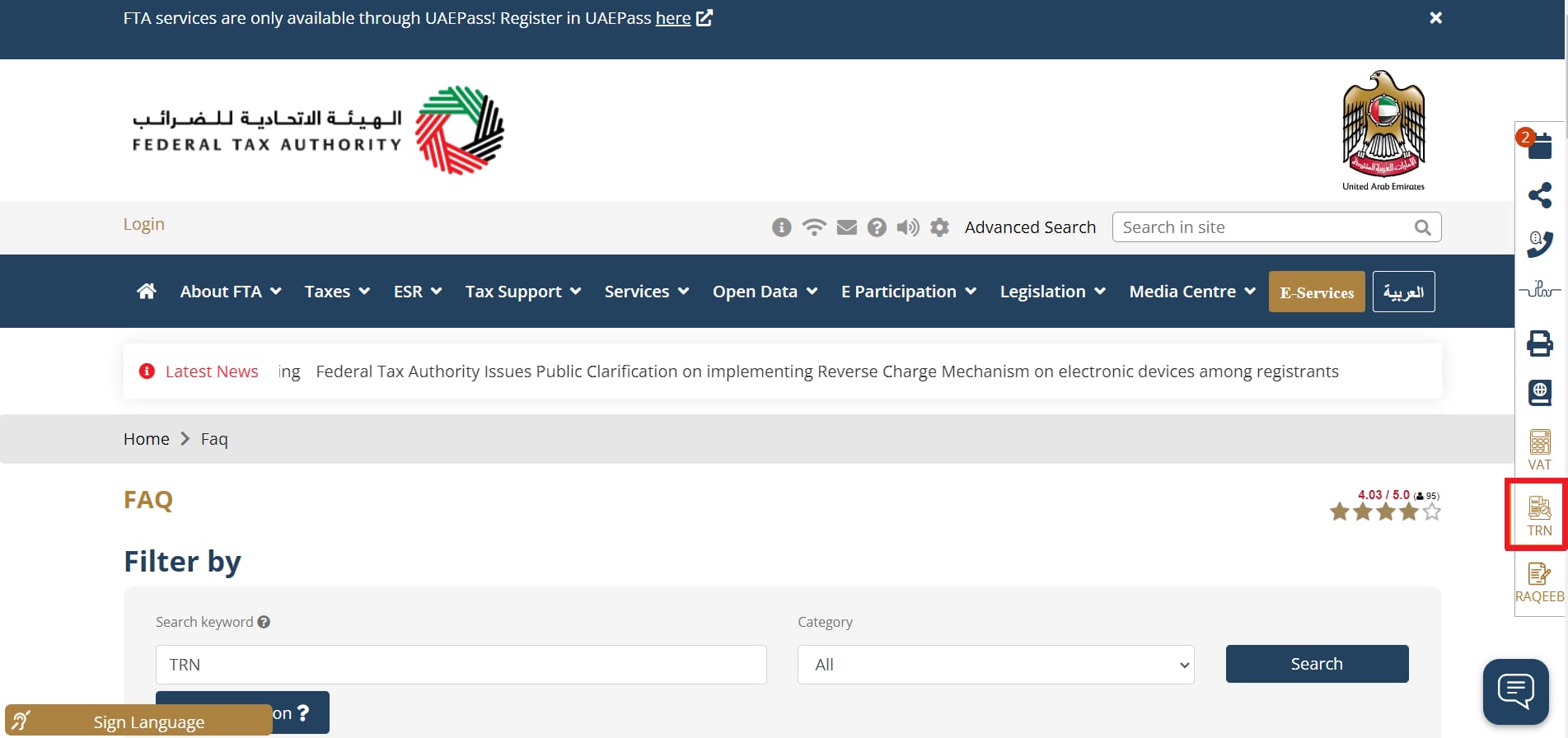
    The introduction of Value Added Tax (VAT) in the UAE in 2018 marked a significant shift, as the country had never previously applied a federal tax on goods and services. This led to understandable confusion among businesses and residents about how VAT works and what compliance involves. Since then, one of the most common queries has been about the Tax Registration Number (TRN), what it is, how to obtain it, and how TRN verification in Dubai or the UAE works for checking a business’s VAT status.

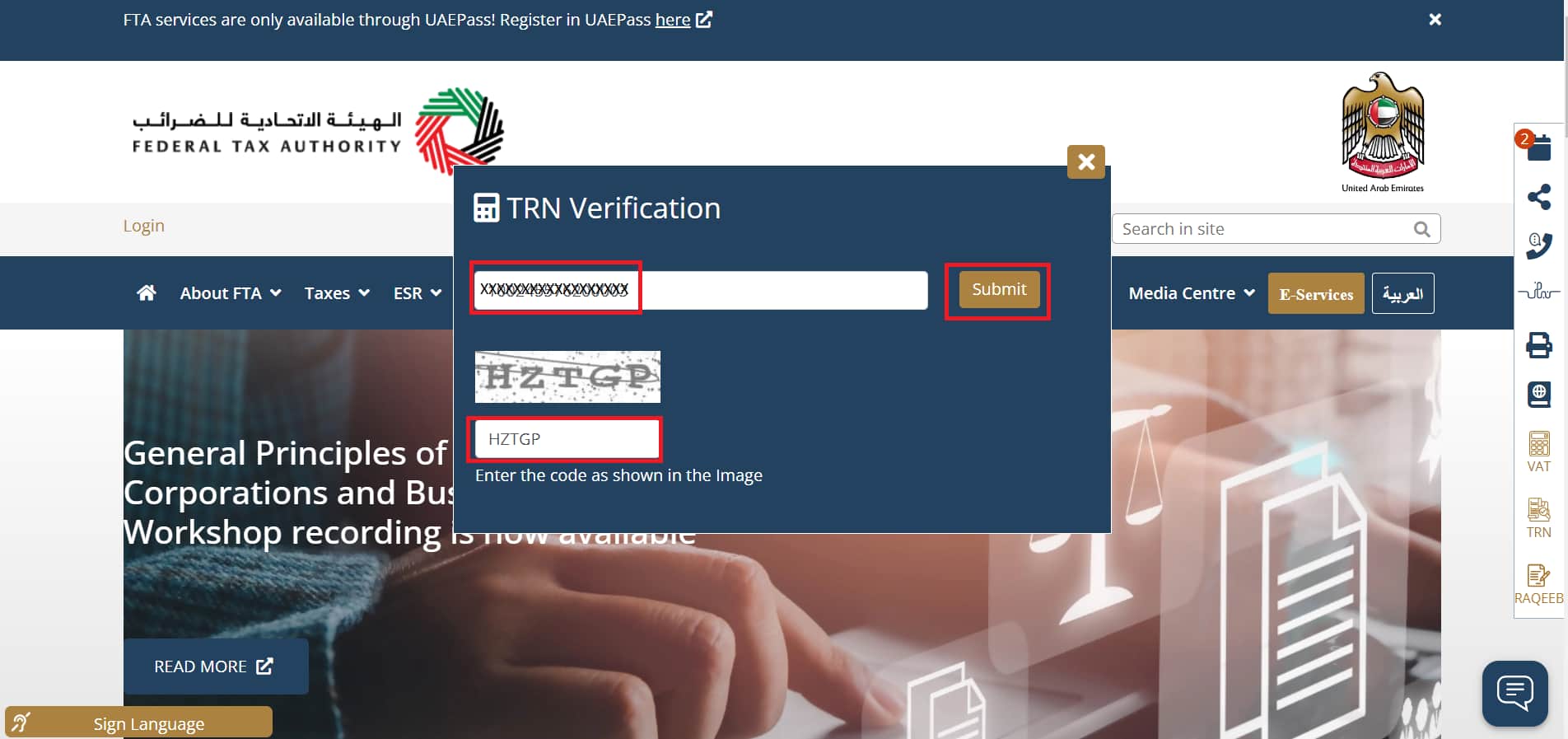
    A TRN is issued once a business successfully completes VAT registration with the Federal Tax Authority (FTA). After approval, the FTA assigns the TRN, which is required for VAT invoicing, return filings, and official documentation. It also enables TRN verification in the UAE through the FTA’s system, allowing businesses and individuals to confirm a company’s VAT registration status.

    What is TRN in the UAE?

    A Tax Registration Number (TRN) in the UAE is a unique identification number issued by the Federal Tax Authority (FTA) to businesses and individuals after successful VAT registration. Introduced alongside VAT in 2018, the TRN became a key component of the UAE’s first nationwide tax system. It confirms that a business or individual is officially registered with the FTA and authorised to charge, collect, and remit VAT.

    Once VAT registration is approved, the TRN is automatically generated through the FTA portal and is mandatory for issuing VAT-compliant invoices, filing returns, and dealing with tax authorities. The TRN also supports transparency, as clients, suppliers, and regulators can conduct TRN verification in Dubai or across the UAE to confirm a business’s VAT registration status and ensure compliance with tax regulations.

    What is the TRN Format in the UAE?

    The Tax Registration Number (TRN) format in the UAE follows a standard structure set by the Federal Tax Authority (FTA) to uniquely identify every VAT-registered business or individual.

    A UAE TRN is a 15-digit numeric code, with no letters, symbols, or spaces.

    UAE TRN Format Example

    TRN: 123456789012345

    Key Points About the TRN Format

    • Always 15 digits long
    • Numeric only (no alphabets or special characters)
    • Issued only after successful VAT registration
    • Unique to each VAT-registered entity
    • Remains the same unless the VAT registration is cancelled or amended by the FTA

    Where Is the TRN Used?

    The TRN must be clearly mentioned on:

    • VAT tax invoices
    • Credit notes and debit notes
    • VAT returns filed with the FTA
    • Official tax-related communications

    Why the Correct TRN Format Matters?

    Using the correct TRN format ensures:

    • Valid VAT invoices
    • Smooth VAT return filing
    • Easy TRN verification in the UAE via the FTA portal
    • Accurate TRN verification in Dubai for customers and suppliers

    Any error in the TRN format can lead to invoice rejection, compliance issues, or penalties under UAE VAT law.

    The UAE TRN format is simple but critical, a 15-digit number that confirms your VAT registration and legal tax status in the UAE

    Penalties & Risks of Using Invalid TRNs in the UAE

    Below are the penalties and risks of using invalid TRNs in the UAE:

    Penalty / Risk    What It Means  Penalty Amount / Impact
    Using an Incorrect or Invalid TRN   Mentioning a wrong, fake, or inactive TRN on tax invoices or documents.    AED 5,000 per incorrect TRN
    VAT Non-Compliance   Charging or reclaiming VAT without a valid TRN.   AED 10,000 for first offence, AED 50,000 for repeat offences  
     Input VAT Claim Rejection Claiming VAT using invoices with invalid TRNs.   Input VAT denied, resulting in direct financial loss  
    Submission of Incorrect VAT Details    Providing inaccurate VAT or TRN-related information to the FTA.  AED 3,000–5,000 per incorrect submission
    Tax Evasion (Intentional Misuse)   Deliberate use of fake or misleading TRNs to evade VAT.    Up to 5 times the VAT amount involved, plus legal action
     Legal & Regulatory Action Serious or repeated VAT violations linked to invalid TRNs.   Business suspension, licence risk, or prosecution  
    Bank & Audit Issues    Banks and auditors are rejecting documents with invalid TRNs.  Account freezes, audit failures, delayed approvals
    Business Reputation Damage   Clients verify TRN through TRN verification in Dubai / UAE.   Loss of contracts, delayed payments, and credibility damage  

    Important Note

    Penalty amounts are based on FTA administrative penalty guidelines and may vary depending on:

    • Nature of the violation
    • Whether it’s a first or a repeat offence
    • Intent (error vs. deliberate misuse)

    What is TRN’s Significance?

    TRN registration is a productive, time-efficient, and cost-saving process for both the public and private sectors. It can assist with:

    • Reclaiming previously paid taxes on the purchase, production, and processing of a product or merchandise.
    • Offering a refund to businesses that have registered for VAT and acquired a valid TRN.
    • Recoupment of business purchases through VAT by the purchaser.
    • Tax registration number strengthens the credibility and profile of the Company.

    According to the UAE’s VAT Law, TRN Verification of all tax documents is required for businesses, including the following:

    • Tax Invoice
    • VAT Return Tax
    • Credit notes
    • Other relevant tax documents

    Who Needs to Register for a TRN in the UAE?

    Businesses in the UAE must assess their turnover to determine whether they are required to register for VAT and obtain a TRN. The Federal Tax Authority (FTA) has set clear thresholds to guide this process and ensure smooth TRN verification with the FTA, especially for businesses operating in Dubai and across the UAE.

    Mandatory VAT Registration

    VAT registration becomes compulsory once a business’s taxable supplies and imports cross AED 375,000.

    If your company’s revenue or taxable imports exceeded AED 375,000 in the past 12 months or are expected to cross this limit within the next 30 days, you must register for VAT and complete TRN verification to stay compliant and avoid fines.

    It’s important to note that this threshold does not apply to foreign businesses, which may be required to register regardless of turnover, depending on their taxable activities in the UAE.

    Voluntary VAT Registration

    Businesses with taxable turnover between AED 187,500 and AED 375,000 have the option to register voluntarily.

    Voluntary registration allows businesses to obtain a TRN and proceed with TRN verification in Dubai, helping them recover input VAT and improve credibility with clients and suppliers, even if registration isn’t legally mandatory yet.

    Exempt from VAT Registration

    If a company’s annual taxable revenue and imports remain below AED 187,500, VAT registration is not required, and TRN verification with the FTA is not applicable.

    Understanding where your business stands help ensure timely TRN verification, avoids compliance issues, and keeps your operations fully aligned with UAE VAT regulations.

    How to Verify a TRN in the UAE?

    TRN verification is a simple online process that helps you confirm whether a business is VAT-registered with the Federal Tax Authority (FTA). Whether you’re validating a supplier or doing a routine compliance check, TRN verification in the UAE can be done by anyone in just a few minutes.

    Here’s how to complete a TRN check smoothly:

    Step 1: Access the FTA Portal

    Visit the official Federal Tax Authority website. On the homepage, locate and select the “TRN” option from the side panel.

    Access the FTA Portal

    Step 2: Enter TRN Details

    Input the Tax Registration Number in the required field, complete the captcha for security verification, and click Search.

    Enter TRN Details

    Step 3: Confirm Business Information

    The system will display the registered business name associated with the TRN. Match these details with your records to ensure accuracy.

    Confirm Business Information

    This process applies nationwide and is commonly used for TRN verification in Dubai and other emirates. Regular TRN verification helps businesses avoid errors, ensure VAT compliance, and maintain transparent transactions.

    What Is the Purpose of a TRN and VAT in the UAE?

    After a business successfully completes VAT registration, the Federal Tax Authority (FTA) issues a Tax Registration Number (TRN) along with an official TRN certificate. This certificate authorises the company to file VAT returns within the timelines set by the FTA and confirms its legal status as a VAT-registered entity.

    Holding a valid TRN allows a business to:

    • Build trust with large corporations and government entities, as many prefer working only with TRN-registered vendors
    • Strengthen its banking profile when opening or maintaining corporate bank accounts
    • Officially represent the company before foreign authorities, partners, and international institutions

    How can Shuraa Tax support you?

    To avoid penalties, you can employ a reputable consulting firm that can provide end-to-end solutions for TRN registration, from assessment to procurement.

    For a better grasp of the TRN requirements, Shuraa Tax can assist your business in navigating the extensive guidelines of the UAE’s new tax law. With our assistance, you can establish a tax structure for your business that will save you time, mitigate risks, and safeguard your assets.

    📞 Call: +(971) 44081900

    💬 WhatsApp: +(971) 508912062

    📧 Email: info@shuraatax.com

  • VAT Returns in UAE: Simplified Guide for Businesses

    VAT Returns in UAE: Simplified Guide for Businesses

    The implementation of the Value Added Tax (VAT) system in the United Arab Emirates (UAE) has made it essential for businesses to accurately file VAT returns in UAE and comply with tax regulations. A VAT return in UAE is a formal declaration of a company’s taxable sales and purchases within a specific period. Ensuring timely VAT return filing in UAE helps businesses maintain compliance and avoid penalties.

    All taxable businesses must submit UAE VAT returns by the deadline, typically the 28th of the month following the relevant tax period. Failure to do so may result in fines or legal consequences. Understanding the UAE VAT return format is crucial, as it ensures accurate VAT reporting on sales, purchases, and other taxable transactions.

    This guide provides a step-by-step approach to VAT return filing in UAE, covering the VAT return form, submission procedure, and key considerations for businesses to meet their tax obligations efficiently.

    What is a VAT return in UAE?

    A VAT return in UAE is an official document that VAT-registered businesses must submit to the Federal Tax Authority (FTA), reporting the VAT collected on taxable supplies and the VAT paid on expenses. This process, known as VAT return filing in UAE, helps businesses calculate their net VAT payable or refundable.

    VAT returns UAE typically follow a quarterly or monthly filing schedule, depending on the business’s tax registration details. Timely submission of UAE VAT return is crucial to avoid penalties and ensure compliance with UAE tax laws. The VAT return form includes total sales, purchases, output VAT, input VAT, and the final VAT amount payable or reclaimable.

    What is a VAT Return Form?

    The Form VAT 201 in the UAE is broadly categorised into seven sections, each serving a specific purpose in reporting taxable sales and purchases. These sections are:

    1. Tax Period: It will be auto captured.
    2. Output VAT: This section reports the VAT collected on taxable sales. Businesses must provide the total value of standard-rated sales, zero-rated sales, and exempt sales, along with the corresponding VAT amounts. It is obligatory to mention local taxable sales emirates-wise and corresponding VAT.
    3. Input VAT: Businesses report the VAT paid on eligible business purchases. This includes input VAT on goods and services acquired for business purposes, which can be offset against the output VAT liability.
    4. Adjustments: If any adjustments need to be made to previously reported amounts, harmful debt adjustments, or adjustments in the capital scheme. This section allows businesses to provide details and explanations for such changes.
    5. Import details: Descriptions 3, 6 and 7 mention imports of goods and services and adjustments. Details of imports linked with TRN will auto-populate.
    6. Total VAT Due and Refunds: Businesses calculate the net VAT liability or the refundable amount by subtracting the input VAT from the output VAT. This section displays the total VAT due or the refundable VAT, if applicable.
    7. Profit margins: The business needs to mention if the profit margin scheme is applied for the reportable tax period.
    8. Declaration and Signature: The final section requires the authorised person to declare the accuracy of the information provided and affix their signature, acknowledging their responsibility for the contents of the VAT return.

    By organising the VAT returns in UAE into these distinct sections, Form VAT 201 streamlines the reporting process, ensuring that businesses can accurately report their taxable sales and purchases in a structured manner.

    Who must file a VAT return in UAE?

    Businesses registered under VAT in the UAE must comply with VAT return filing in UAE regulations. The UAE VAT return must be filed by taxable businesses and individuals whose taxable supplies and imports exceed the mandatory registration threshold of AED 375,000. Additionally, voluntary registration is allowed for businesses with taxable supplies exceeding AED 187,500.

    The VAT return in UAE is typically filed every quarter, though some businesses may be required to file monthly. The Federal Tax Authority (FTA) mandates that companies submit their VAT returns UAE through the FTA portal, ensuring accurate reporting of output VAT (collected from customers) and input VAT (paid on purchases).

    Failure to meet the VAT return deadlines can result in penalties, making it crucial for businesses to comply with UAE tax regulations.

    Key Filing Dates for VAT Returns in the UAE

    The key filing dates for VAT returns in the UAE are as follows:

    1. Monthly and Quarterly Deadlines: For both monthly and quarterly VAT returns in the UAE, the deadline for filing is set as the 28th day of the month following the end of the VAT return period. For example, if you are filing a quarterly VAT return for the period from February to April, the deadline for filing this return would be the 28th of May. In the case of public holidays or weekends on the 28th day, then deadlines will be extended to the following working day.
    2. First Tax Period: The first tax period can vary for each business based on individual instructions received from the Federal Tax Authority (FTA). For instance, if your first tax period is from January 1 to January 31, you must file your VAT return for this period on or before February 28/29. If your first tax period is Jan- Mar 23, then VAT return will be due by 28th April (or the next business day if February 28 falls on a public holiday or weekend).
    3. Extended Tax Period: In some cases, the first tax period for a business may span more than three months. For example, if your first tax period is from January 1, 2018, to April 30, 2018, you must file your VAT return on or before May 28, 2018 (If May 28 falls on a public holiday or a weekend, the deadline for filing the VAT returns in the UAE, whether it is monthly or quarterly, is extended to the next business day).

    Businesses must adhere to these essential filing dates to ensure the timely submission of VAT returns and avoid any penalties or non-compliance issues.

    Details Required to File VAT 201 Return Form

    To file a VAT 201 Return Form in the UAE, you need the following details:

    Taxable Person Details

    Sales and Output Tax

    • Standard Rated Sales (5%): Domestic sales subject to VAT
    • Zero-rated Supplies: Exports, education, healthcare, etc.
    • Exempt Supplies: Certain financial services, residential properties, etc.
    • Reverse Charge Transactions: Imported goods/services where the buyer pays VAT
    • Adjustments (if any): Discounts, bad debts, etc.

    Purchases and Input Tax

    • Standard Rated Purchases (5%)
    • Reverse Charge Mechanism Purchases
    • Imports from GCC & Non-GCC countries
    • Recoverable Input Tax (VAT paid on expenses that can be claimed)

    VAT Payable or Refundable Calculation

    • Total Output VAT (VAT collected from customers)
    • Total Input VAT (VAT paid on purchases)
    • Net VAT Payable or Refundable (Output VAT – Input VAT)

    Additional Information (if applicable)

    • Any voluntary disclosures for corrections from previous returns
    • Tax Credit Notes for returned goods or services
    • Penalties or Adjustments applied by the FTA

    Payment Details

    • Amount to be paid to the FTA (if VAT payable)
    • Bank details for refund (if VAT refundable)

    Overview of Sections in the VAT Return Form: Pre-Populated Data and Taxpayer Details

    • Main Section: Pre-Populated Data The main section of the VAT Return Form contains pre-populated details specific to your business. This includes information such as the form type, Address, Contact number, and submission date. The details are automatically filled in based on your data, ensuring accuracy and efficiency in the filing process.
    • Taxable Person Details Section: The Taxable Person Details section captures essential information about your business. It includes your Tax Registration Number (TRN), the Company’s name in both English and Arabic, the registered address or place of residence of your business, the name of the tax agency, the Tax Account Number (TAN), the name of the tax agent, and the Tax Agent Approval Number (TAAN). These details are also pre-populated based on the information provided during registration.
    • VAT Return Period Section: The VAT Return Period section displays essential details related to the tax year and the specific VAT returns in UAE period, whether monthly or quarterly. It also includes the VAT return period reference number, which allows you to make adjustments and recover tax at the end of the tax year based on any necessary corrections made throughout the year.

    Step-by-Step Guide to Filing VAT Return in UAE Using Form VAT 201

    Below are the steps to file VAT return in UAE using form VAT 201

    Step 1: Accessing the VAT Return Form 201 on the FTA e-Services Portal

    To start the VAT return filing in UAE, follow these steps:

    • Log in to the FTA EmaraTax e-Services portal using your registered username and password.
    • Go to the Form Navigation menu and select your company name.
    • Click on ‘VAT’ from the menu on the left.
    • Select ‘My Filings’ and then ‘View All’.
    • Find the unfiled return (it will not have a VAT reference) and click ‘File’ under the action column.
    • Click ‘VAT 201 – New VAT Return’ to begin.
    • Tick the confirmation box to indicate you have read the instructions.
    • Click ‘Start’ to proceed.

    Step 2: Taxable Person Details

    • This section auto-fills the taxpayer’s TRN (Tax Registration Number), name, and address.
    • If a tax agent is filing on behalf of the taxpayer, their details can be added.

    Step 3: VAT Return Period

    • This section automatically includes details such as:
    • VAT return period (e.g., monthly or quarterly).
    • Tax year-end.
    • Reference number and VAT return due date.

    Step 4: Reporting VAT on Sales and Other Outputs

    This section captures VAT on all sales and supplies made during the VAT filing period in UAE.

    • The information is displayed in a table format:
    • Total Transaction Amount (AED) – Total invoice value, including any adjustments.
    • VAT Amount Collected (AED) – VAT collected from sales.
    • Adjustments (AED) – Any changes in VAT due to credit notes or corrections.
    • You must also provide details of taxable supplies in each Emirate, including:
    • Standard-rated supplies
    • Zero-rated and exempt supplies
    • Reverse charge mechanism supplies

    Step 5: VAT on Expenses and All Other Inputs

    This section captures purchases and expenses where VAT is paid.

    • Details include:
    • Total Purchase Amount (AED) – From purchase invoices, including adjustments.
    • Recoverable VAT Amount (AED) – VAT you can claim as a refund.
    • Adjustments (AED) – Modifications to input tax from earlier periods.

    Step 6: Net VAT Due

    This section calculates how much VAT you owe or can reclaim.

    • Box 12: Total VAT due for the period (from the sales and outputs section).
    • Box 13: Total VAT recoverable (from expenses and inputs section).
    • Box 14: Net VAT payable or refundable.
    • If Box 12 > Box 13, you need to pay VAT.
    • If Box 12 < Box 13, you can request a refund or carry the balance to the next VAT filing period in UAE.

    Step 7: Additional Reporting Requirement

    • If your business used the Profit Margin Scheme, report it here.
    • If not, select ‘No’ and move to the next section.

    Step 8: Declaration and Authorized Signatory

    • Enter the authorised signatory’s details.
    • Tick the declaration box to confirm accuracy.
    • You can save it as a draft or submit the VAT return.
    • Once submitted, the FTA will send a confirmation email.

    By following this step-by-step VAT return filing in UAE guide, businesses can ensure compliance with UAE VAT laws and submit their UAE VAT return efficiently.

    Documents required for VAT Return filing in the UAE

    For VAT return filing in the UAE, businesses must prepare and submit specific documents to ensure compliance with the Federal Tax Authority (FTA). The key documents required include:

    Tax Invoices and Credit Notes

    • Sales invoices issued to customers
    • Purchase invoices received from suppliers
    • Credit notes for returned goods or discounts

    VAT Return Form (Form 201)

    • Completed VAT return form available on the FTA portal

    VAT Ledger and Reports

    • Output VAT report (VAT collected on sales)
    • Input VAT report (VAT paid on purchases)
    • Summary of taxable and exempt supplies

    Bank Statements

    • Proof of VAT payments and receipts

    Import and Export Documents

    • Customs declarations
    • Import VAT statements from the FTA (if applicable)

    Financial Statements (Optional but Recommended)

    • Profit and loss statement
    • Balance sheet

    Penalties Associated with VAT Returns in UAE

    The Federal Tax Authority (FTA) in the UAE imposes penalties for non-compliance with Value Added Tax (VAT) return regulations. These penalties apply to businesses that fail to meet VAT obligations, including late filings, incorrect submissions, and tax evasion. Below are the key penalties associated with VAT returns in the UAE:

    Late VAT Return Filing

    • AED 1,000 for the first offence.
    • AED 2,000 for subsequent offences within 24 months.

    Late VAT Payment

    • 2% of the unpaid tax is charged immediately after the due date.
    • 4% per month is charged on the outstanding amount if unpaid within a month.

    Incorrect VAT Return Submission

    • AED 3,000 for the first offence.
    • AED 5,000 for repeated offences.

    Failure to Maintain Records

    • AED 10,000 for the first offence.
    • AED 20,000 for subsequent offences.

    Failure to Voluntarily Disclose Errors

    • 5% to 50% of the unpaid tax (depending on when the error is disclosed).

    Incorrect Tax Invoice Issuance

    • AED 5,000 per incorrect invoice issued.

    Failure to Register for VAT (if required)

    • AED 10,000 penalty for failing to register.

    Failure to De-Register for VAT (if required)

    • AED 1,000 penalty, increasing by AED 1,000 per month, up to AED 10,000.

    VAT compliance is crucial for businesses in the UAE. Ensuring timely filing, accurate records, and proper tax invoices can help avoid hefty penalties. If you need VAT assistance, Shuraa Tax can help with VAT registration, filing, and compliance.

    VAT Return Filing in Dubai, UAE

    Filing a VAT return in UAE is a detailed and intricate process that requires careful attention. It is crucial for businesses to seek expert advice before submitting their VAT return to avoid potential errors that may result in substantial fines and penalties imposed by the Federal Tax Authority (FTA).

    Shuraa Tax is a reputable audit and accounting company based in Dubai, offering reliable VAT Return Filing Services that comply with FTA regulations. Contact Shuraa Tax Consultants right immediately to file a VAT return in Dubai! All you need to do is contact us at info@shuraatax.com or +971 508912062.

    FAQs

    Q1. What is the due date to submit VAT return in UAE?

    The 28th of the month following the end of the tax period.

    Q2. What will be the consequence of not filing the VAT return?

    Penalties, fines, and possible restrictions on business operations.

    Q3. If I don’t have any sales and purchases during the tax period, what should I do?

    Submit a nil VAT return to avoid penalties.

    Q4. Who is liable for monthly and quarterly returns submission?

    Businesses assigned a monthly or quarterly tax period by the FTA based on turnover.

    Q5. What is an advantage for a company to register for VAT?

    Legitimacy, input VAT recovery, and compliance with UAE tax laws.

    Q6. When are VAT returns due?

    By the 28th of the following month after the tax period ends.

    Q7. How to file a VAT return?

    Log in to the FTA portal, complete the VAT201 form, and submit it online.

    Q8. What information is required to file a VAT return?

    Sales, purchases, VAT collected, VAT paid, and any adjustments.

    Q9. How to calculate VAT liability?

    VAT liability = Output VAT (collected) – Input VAT (paid).

  • VAT Penalty Waiver in the UAE

    VAT Penalty Waiver in the UAE

    The UAE’s Value Added Tax (VAT) system, implemented in 2018, established a structured approach to tax compliance. While this system benefits the UAE’s commercial landscape, compliance errors can sometimes result in administrative penalties for businesses. The Federal Tax Authority (FTA) recognises this and offers a VAT Penalty Waiver in UAE as a remedy for organisations with justifiable reasons for non-compliance. This waiver allows businesses in Dubai and other Emirates to reduce or eliminate their penalty burden, enabling them to focus on growth.  

    This guide provides insights into the VAT Penalty Waiver in UAE, including its benefits, eligibility criteria, application procedures, and how professional tax consultants can assist in navigating this process.

    VAT Reconsideration Services In UAE 

    VAT Reconsideration Services in UAE provide professional assistance to businesses and individuals who wish to challenge VAT penalties imposed by the Federal Tax Authority (FTA). These services are especially beneficial for those who believe the penalty was issued in error or due to factors beyond their control, such as administrative mistakes or unexpected delays. 

    Key Features of VAT Reconsideration Services in UAE: 

    1. Expert Guidance: Tax consultants and agents with knowledge of UAE tax laws help applicants understand the FTA’s requirements and navigate the reconsideration process.
    2. Document Preparation: Professionals assist in gathering and organising supporting documents, such as proof of payment, compliance records, or explanations of the circumstances that led to the penalty.
    3. Detailed Explanation of Cases: VAT reconsideration services in UAE involve drafting clear, concise explanations that outline the reasons for reconsideration, presenting the most robust case for a penalty waiver or reduction.
    4. Timely Submission: Experts ensure that reconsideration requests are submitted within the FTA’s 20-day window to avoid rejections due to missed deadlines.
    5. Compliance with FTA Standards: By adhering to the FTA’s guidelines, these services increase the likelihood of success in reconsideration applications, minimising the risk of repeated penalties.

    Using VAT reconsideration services in UAE can save businesses time and effort while significantly improving their chances of obtaining favourable outcomes in VAT penalty reconsideration in Dubai or other Emirates. 

    Who Can Apply for VAT Penalty Reconsideration? 

    VAT penalty reconsideration in Dubai allows businesses and individual taxpayers to contest fines issued by the Federal Tax Authority (FTA) when they believe the penalties were unfairly applied due to legitimate mistakes or circumstances beyond their control. Through VAT reconsideration services in UAE, taxpayers can seek guidance to ensure their application is accurate, complete, and submitted within the FTA’s 20-day deadline from the penalty issuance date.  

    To apply for VAT penalty reconsideration in Dubai, applicants must submit a reconsideration form and a detailed explanation of their case, supported by evidence, on the FTA’s e-portal. This includes documentation that clarifies the cause of the error, such as delayed filings, administrative mistakes, or technical difficulties. Companies often rely on VAT penalties and reconsiderations in Dubai services to improve their chances of success by structuring a persuasive argument and ensuring compliance with FTA requirements.  

    These services guide applicants in presenting accurate documentation and understanding FTA standards, making the VAT reconsideration process smoother and enhancing the possibility of penalty adjustments or cancellations. 

    What is the VAT Penalty Waiver in UAE? 

    The VAT Penalty Waiver in UAE is an initiative by the Federal Tax Authority (FTA) allowing businesses to request a reduction or exemption from penalties incurred for VAT non-compliance.  

    Designed to alleviate financial pressure and encourage a proactive approach to compliance, this waiver supports companies striving to maintain economic stability. The UAE reinforces its commitment to promote a supportive and business-friendly environment through this initiative. 

    Key Benefits of VAT Penalty Waivers in UAE 

    The benefits of VAT penalty waivers in UAE are as follows: 

    Financial Relief 

    The VAT penalty waiver reduces or eliminates administrative penalties, freeing businesses from substantial financial liabilities and easing compliance-related expenses. 

    Opportunity for Correction

    This waiver allows companies to correct compliance issues without severe penalties, encouraging better adherence to VAT regulations in the future. 

    Strengthened Business Continuity 

    With reduced penalties, companies can focus resources on growth and continuity instead of diverting funds to cover financial liabilities. 

    Who Qualifies for a VAT Penalty Waiver in UAE? 

    The FTA provides specific eligibility criteria to qualify for the VAT penalty waiver in the UAE, including: 

    Legitimate Reason for Non-compliance 

    Applicants must provide a valid and genuine reason for non-compliance. Acceptable reasons include inadvertent errors or circumstances beyond control that affected timely compliance. 

    Prompt Rectification 

     Businesses seeking a VAT penalty waiver in Dubai or any other Emirate must address and correct compliance issues as soon as possible to demonstrate their commitment to meeting VAT requirements. 

    Cooperation with the FTA  

    The FTA values applicants’ cooperation during the review process, considering it part of the eligibility criteria. 

    Steps to Apply for VAT Penalty Waivers in UAE 

    Here’s a step-by-step guide on how to apply for the VAT penalty waiver:  

    Step 1: Submission of Application

    Companies can submit their application to the FTA, which should include a detailed explanation of the reason for non-compliance and necessary supporting documents. 

    Step 2: Meeting Submission Deadlines

    The FTA requires waiver applications to be submitted within 40 business days of the conclusion of the non-compliance event. Timely filing is crucial to avoid additional penalties. 

    Step 3: Supporting Documentation

    All applications should include relevant documentation, such as invoices, signed declarations as per FTA standards, and financial records to validate the non-compliance reason. 

    Step 4: Consistent Communication

    Applicants should maintain open communication with the FTA throughout the waiver review process. 

    Essential Criteria and Waiver Options

    The essential criteria and waiver options are as follows:  

    Authorised Representatives

    Businesses can apply for the waiver via an authorised tax advisor, registered tax agent, or legal representative. Only the designated Representative Member is eligible to apply for companies part of a Tax Group. 

    Penalty Installment Options

    Companies meeting specific conditions, such as having penalties above AED 50,000, can apply for instalment payments, provided there are no ongoing disputes with the FTA. 

    Penalty Reduction or Exemption Eligibility

    According to Cabinet Decision No. 51 of 2021, businesses may request a penalty reduction or exemption if they meet specific criteria, like significant challenges impacting compliance, such as illness, death, or systemic FTA communication errors. 

    VAT Penalty Waiver Timeline  

    The FTA follows a structured timeline for processing VAT penalty waivers: 

    1. Review of Application: Within 40 working days of submission, the FTA reviews the waiver request. 
    2. Decision Notification: The FTA issues a decision within 20 working days of the review completion. 
    3. Taxpayer Notification: Companies are notified of the decision within 10 days of issuance. If no notification is provided, the waiver request is considered denied. 

    Additional Mechanisms for VAT Penalty Waivers in UAE 

    The additional mechanisms for VAT Penalty waivers in the UAE are as follows:  

    1. VAT Reconsideration Submission: Businesses can request VAT reconsideration for penalty relief if they believe the penalty was applied in error or if they can provide justifiable reasons. 
    2. Appeal to Tax Dispute Resolution Committee (TDRC): If the FTA denies the VAT penalty reconsideration, companies can appeal to the Tax Dispute Resolution Committee (TDRC) within 20 days of the decision. 
    3. Application for Reduction or Exemption: As per Cabinet Decision No. 51 of 2021, companies may request penalty reductions or exemptions, provided they meet specific conditions such as unintentional errors or force majeure circumstances. 

    The VAT Penalty Waiver in UAE is a crucial tool for businesses seeking financial relief and compliance correction opportunities. By reducing financial liabilities, offering a second chance at compliance, and supporting business continuity, the waiver program demonstrates the UAE’s dedication to a supportive and resilient business ecosystem.   

    Whether your business is new or established, understanding and utilizing VAT penalty waivers can be invaluable in maintaining compliance and focusing on growth in the UAE. 

    How Professional Assistance Can Help with VAT Penalty Waivers in Dubai, UAE 

    Navigating VAT compliance and penalty waivers can be challenging for companies, especially those unfamiliar with UAE tax regulations. Working with expert tax consultants, like Shuraa Tax Consultants, can streamline the process. With extensive knowledge of the UAE’s tax system, Shuraa’s team can assist companies with the VAT penalty waiver application, help resolve penalties and ensure long-term compliance.  

    Get in Touch 

    For assistance with VAT Penalty Waivers or VAT Penalty reconsideration in UAE, contact Shuraa Tax at +971 508912062 or email info@shuraatax.com.

    Additional Services We Offer: 

    Corporate Tax Registration  Bookkeeping & Accounts Outsourcing    
    Corporate Tax return filing services  Accounts Review Services  Tax Residency Certificate 
    Excise Advisory and return filing  MIS Reporting & Compliance Services  Economic Substance Reporting 
    Excise Tax Registration  Payroll Services  Feasibility Study Reporting 
    Tax Compliance Service  Budgeting services  AML registration 
    Tax Penalty Appeal  VAT registration in UAE   

    FAQs 

    Q1. What is the timeframe for applying for a VAT penalty waiver in Dubai, UAE? 

    The application for a VAT penalty waiver in UAE should be filed within 40 business days of receiving the penalty notification. 

    Q2. Are there any penalties that cannot be waived?

    Some penalties, such as repeated offences, tax evasion, or intentional non-compliance, may not be eligible for a waiver. The FTA assesses each case individually. The waiver is approved only if the authority justifies the reason. The penalties applied were delayed.

    Q3. Can a business apply for a waiver of multiple penalties in the UAE?

    Yes, businesses can apply for a multiple VAT penalties waiver if they meet the eligibility criteria and can demonstrate genuine reasons for non-compliance.

    Q4. Does the VAT penalty waiver scheme apply to all types of businesses?

    Yes, the VAT penalty waiver scheme is available to all businesses registered for VAT in the UAE, regardless of size or sector.

    Q5. Are there any specific documents required for the VAT penalty waiver application?

    While the required documents may vary depending on the circumstances, generally, businesses should include relevant invoices, declarations, financial statements, or any other evidence supporting the genuine reason for non-compliance.