Author: Kajol Kanojia

  • UAE Canada Double Tax Treaty Explained

    UAE Canada Double Tax Treaty Explained

    For anyone living, working, or doing business between the UAE and Canada, understanding how taxes apply can be tricky. That’s where the UAE Canada Tax Treaty comes in. Signed in 2002 and effective from 2003, this treaty was designed to facilitate the lives of individuals and businesses operating across both countries.

    The main goal of the treaty is to prevent double taxation, so you don’t end up paying tax on the same income in both countries. It also encourages cross-border investments by providing clear rules on tax responsibilities, making it more straightforward to plan your finances or business moves. The treaty creates clarity, reduces financial headaches, and supports smoother trade and investment between the UAE and Canada.

    What is a Double Tax Treaty?

    A double tax treaty is an agreement between two countries designed to prevent the same income from being taxed twice in both countries. Without such contracts, a person or business earning money across borders could end up paying tax in both their home country and the country where the income is generated, a situation known as double taxation.

    For example, the tax treaty between Canada and the UAE ensures that individuals and companies operating between these two countries don’t face double taxation on the same income. The treaty clearly defines which country has the right to tax various types of income, including business profits, salaries, and dividends.

    Moreover, these treaties limit the host country’s ability to tax certain income and provide mechanisms to resolve disputes if both countries claim taxing rights over the same income. This facilitates smoother cross-border trade and investment, providing taxpayers with clarity on their obligations.

    In short, double tax treaties, such as the one between Canada and the UAE, protect businesses and individuals from paying tax twice, encourage international trade and investment, and provide a structured mechanism for resolving tax disputes.

    Key Provisions of the UAE-Canada Double Tax Treaty

    When it comes to cross-border income, clarity is everything. The UAE-Canada Double Tax Treaty was designed to simplify the tax treatment of individuals and businesses earning income in both countries.

    By clearly defining which types of income are taxed, how residency is determined, and what protections exist against unfair taxation, the treaty ensures that taxpayers don’t face unnecessary financial burdens. Let’s break down the most important provisions that make this treaty work:

    1. Income Types Covered

    The treaty explicitly addresses various types of income to prevent double taxation. This includes pensions, business profits from shipping, income of artists and athletes, students’ income, and income of tax-exempt organisations.

    2. Dual Residency Rules

    Sometimes, a person or company could be considered a resident in both countries. The treaty provides tie-breaker rules to determine which country has primary taxing rights in such cases.

    3. Non-Discrimination and Foreign Tax Credits

    The treaty ensures that residents of one country are not unfairly taxed in the other and allows taxpayers to claim credits for taxes already paid in one country against tax liabilities in the other.

    4. Mutual Agreement Procedure (MAP)

    If double taxation or disputes arise, the treaty provides a formal mechanism for resolving them. This enables the tax authorities of Canada and the UAE to communicate and resolve issues in a structured manner.

    Canada’s Broader Tax Treaty Network

    Canada has established a strong network of over 90 tax treaties and approximately 25 Tax Information Exchange Agreements (TIEAs) with countries worldwide, including the UAE. These agreements serve multiple purposes: they promote transparency, prevent double taxation, and provide a framework for Canada to engage with countries that have low or no tax rates.

    The goal is straightforward: to facilitate international business and investment while ensuring that taxpayers aren’t unfairly taxed twice. In this context, the UAE-Canada Double Tax Treaty is a key part of this network. It reflects Canada’s broader approach to creating clear rules for cross-border income, protecting residents and businesses, and providing mechanisms to resolve disputes efficiently.

    By being part of Canada’s vast treaty network, the UAE treaty ensures both countries can maintain fair taxation practices while promoting trade and investment opportunities.

    The Role of the Multilateral Instrument (MLI)

    The Multilateral Instrument (MLI) is an international agreement developed by the OECD to update and modify existing tax treaties without the need for renegotiation of each one individually. Its main goal is to prevent tax avoidance and ensure that treaties are used as intended.

    For Canada, the MLI introduced several essential features to its tax treaty network:

    • Treaty Abuse Prevention: Measures to stop companies or individuals from exploiting treaties to avoid paying taxes.
    • Binding Arbitration: Provides a formal process for resolving disputes between countries regarding taxation.
    • Dual Residence Rules: Clarifies which country has taxing rights when a person or company qualifies as a resident in both countries.
    • Capital Gains Regulations: Update rules on taxing gains from the sale of certain assets, including real estate and shares.

    Not all of Canada’s treaties were affected by the MLI. Some older agreements were left untouched, while others were updated in line with MLI provisions. In the case of the UAE-Canada Double Tax Treaty, certain aspects of the treaty, such as dispute resolution and anti-abuse rules, are influenced by the MLI framework, thereby strengthening clarity and reducing opportunities for tax avoidance.

    Overall, the MLI plays a crucial role in modernising Canada’s treaty network, ensuring fairness, and maintaining trust in international taxation.

    How Canadian Courts Interpret Tax Treaties?

    Canadian courts generally follow a liberal interpretation of tax treaties to ensure that the country of source does not unfairly tax income from sources outside its jurisdiction. In practice, this means that treaties are interpreted in a manner that limits the host country’s ability to over-tax cross-border income and protects taxpayers from double taxation.

    The Income Tax Conventions Interpretation Act guides this process by providing rules on how Canadian tax treaties should be interpreted. Courts also often refer to the OECD Model Tax Convention, which serves as a blueprint for understanding treaty provisions, particularly those related to residence, source of income, and dispute resolution.

    A landmark case illustrating this approach is Canada v. Crown Forest Industries Limited, where the Supreme Court emphasised that treaty provisions should be interpreted in a way that gives effect to their purpose, rather than being narrowly confined to the literal wording.

    For UAE residents earning income from Canada, understanding this judicial approach is crucial. It ensures they can claim treaty benefits correctly, avoid excessive taxation, and take full advantage of protections under the UAE-Canada Double Tax Treaty.

    Benefits of the UAE-Canada Double Tax Treaty

    The UAE-Canada Double Tax Treaty offers several advantages for individuals and businesses operating between the two countries:

    1. Avoids Double Taxation: Ensures that the same income is not taxed in both the UAE and Canada, reducing financial burden.
    2. Simplifies Cross-Border Planning: Facilitates financial and business planning for individuals with income sources in both countries, streamlining the process.
    3. Legal Clarity and Dispute Resolution: Provides clear rules governing taxing rights and formal mechanisms for resolving disagreements.
    4. Efficient Tax Planning for UAE Residents: Helps UAE residents earning Canadian-source income optimise their taxes while staying fully compliant.

    By offering these protections, the treaty encourages investment, trade, and professional collaboration between the UAE and Canada, while maintaining fair and predictable taxation.

    Practical Steps for UAE Residents & Businesses

    For UAE residents and businesses earning income in Canada, the UAE-Canada Double Tax Treaty offers valuable benefits; however, leveraging them effectively requires careful planning. Here are some practical steps:

    1. Understand Your Tax Obligations: Identify the types of income covered under the treaty, including salaries, business profits, dividends, and pensions.
    2. Claim Treaty Benefits: Ensure you apply the treaty provisions to avoid double taxation and optimise your tax position.
    3. Consult Tax Experts: Professional advice is crucial for proper planning and compliance with both UAE and Canadian tax laws.

    Our experts can help UAE residents and businesses handle treaty rules, resolve disputes, and plan taxes effectively, allowing you to focus on growing your business or managing your income without worrying about double taxation.

    Staying Compliant and Informed with Shuraa Tax!

    Understanding the UAE Canada Tax Treaty is essential for individuals and businesses handling cross-border taxation. The tax treaty between Canada and UAE not only helps prevent double taxation but also provides clarity on tax obligations. It makes international transactions smoother and more predictable.

    However, tax laws and treaty interpretations can change over time, especially with updates under the Multilateral Instrument (MLI). Staying informed about these developments is crucial to remaining compliant and avoiding unexpected tax liabilities.

    Engaging professional guidance ensures that your cross-border transactions are structured efficiently and in accordance with the UAE Canada Double Tax Treaty. Experts can help you make informed decisions, optimise tax benefits, and handle reporting requirements seamlessly.

    For customised advice and assistance, you can reach out to Shuraa Tax:

    📞 Call: +(971) 44081900
    💬 WhatsApp: +(971) 508912062
    📧 Email: info@shuraatax.com

    Staying compliant and well-informed is the key to leveraging the UAE-Canada Tax Treaty effectively while ensuring peace of mind in your cross-border operations.

  • How Startups in the UAE Can Simplify VAT Return Filing

    How Startups in the UAE Can Simplify VAT Return Filing

    Filing VAT Returns for Startups doesn’t have to be a complicated or stressful process. Yet, many new entrepreneurs in the UAE find themselves confused about compliance, deadlines, and documentation. If you’re running a young business, understanding VAT Returns for Startups in the UAE is essential to avoid penalties and maintain smooth financial operations.

    In this blog, we’ll walk you through the entire process of VAT Return Filing for Startups in the UAE, from understanding your eligibility to preparing accurate records and submitting them on time. We’ll also cover the most common mistakes startups make, practical tips to simplify the filing process, the VAT return filing for startups in the UAE, and the requirements you need to be aware of.

    Whether you are a small e-commerce business in Dubai, a tech startup in Abu Dhabi, or a growing enterprise in Sharjah, this guide will equip you with the knowledge to manage your VAT obligations easily and efficiently. By the end, you’ll feel more confident about handling your VAT returns and keeping your business fully compliant.

    What is VAT Return Filing in the UAE?

    VAT return filing in the UAE is the process where businesses registered for Value Added Tax (VAT) report their VAT-related transactions to the Federal Tax Authority (FTA) for a specific tax period.

    Here’s what it means in simple terms:

    What is Filed?

    Businesses must report:

    • Output VAT – VAT they charged customers on sales.
    • Input VAT – VAT they paid to suppliers on purchases.

    Purpose:

    To calculate whether the business owes VAT to the FTA (if output VAT > input VAT) or is eligible for a refund (if input VAT > output VAT).

    Who Needs to File:

    Any business registered for VAT in the UAE (i.e., with a Tax Registration Number – TRN) is required to file VAT returns.

    How Often:

    Most businesses file VAT returns quarterly (every three months), while some may be required to file monthly, depending on their annual turnover or FTA requirements.

    Where & How:

    Filing is done online via the FTA e-Services portal. Businesses must submit the VAT return (Form VAT201) and pay any due amount within the deadline (usually within 28 days after the end of the tax period).

    When to File VAT Returns in the UAE?

    In the UAE, businesses registered for VAT are required to file their VAT returns with the Federal Tax Authority (FTA) regularly, typically quarterly or monthly, depending on their turnover and the FTA’s allocation.

    Here’s a breakdown:

    1. Quarterly Filing (Most Common):

    • The majority of businesses file VAT returns every quarter (once every 3 months).
    • This is the default frequency assigned by the FTA unless monthly filing is specifically required.

    2. Monthly Filing (High-Turnover Businesses):

    • Businesses with an annual turnover exceeding AED 150 million are typically required to file VAT returns every month.
    • This helps the FTA track high-value transactions more closely.

    VAT Return Filing Deadlines 

    A VAT return must be filed within 28 days after the end of the tax period.

    For example:

    • If your tax period is Jan – Mar, your VAT return must be filed by April 28.
    • The payment for VAT liability must also be made by the same due date.

    VAT Registration Requirements for Startups in UAE

    When launching a new business, understanding the VAT return filing requirements for startups in the UAE is crucial. UAE’s VAT framework is designed to ensure that companies contribute fairly to the economy while benefiting from input tax recovery. For startups, getting this step right early on helps avoid penalties and ensures operations remain compliant.

    Understanding Taxable Supplies

    Startups first need to determine whether their activities fall under taxable supplies. This includes any sale of goods or services that are subject to the UAE VAT regime.

    If your startup is generating revenue from these taxable transactions, it becomes essential to assess whether you meet the criteria for VAT registration.

    VAT Registration Thresholds for Startups

    1. Mandatory Registration

    If your startup’s annual taxable turnover exceeds AED 375,000, you must register for VAT. This ensures that your business charges VAT correctly and files accurate VAT returns for startups.

    2. Voluntary Registration

    If your annual turnover falls between AED 187,500 and AED 375,000, you may choose to register voluntarily. While this is not compulsory, it allows you to reclaim VAT on business expenses, helping optimise cash flow and reduce operational costs from day one.

    Key Documents for VAT Registration

    Before you start VAT return filing for startups in the UAE, gather these documents to streamline the process:

    • Trade License: Proof that your startup is legally registered and authorised to operate in the UAE.
    • Owner/Partner IDs: Copies of passports or Emirates IDs of shareholders, partners, or directors.
    • Financial Records: Recent bank statements or financial statements to validate turnover figures.
    • Business Location Proof: A tenancy contract or utility bill that confirms the physical address of your operations.
    • Business Activity Details: A brief business plan or activity description outlining projected revenue and services offered.

    Why Early VAT Registration Matters

    Registering on time helps startups stay compliant with UAE VAT regulations and avoid late registration penalties. More importantly, it enables startups in the UAE to file VAT returns smoothly, making it easier to claim input tax credits and maintain financial transparency.

    Step-by-Step VAT Registration & Filing Guide for Startups in UAE

    For startups in Dubai and across the UAE, understanding and complying with Value Added Tax (VAT) requirements is crucial. VAT is a mandatory part of doing business and getting it right from the start will save you from compliance issues and penalties later. Below is a clear step-by-step guide to help you handle VAT registration and VAT return filing for startups in UAE smoothly.

    1. Registering for VAT Through the FTA Portal

    VAT registration is done entirely online through the Federal Tax Authority (FTA) portal, making it accessible and straightforward for startups.

    Step 1: Create Your FTA Account

    • Visit the FTA e-Services portal and click on “Sign Up.”
    • Please provide your email address and create a secure password to set up your account.
    • Confirm your email by clicking on the verification link sent by the FTA.

    Step 2: Complete the VAT Registration Form

    Once logged in, go to the “VAT Registration” (VAT101) section and fill out the form with:

    • Business details: legal name, activity type, and trade license information
    • Contact details: business address, phone, and email
    • Banking details: IBAN and bank information for transactions
    • Turnover details: expected annual revenue to assess eligibility

    Step 3: Upload Supporting Documents

    Prepare and upload scanned copies of:

    • Trade license
    • Passport copies of owners/partners
    • Financial statements or bank statements proving turnover
    • Lease agreement or utility bill confirming business address

    Step 4: Submit Application & Receive TRN

    After completing the form, submit your application. The FTA reviews the data and may request additional documents if necessary. Once approved, you will receive your Tax Registration Number (TRN) — your official VAT identity, which must be included on all future VAT invoices.

    2. Setting Up for VAT Return Filing

    Once you are registered, it’s time to prepare your systems for VAT return filing for startups in UAE:

    • Implement Accounting Software: Set up bookkeeping that tracks VAT on sales (output tax) and purchases (input tax).
    • Generate VAT-Compliant Invoices: Ensure every invoice includes the seller’s TRN, date of supply, description of goods/services, VAT rate (5%), and total VAT charged.

    3. Filing VAT Returns

    VAT Returns for Startups – What to Expect

    VAT returns must be filed either monthly or quarterly, depending on your business turnover. Your VAT return will include:

    • Total sales and output VAT collected
    • Total purchases and input VAT paid
    • Net VAT due to the FTA or a refund claim if input VAT is higher

    Filing Process

    1. Log in to the FTA portal.
    2. Select the VAT return period.
    3. Enter sales, purchase, and VAT amounts.
    4. Submit the return before the due date to avoid penalties.

    4. Meeting VAT Payment Obligations

    After submitting your VAT return, pay any outstanding VAT dues through your preferred payment channel (eDirham, bank transfer, etc.). Late payments attract penalties and interest, so it’s wise to pay early.

    5. Key VAT Compliance Requirements for Startups

    Here’s a quick checklist to stay on top of VAT return filing for startups in UAE requirements:

    • Charge 5% VAT on all taxable supplies (goods & services)
    • Issue VAT-compliant invoices for every sale
    • Maintain proper financial records for at least 5 years
    • File VAT returns on time — monthly or quarterly as per the FTA schedule
    • Pay VAT dues promptly to avoid fines

    Getting VAT right is critical for business credibility and compliance. For startups, having a streamlined process for VAT returns in the UAE ensures smooth operations and avoids penalties.

    By registering promptly, setting up accurate record-keeping systems, and filing returns on time, you stay fully compliant with UAE tax laws while focusing on growing your business.

    What is the VAT rate structure in UAE?

    The VAT rate structure in the UAE is simple and business-friendly, with three main categories. Most goods and services are subject to the standard 5% VAT, which applies to retail sales, restaurants, hospitality, and imports.

    Certain supplies are zero-rated, meaning they are exempt from tax. However, businesses can still claim input VAT, which includes exports, international transport, specific healthcare and education services, and some precious metals.

    There are also VAT-exempt supplies, where no VAT is charged and input VAT cannot usually be recovered, such as local passenger transport, certain financial services, residential property (in specific cases), and bare land.

    Advantages of Registering for VAT as a Startup

    Here’s a straightforward overview of the advantages of registering for VAT as a startup:

    1. Legal Compliance

    Registering for VAT ensures your startup is fully compliant with local tax laws. In jurisdictions like the UAE, businesses that exceed the mandatory threshold must register for VAT to avoid fines or penalties.

    2. Business Credibility

    A VAT registration number adds credibility to your startup. Suppliers, partners, and clients often view VAT-registered businesses as more established and trustworthy.

    3. Input VAT Recovery

    VAT-registered startups can reclaim the VAT paid on business expenses (input VAT), thereby reducing their overall costs. This can include purchases like office supplies, software subscriptions, or equipment.

    4. Facilitates Business Growth

    Being VAT-compliant makes your business more attractive to larger clients and corporations who prefer to deal with VAT-registered vendors. It also positions your startup for smooth expansion in domestic and international markets.

    5. Transparency and Record-Keeping

    VAT registration requires systematic accounting of sales and purchases. This encourages better financial management, improves transparency, and simplifies audits.

    6. Avoids Future Tax Liabilities

    Early VAT registration can prevent the accumulation of unpaid VAT liabilities. Staying compliant from the beginning ensures your startup avoids backdated penalties.

    7. Enhances Competitive Edge

    Some customers may prefer working with VAT-registered suppliers to claim back VAT themselves. Registering early can make your startup a preferred choice in B2B transactions.

    Common VAT Mistakes Startups Should Avoid

    Here’s a list of common VAT mistakes startups should avoid:

    1. Not Registering on Time

    Many startups delay VAT registration, thinking they’re under the threshold or that it’s optional. Late registration can lead to penalties, interest on unpaid VAT, and compliance issues.

    2. Incorrectly Calculating VAT

    Misunderstanding the difference between standard-rated, zero-rated, and exempt supplies can result in charging the incorrect VAT rate to clients. This mistake can trigger audits and fines.

    3. Poor Record-Keeping

    Failing to maintain proper invoices, receipts, and VAT records can make filing VAT returns difficult and risky. Proper bookkeeping is crucial for audits and input VAT recovery.

    4. Claiming VAT Incorrectly

    Startups sometimes claim VAT on personal or non-business expenses. Only VAT on legitimate business purchases can be reclaimed. Improper claims can result in penalties.

    5. Mixing VAT-Exempt and VATable Supplies

    Startups offering both VATable and exempt products/services may misallocate VAT, leading to incorrect filings. Precise categorisation is essential.

    6. Late or Inaccurate VAT Returns

    Submitting VAT returns late or with errors can attract fines. Staying on top of deadlines and double-checking numbers is critical.

    7. Ignoring Cross-Border Transactions

    Startups selling internationally may overlook VAT rules for imports, exports, or e-services. Mismanaging these can create unexpected tax liabilities.

    8. Not Seeking Professional Help

    Trying to handle VAT without guidance can be risky. Consulting a VAT expert ensures compliance, particularly in countries like the UAE, where regulations can be complex.

    Streamline Your VAT Returns with Shuraa Tax!

    Simplifying VAT return filing doesn’t have to be a daunting task for new businesses. By understanding the essentials of VAT Returns for Startups, keeping accurate records, meeting deadlines, and knowing the VAT return filing for startups in UAE requirements, entrepreneurs can maintain compliance while focusing on growth.

    Registering early, using proper accounting systems, and avoiding common pitfalls will not only protect your startup from penalties but also enhance credibility and financial transparency.

    For startups seeking expert guidance, Shuraa Tax offers professional support to make VAT Returns for Startups in UAE seamless and stress-free. Get in touch today to ensure your VAT compliance is accurate and timely:

    Call: +(971) 44081900
    WhatsApp: +(971) 508912062
    Email: info@shuraatax.com

    With the right knowledge and support, managing VAT Return Filing for Startups in the UAE can become a smooth, efficient part of running your business.

  • What Are the Three Golden Rules of Accounting?

    What Are the Three Golden Rules of Accounting?

    Accounting is the backbone of any business, whether it’s a small startup or a large enterprise. Maintaining clear and accurate financial records is essential for making informed decisions, managing cash flow effectively, and ensuring long-term economic stability and growth.

    Understanding the basic accounting rules is necessary for keeping your books organised and compliant with legal and financial standards. These include the fundamental principles of financial accounting and the basic rules of bookkeeping, which govern how transactions are recorded, classified, and reported.

    Partnering with experts like Shuraa Tax can help businesses effectively implement these rules, ensuring accurate taxation, seamless compliance, and peace of mind. By following these fundamental principles, companies can maintain a clear financial position and focus on their core competencies.

    Why Accounting Rules Matter?

    Accounting is often referred to as the language of business, and like any language, it only functions effectively if everyone adheres to the rules. Basic accounting rules and concepts ensure that financial information is recorded accurately, consistently, and transparently. For any business, whether a startup or a multinational, adhering to these rules is essential for three main reasons: accuracy, transparency, and compliance.

    Accuracy ensures that all transactions are accurately recorded, providing business owners with a clear picture of their financial health. Transparency enables stakeholders, such as investors, banks, and regulators, to trust the information presented to them. Compliance ensures that businesses meet legal and regulatory obligations, avoiding penalties and legal issues.

    Key to Compliance and Growth in the UAE

    In the UAE business context, following basic rules of financial accounting is especially important due to stringent regulations from the Federal Tax Authority (FTA). Companies are required to maintain accurate records to file taxes correctly, submit audit reports when necessary, and demonstrate compliance with UAE corporate and VAT regulations. Errors or omissions can result in fines, delayed approvals, or reputational damage.

    This is where Shuraa Tax comes in. Shuraa Tax helps businesses handle these complex requirements by providing expert guidance on applying accounting principles correctly. From maintaining precise records to ensuring timely tax filings, Shuraa Tax ensures that companies remain fully compliant with UAE financial regulations while focusing on growth.

    By following basic accounting rules and concepts, businesses in the UAE can not only meet legal obligations but also gain valuable insights into their operations, make informed decisions, and build trust with stakeholders.

    What are the Three Golden Rules of Accounting?

    Accounting might seem tricky at first, but at its core, it’s guided by 3 basic accounting rules. These rules, also known as the basic accounting golden rules, facilitate the accurate recording of financial transactions. Let’s break them down in a simple, easy-to-understand way.

    1. Debit the Receiver, Credit the Giver (Personal Account)

    This rule applies to personal accounts, which relate to people, firms, or organisations.

    1. Rule: When someone receives value, debit them. When someone gives value, give them credit.
    2. Example: If a business buys goods on credit from Raj, Raj is giving goods, and the company is receiving them.
    • Entry
    • Debit: Purchases Account
    • Credit: Raj’s Account

    This rule ensures that the flow of value between individuals or organisations is accurately recorded.

    2. Debit What Comes In, Credit What Goes Out (Real Account)

    This rule applies to real accounts, which represent tangible assets such as cash, machinery, or inventory.

    1. Rule: When an item enters the business, debit it. When something goes out, credit it.
    2. Example: If the company buys a machine for cash:
    • Entry:
    • Debit: Machinery Account (it comes in)
    • Credit: Cash Account (it goes out)

    Using this rule helps track the movement of tangible assets accurately and efficiently.

    3. Debit Expenses and Losses, Credit Income and Gains (Nominal Account)

    This rule applies to nominal accounts, which include all incomes, expenses, gains, and losses.

    1. Rule: Record expenses and losses on the debit side, and income and gains on the credit side.
    2. Example: If the company earns interest income:
    • Entry: 
    • Debit: Bank Account (money comes in)
    • Credit: Interest Income Account

    This rule ensures that the company’s profitability is reflected correctly in the accounts.

    Why Do These 3 Basic Accounting Rules Matter?

    The basic three rules of accounting form the foundation of all bookkeeping. They simplify complex financial transactions, ensure accuracy, and make it easy to prepare financial statements. By understanding these basic accounting debit and credit rules, anyone can maintain precise and reliable records.

    Practical Application of These Rules

    Understanding the 3 basic accounting rules is one thing but seeing them in action is where their actual value shines. These rules are the backbone of day-to-day business bookkeeping and financial management.

    1. Managing Expenses

    When a business pays rent, utility bills, or salaries, these are expenses. Using the nominal account rule, Which Involves Debiting Expenses and Losses and Crediting Income and Gains, ensures that these costs are appropriately recorded.

    • Example: Paying office rent of AED 5,000:
    • Debit: Rent Expense Account AED 5,000
    • Credit: Bank Account AED 5,000

    This makes it easy to track where money is being spent and helps with budgeting for future expenses.

    2. Recording Sales

    Sales generate income, which falls under nominal accounts. Following the rule, Credit Income and Gains, record revenue accurately.

    • Example: Selling goods worth AED 10,000 on credit:
    • Debit: Accounts Receivable AED 10,000
    • Credit: Sales Account AED 10,000

    By following this approach, a business can quickly determine its earnings, thereby simplifying profit analysis.

    3. Tracking Purchases

    Purchases of goods or raw materials are part of real and personal property accounts, depending on whether they are made with cash or credit. The rules, “Debit What Comes In, Credit What Goes Out” and “Debit the Receiver, Credit the Giver,” help maintain accurate inventory and supplier balances.

    • Example: Buying stock from a supplier on credit for AED 7,000:
    • Debit: Inventory Account AED 7,000
    • Credit: Supplier’s Account AED 7,000

    This ensures the business knows exactly what it owns and owes at any given time.

    How Following These Rules Simplifies Bookkeeping?

    By applying the basic rules of bookkeeping and basic rules of financial accounting, businesses can:

    • Maintain organised, error-free records.
    • Track cash flow, income, and expenses effortlessly.
    • Make informed financial decisions quickly.
    • Prepare accurate financial statements without confusion.

    These rules turn complex transactions into a clear, manageable system, making accounting more straightforward and more reliable for businesses of all sizes.

    How Shuraa Tax Helps Businesses Follow these Rules?

    Keeping financial records accurate and compliant with regulations can be challenging for any business. This is where Shuraa Tax steps in, providing expert support to make accounting simple and reliable.

    1. Bookkeeping Made Easy

    Shuraa Tax helps businesses implement the fundamental principles of bookkeeping accurately and efficiently. From recording day-to-day transactions to tracking purchases, sales, and expenses, their services ensure that every entry follows the basic rules of financial accounting.

    Example: Properly recording a supplier payment or sales revenue according to the 3 basic accounting rules.

    2. Accounting Guidance and Compliance

    With Shuraa Tax, businesses get clear guidance on accounting practices, including:

    • Correct application of Debit and Credit rules.
    • Maintaining accurate ledgers for personal, honest, and nominal accounts.
    • Preparing audit-ready financial statements.

    This structured approach prevents errors and ensures that all financial records are accurate and reliable.

    3. Hassle-Free Tax Filing

    Compliance with UAE corporate tax laws can be complex. By following basic accounting golden rules with Shuraa Tax:

    • Businesses avoid errors in tax filings.
    • Audits and financial reviews become smoother and faster.
    • Companies can focus on growth rather than worrying about accounting compliance.

    Shuraa Tax bridges the gap between accounting principles and practical business operations, enabling businesses to maintain accurate records, stay compliant with regulations, and make informed financial decisions.

    Tips for Beginners

    Starting with accounting can feel overwhelming, but following a few simple practices makes it much easier to stick to the basic accounting rules and maintain accurate records.

    1. Understand the Three Golden Rules

    Keep the basic 3 rules of accounting in mind:

    1. Debit the Receiver, Credit the Giver (Personal Account)
    2. Debit What Comes In, Credit What Goes Out (Real Account)
    3. Debit Expenses and Losses, Credit Income and Gains (Nominal Account)

    Try associating each rule with everyday transactions to make them more relatable. For example, think of paying rent as debiting an expense; this makes the rule easier to remember.

    2. Use Simple Notation

    • Maintain transparent ledgers or use simple templates.
    • Highlight debit and credit columns to avoid confusion.
    • Practising small transactions daily helps internalise the basic accounting debit and credit rules.

    3. Leverage Digital Tools

    • Utilising accounting software or services, such as Shuraa Tax, can significantly reduce errors.
    • Digital tools automatically apply basic accounting golden rules, generate accurate reports, and simplify bookkeeping.
    • This not only saves time but ensures compliance with regulations, making audits and tax filing hassle-free.

    4. Practice Consistency

    • Record transactions promptly and regularly.
    • Regularly review your accounts to ensure that all entries comply with fundamental accounting principles and regulations.
    • Consistency builds confidence and makes financial management easier over time.

    By following these tips and utilising supportive tools like Shuraa Tax, beginners can quickly grasp the basics of accounting, maintain reliable records, and make more informed business decisions.

    Ensure Accurate Accounting with Shuraa Tax

    Following the basic accounting rules is essential for smooth business operations, accurate financial reporting, and regulatory compliance. The 3 basic accounting rules, Debit the Receiver, Credit the Giver; Debit What Comes In, Credit What Goes Out; and Debit Expenses and Losses, Credit Income and Gains, form the foundation of basic bookkeeping and financial accounting.

    By applying these basic accounting debit and credit rules and adhering to the fundamental accounting principles, businesses can maintain organised records, make informed decisions, and build trust with stakeholders.

    For companies in the UAE, understanding basic accounting rules and concepts, as well as the fundamental principles of financial accounting, is crucial for compliance with the Federal Tax Authority (FTA) and for filing taxes smoothly. Following the basic rules of bookkeeping ensures accurate tracking of income, expenses, and assets, helping businesses grow without unnecessary penalties or errors.

    Partnering with experts like Shuraa Tax simplifies this process. Their professional guidance ensures that businesses correctly implement the three fundamental accounting principles, maintain accurate records, and remain fully compliant with UAE regulations.

    📞 Call: +(971) 44081900
    💬 WhatsApp: +(971) 508912062
    📧 Email: info@shuraatax.com

  • How to Choose the Right Accounting Services in the UAE

    How to Choose the Right Accounting Services in the UAE

    The United Arab Emirates has rapidly transformed into a global business hub, attracting entrepreneurs, investors, and multinational companies with its central location, advanced infrastructure, and pro-investment policies. Yet, with this rapid growth comes an increasingly complex regulatory and tax environment.

    Accurate accounting is no longer a back-office formality; it is essential for staying compliant with UAE tax laws and managing cash flow efficiently. Whether you are starting a startup, expanding your operations, or managing a large enterprise. Choosing the right accounting service can protect you from costly penalties, streamline your financial processes, and provide the insights needed to scale sustainably.

    This guide will walk you through the process of selecting the right accounting services in the UAE and explain why it is crucial for your long-term growth. As a trusted industry leader, Shuraa Tax has helped countless businesses maintain compliance, optimise performance, and stay ahead in a competitive market by offering customised solutions.

    Understanding Your Business Needs Before Choosing an Accounting Service

    Before selecting an accounting service, it’s essential to gain clarity on what your business truly requires. Begin by assessing the size of your company, the sector in which you operate, and the complexity of your financial structure. For example, a small e-commerce startup with straightforward transactions may only need basic bookkeeping, while a mid-sized logistics firm dealing with cross-border payments, tax filings, and regulatory compliance will require a far more robust accounting framework.

    This is where many businesses go wrong, assuming that any accounting firm can handle their needs. In reality, a one-size-fits-all approach often leads to missed opportunities, inefficiencies, or even compliance risks. A generic service may not have industry-specific knowledge, leaving you without customised advice on tax benefits, cost optimisation, or growth strategies unique to your sector.

    By defining your financial pain points and future goals early on, you can choose an accounting partner who does more than just balance your books. The right service provider will help streamline processes, provide timely reporting, highlight cost-saving opportunities, and offer strategic guidance to fuel sustainable growth. In short, understanding your business first ensures that your accounting solution works for you, not the other way around.

    Key Factors in How to Choose the Right Accounting Services

    When selecting an accounting service, it’s not just about finding someone to manage your books. It’s about partnering with experts who can add real value to your business. Here are the key factors to consider:

    1. Experience in UAE Tax Regulations and VAT

    The UAE has its own set of tax laws, including corporate tax, VAT, and compliance requirements. Look for firms that have proven expertise in local regulations to help you avoid penalties and stay compliant.

    2. Verified Certifications and Industry Expertise

    Ensure your accounting partner holds recognised certifications and has experience in your specific sector. Industry knowledge allows them to provide specialised advice on tax benefits, financial planning, and cost efficiencies.

    3. Use of Advanced Technology

    Modern accounting solutions, including cloud-based accounting platforms and automation tools, provide real-time reporting, seamless collaboration, and reduced errors. A tech-savvy provider ensures greater accuracy and efficiency in your financial management.

    4. Transparency in Pricing and Service Scope

    Clear pricing structures and well-defined service packages prevent unexpected costs, ensuring you know exactly what you’re paying for. The right firm will outline all deliverables upfront so there are no surprises later.

    Choosing the right accounting service is about aligning expertise, tools, and integrity with your business needs, ensuring smooth operations today and planned expansion for tomorrow.

    Why Local Expertise Matters in the UAE?

    The UAE’s business environment is dynamic, with unique laws, tax frameworks, and compliance standards that can vary depending on where your company is registered. Having local expertise is crucial to ensure you stay compliant while maximising the benefits available.

    1. Navigating UAE Laws and Compliance Requirements

    UAE regulations, from VAT filings to corporate tax obligations, require precise handling. A locally experienced accounting firm can guide you through these requirements. It helps you avoid penalties and ensure smooth operations.

    2. Expertise in Free Zones, Mainland, and Offshore Structures

    Each jurisdiction in the UAE comes with its own set of incentives, ownership rules, and reporting standards. Firms that understand these differences can help you choose and manage the structure best suited to your business model and growth plans.

    3. Shuraa Tax Strong Local Presence

    With deep roots in Dubai and across other Emirates, Shuraa Tax combines regulatory know-how with practical business insights. Their on-the-ground expertise ensures clients receive customised advice and end-to-end support, whether you’re a startup or an established enterprise expanding in the UAE.

    Working with a locally knowledgeable partner like Shuraa Tax is not just about compliance; it’s about leveraging the UAE’s business landscape to your full advantage.

    Benefits of Choosing Shuraa Tax for Your Accounting Needs

    Partnering with Shuraa Tax means more than just hiring an accounting service, you’re gaining a trusted advisor who understands the UAE’s financial framework inside and out. Here’s why businesses across industries choose Shuraa Tax:

    1. Customised Accounting and Bookkeeping Solutions

    No two businesses are the same. Shuraa Tax provides customised accounting services designed to match your company’s size, sector, and operational needs, ensuring accuracy and efficiency at every stage.

    2. VAT Registration and Filing Support

    Handling VAT requirements in the UAE can be a challenging task. Shuraa Tax simplifies the process with end-to-end support, from registration to timely and compliant filing, helping you avoid costly errors or penalties.

    3. Corporate Tax Compliance Guidance

    With the UAE introducing corporate tax regulations, staying compliant is more critical than ever. Shuraa Tax offers expert advice to help you understand obligations, optimise tax planning, and maintain full compliance.

    4. Proven Track Record with Startups and Established Businesses

    Whether you’re a new venture finding your footing or a growing enterprise expanding operations, Shuraa Tax has a strong history of delivering reliable results and strategic insights to businesses of all sizes.

    By choosing Shuraa Tax, you secure a partner committed to your financial success, helping you focus on what truly matters: growing your business.

    Common Mistakes to Avoid When Selecting an Accounting Firm

    Choosing the right accounting partner can have a lasting impact on your business. Unfortunately, many companies make avoidable mistakes during the selection process, which can lead to compliance issues, financial mismanagement, or lost opportunities. Here are key pitfalls to steer clear of:

    1. Going Only by Cost Instead of Quality

    While it’s natural to look for competitive pricing, selecting a firm solely because they’re the cheapest can backfire. Low-cost services may lack the expertise, technology, or resources necessary to meet your needs effectively, potentially resulting in higher costs in the long run.

    2. Ignoring Future Scalability

    Your business today won’t be the same as it is in a year or two. Choosing an accounting firm that can’t grow with you. Look for a firm that offers more advanced services as your operations expand, as this may force you to switch providers later, causing disruption and added expense.

    3. Not Checking Reviews or Client References

    A firm may look impressive on paper, but firsthand feedback from current or past clients tells the real story. Skipping this step can result in overlooking issues such as poor communication, missed deadlines, or a lack of industry-specific knowledge.

    Avoiding these mistakes ensures you choose an accounting partner who not only meets your current requirements but also supports your long-term success.

    Steps to Get Started with the Right Accounting Service

    Finding the perfect accounting partner doesn’t have to be complicated. By following a straightforward process, you can ensure a smooth transition and establish a foundation for accurate and efficient financial management. Here’s how to begin:

    1. Initial Consultation

    Start with a discovery meeting to discuss your business model, current financial practices, and specific accounting needs. This helps the service provider understand your goals and challenges.

    2. Service Proposal Review

    Next, review a detailed proposal outlining the scope of work, timelines, technology to be used, and pricing. This step ensures complete transparency and alignment before you make a commitment.

    3. Onboarding and Regular Reporting

    Once you finalise the partnership, the onboarding process begins, transferring your records, setting up systems, and establishing reporting cycles. Regular updates and performance reviews keep everything on track.

    4. How Shuraa Tax Makes the Process Seamless

    Shuraa Tax simplifies every stage of this journey. From offering personalised consultations to providing clear proposals and quick onboarding, their team ensures you get started without stress. With strong reporting systems and consistent communication, Shuraa Tax helps you focus on running your business while they efficiently handle your accounting needs.

    What Services Does Shuraa Tax Offer?

    Shuraa Tax offers a comprehensive suite of accounting, tax, and compliance solutions customised to support businesses of all sizes and sectors in the UAE. Their services are targeted to meet local regulatory requirements while helping companies optimise their financial performance. Key offerings include:

    1. Accounting and Bookkeeping

    Accurate, timely bookkeeping and comprehensive accounting services to maintain clean financial records and support informed decision-making.

    2. VAT Registration, Filing, and Advisory

    End-to-end VAT solutions, including registration, periodic return filing, compliance checks, and strategic advice to manage VAT obligations efficiently.

    3. Corporate Tax Compliance and Planning

    Guidance on navigating the UAE’s corporate tax framework, ensuring your business stays compliant while identifying opportunities to optimise your tax liabilities.

    4. Auditing and Assurance Services

    Independent audits to meet statutory requirements or investor expectations, along with detailed financial reviews for improved transparency and governance.

    5. Business Advisory and Financial Consulting

    Practical advice on cost optimisation, budgeting, cash-flow management, and financial planning to help businesses achieve sustainable growth.

    6. Payroll Management and HR Support

    Streamlined payroll services that ensure accurate salary disbursements, WPS compliance, and proper employee record maintenance.

    7. Company Formation and Structuring Assistance

    Support in choosing the proper business structure, Mainland, Free Zone, or Offshore, and aligning it with your financial and tax goals.

    With a team of experts and a strong local presence, Shuraa Tax acts as a coordinated partner rather than just an accounting service provider, helping businesses remain compliant, competitive, and financially sound in the UAE.

    Partner with Experts like Shuraa Tax Who Understand Your Business

    Selecting the right accounting partner is not just about managing books; it’s about empowering your business to grow with confidence. Knowing how to choose the right accounting services in the UAE can protect you from compliance risks, streamline operations, and unlock valuable financial insights.  

    With their deep local expertise, customised solutions, and proven track record, Shuraa Tax is uniquely positioned to guide you through every step of the process. Whether you need support with VAT, corporate tax compliance, or strategic financial planning, their team ensures your business stays compliant and competitive in today’s dynamic market. 

    For reliable accounting solutions that fit your business needs, connect with Shuraa Tax today:

    📞 Call: +(971) 44081900
    💬 WhatsApp: +(971) 508912062
    📧 Email: info@shuraatax.com

  • Understanding UAE Corporate Tax for Free Zone Person

    Understanding UAE Corporate Tax for Free Zone Person

    The implementation of UAE Corporate Tax for Free Zone Persons marks a significant shift in the country’s tax landscape, especially for businesses that have long benefited from zero-tax incentives. Free Zone Persons are now required to carefully assess how these rules apply to their operations, income sources, and ongoing eligibility for tax exemptions.

    While the UAE continues to position its free zones as competitive hubs for international trade and investment, the introduction of a corporate tax regime introduces new criteria to distinguish between qualifying and non-qualifying income. For Free Zone Persons, understanding these nuances is essential to maintain compliance, optimise tax efficiency, and fully leverage the advantages offered by the UAE’s free zone framework.

    This guide explains the key provisions, eligibility requirements, and strategic considerations every Free Zone Person should know under the new corporate tax system.

    UAE Corporate Tax in Free Zones

    The UAE introduced federal corporate tax in June 2023. Still, Free Zone Persons (businesses registered in UAE Free Zones) benefit from a unique tax framework designed to maintain the country’s competitiveness as a global business hub.

    Free Zones were established to attract foreign investment with incentives such as 100% foreign ownership, simplified import/export procedures, and favourable tax regimes. Under the new corporate tax law, these zones continue to enjoy significant advantages, provided certain conditions are met.

    Key Features:

    • Qualifying Income: Free Zone companies can enjoy a 0% corporate tax rate on income derived from transactions with businesses outside the UAE, within the same Free Zone, or other Free Zones, as long as these are considered “qualifying activities.”
    • Non-Qualifying Income: Income earned from mainland UAE (non-Free Zone) entities or non-qualifying activities is generally subject to the standard 9% corporate tax rate.
    • Substance Requirements: To benefit from the 0% tax rate, Free Zone Persons must maintain adequate economic substance, including a real office space, active operations, and a sufficient number of employees within the Free Zone.
    • Compliance Obligations: Even if a Free Zone entity qualifies for the 0% tax rate, it must register, file annual tax returns, and maintain proper records to remain compliant with the Federal Tax Authority (FTA).
    • Optional Election: In some cases, Free Zone companies can opt to be taxed at 9% if they expect to have mostly non-qualifying income.

    Why this matters:

    The UAE’s corporate tax regime strikes a balance between its need for global alignment with OECD tax principles and preserving the attractiveness of Free Zones. Businesses operating in Free Zones should carefully assess their income streams and structure to ensure they maximise tax efficiency without breaching compliance requirements.

    What are Free Zones in the UAE?

    Free Zones in the UAE are designated special economic areas that offer businesses a range of commercial benefits and tax incentives to attract foreign investment. They were introduced to diversify the UAE’s economy beyond oil and create a global hub for trade, logistics, finance, technology, and manufacturing.

    Key Features of UAE Free Zones

    1. 100% Foreign Ownership – Foreign investors can fully own companies in Free Zones without requiring a local partner.
    2. Tax Incentives – Traditionally, Free Zone companies have enjoyed exemptions from corporate and personal income taxes. Under the new corporate tax law, many still qualify for a 0% corporate tax rate on qualifying income.
    3. Customs Benefits – Goods imported, manufactured, and re-exported within Free Zones are usually exempt from customs duties.
    4. Simplified Setup Process – Free Zones often offer streamlined company formation, licensing, and visa processing.
    5. Sector-Specific Zones – Many Free Zones focus on particular industries, such as media (Dubai Media City), finance (Dubai International Financial Centre), aviation (Dubai Airport Free Zone), or logistics (Jebel Ali Free Zone).
    6. Modern Infrastructure – Free Zones provide world-class office space, warehousing, and logistics facilities to support global operations.

    Why Free Zones Matter

    • For Startups: Quick setup and lower costs make Free Zones an attractive option for entrepreneurs.
    • For multinationals: A prime location between Europe, Asia, and Africa provides easy access to regional markets.
    • For the UAE Economy: They help diversify revenue sources, boost trade, and encourage innovation.

    Understanding UAE Corporate Tax for Free Zone Persons

    In the UAE, Free Zone Persons are businesses or individuals that operate exclusively within one of the country’s designated free zones. These zones provide unique advantages, including exemptions from certain taxes and streamlined regulations, to encourage investment and economic growth. With the new UAE corporate tax framework, Free Zone Persons need to understand how their income may be impacted.

    1. Natural Person

    A natural person in this context refers to an individual operating a business in the UAE. If their business income exceeds AED 1 million in a year, it becomes subject to UAE corporate tax. Income from employment or investments that do not require a trade license is exempt from taxation under this regime.

    2. Juridical Person

    Juridical persons are legal entities such as companies, partnerships, or corporations recognised by UAE law. These entities are required to pay corporate tax on profits earned from business activities within the UAE, including those conducted in free zones.

    By understanding these rules, Free Zone Persons, whether individual entrepreneurs or corporate entities, can plan their operations efficiently and ensure compliance with the UAE corporate tax system.

    Tax Rates for Free Zone Persons

    Free Zone Persons in the UAE benefit from a specially structured corporate tax regime, designed to encourage investment while ensuring compliance with the UAE Corporate Tax law. The applicable tax rates depend on whether the entity is a natural person or a juridical person, as well as the level of taxable income.

    Key Points for Free Zone Persons: 

    1. 0% Corporate Tax

    • Many Free Zone Persons may continue to enjoy a 0% corporate tax rate if they meet certain conditions, such as deriving income solely from within the free zone and complying with all regulatory requirements.
    • This makes free zones an attractive option for startups, multinational subsidiaries, and export-oriented businesses.

    2. Standard Corporate Tax Rate

    • Free Zone Persons whose taxable income exceeds the AED 1 million threshold, or who earn income from outside the free zone, may be subject to the standard UAE corporate tax rate of 9%.
    • This applies to both natural and juridical persons if they do not qualify for exemptions or incentives provided to free zone businesses.

    3. Exemptions & Conditions

    • Free Zone Persons must maintain adequate substance, proper financial reporting, and licensing compliance to qualify for preferential tax treatment.
    • Tax incentives may vary between free zones, so businesses must check the specific rules applicable to their zone.

    Free Zone Persons can either benefit from 0% tax under qualifying conditions or be liable for the 9% standard corporate tax if thresholds are exceeded or regulatory conditions are not fully met. Understanding these rates is crucial for planning business operations and maximising benefits under the UAE corporate tax system.

    Will Free Zones Be Affected by Corporate Tax?

    Yes, Free Zones in the UAE will be affected by the new corporate tax regime, but the impact depends on how Free Zone Persons operate and structure their businesses. While free zones were historically tax-exempt, the introduction of UAE corporate tax means that even businesses in these zones need to understand their obligations.

    How Free Zone Persons Are Affected: 

    1. Qualified Free Zone Persons – Businesses that meet all regulatory requirements and generate income primarily within the free zone can continue to enjoy preferential tax treatment, often at a 0% corporate tax rate.
    2. Income Thresholds – If a Free Zone Person’s taxable income exceeds AED 1 million, or if they earn income outside the free zone, the standard corporate tax rate of 9% may apply.
    3. Compliance Requirements – Free Zone Persons must maintain proper financial records, have adequate economic substance, and comply with licensing regulations to benefit from tax incentives. Failure to meet these conditions can trigger corporate tax liability.

    Zones remain attractive for investors, but they are no longer automatically exempt from corporate tax. Free Zone Persons must carefully assess their business activities, income sources, and compliance obligations to ensure they maximise available benefits under the UAE Corporate Tax for Free Zone Persons.

    What is a Qualifying Activity?

    In the context of UAE corporate tax, a Qualifying Activity refers to specific business operations that a Free Zone Person can conduct to benefit from preferential tax treatment. Not all activities automatically qualify; only those recognised by the free zone authority and aligned with the UAE corporate tax rules are eligible.

    Key Features of Qualifying Activities: 

    1. Approved Business Operations: The activity must be explicitly permitted under the free zone’s licensing regulations. Examples often include trading, manufacturing, consulting, IT services, and export-oriented activity.
    2. Income Source Requirement: Only income generated directly from these qualifying activities within the free zone is considered for the 0% corporate tax rate. Revenue from activities outside the approved scope may be subject to taxation at the standard rate.
    3. Substance Alignment: The activity should be supported by tangible business presence, such as employees, offices, or equipment within the free zone. This ensures the business is genuinely operating rather than existing only on paper.
    4. Compliance with Free Zone Rules: To maintain the benefits, the business must continue to meet the reporting, licensing, and regulatory requirements associated with its qualifying activities.

    Only businesses carrying out qualifying activities can enjoy corporate tax incentives in free zones. Understanding what counts as a qualifying activity helps Free Zone Persons plan their operations, avoid penalties, and maximise tax efficiency.

    What is Qualifying Income?

    In the UAE corporate tax framework, Qualifying Income refers to revenue or profits earned by a Free Zone Person that are eligible for preferential tax treatment, such as the 0% corporate tax rate. Not all income earned by free zone businesses automatically qualifies; only income arising from approved activities and sources is considered.

    Key Characteristics of Qualifying Income: 

    1. Derived from Qualifying Activities: The income must originate from business operations recognised as qualifying activities by the free zone authority, such as trading, consulting, IT services, manufacturing, or export-focused services.
    2. Within Free Zone Operations: To be treated as qualifying, the income must be generated from activities carried out within the free zone itself. Revenue from outside the free zone may be subject to the standard corporate tax regime.
    3. Compliant with Regulatory Requirements: Only income from businesses that maintain proper records, comply with licensing rules, and meet substance requirements qualifies. Non-compliant operations can result in the partial or complete loss of tax benefits.
    4. Exclusions: Passive income such as personal investments, employment wages, or unrelated business activities, typically do not count as qualifying income for Free Zone Persons.

    Why It Matters: 
    Identifying and maintaining a qualifying income is essential for Free Zone Persons to benefit from UAE corporate tax incentives. Proper planning ensures businesses maximise their tax efficiency while remaining fully compliant.

    Conditions for Qualifying Free Zone Person

    Not all businesses in UAE free zones automatically benefit from corporate tax incentives. To be recognised as a Qualifying Free Zone Person, a company or individual must meet certain conditions set under the UAE corporate tax rules. These requirements ensure that tax benefits are reserved for businesses genuinely operating within free zones.

    Key Conditions: 

    1. Incorporation in a Free Zone: The entity must be legally registered and licensed to operate within one of the UAE’s designated free zones.
    2. Eligible Activities: Income must arise from activities approved by the free zone authority. Certain prohibited or excluded business activities may disqualify a Free Zone Person from preferential tax treatment.
    3. Substance Requirements: The business must maintain adequate economic substance in the free zone. This includes having an office, employees, and operations aligned with the nature of its licensed activities.
    4. Regulatory Compliance: The entity must comply with all free zone regulations, including reporting, licensing, and filing requirements.
    5. Income Limitations: Only income derived from eligible sources within the free zone is considered for the 0% corporate tax rate. Income earned outside the free zone or exceeding certain thresholds may be taxed at the standard rate.

    By fulfilling these conditions, Free Zone Persons can retain their 0% corporate tax benefits, making it essential for businesses to carefully manage operations, licensing, and reporting in line with UAE corporate tax rules.

    What are Qualifying Activities and Non-Qualifying Activities?

    In the context of UAE Corporate Tax for Free Zone Persons, understanding the distinction between Qualifying Activities and Non-Qualifying Activities is crucial, as only income from qualifying activities is eligible for the 0% corporate tax rate in Free Zones. Here’s a detailed breakdown:

    Activity Type  Definition  Examples  Tax Treatment 
    Qualifying Activities  Activities eligible for Free Zone tax benefits Export of goods, IT/consulting services, IP licensing, and manufacturing 0% corporate tax (if other conditions met)
    Non-Qualifying Activities  Activities outside the scope of Free Zone benefits Trading on the mainland without approval, unrelated investments, income from non-Free Zone operations Standard UAE corporate tax (9%)

    Tax Applicability for Different Types of Entities

    The UAE corporate tax framework applies differently depending on the type of entity and the nature of its business activities. Understanding these distinctions is crucial for ensuring compliance and optimising tax obligations.

    1. Mainland Companies

    All companies registered in the UAE mainland are subject to corporate tax on their global income, meaning profits earned both inside and outside the country are considered for taxation. This ensures that mainland businesses contribute appropriately under the UAE corporate tax system.

    2. Free Zone Companies

    Free Zone Persons can enjoy special tax benefits, including a 0% corporate tax rate on qualifying income. To retain this status, entities must comply with the free zone’s regulatory requirements, maintain proper accounting records, and conduct eligible business activities as defined under the UAE corporate tax rules.

    3. Foreign Companies with Permanent Establishments (PEs)

    Foreign businesses operating in the UAE through a Permanent Establishment are liable to pay corporate tax on income generated within the UAE. Only profits attributable to the PE are taxed, ensuring that international businesses are compliant without incurring tax on their global earnings outside the UAE.

    4. Individuals with Commercial Licenses

    Individuals carrying out business activities under a UAE commercial license—whether as sole proprietors or freelancers—are subject to corporate tax on their business income. This ensures that natural persons conducting commercial activities are included under the UAE corporate tax regime.

    The UAE corporate tax system encompasses a wide range of entities, including mainland companies, Free Zone Persons, and licensed individuals. Each category has specific rules and conditions, making it essential for businesses and entrepreneurs to understand their tax responsibilities thoroughly.

    What is the De Minimis Tax Rule?

    The De Minimis Tax Rule is a tax principle employed in many countries that allows for the exclusion of tiny amounts of income, transactions, or benefits from taxation, as they are deemed too trivial to warrant tax collection. The term “de minimis” comes from the Latin phrase “de minimis non curat lex”, which means “the law does not concern itself with trifles.”

    Here’s a breakdown of how it works: 

    1. Purpose:

    • The rule is designed to reduce the administrative burden for both taxpayers and tax authorities. If the taxable amount is minimal, it is not worth the cost and effort of taxing it.

    2. Common Applications:

    • Income: Small gifts, reimbursements, or allowances provided by an employer may not be taxed if they fall under the de minimis threshold.
    • Goods and Services: In customs or VAT law, items of very low value may be exempt from taxes.
    • Corporate Tax: Some countries allow minor foreign transactions or benefits below a set threshold to be ignored for tax purposes.

    3. Example:

    • If an employer gives each employee a gift worth $50 once a year, and the de minimis threshold for gifts is $100, this gift would not be taxed.
    • Small errors in invoicing or minor currency gains below a certain threshold might also be ignored under this rule.

    4. Key Point:

    • The specific threshold for what counts as “de minimis” varies by country, tax type, and context. Always check local tax laws to see the applicable limits.

    Navigating UAE Corporate Tax for Free Zone Persons with Shuraa Tax!

    The introduction of UAE Corporate Tax for Free Zone Persons reflects the UAE’s commitment to aligning with global tax standards while preserving the benefits that make its free zones internationally competitive.

    For Free Zone Persons, this means that while preferential tax rates, such as the 0% corporate tax on qualifying income- remain available, they are no longer automatic. Businesses must now ensure they meet substance requirements, comply with reporting obligations, and correctly classify qualifying versus non-qualifying income to maintain these advantages.

    Navigating these changes requires careful planning and a clear understanding of the UAE corporate tax framework. Partnering with experts like Shuraa Tax can help businesses structure their operations efficiently, stay fully compliant, and optimise their tax position under the new regime.

    Whether you are a startup, multinational subsidiary, or individual entrepreneur, proactive tax planning is essential to secure the benefits of operating in the UAE Free Zones. Shuraa Tax – Your trusted partner for UAE Corporate Tax compliance.

    📞 Call: +(971) 44081900
    💬 WhatsApp: +(971) 508912062
    📧 Email: info@shuraatax.com

    FAQs

    Q1. What is Free Zone Corporate Tax in UAE?

    Free Zone Corporate Tax is a specific UAE corporate tax regime that allows qualifying businesses in designated Free Zones to benefit from preferential tax treatment. Eligible Free Zone entities may enjoy a 0% corporate tax on qualifying income, subject to meeting certain conditions.

    Q2. What are the Tax Rates and Thresholds for Free Zone Entities?

    Qualifying Free Zone entities can enjoy a 0% corporate tax on qualifying income. However, if the entity earns income outside the Free Zone or fails to meet eligibility requirements, regular UAE corporate tax rates may apply.

    Q3. What is the Taxation Process for Free Zone Entities in the UAE?

    The taxation process includes:

    • Registering with the UAE Federal Tax Authority (FTA)
    • Determining taxable income
    • Filing annual corporate tax returns
    • Claiming eligible exemptions and benefits for qualifying income

    Q4. What are Free Zone Entities’ Obligations Regarding Filing and Reporting?

    Free Zone entities must:

    • Maintain proper accounting records
    • Submit annual corporate tax returns to the FTA
    • Report any non-qualifying income earned outside the Free Zone
    • Notify the FTA of any changes in business activity or ownership

    Q5. What are the Free Zone Corporate Tax Filing Documents?

    Required documents typically include:

    • Financial statements (audited, if applicable)
    • Corporate tax return forms
    • Details of income and expenses
    • Supporting documents for exemptions and qualifying income

    Q6. What is the Free Zone Corporate Tax Filing Timeline?

    • Annual corporate tax returns must generally be filed within 9 months of the end of the financial year.
    • Deadlines may vary depending on the Free Zone authority and the nature of the business.

    Q7. What are the Penalties for Non-Compliance with Free Zone Corporate Tax?

    Penalties can include:

    • Fines for late or inaccurate filing
    • Penalties for failure to maintain proper records
    • Interest on unpaid taxes
    • Potential loss of Free Zone tax benefits

    Q8. How Do Corporate Tax Benefits Work for Free Zone Businesses?

    • Eligible Free Zone entities can enjoy 0% corporate tax on qualifying income.
    • Tax benefits help attract investment, reduce costs, and encourage business growth within Free Zones.
    • Benefits apply as long as the entity meets all compliance requirements and conducts qualifying activities.

    Q9. What’s the Difference Between Corporate Tax in the Mainland and Free Zones?

    • Mainland Companies: Subject to UAE corporate tax on worldwide income.
    • Free Zone Entities: Can benefit from preferential 0% tax on qualifying income, provided they meet conditions set by the FTA and Free Zone authority.
    • Free Zone tax benefits are generally not applicable if income is earned outside the Free Zone or if compliance requirements are not met.
  • What is a Credit Note?

    What is a Credit Note?

    A credit note is an essential financial document used in business to correct or adjust the value of a transaction without altering the original invoice. Typically issued by a seller to a buyer, a credit note acknowledges that the buyer is entitled to receive a refund, replacement, or a reduction in the amount payable due to reasons such as product returns, damaged goods, overcharging, or service discrepancies.

    Beyond serving as proof of the adjustment, a credit note also helps maintain accurate accounting records, ensures compliance with tax regulations, and build trust between businesses and their customers. In modern trade and accounting systems, credit notes have become an integral tool to maintain transparency and streamline financial settlements.

    What is a Tax Credit Note?

    A credit note is a document issued by a supplier to a buyer to adjust or reduce the value of an invoice that has already been issued. It typically comes into play when goods are returned, services are cancelled, or an overcharge occurs. In the UAE, under Value Added Tax (VAT) regulations, this document is referred to as a UAE Tax Credit Note.

    It must follow specific guidelines set by the Federal Tax Authority (FTA). A UAE Tax Credit Note not only corrects the value of the original taxable supply but also ensures that both the supplier and the recipient properly account for the revised VAT amount in their records. This helps maintain transparency, prevents discrepancies in tax reporting, and ensures compliance with UAE VAT laws.

    Latest VAT Law Updates on Tax Credit Notes in the UAE

    The UAE Federal Tax Authority (FTA) has rolled out important updates to VAT rules governing tax credit notes, changes that every business must keep on their radar. Under the revised law, companies are no longer required to disclose every detail of the original transaction before issuing a tax credit note.

    Another major shift: businesses now have the flexibility to cancel a tax credit note at any time, provided it’s done before filing their VAT return. Any such cancellations must be recorded in the company’s books or electronic records to maintain transparency and avoid conflicts with the FTA’s data.

    With these new provisions, compliance becomes simpler, but the stakes remain high. Missteps can still lead to significant penalties. Businesses should review their current VAT procedures, update internal controls, and ensure their teams are fully aligned with the latest requirements.

    Understanding the New UAE VAT Rules on Credit Notes

    The UAE’s VAT framework has taken another step forward with a key amendment impacting how businesses issue credit notes. The latest changes demand not only timely action but also smarter internal processes to ensure full compliance.

    1. The New 14-Day Rule – Why It Matters

    Under the updated law, companies now have a strict 14-day deadline to issue a UAE Tax Credit Note once an adjustment becomes necessary. Whether it’s the wrong VAT rate applied or an overcharged customer, organisations must respond quickly. This means upgrading accounting systems to automatically flag incorrect transactions and generate a credit note invoice without delay. Proactive firms will integrate these checks directly into their billing workflows rather than relying on manual reviews.

    2. Effective from Day One

    This isn’t a change to prepare for “someday.” The amendment has been in force since January 1, 2023, and businesses are expected to comply immediately. Late or incorrect issuance of a credit note could expose companies to penalties, so getting professional VAT advice in Dubai is now more critical than ever.

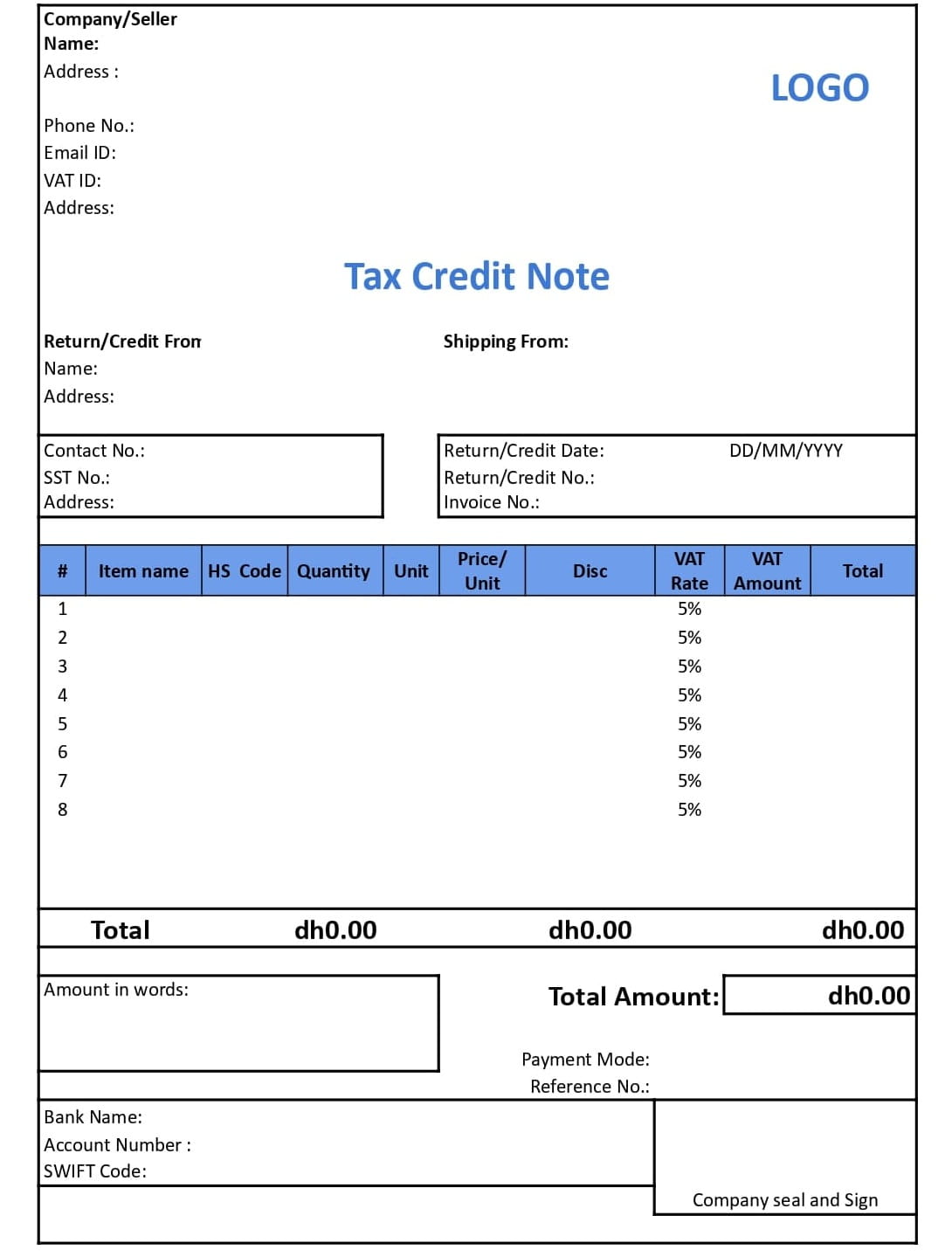
    3. What a Tax Credit Note Must Contain

    The Federal Tax Authority has outlined a clear checklist to avoid invalid or incomplete notes. Every valid credit note invoice in the UAE must:

    • Include the supplier’s name, address, and Tax Registration Number (TRN).
    • Provide enough information to link back to the original supply or supplier.
    • Display the title “Tax Credit Note.”
    • State the date of issue.
    • Explain why the invoice note was issued.
    • Show the original invoice value, the corrected amount, and the VAT difference.
    • Include the recipient’s details and TRN if they are VAT-registered.

    4. What Businesses Should Do Now

    This isn’t just about paperwork; it’s about maintaining credibility with the tax authorities and avoiding expensive disputes. Companies should:

    • Update ERP or accounting software to comply with the new rules.
    • Audit their current invoicing processes.
    • Train finance teams to recognise when a UAE Tax Credit Note is required.
    • Seek ongoing advice from VAT consultants to handle complex cases.

    By treating credit notes as more than a correction tool, but as a core compliance requirement, businesses can stay ahead of regulatory changes while ensuring smooth VAT reporting.

    Tax Credit Note Example in the UAE

    A Tax Credit Note under VAT is issued by a supplier when the value of an original supply is reduced due to reasons such as product returns, discounts, or errors in the invoice. It ensures that the supplier adjusts the VAT charged and the buyer claims the correct tax amount.

    Credit invoice example:

    Suppose a company in Dubai sells goods worth AED 10,000 plus 5% VAT (AED 500), making the total invoice value AED 10,500. Later, the customer returns goods worth AED 2,000. The supplier must issue a Tax Credit Note to reduce the taxable value:

    • Original invoice amount: AED 10,000 + AED 500 VAT = AED 10,500
    • Returned goods value: AED 2,000 + AED 100 VAT = AED 2,100
    • Tax Credit Note issued: AED 2,100 to adjust the VAT and supply value

    This process ensures both parties remain VAT compliant while maintaining accurate records.

    When is a Tax Credit Note Issued?

    In the UAE, a Tax Credit Note is issued when a business needs to adjust or reduce the value of a previously issued tax invoice under VAT law. This usually happens when:

    1. The customer returns goods: e.g., faulty or unwanted items.
    2. Services are cancelled or reduced: e.g., the scope of work changes after invoicing.
    3. An error in the original tax invoice, such as overcharging or applying the wrong VAT rate.
    4. Post-supply discounts are given: if a discount was not reflected in the original invoice.

    According to UAE VAT regulations, a Tax Credit Note must be issued within 14 days from the date the business becomes aware of the need for adjustment. This ensures VAT records remain accurate and compliant.

    Tax Credit Note Format

    Here’s a sample tax credit note from the UAE, fully aligned with VAT regulations.

    credit note format

    Benefits of Tax Credit Notes under UAE VAT

    Below are the benefits of tax credit notes under UAE VAT:

    1. Reduction in VAT Liability for Suppliers

    Tax Credit Notes allow suppliers to correct previously issued invoices by reducing the VAT amount owed to the Federal Tax Authority (FTA). These adjustments might arise due to product returns, post-sale discounts, or invoice errors. This correction ensures businesses don’t overpay VAT.

    2. Input Tax Adjustment Benefit for VAT-Registered Recipients

    If the recipient is also VAT-registered, the Tax Credit Note enables them to decrease their claimed input tax, aligning with the corrected taxable amount.

    3. Improved Cash Flow

    By avoiding overpayment of VAT, businesses can retain funds that would otherwise be held until refunds are processed or adjustments confirmed—enhancing liquidity.

    4. Enhanced Accuracy and Error Reduction

    Tax Credit Notes serve as a clean and systematic way to amend billing errors, such as overcharges or wrong VAT calculations, without generating new invoices or complicated manual adjustments.

    5. Regulatory Compliance and Audit Readiness

    Using Tax Credit Notes in alignment with FTA rules ensures proper documentation and reduces the risk of penalties during audits.

    6. Customer Trust & Satisfaction

    For returns or price adjustments, Tax Credit Notes provide transparency and fairness, reinforcing trust between businesses and their customers.

    7. Supports Electronic Record-Keeping & E-Invoicing

    Electronic Tax Credit Notes are encouraged, when issued via approved digital systems, they’re secure, tamper-evident, and seamlessly integrated into accounting workflows.

    8. Simplifies Complex Transactions

    Under Cabinet Decision No. 81 of 2023, businesses can combine tax invoices and credit notes within a single document labelled “Tax Invoice/Tax Credit Note,” reducing administrative burden without compromising clarity.

    How Shuraa Tax Ensures Compliance with Credit Notes and UAE Tax Credit Notes

    A credit note, whether a simple adjustment tool or a formal UAE Tax Credit Note under VAT is far more than just an invoice note issued against errors or returns. It safeguards accurate financial records, ensures VAT compliance, and maintains transparency in every business transaction. Whether you’re issuing a credit note invoice, reconciling a credit note against invoice, or referring to a credit invoice example, precision and timely action are non-negotiable under UAE law.

    With the Federal Tax Authority’s updated 14-day rule and evolving VAT framework, businesses can no longer rely on manual checks or outdated processes. Non-compliance, even if unintentional, can trigger penalties and disrupt cash flow. That’s why proactive measures, like automating credit note workflows, training finance teams, and auditing VAT processes, are critical.

    Shuraa Tax can help you navigate these requirements with ease. From ensuring every Tax Credit Note under VAT meets FTA standards to streamlining your accounting systems for error-free reporting, their experts make compliance seamless. Whether you need guidance on issuing a credit note invoice, structuring a credit note against invoice, or understanding a detailed credit invoice example, Shuraa Tax offers the clarity and precision your business deserves.

    Get expert VAT support today:
    Call: +(971) 44081900
    WhatsApp: +(971) 508912062
    Email: info@shuraatax.com

    By treating credit notes as a compliance asset not just a correction tool you’ll protect your business, improve liquidity, and build lasting trust with both customers and regulators.

    FAQs

    1. What is a Tax Credit Note under UAE VAT?

    A Tax Credit Note is a document issued by a supplier to adjust or reduce the value of a previously issued tax invoice. It is typically used when goods are returned, services are cancelled, discounts are applied after invoicing, or errors are found in the original invoice. The note ensures VAT adjustments are correctly reflected in both supplier and buyer records.

    2. When can a Tax Credit Note be issued in the UAE?

    As per Federal Tax Authority (FTA) regulations, a Tax Credit Note must be issued within 14 days from the date the supplier becomes aware of the adjustment requirement. This ensures VAT records remain accurate and compliant with UAE law.

    3. What details must a valid UAE Tax Credit Note contain?

    A valid Tax Credit Note must include:

    • Supplier’s name, address, and Tax Registration Number (TRN).
    • Recipient’s details and TRN (if VAT registered).
    • Title “Tax Credit Note.”
    • Date of issue.
    • Reason for issuing the note.
    • Original invoice value, corrected amount, and VAT adjustment.
    • Reference to the original supply or invoice.

    4. What are the benefits of issuing a Tax Credit Note?

    Tax Credit Notes ensure:

    • Reduction in VAT liability for suppliers.
    • Correct input tax adjustment for buyers.
    • Improved cash flow by avoiding VAT overpayment.
    • Error-free records for audits and compliance.
    • Transparency and stronger customer trust.

    5. What happens if a Tax Credit Note is not issued correctly or on time?

    Failure to issue a Tax Credit Note within the 14-day deadline, or providing incomplete details, may result in FTA penalties, incorrect VAT reporting, and potential disputes with customers. Businesses should upgrade their accounting systems and train finance teams to avoid such risks.

  • Understanding Property Tax in Dubai: What Investors Need to Know

    Understanding Property Tax in Dubai: What Investors Need to Know

    Investing in Dubai’s real estate market is a popular choice for both local and international investors, thanks to its tax-friendly environment and booming property sector. However, understanding the nuances of Dubai property tax is essential for making informed decisions.

    While the emirate does not levy a traditional real estate tax, investors should be aware of other financial obligations such as VAT on property in Dubai, registration fees, and maintenance charges. This guide breaks down the key aspects of real estate tax in Dubai, helping you navigate the legal and financial landscape before making your next property investment.

    Understanding the Property Tax System in Dubai

    Thinking of buying a property in Dubai? Dubai is one of the most tax-friendly places in the world when it comes to real estate. Unlike many other big cities, you don’t have to pay a yearly property tax just for owning a home or apartment. That’s one big reason why so many people love investing here.

    But wait — while there’s no yearly tax, there are a few one-time costs you should know about:

    • When you buy a property, you’ll need to pay a 4% fee to the Dubai Land Department. It’s kind of like a transfer fee for making the deal official. You only pay this once, at the time of purchase.

    Also, depending on the type of property you’re buying, VAT (value-added tax) may or may not apply:

    • Residential properties (like apartments or villas for living): No VAT after the first sale. So if you’re buying a home that’s already been sold once before, there’s no VAT.
    • Commercial properties (like office spaces or shops): You’ll pay 5% VAT when buying or renting these kinds of places.

    Benefits of Dubai’s Property Tax System

    One of the most compelling reasons investors are drawn to Dubai’s property market is its tax-friendly framework. The city offers a uniquely favourable environment for both residential and commercial property buyers, contributing to its status as a global investment hub.

    Here are some of the key benefits of the Dubai real estate tax system: 

    1. No Annual Property Tax

    Unlike many major cities around the world, Dubai does not impose an annual property tax on owned real estate. This significantly reduces long-term ownership costs, allowing investors to retain more of their returns.

    2. Zero Dubai Real Estate Corporation Tax

    At present, Dubai real estate corporation tax does not apply to most property investors. Companies or individuals who own property in their name typically do not pay corporate income tax on rental income or capital gains, unless they are engaged in another taxable business activity under the UAE’s corporate tax regime.

    3. No Capital Gains Tax

    Profits earned from selling a property are not subject to capital gains tax in Dubai, which is a significant advantage for investors and flippers looking to grow their portfolios.

    4. Transparent One-Time Fees

    Instead of hidden annual levies, Dubai applies clear, one-time charges like the 4% transfer fee to the Dubai Land Department. These upfront costs make the financial planning process more predictable.

    5. Simplified Commercial Property Tax in Dubai

    While there is no recurring commercial property tax in Dubai, 5% VAT is applied on commercial property transactions. This is a one-time tax at the point of sale or lease and is regulated under the UAE VAT law. However, this system is far more straightforward and transparent compared to corporate real estate taxation models in other countries.

    6. Investor Confidence and Market Stability

    The clarity and consistency of Dubai’s tax rules inspire investor confidence. With no surprise tax hikes or hidden property levies, Dubai continues to attract global property buyers looking for reliable returns.

    In summary, the lack of recurring property and corporate real estate taxes, combined with a clear structure around commercial property tax in Dubai, makes the emirate’s property market one of the most lucrative and stable in the world.

    Types of Property-Related Fees in the UAE

    Investing in real estate in the UAE involves several property-related fees that buyers, sellers, and landlords should be aware of. Although there is no direct Dubai property tax like in other global cities, there are still several mandatory charges to consider:

    1. Value Added Tax (VAT) on UAE Property Tax

    • VAT on property in Dubai applies under specific conditions:
    • Residential properties are generally exempt or zero-rated.
    • Commercial properties are subject to 5% VAT on the sale or lease.
    • VAT is also applicable to services related to real estate transactions, such as brokerage and legal fees.

    2. Dubai Land Department (DLD) Fees

    • A 4% transfer fee is paid to the Dubai Land Department when a property changes hands.
    • This fee is usually split equally between the buyer and the seller unless agreed otherwise.

    3. Registration Fees

    • Oqood registration for off-plan properties: AED 5,250.
    • For ready properties, a registration fee is often AED at 4,000 or 0.25% of the property value, whichever is higher.

    4. Agency Commission

    • Typically, 2% of the purchase price is paid by the buyer to the real estate agent or broker.

    5. Service Charges and Maintenance Fees

    • Property owners pay annual fees for the upkeep of common areas.
    • These charges vary by location and developer and are based on the RERA service charge index.

    6. Mortgage Registration Fee

    • If purchased with a mortgage, a 0.25% mortgage registration fee (plus AED 290 admin fee) is paid to the DLD.

    Common Misconceptions About Dubai Real Estate Taxes

    Dubai’s real estate market has gained global recognition for its investor-friendly tax regime, but with popularity comes confusion. Many buyers and potential investors misunderstand how Dubai property tax and related charges work. Below, we separate fact from fiction and break down the real costs of property ownership in the emirate.

    Common Myths About Dubai Property Taxes 

    Myth 1: Dubai has zero taxes on real estate.

    While it’s true that there’s no annual property tax in Dubai, this doesn’t mean real estate is entirely tax-free. One-time fees and indirect taxes do apply depending on the type of property and transaction.

    Myth 2: No VAT applies to any property in Dubai.

    False. VAT on property in Dubai does not apply to most residential property sales after the first supply. However, 5% VAT is charged on commercial property transactions, including sales and leases, as per UAE VAT laws.

    Myth 3: There are no hidden real estate taxes.

    While Dubai avoids traditional recurring taxes, owners still pay service charges, maintenance fees, and sometimes municipality housing fees (in the case of tenants or owner-occupiers). These are not technically real estate taxes in Dubai, but they are recurring ownership costs.

    Myth 4: Corporations pay the same taxes as individuals.

    Not exactly. Though Dubai real estate corporation tax currently does not apply in most cases, companies involved in taxable business activities or earning above specific thresholds might be subject to the UAE’s new corporate tax regulations.

    Rates & Fees for Property Owners in Dubai

    Here’s a snapshot of the main charges associated with owning property in Dubai:

    Type of Fee/Tax  Applicable To  Rate / Amount 
    Property Transfer Fee  All property buyers 4% of property value (paid to DLD)
    VAT on Commercial Property  Commercial property buyers & tenants 5% on sale or lease
    VAT on Residential Property  First sale of new residential property only 5% (developer charged, usually included)
    Annual Service Charges  All property owners Varies (AED 10–30+ per sq. ft. annually)
    Municipality Housing Fee  Tenants / owner-occupiers 5% of annual rent (billed monthly)
    Commercial Property Tax Dubai  Indirectly through VAT See above (5% VAT)
    Dubai Real Estate Corporation Tax  Corporate investors Not applicable in most property cases*

    *Corporate tax may apply if the property is part of a broader taxable business activity. 

    Dubai’s tax landscape is among the most transparent and investor-oriented in the world. By understanding the reality behind Dubai property tax, the impact of VAT on property in Dubai, and distinctions like commercial property tax Dubai vs. Dubai real estate corporation tax, buyers can make informed decisions and avoid being misled by common myths.

    Commercial Property Tax in Dubai vs. Dubai Real Estate Corporation Tax

    When investing in Dubai’s real estate market, it’s important to distinguish between commercial property tax and real estate corporation tax. While both relate to property ownership and transactions, they apply in different contexts and under different legal frameworks.

    1. Commercial Property Tax in Dubai

    Despite the term “tax,” Dubai doesn’t impose a traditional recurring property tax, even on commercial real estate. However, there is an indirect tax that functions similarly:

    • What it means: In Dubai, commercial property tax primarily refers to the 5% Value Added Tax (VAT) applied to the sale or lease of commercial properties.
    • Who pays: Buyers or tenants of offices, warehouses, retail units, and other non-residential spaces.
    • When it applies: At the time of purchase or lease, whether freehold or leasehold.
    • Regulation: Governed under the UAE Federal Tax Authority’s VAT Law.

    Key Point: This is a transaction-based tax, not a recurring annual fee like in many other countries.

    2. Dubai Real Estate Corporation Tax

    This refers to the potential application of UAE’s corporate tax on companies involved in property ownership or investment.

    • What it means: As of 2023, the UAE introduced a 9% corporate tax on business profits exceeding AED 375,000. If a company earns rental income, capital gains, or trading profits through real estate, it may be subject to this tax.
    • Who pays: Only corporate entities are involved in real estate as part of a business activity. This does not apply to individuals holding property for investment.
    • When it applies: When income from real estate exceeds the corporate tax threshold and is part of a taxable business activity.

    Key Point: This is not a property-specific tax, but a corporate income tax on real estate-related profits earned by registered businesses.

    Summary Comparison Table

    Aspect  Commercial Property Tax (Dubai)  Dubai Real Estate Corporation Tax 
    Nature  Indirect tax (VAT) on property transactions Corporate income tax on business profits
    Applies to  Buyers/tenants of commercial properties Corporations earning real estate income
    Tax Rate  5% VAT on sale or lease 9% on taxable income above AED 375,000
    Recurring?  No (charged at point of transaction) Yes, based on annual profits
    Individual Investors Affected?  Yes, if buying/using commercial property No, unless operating as a business entity
    Legal Basis  UAE VAT Law UAE Corporate Tax Law (2023)

    While commercial property tax in Dubai refers to a one-time VAT applied during transactions, Dubai real estate corporation tax may affect companies earning profits from property.

    Understanding the difference helps investors choose the proper ownership structure—whether as an individual, corporate entity, or through an offshore setup.

    Navigate Dubai’s Property Tax System with Shuraa Tax

    In conclusion, Dubai offers one of the most attractive and transparent property tax environments in the world. With no annual Dubai property tax, zero capital gains tax, and no Dubai real estate corporation tax for most investors, the emirate remains a hotspot for real estate investment. However, understanding associated charges such as VAT on property in Dubai, registration fees, and service charges is crucial for making informed decisions.

    Whether you are investing in residential or commercial property, knowing the difference between commercial property tax in Dubai (typically the 5% VAT) and corporate obligations under the Dubai real estate corporation tax regime can help you structure your investments wisely and avoid unnecessary costs.

    At Shuraa Tax, we specialise in guiding property investors through Dubai’s tax and compliance framework with clarity and confidence. From clarifying your real estate tax obligations in Dubai to helping structure corporate ownership effectively, we’re here to help every step of the way.

    📞 Call: +(971) 44081900
    💬 WhatsApp: +(971) 508912062
    📧 Email: info@shuraatax.com

    Contact Shuraa Tax today for personalised tax and real estate advisory services tailored to your investment goals.

  • Guide for Small Business Tax Preparation In 2025

    Guide for Small Business Tax Preparation In 2025

    If you own a small business in the UAE, filing taxes might seem like a big task, but it doesn’t have to be. With the introduction of corporate tax, it’s now more important than ever to understand the basics of small business tax preparation. Whether you’re running a home-based business, a startup, or a freelance gig, understanding how to file a tax return for a small business is crucial for avoiding mistakes and staying compliant.

    This blog will guide you through the entire process of small business tax filing in 2025. From understanding who needs to file, to preparing your records, calculating tax, and submitting your return, we’ve covered it all in simple steps. So, if you’re worried about filing taxes with a small business, this guide will help you get it right and file with confidence.

    What Is Corporate Tax in the UAE?

    Corporate Tax in the UAE is a direct tax imposed on the net income or profit of companies and other business entities. Introduced by the UAE government, it came into effect on June 1, 2023, to align with international tax standards and diversify the country’s revenue sources.

    Key Features of Corporate Tax in UAE:

    • Standard Rate: 9% on taxable income exceeding AED 375,000.
    • 0% Tax Rate: For taxable income up to AED 375,000 (to support small businesses and startups).
    • Scope: Applies to all businesses and commercial activities in the UAE, including those in free zones (with exceptions and incentives if they meet certain conditions).
    • Exemptions: Includes government entities, qualifying public benefit entities, and certain extractive businesses.
    • Filing Requirement: Companies must file a corporate tax return annually, even if they are eligible for a 0% tax rate.

    Purpose:

    The UAE introduced corporate tax to: 

    • Strengthen the country’s position as a global business hub.
    • Comply with OECD’s global minimum tax rules.
    • Reduce reliance on oil and diversify the economy.

    Do Small Businesses in UAE Need to File Corporate Tax?

    Yes, small businesses in the UAE are required to file a corporate tax return, even if they don’t have to pay any tax due to their low income. According to the UAE Corporate Tax Law, businesses with an annual taxable income of up to AED 375,000 are exempt from tax. However, they must still complete the necessary small business tax preparation and comply with reporting requirements.

    Whether you’re a sole proprietorship, an SME, or operating under a trade license, you must file a tax return for your small business each financial year. This helps maintain compliance and ensures your company remains in good standing with the Federal Tax Authority (FTA).

    So, if you’re filing taxes on a small business in the UAE, make sure to keep accurate financial records and submit your tax return on time—even if you qualify for the 0% rate under the small business relief provision.

    What Qualifies as a ‘Small Business’ under UAE Corporate Tax Rules?

    Under UAE Corporate Tax rules, a small business is generally defined as a business whose revenue does not exceed AED 3 million in a tax year. This threshold applies from June 1, 2023, to December 31, 2026, and businesses meeting this condition can elect to receive Small Business Relief under the law.

    If your business qualifies, you can benefit from simplified small business tax preparation and may not have to calculate or pay corporate tax on your profits. However, you’re still required to file a tax return for your small business with the Federal Tax Authority (FTA) each year.

    Whether you’re filing taxes on a small business or just starting your journey, it’s essential to maintain proper financial records. Even with Small Business Relief, small business tax filing remains a legal obligation. When filing taxes for a small business, be sure to follow the correct procedures to stay compliant and avoid penalties.

    Revenue Thresholds, Exemptions & 0% Tax Bracket under UAE Corporate Tax

    Understanding the revenue limits and exemptions is crucial for accurate small business tax preparation in the UAE. Here’s a clear breakdown:

    1. Revenue Thresholds

    • Businesses with revenue up to AED 3 million per year (for tax periods from June 1, 2023, to December 31, 2026) may qualify for Small Business Relief.
    • This allows eligible businesses to be treated as if they have no taxable income—greatly simplifying small business tax filing.

    2. 0% Tax Bracket

    • If your taxable income is up to AED 375,000, you fall under the 0% corporate tax rate.
    • You still need to file a tax return for your small business, even if you owe no tax. This is a legal requirement under UAE Corporate Tax law.

    Exemptions

    The following are exempt from filing and paying corporate tax:

    • Government entities and government-controlled entities.
    • Extractive businesses (oil & gas, etc.) that meet exemption conditions.
    • Certain qualifying free zone businesses (if they meet substance and activity requirements).
    • Charities and public benefit organisations approved by the Cabinet.

    Even if you qualify for exemptions or the 0% rate, you’re still responsible for filing taxes on a small business and keeping proper records. Being compliant not only avoids penalties but also strengthens your business credibility with banks and investors.

    Important CT Filing Deadlines for 2025

    Here are the important Corporate Tax (CT) filing deadlines in the UAE for 2025, based on your financial year-end. Every taxable person must file their CT return within nine months after their financial year closes (and pay any tax due in the same timeframe):

    Financial Year-End  CT Return & Payment Due By 
     31 Dec 2024 30 Sept 2025
    31 Mar 2025 31 Dec 2025
    30 Jun 2025 31 Mar 2026

    Additional reminders related to deadlines in 2025:

    • Natural persons (e.g., freelancers/sole proprietors) whose business turnover exceeded AED 1 million during 2024 must register by 31 March 2025.
    • Entities with short financial periods (e.g., those incorporated or liquidated before February 29, 2024) had extended deadlines for filing by December 31, 2024.

    Why These Deadlines Matter

    Missing these deadlines can result in penalties, including AED 500 for late filing and up to AED 20,000 for extended non-compliance. Staying on top of these dates ensures compliance, avoids fines, and facilitates the smooth filing of taxes for a small business in the UAE.

    How to Prepare Your Corporate Tax Filing in the UAE?

    Filing taxes on a small business in the UAE doesn’t have to be complicated. Follow these simple steps to stay compliant, avoid penalties, and make your small business tax preparation process smooth and stress-free.

    Step 1: Determine if Your Business Needs to File

    Before starting your small business tax preparation, check if your company is required to file for corporate tax. In the UAE, all resident businesses are required to register for corporate tax, unless they are specifically exempt.

    If your business earns less than AED 3 million annually, you may qualify for Small Business Relief and benefit from a 0% corporate tax rate. However, even if you’re eligible for this relief, you’re still required to file a return with the FTA.

    Step 2: Register for Corporate Tax on EmaraTax

    The next step is to register your business on the EmaraTax portal. The Federal Tax Authority manages this online platform and is where you’ll complete all your corporate tax-related filings.

    Registration is mandatory and must be done before your tax return due date. This is a key part of small business tax filing in the UAE.

    Step 3: Organise and Maintain Financial Records

    Good bookkeeping is essential for filing taxes with a small business. Ensure your financial records are up-to-date and accurate.

    This includes tracking your income, expenses, invoices, payroll, and other transactions. Keeping clear records helps ensure that your tax calculations are correct and can be easily verified if the FTA requests supporting documentation.

    Step 4: Calculate Your Taxable Income

    To file your tax return for a small business, calculate your taxable income by subtracting allowable business expenses from your gross revenue. If your net taxable income is below AED 375,000, you fall under the 0% tax bracket.

    If it exceeds AED 375,000, you’ll need to pay 9% tax on the amount above that threshold. This step is crucial for determining the exact amount of corporate tax your business is liable for.

    Step 5: Prepare and Submit the Corporate Tax Return (CTTR)

    Once your financial data is ready and your taxable income is calculated, log into the EmaraTax portal and fill out the Corporate Tax Return (CTTR) form.

    This is where you officially declare your income, claim any reliefs or deductions, and report your final tax amount. This step is the core of filing taxes for small businesses in the UAE.

    Step 6: File Your Return Within the Deadline

    The deadline to file your corporate tax return is within 9 months from the end of your financial year. For example, if your financial year ends on December 31, 2024, your return must be filed by September 30, 2025. Missing this deadline can result in penalties, so timely filing is essential.

    Step 7: Pay Any Tax Due

    If your business is liable for corporate tax, the payment must be made through the EmaraTax portal before the filing deadline. Ensure your tax liability is settled on time to avoid fines or interest charges.

    Step 8: Keep Supporting Documents Ready

    Lastly, after you’ve filed your tax return, keep all supporting documents—like invoices, receipts, and bank statements—ready and accessible. The FTA may request these records for verification. Proper documentation not only protects your business during audits but also helps with future filings.

    Mistakes to Avoid When Filing as a Small Business

    Filing taxes on a small business can be overwhelming, especially if you’re doing it for the first time. Many business owners rush through the process or overlook key details, which can lead to errors that result in penalties, audits, or missed opportunities for savings.

    Here are some common mistakes to avoid during your small business tax preparation and small business tax filing in the UAE:

    1. Missing the Filing Deadline

    One of the most common and costly mistakes is missing the corporate tax return deadline. UAE businesses must file their tax return within 9 months from the end of their financial year.

    Late filing can lead to fines, even if your small business qualifies for the 0% tax bracket. Always mark your calendar and prepare in advance.

    2. Not Keeping Proper Financial Records

    Accurate bookkeeping is the foundation of good small business tax preparation. Failing to track income, expenses, or invoices properly can result in incorrect filings. Without organised records, you also risk non-compliance if the Federal Tax Authority (FTA) requests proof during an audit.

    3. Assuming You Don’t Need to File

    Even if your business revenue is below AED 3 million and you’re eligible for Small Business Relief, you still need to file a tax return. Many entrepreneurs believe they’re exempt and skip this step, which could result in penalties or complications later on.

    4. Overlooking Allowable Deductions

    When you file a tax return for your small business, it’s essential to claim all eligible business expenses. Failing to do so can result in an unnecessary increase in your taxable income. Work with an accountant or advisor to ensure you’re taking advantage of all legal deductions available.

    5. Filing Incorrect or Incomplete Information

    Submitting incorrect financial data, using outdated figures, or skipping required fields are common issues when filing taxes for a small business. Always double-check your entries and review your financial statements before submission. Even simple mistakes can delay your tax processing or lead to rejection.

    6. Not Consulting a Tax Professional

    Trying to handle everything yourself may seem cost-effective, but corporate tax law in the UAE can be complex and challenging. If you’re unsure about any step, working with a tax advisor can help you stay compliant and avoid costly errors during small business tax filing.

    Penalties for Late or Incorrect Corporate Tax Filing

    Non-compliance with UAE Corporate Tax regulations can lead to significant financial consequences:

    • AED 10,000 penalty for not registering on time
    • AED 500 per month, accumulating, for delayed tax return submissions
    • AED 1,000 or more for not maintaining accurate financial records
    • Up to AED 50,000 for providing false information or attempting tax evasion
    • Interest charges apply on unpaid taxes from the due date until settlement

    Note: It’s essential to stay compliant to avoid these escalating penalties.

    Make Small Business Tax Filing Easy with Shuraa Tax

    Preparing and filing taxes on a small business doesn’t have to be stressful. With proper planning, clear financial records, and timely submissions, tax preparation for small businesses becomes manageable and straightforward.

    Remember, even if your business qualifies for the 0% tax rate or Small Business Relief, you still need to file a return. Avoid mistakes, stay informed about UAE tax rules, and don’t hesitate to ask for help when needed.

    If you’re unsure how to file a tax return for your small business or need guidance, Shuraa Tax is here to support you every step of the way.

    📞 Call: +(971) 44081900
    💬 WhatsApp: +(971) 508912062
    📧 Email: info@shuraatax.com

  • How to Obtain a TIN Number in the UAE

    How to Obtain a TIN Number in the UAE

    As the UAE continues to build a stronger tax and regulatory system, having a Tax Identification Number (TIN) — also called a Tax Registration Number (TRN) – is becoming essential. Whether you own a business or work as a freelancer, getting a TIN/TRN helps you stay compliant with UAE tax laws and makes financial transactions smoother.

    In this blog, we’ll break down everything you need to know about the TIN/TRN in the UAE — who needs it, how to apply, and why it matters.

    What is the TIN Number in UAE?

    The TIN number in UAE, or Tax Identification Number, is a unique identifier assigned by the Federal Tax Authority (FTA) to entities and individuals for tax purposes. It plays a crucial role in identifying taxpayers and tracking their obligations under UAE tax laws.

    In the UAE, the TIN is often used interchangeably with the TRN (Tax Registration Number); however, there is a subtle distinction, which we’ll cover later.

    Who Needs a TIN Number in the UAE?

    A Tax Identification Number (TIN) in the UAE is mainly required for individuals and businesses involved in taxable or internationally reportable activities. Here’s a breakdown:

    For Businesses

    1. Companies Registered Under UAE VAT Law

    Any business that has registered for VAT (Value Added Tax) must obtain a TIN. This is crucial for filing tax returns, invoicing, and other compliance-related processes.

    2. Free Zone and Mainland Businesses Exceeding the VAT Threshold

    If a business (whether in a free zone or on the mainland) earns more than the mandatory VAT registration threshold (currently AED 375,000 per annum), it must register for VAT. It will be issued a Tax Identification Number (TIN).

    3. Import-Export Businesses

    Companies involved in importing or exporting goods are often required to have a Taxpayer Identification Number (TIN) to comply with customs and tax regulations, especially when trading with VAT-registered entities.

    For Individuals

    1. Freelancers and Sole Proprietors Offering Taxable Goods or Services

    If you’re a freelancer or operate as a sole trader providing services or products that fall under VAT, you’ll need to register and obtain a TIN.

    2. UAE Residents with International Income (for Tax Reporting Abroad)

    Residents who earn income outside the UAE and are subject to tax reporting in other countries, such as those under FATCA or CRS, may need a UAE Tax Identification Number (TIN) for foreign tax compliance purposes.

    3. Foreign Nationals Conducting Business in the UAE

    Non-residents or foreign entrepreneurs operating a business within the UAE (e.g., through free zones) and engaging in taxable activities are also required to obtain a TIN.

    Special Note for Individuals

    If you’re specifically looking for the UAE TIN number for individuals, it generally applies if you’re:

    • Engaged in any taxable business or freelance activity.
    • Subject to international tax reporting laws, such as the Foreign Account Tax Compliance Act (FATCA) or Common Reporting Standard (CRS), which require the disclosure of tax information to other countries.

    Who Is Eligible to Get a VAT Tax Number in UAE?

    To obtain a VAT Tax Registration Number (TRN) in the UAE, businesses must fall under at least one of the following categories:

    1. Mandatory Registration

    Your business must register for VAT if:

    • Your annual taxable turnover exceeds AED 375,000.
    • This includes revenue from goods and services that are subject to VAT at either 5% or 0%.

    2. Voluntary Registration

    Your business can choose to register if:

    • Your annual taxable turnover exceeds AED 187,500 but is less than AED 375,000.
    • This is ideal for startups or small businesses looking to establish credibility and recover input VAT.

    3. Import/Export Businesses

    • Companies involved in importing or exporting goods and services, even if the goods are zero-rated, are required to register.
    • VAT compliance is crucial for smooth customs clearance and international trade.

    4. Businesses in Designated Free Zones

    • Businesses operating in designated free zones that deal with taxable goods or services are required to register for a Tax Registration Number (TRN).
    • Although certain free zone areas have special VAT treatments, TRN is still needed if taxable supplies are involved.

    Importance of Tax Identification Number (TIN) for Businesses in the UAE

    A Tax Identification Number (TIN)—commonly referred to as a tax number in Dubai or the United Arab Emirates—is a vital requirement for businesses operating in the region. Here’s why it’s so important:

    1. Accurate VAT Return Filing

    The TIN allows businesses to file their VAT returns correctly and on time with the Federal Tax Authority (FTA). This ensures transparency in all tax-related matters and helps avoid unnecessary fines.

    2. Legally Compliant Business Operations

    With a TIN, businesses can operate within the legal framework of the UAE’s taxation system. It acts as proof of tax registration, which is essential for legitimate and credible operations.

    3. Smooth Import and Export

    A registered TIN is necessary for customs clearance during import and export activities. It helps businesses avoid regulatory hurdles and ensures that cross-border transactions go smoothly.

    4. Avoidance of Penalties

    Businesses that fail to register for tax or misreport their tax obligations risk heavy penalties. A TIN helps them comply with FTA requirements and avoid financial and legal consequences.

    5. Builds International Trust

    Having a TIN adds to a business’s credibility with international clients, suppliers, and banks. It signifies that the company is tax-compliant and transparent, key traits for building cross-border partnerships.

    6. Crucial for Invoicing and Audits

    Whether you’re a freelancer or a company, a UAE tax identification number is critical for issuing VAT-compliant invoices, maintaining proper tax records, and responding to audits by the authorities.

    In summary, the TIN in the UAE is not just a formality—it’s a core requirement for lawful, efficient, and reputable business operations.

    How to Get a TRN Number Online in UAE

    If you’re planning to operate a business in the UAE and your taxable turnover meets the threshold, obtaining a TRN (Tax Registration Number) is mandatory. Here’s how you can get your TRN number online through the Federal Tax Authority (FTA) portal:

    Step 1: Create an FTA Account

    Start by visiting the FTA e-Services Portal.
    Click on Sign up and fill in the basic details such as:

    • Email address
    • Mobile number
    • Username and password

    You’ll receive a verification link via email or SMS. Once verified, your account will be activated.

    Step 2: Log in to Your FTA Dashboard

    Use your credentials to log in. Once inside your FTA dashboard:

    • Look for the ‘VAT Services’ tab.
    • Click on ‘Register for VAT’ to begin your application.

    Step 3: Fill in the VAT Registration Form

    Complete the online form by providing the following details:

    Business Information

    • Registered business name (as per your trade license)
    • Legal structure (LLC, Sole Establishment, etc.)
    • Trade license number and issuing authority
    • Business address and contact details

    Financial Details

    • Projected or actual taxable turnover (must exceed AED 375,000 for mandatory registration)
    • Details of imports/exports if applicable
    • Description of business activities

    Banking Information

    • Bank name
    • IBAN (International Bank Account Number)

    Managerial Contacts

    • Details of business owners or managers (Emirates ID/passport info)

    Step 4: Upload Required Documents

    You must scan and upload the following documents (formats: PDF, JPEG, etc.):

    • Trade license copy
    • Passport and Emirates ID of owners/partners
    • Proof of business address (e.g., tenancy contract or utility bill)
    • Financial statements or invoices proving turnover
    • Bank account letter or statement
    • Customs code certificate (if importing/exporting)

    Step 5: Review and Submit the Application

    Double-check all your entries and uploaded documents.
    Once satisfied: 

    • Click Submit
    • You will receive an Application Reference Number and a confirmation email.

    Step 6: FTA Review and TRN Issuance

    The FTA will review your application, which usually takes 5–20 business days. If approved, your TRN (Tax Registration Number) will be issued and visible in your FTA dashboard. You’ll also get an official VAT Certificate.

    Documents Required for Online TIN Registration in UAE

    To successfully register and get your TRN/TIN, prepare the following documents:

    • Copy of Trade License
    • Emirates ID and Passport copy of the owner/partners
    • Business contact details (email, mobile)
    • Bank account details
    • Custom code certificate (if applicable)
    • Turnover proof (bank statements, audited accounts, etc.)
    • Memorandum of Association (MOA)

    How to Verify TIN Number Online in UAE?

    Once issued, you can verify your TIN in the UAE through:

    • Visiting the FTA TRN Verification Tool.
    • Enter the TRN number to confirm its validity.
    • This ensures that you’re dealing with VAT-registered entities.

    Difference between TIN and TRN in UAE

    Here’s a clear table highlighting the difference between TIN and TRN in the UAE:

    Aspect TIN (Tax Identification Number) TRN (Tax Registration Number)
    Full Form Tax Identification Number Tax Registration Number
    Issued By Federal Tax Authority (FTA) or the relevant authority for international reporting Federal Tax Authority (FTA), UAE
    Who Needs It Individuals and businesses with international tax obligations Businesses in the UAE meeting the VAT registration threshold
    Usage Scope Broad — for global tax reporting, FATCA, CRS, banking, etc. Narrow — specific to VAT returns, invoicing, and tax compliance in UAE
    Format Not publicly standardized; varies based on type 15-digit number (e.g., 100123456700003)
    Applies To Individuals? Yes, especially those with foreign income or reporting needs No, unless the individual is running a taxable business or freelance activity
    Applies To Businesses? Yes, especially those involved in cross-border operations Yes, for businesses with taxable supplies exceeding AED 375,000 annually
    Registration Requirement Not always mandatory unless dealing with international tax matters Mandatory for businesses exceeding the VAT threshold in UAE
    Main Legal Reference OECD guidelines, FATCA, CRS regulations UAE VAT Law and FTA regulations

    In essence, the TIN number in the UAE, TRN, and VAT number often refer to the same number assigned by the FTA; however, TIN can also refer to identifiers used for international tax compliance.

    What is the Processing Time to Obtain a TRN Certificate in the UAE?

    After submitting your VAT registration, the typical processing time is 5–20 business days, depending on the completeness and accuracy of your application. Upon approval, the TRN certificate will be available for download via the FTA dashboard.

    Understanding Tax Registration!

    Whether you’re a business owner or an individual involved in taxable services, obtaining your TIN number in UAE is a crucial step toward tax compliance and smoother operations. Understanding the process, documents, and differences between TIN, TRN, and VAT numbers can save you time and ensure regulatory peace of mind.

    Need help registering for your UAE TIN or VAT number? 
    Let the experts at Shuraa Tax guide you through the hassle-free process.

    📞 Call: +(971) 44081900
    💬 WhatsApp: +(971) 508912062
    📧 Email: info@shuraatax.com

    Note: The information provided above is for educational purposes only. For professional assistance with TRN registration in the UAE, Shuraa Tax is here to help.

  • Corporate Tax Fines and Penalties in UAE

    Corporate Tax Fines and Penalties in UAE

    With the implementation of the UAE Corporate Tax regime, businesses across the Emirates are expected to comply with the new tax rules. Failing to meet these obligations can result in significant Corporate Tax fines in UAE, including penalties for late registration, incorrect filing, and non-compliance.

    In this blog, we’ll break down the penalties for UAE Corporate Tax, explore the UAE Corporate Tax Penalty Waiver, and provide clear steps to avoid these costly fines.

    What Is the UAE Corporate Tax Penalty Waiver?

    The UAE Corporate Tax Penalty Waiver is a government-backed relief initiative launched by the Ministry of Finance and implemented by the Federal Tax Authority (FTA). It is designed to support businesses that may have struggled to comply with new tax regulations, especially during the initial phases of implementing the UAE’s corporate tax system.

    Under this waiver scheme, eligible businesses can apply to have administrative penalties reduced or completely waived, provided they fulfil certain conditions. These penalties typically include fines related to:

    • Late registration for corporate tax
    • Late filing of tax returns
    • Late payment of corporate tax liabilities
    • Failure to maintain proper accounting records
    • Other non-compliance actions under the UAE Tax Procedures Law

    Why the UAE Launched the Corporate Tax Penalty Waiver

    The UAE government introduced the corporate tax penalty waiver as a strategic move to support the business community during the early stages of the new corporate tax regime. Here’s a breakdown of the key reasons behind this initiative:

    1. Encourage Voluntary Tax Compliance

    The waiver motivates businesses to come forward, register, and comply with tax regulations without fear of heavy penalties. This builds a culture of self-compliance rather than enforcement-led compliance.

    2. Ease the Transition to the New Corporate Tax Regime

    Since corporate tax is a new concept for many businesses in the UAE, the waiver serves as a grace period. It helps companies understand, adapt, and comply with new tax laws without the immediate burden of fines.

    3. Support Businesses with New Reporting Standards

    Filing taxes involves new financial reporting, recordkeeping, and documentation. The waiver acknowledges this learning curve and provides businesses, especially small and medium enterprises (SMEs), breathing room to adjust appropriately.

    4. Strengthen Economic Stability

    By reducing legal and financial stress, especially on smaller firms, the waiver promotes a healthier business environment. This helps maintain investor confidence and economic growth in the face of regulatory changes.

    The UAE’s goal is not to punish businesses, but to guide them towards full compliance while maintaining a stable and supportive economic environment.

    Aims of the Waiver

    The UAE Corporate Tax Penalty Waiver is more than just a short-term financial relief — it’s a strategic move by the government with broader goals in mind:

    1. Promoting Long-Term Compliance

    By offering a second chance to businesses, the waiver encourages them to meet their tax responsibilities moving forward consistently. It builds a habit of timely registration, filing, and payment, aligning businesses with the new tax culture in the UAE.

    2. Educating Businesses on Their Tax Obligations

    The waiver period serves as an educational window. Businesses unfamiliar with the new corporate tax regime have the opportunity to learn about their duties without facing harsh penalties immediately.

    3. Creating a Fair and Transparent Tax Environment

    The initiative supports a level playing field where all companies are held to the same standards. Transparent rules and penalty relief help build trust between authorities and businesses.

    4. Minimising Errors in Initial Tax Filings

    As the law is new, mistakes are expected. The waiver helps businesses correct these early errors without facing punitive consequences, thus reducing the administrative burden on both the taxpayer and the government.

    In short, the waiver aims to build a strong, compliant, and educated business community in line with international tax standards.

    Who Qualifies for the UAE Corporate Tax Penalty Waiver?

    Your business may be eligible for the UAE Corporate Tax penalty waiver if it takes the right corrective actions within the stipulated timeframe. The Federal Tax Authority (FTA) has outlined key conditions businesses must meet to qualify:

    1. Timely Payment of Taxes

    You must pay all outstanding corporate tax dues by the deadline set by the FTA. Without clearing your liabilities, you won’t be considered for the waiver.

    2. Accurate Tax Return Filing

    Your corporate tax returns should be filed accurately and on time. Filing errors or delays can disqualify your business from the waiver benefits.

    3. Correction of Errors

    If you’ve made any mistakes or left out information in previous tax filings, you must correct those errors through proper channels before applying.

    4. Voluntary Disclosure Compliance

    You must meet the criteria for voluntary disclosure, as defined by the FTA. This means proactively coming forward to correct your filings before the FTA identifies the issue.

    Important Note: 

    The FTA may reject waiver requests in the following cases:

    • If your business fails to meet any of the above conditions
    • If the penalties were imposed due to fraudulent behaviour or intentional misreporting
    • Being proactive, transparent, and compliant is essential to benefit from the waiver scheme.

    How to Register for Corporate Tax and File on Time in the UAE

    To avoid penalties and stay compliant with UAE’s Corporate Tax law, businesses must follow a structured process for registration and timely filing:

    Step 1: Register on the EmaraTax Portal

    All businesses, whether taxable or not, must register for Corporate Tax through the EmaraTax portal. This is a mandatory step introduced by the Federal Tax Authority (FTA).
    Even if your business qualifies for a 0% rate or exemption, registration is still required.

    Step 2: Prepare and Upload Required Documents

    Before starting your registration, keep the following documents ready:

    • Valid Trade License(s)
    • Emirates ID of business owners or authorised signatories
    • Passport copies of shareholders/owners
    • MOA (Memorandum of Association) or relevant formation documents
    • Details of business activities and the financial year
    • Contact details (email, mobile, office address)

    Step 3: File Tax Returns on Time

    Corporate Tax returns must be filed within 9 months from the end of your financial year.
    For example: 

    • If your financial year ends on 31st December 2024, you must file by 30th September 2025.

    Late filing can lead to hefty penalties, so mark the deadlines and set reminders in advance.

    Step 4: Maintain Proper Records

    The FTA mandates businesses to maintain records for at least 7 years, including:

    • Financial statements
    • Tax invoices and receipts
    • Contracts and agreements
    • Audit reports (if applicable)

    These records must be readily available in the event of an inspection or audit.

    Pro Tip

    If you are unsure about the process, consult a tax agent or business setup consultant to ensure your documents and filings are in order.

    Penalties Without the Waiver

    If your business does not meet the criteria for the UAE Corporate Tax penalty waiver or misses key deadlines, you could face the following hefty fines under the Federal Tax Authority (FTA) regulations:

    1. AED 10,000 – Failure to Register on Time

    If you fail to register for Corporate Tax within the prescribed timeline, you’ll be fined AED 10,000 even if your business is not liable to pay tax yet. Registration is mandatory for all eligible entities.

    2. AED 500 to AED 20,000 – Late Filing of Tax Returns

    Submitting your Corporate Tax return after the due date can result in fines ranging from AED 500 to AED 20,000, depending on the length of the delay and any history of non-compliance.

    3. AED 1,000 per Day – Delay in Providing Information

    If the FTA requests specific documentation or data and you delay submitting it, you can be fined AED 1,000 per day, with the amount increasing the longer you delay.

    4. AED 20,000 – Inadequate Record Keeping

    Failing to maintain proper financial and accounting records as per FTA guidelines will incur a flat penalty of AED 20,000. This includes failure to retain tax invoices, ledgers, and other key documents.

    5. Up to 200% of Tax Due – Filing Incorrect Returns

    Submitting false or incorrect tax returns — whether intentionally or due to negligence — can attract penalties of up to 200% of the unpaid tax amount, making this one of the most serious violations.

    Why It Matters

    These penalties can have a severe impact on cash flow, particularly for startups and small to medium-sized enterprises (SMEs). Non-compliance also risks FTA audits, license suspensions, and reputational damage.

    Tip: Always file on time, keep records updated, and seek professional tax advice to avoid unnecessary penalties.

    How to Apply for a Refund If You Already Paid a Penalty (Under UAE Corporate Tax Waiver)

    If you’ve already paid a penalty that qualifies for relief under the UAE Corporate Tax Penalty Waiver scheme, you can apply to get that amount refunded. Here’s how:

    Step 1: Log In to the EmaraTax Portal

    Visit https://eservices.tax.gov.ae and log in using your EmaraTax credentials.

    Step 2: Submit a Request for Reconsideration

    • Navigate to the “Reconsideration” section.
    • Choose the relevant penalty you’ve already paid.
    • Provide all supporting documents, such as payment receipts, proof of voluntary disclosure (if applicable), and any compliance evidence.

    Step 3: Track Your Request

    • Once submitted, you can monitor the status of your request in the EmaraTax dashboard.
    • The system may notify you if any additional information is required.

    Important Notes

    • Refunds are not automatic; you must submit a formal request.
    • Approval is at the discretion of the Federal Tax Authority (FTA).
    • Ensure your request aligns with the waiver eligibility criteria — including timely tax filing, payment, and voluntary disclosures.

    Cases Where the UAE Corporate Tax Penalty Waiver Applies

    The UAE Corporate Tax penalty waiver is designed to support businesses during the transition to the new tax regime. It applies in specific situations where businesses have made unintentional errors or faced genuine challenges. Common scenarios include:

    Case 1: Failure to Register Due to Lack of Awareness

    Businesses that missed the registration deadline during the early implementation phase—especially small to medium-sized enterprises (SMEs)—may be considered for a waiver if they can demonstrate that they were unaware of the requirement and acted promptly once informed.

    Case 2: Filing Errors Due to First-Time Compliance Challenges

    Mistakes in initial tax filings, especially by businesses new to corporate tax compliance, may be excused if they show efforts were made to understand and follow the law.

    Case 3: Late Payments Caused by Genuine Financial Hardship

    Companies experiencing cash flow problems or financial distress that have delayed their tax payments might be eligible if they can substantiate their financial difficulties and have since paid or committed to paying the due amount.

    Case 4: Voluntary Disclosures Made in Good Faith

    If a business voluntarily corrects its previous filings or discloses omissions/errors before being contacted by the FTA, the waiver may apply—provided the disclosure was honest and timely.

    Important

    Each case is assessed individually by the Federal Tax Authority (FTA). Businesses must provide complete documentation and clear justifications to support their waiver request.

    This approach encourages transparency and responsible behaviour while helping businesses stay compliant without excessive financial burden.

    Penalties for Corporate Tax Non-Compliance in the UAE

    Non-compliance with the UAE Corporate Tax law can result in serious financial, legal, and reputational consequences. Below are the everyday non-compliant actions and their potential outcomes:

    1. Not Registering for Corporate Tax

    All eligible businesses must register for corporate tax through the EmaraTax portal. Failing to do so can lead to:

    • A fixed penalty (e.g., AED 10,000)
    • Potential daily fines until the registration is completed
    • Delay in refunds or other tax-related benefits

    2. Submitting False or Misleading Information

    Providing incorrect financial data, underreporting income, or misrepresenting expenses can trigger:

    • Penalties of up to 200% of the unpaid tax amount
    • Legal actions for fraud or deliberate tax evasion
    • Loss of future eligibility for waiver schemes

    3. Failing to File Returns or Pay Dues

    Tax returns must be filed, and payments made on time. Delays or failures can lead to:

    • Fines ranging from AED 500 to AED 20,000 for late filing
    • Daily penalties for ongoing non-compliance
    • Interest on overdue tax payments

    4. Ignoring Audit Requests from the FTA

    If the Federal Tax Authority (FTA) requests documentation or initiates an audit, businesses must comply with the request. Non-compliance can result in:

    • Additional penalties for obstruction
    • Forced assessments based on FTA estimations
    • Suspension of tax certificates or licenses

    Consequences Beyond Penalties

    In addition to monetary fines, non-compliance can lead to:

    • Legal action and court cases
    • Reputational damage affecting business relationships
    • Operational disruptions including license issues or blacklisting

    Key Tip: Stay proactive—register on time, file accurately, and respond promptly to FTA communications to avoid penalties.

    How Businesses Can Avoid Corporate Tax Penalties in the UAE

    Avoiding corporate tax penalties in the UAE is entirely possible if businesses take a proactive and compliant approach. Here’s how:

    1. Register Early

    • Businesses must register for UAE Corporate Tax through the EmaraTax portal within the required timeframe.
    • Late registration incurs penalties starting from AED 10,000, so it’s essential to act promptly—even if your company isn’t yet taxable.

    2. Know Your Filing Deadlines

    • Tax returns must be filed within 9 months after the end of your financial year.
    • Missing deadlines can result in fines ranging from AED 500 to AED 20,000, depending on the severity of the delay and its recurrence.

    3. Maintain Accurate Financial Records

    • Keep proper documentation of:
    • Revenues
    • Expenses
    • Tax calculations
    • Supporting documents like invoices, contracts, and receipts
    • Failure to maintain adequate records may result in penalties of AED 20,000 or more.

    4. Consult with Tax Experts

    • Hiring a qualified tax consultant helps ensure that your business:
    • Applies the right tax treatment
    • Avoids filing errors
    • Is audit-ready in case of FTA scrutiny

    5. Stay Updated on FTA Guidelines

    • The UAE tax landscape is still evolving. Regularly check for updates from the Federal Tax Authority (FTA).
    • Ignorance of changes does not exempt you from compliance, and violations can lead to both financial and legal consequences.

    Being early, accurate, and informed—with the support of tax professionals—can help your business stay penalty-free in the UAE corporate tax system.

    Secure Your Compliance with Shuraa Tax

    Navigating the UAE’s evolving tax landscape can be challenging, but avoiding UAE corporate tax penalties doesn’t have to be. Whether you’re dealing with corporate tax fines in the UAE, concerned about penalties for UAE corporate tax, or trying to avoid a UAE corporate tax late registration penalty, Shuraa Tax is here to help.

    Our team ensures your business stays fully compliant—from accurate registration to timely filings and strategic waiver applications. With our expert support, you can minimize risks and focus on growth.

    📞 Call: +(971) 44081900
    💬 WhatsApp: +(971) 508912062
    📧 Email: info@shuraatax.com

    Let Shuraa Tax keep your business penalty-free and tax-compliant in the UAE.