Author: Azhar Ahamed

  • How to Claim Excise Tax Refunds in the UAE?

    How to Claim Excise Tax Refunds in the UAE?

    If you’re running a business in the UAE, excise tax is probably something you’ve dealt with already, whether it’s on tobacco, soft drinks, energy drinks, or other excise goods. But what many businesses don’t realise is that in certain situations, you may be eligible for an Excise Tax Refund. Yes, that means you could actually claim back excise tax that was already paid.

    An excise duty refund usually applies when excise goods are exported, returned, destroyed under authority supervision, or used in specific approved cases. While the idea of getting a refund sounds simple, the process itself can feel confusing, especially with documentation, timelines, and FTA requirements to consider.

    If you’re looking to understand how an Excise Tax Refund in Dubai works, or whether your business even qualifies, you’re in the right place.

    In this guide, we’ll break down the refund process in clear, practical terms, so you know exactly what to expect and how to claim what’s rightfully yours, without unnecessary stress or guesswork.

    What is the Excise Tax Refund in the UAE?

    The Excise Tax Refund in the UAE is a government provision that allows eligible businesses to claim back excise tax they have already paid, under specific conditions. In simple terms, if you’ve paid excise tax on certain goods but later become entitled to a refund due to how those goods were used, exported, or handled, you can apply to recover that amount.

    Excise tax in the UAE mainly applies to products considered harmful to health or the environment, such as tobacco products, energy drinks, soft drinks, and electronic smoking devices. While this tax is mandatory at the point of import or production, the law also recognises that businesses shouldn’t always bear this cost if the goods aren’t ultimately consumed in the local market.

    How does an Excise Tax Refund work?

    An Excise Tax Refund in Dubai or anywhere else in the UAE applies when excise goods meet the refund eligibility criteria set by the Federal Tax Authority (FTA). For example, if excise goods are exported outside the UAE, destroyed under FTA supervision, or used for purposes that qualify for exemption, businesses may claim a refund on the excise tax already paid.

    The refund process is fully online and handled through the FTA portal. Businesses must submit supporting documents to prove eligibility, such as export documents, warehouse records, or Destructive certificates.

    Who can apply for an Excise Tax Refund in the UAE?

    Typically, the following entities may apply for a Dubai Excise Tax Refund or refunds across the UAE:

    • Registered excise tax businesses
    • Importers or manufacturers of excise goods
    • Warehouse keepers dealing with excise products
    • Businesses exporting excise goods outside the UAE

    The key requirement is that the applicant must be registered with the FTA and able to clearly demonstrate that the excise tax paid is refundable under UAE tax regulations.

    Why is the Excise Tax Refund important?

    The Excise Tax Refund in UAE helps businesses maintain healthy cash flow and avoid unnecessary tax burdens. Without this provision, companies exporting or reusing excise goods would end up paying tax on products never consumed locally, which would be unfair and financially restrictive.

    By allowing refunds, the UAE ensures a fair and business-friendly tax environment, especially companies involved in trading, logistics, and manufacturing.

    When Can You Apply for an Excise Tax Refund?

    Businesses registered under excise tax can apply for a refund when tax has been paid but later becomes recoverable under UAE regulations. Understanding when you’re eligible helps avoid delays and ensures smooth compliance.

    Here are the most common situations where an Excise Tax Refund in Dubai and across the UAE may apply:

    1. Excise Tax Paid on Returned or Destroyed Goods

    If excise goods such as tobacco, energy drinks, or carbonated beverages are returned to the supplier or destroyed under approved supervision, you may be eligible for a Dubai Excise Tax Refund for the tax already paid.

    2. Overpaid or Incorrect Tax Payments

    If you’ve paid more excise tax than required due to calculation or reporting errors, you can apply for an Excise Tax Refund in UAE once the discrepancy is identified and properly documented.

    3. Export of Excise Goods Outside the UAE

    When excise goods are exported out of the UAE after tax has been paid locally, businesses can request a refund, provided valid export proof is submitted.

    4. Use of Goods for Approved Exempt Purposes

    Certain excise goods used for approved industrial or non-consumable purposes may qualify for a refund if tax was initially paid but later deemed refundable under UAE to excise tax regulations.

    5. Refunds Due to Amended Returns or Assessments

    If a tax return is amended or an official tax assessment is revised, resulting in excess tax paid, you can submit a refund request through the Federal Tax Authority portal.

    6. Filing Within the Allowed Timeframe

    Excise tax refund applications must be submitted within the timelines set by the authorities. Missing the deadline can lead to rejection, even for valid claims, making timely filing essential for any Excise Tax Refund in Dubai or the UAE.

    Apply for an excise tax refund as soon as excess tax is identified and all supporting documents are in place. Early action ensures faster processing and a smoother refund experience.

    How to Claim Excise Tax Refunds in the UAE?

    Businesses registered for excise tax in the UAE may be eligible to recover excess tax paid under specific circumstances. An Excise Tax Refund in the UAE is usually claimed when excise goods are exported, destroyed, or taxed more than once. Below is a complete breakdown of the process.

    Step 1: Check Your Eligibility for an Excise Tax Refund

    Before applying, confirm that your business qualifies for an Excise Tax Refund. Refunds are typically allowed if:

    • Excise goods are exported outside the UAE
    • Goods are destroyed under official supervision
    • Excise duty was paid more than once on the same goods
    • Excise goods were returned to the supplier

    Eligibility applies across the UAE, including the Excise Tax Refund in Dubai.

    Step 2: Ensure You Are Excise Tax Registered

    Only businesses registered with the UAE excise tax system can apply for an excise duty refund. Your registration must be active and compliant, with no major filing or payment issues.

    Registration and refunds are handled through the Federal Tax Authority portal.

    Step 3: Prepare the Required Supporting Documents

    Accurate documentation is critical for approval. Common documents include:

    • Excise tax returns showing tax paid
    • Proof of export (customs declarations, shipping documents)
    • Destruction certificates approved by the authorities
    • Purchase invoices and stock records
    • Any additional documents requested by the FTA

    Incomplete or incorrect records can delay your Dubai Excise Tax Refund.

    Step 4: Submit the Excise Tax Refund Application Online

    Log in to the FTA online portal and:

    1. Select the excise tax refund service
    2. Enter the refund period and amount
    3. Upload supporting documents
    4. Review and submit the application

    This process applies to both the Excise Tax Refund in Dubai and to the wider Excise Tax Refund system across the UAE.

    Step 5: Respond to Clarifications (If required)

    The FTA may request additional details or clarifications during the review. Respond promptly to avoid delays in processing your excise duty refund.

    Step 6: FTA Review and Verification

    The authority reviews:

    • Accuracy of tax calculations
    • Supporting documents
    • Compliance history of the business

    If everything is in order, the refund request moves to approval.

    Step 7: Receive the Excise Tax Refund

    Once approved, the refund amount is credited to your registered bank account. Processing timelines may vary depending on the complexity of the claim and verification requirements.

    Maintaining accurate inventory records, timely excise tax filings, and proper documentation significantly improves your chances of a smooth Excise Tax Refund in the UAE. For complex cases, professional tax support can help reduce errors and speed up approvals.

    How Long Does an Excise Tax Refund Take in the UAE?

    The timeline for receiving an Excise Tax Refund in the UAE depends on several factors, including the accuracy of your application, the reason for the refund, and the completeness of your supporting documents. While there is no fixed guarantee, most refunds follow a structured review process.

    Standard Processing Time

    Once you submit your refund request through the Federal Tax Authority portal, the review process generally takes 20 to 45 business days. This applies to both the Excise Tax Refund in Dubai and other emirates across the UAE.

    Factors That Can Affect the Timeline

    The time taken for a Dubai Excise Tax Refund or excise duty refund may vary based on:

    • Type of refund claim: Refunds related to exports or double taxation are usually processed faster than destruction-based claims, which require additional verification.
    • Document accuracy and completeness: Missing invoices, incorrect customs documents, or unclear stock records can extend review timelines.
    • FTA clarification requests: If the FTA requests additional information, the refund timeline pauses until the clarification is submitted and reviewed.
    • Compliance history: Businesses with consistent excise tax filings and clean compliance records often experience smoother and faster processing.

    After Approval

    Once approved, the Excise Tax Refund amount is credited directly to the bank account registered with the FTA. Bank processing may take a few additional working days after approval.

    Practical Tip

    To avoid delays in your Excise Tax Refund in UAE, ensure that:

    • All excise tax returns are filed correctly
    • Supporting documents match declared figures
    • Refund claims are submitted promptly for the relevant tax period

    A well-prepared application significantly reduces processing time and follow-ups.

    Get Your Excise Tax Refund Right with Shuraa Tax

    Claiming an Excise Tax Refund in the UAE doesn’t have to be complicated. If your business has paid excise tax on goods that were later exported, destroyed, returned, or overpaid, you may be eligible for an excise duty refund. The key is understanding when you qualify, what documents are required, and how to submit your claim correctly through the FTA portal.

    Whether you’re applying for an Excise Tax Refund in Dubai or anywhere else in the country, proper records, timely filing, and compliance with FTA rules make all the difference. A small mistake or missing document can delay or even reject an otherwise valid Dubai Excise Tax Refund claim.

    That’s where Shuraa Tax can help. Our experienced tax consultants simplify the entire process, from eligibility checks and documentation to submission and follow-ups, ensuring your Excise Tax Refund in UAE is claimed smoothly, accurately, and on time.

    If you want to recover excess tax without stress or guesswork, expert support can save you time, money, and unnecessary back-and-forth with authorities.

    Get in touch with Shuraa Tax today:

    Call: +(971) 44081900
    WhatsApp: +(971) 508912062
    Email: info@shuraatax.com

  • DMCC Audit Deadline 2025

    DMCC Audit Deadline 2025

    The DMCC audit deadline plays an essential role for businesses operating in the Dubai Multi Commodities Centre, ensuring each company maintains transparency and financial accountability. Under DMCC regulations, every licensed entity must submit its annual DMCC audit report prepared by an approved auditor.

    This isn’t just a formality; your audit filing confirms that your books are accurate, your operations are compliant, and your business is in compliance with the authority’s financial standards. As the 2025 deadline approaches, companies should start gathering financial statements, cross-checking documentation, and coordinating with auditors early to avoid unnecessary stress, penalties, or delays. Staying proactive now means running your business with confidence and maintaining a strong standing within one of Dubai’s most respected free zones.

    What is DMCC Dubai, UAE?

    The Dubai Multi Commodities Centre (DMCC) is one of the most popular free zones in the UAE, known for offering a business-friendly environment and easy access to international markets.

    Located in the heart of Dubai at Jumeirah Lakes Towers (JLT), DMCC is home to thousands of companies from small start-ups to global trading giants. It provides a well-structured ecosystem in which businesses can operate smoothly, with clear support services and strong legal frameworks.

    Audit Submission Deadline Extended

    The DMCC audit deadline for the financial year 2024 has now been officially moved to September 30, 2025. Previously, businesses were required to submit their audited financial statements by June 30, 2024.

    However, the new timeline provides companies with more breathing space to organise their records, collaborate with auditors, and ensure that their submissions are fully aligned with DMCC regulations.

    Why Was the Deadline Extended?

    This extension isn’t just a date of change; it reflects DMCC’s understanding of the fundamental challenges businesses face. Preparing for a DMCC audit involves gathering financial data, reviewing accounts, coordinating with auditors, and ensuring compliance with all applicable standards. These tasks can be time-consuming, especially for growing companies.

    By extending the deadline, DMCC aims to: 

    • Support businesses in maintaining accurate and reliable financial reporting
    • Reduce the pressure of rushed submissions
    • Encourage transparency and good governance among member companies

    In other words, the new deadline is meant to make the audit process smoother, more transparent, and more manageable, without compromising quality or compliance.

    Audit Requirements in the DMCC Free Zone

    If your company is registered in the DMCC (Dubai Multi Commodities Centre) Free Zone, conducting an annual audit isn’t just a formality; it’s a mandatory compliance requirement. DMCC has clear regulations that every business must follow, and submitting audited financial statements is among the most important. This audit helps DMCC ensure that companies maintain transparency, follow proper accounting standards, and operate in a responsible and compliant manner.

    Once the audited financial statements are prepared, they must be submitted through the DMCC member portal. The Authority then reviews the audit report and financial statements to verify accuracy and compliance with established standards. If everything meets the required guidelines, DMCC issues a Certificate of Compliance, confirming that the company has successfully met its annual audit obligations.

    Timeline to remember: 
    Companies operating in DMCC must submit their audited financial statements within 180 days from the end of their financial year. (Earlier, it was within 90 days, but updated timelines now allow more flexibility.)

    Documents Required for the DMCC Audit

    To complete the audit smoothly, the appointed auditor will request key financial and legal records. Some commonly required documents include:

    • Trade License and Company Profile
    • Office Lease Agreement or Tenancy Contract
    • Trial balance and general ledger reports
    • Passport copies of shareholders/directors
    • Share Certificates
    • Memorandum & Articles of Association (MoA & AoA)
    • Fixed asset and depreciation schedule
    • VAT registration details (if applicable)
    • Bank statements and bank confirmation letters
    • Customer and supplier listings
    • Management accounts (Balance Sheet & P&L)
    • Invoices, bills, receipt books, and supporting documents
    • Fixed asset and depreciation schedule

    Why is Audit So Important in DMCC?

    Apart from being a regulatory requirement, the audit serves multiple valuable purposes:

    Benefit  Why It Matters 
    Compliance  Ensures the business meets DMCC and UAE financial regulations
    Trade License Renewal  You cannot renew your DMCC license without submitting the audit
    Financial Clarity  Helps business owners clearly understand financial health
    Investor & Bank Confidence  Builds credibility when applying for loans or funding
    Fraud Prevention  Highlights irregularities or weak internal controls
    Corporate Tax Readiness  Helps align with UAE Corporate Tax requirements

    What If a Company Fails to Submit the Audit?

    Not submitting the audit is considered a compliance violation. The most immediate consequence is that DMCC will not renew your trade license, which can eventually lead to penalties, restrictions, or even business suspension.

    That’s why working with a DMCC-approved audit firm is essential; they ensure your accounts are correctly maintained, and your audit is completed on time.

    How to Prepare Your DMCC Audit in the UAE?

    Preparing for your DMCC audit doesn’t have to be stressful. In fact, if you organise your financial records throughout the year, the audit becomes a smooth and straightforward process. Since the DMCC (Dubai Multi Commodities Centre) requires companies registered in the free zone to undergo an annual audit, it’s essential to know what to expect and be prepared.

    Below are some practical steps you can follow to ensure your audit goes off without any last-minute panic:

    Step 1: Keep Your Financial Records Organised

    Your auditor will need access to complete and accurate records. Make sure you maintain:

    • Sales and purchase invoices
    • Expense receipts
    • Bank statements
    • VAT records (if VAT registered)
    • Payroll details

    Simple accounting software (like Zoho, QuickBooks or Xero) can make your life easier.

    Step 2: Reconcile Your Accounts Regularly

    Don’t wait until the audit deadline.
    Ensure your: 

    • Bank accounts match your internal records
    • Petty cash balances are updated
    • Inventory counts are accurate

    Step 3: Understand DMCC Accounting Guidelines

    DMCC requires financial statements prepared in accordance with International Financial Reporting Standards (IFRS). Your accountant should already be aware of this, but if you handle your own books, make sure your statements comply with IFRS rules.

    Step 4: Choose a DMCC-Approved Auditor

    Not every auditor can sign off on your DMCC audit.

    • You must appoint an auditor from the DMCC Approved Auditors List.
    • This ensures that the authority will accept your audit report without complications.

    Step 5: Keep Corporate Documents Updated

    Auditors may request supporting documents like:

    • Trade License copy
    • MoA (Memorandum of Association)
    • Passport copies of shareholders
    • Tenancy / flexi-desk agreement
      Make sure all documents are current and valid.

    Step 6: Prepare an Internal Review Before Audit

    Do a basic internal check with your accountant:

    • Are all expenses justified?
    • Are there any unusual or unclear transactions?
    • Do closing balances tie up correctly?

    Step 7: Know Your Deadline

    DMCC requires companies to submit audited financial statements every year, usually within a specific timeframe after your financial year-end. Missing the DMCC audit deadline may result in fines or delays in license renewal, so plan accordingly.

    Common Mistakes to Avoid During the DMCC Audit Process

    Preparing a DMCC audit doesn’t have to be overwhelming, but many businesses end up facing delays or penalties due to avoidable mistakes. Understanding these common slip-ups can help your company stay compliant and submit its audit smoothly.

    1. Delaying the Audit Process

    One of the most significant issues is waiting until the last moment to start the audit. Auditors need time to review financial records, request clarifications, and prepare the final reports. Starting late often leads to rushed work and potential errors.

    2. Incomplete or Disorganised Financial Records

    The DMCC audit requires well-organised accounts. If invoices, bank statements, ledgers, or reconciliations are incomplete or scattered, the auditor cannot verify your company’s financial position accurately. This leads to time-consuming back-and-forth communication.

    3. Not Reconciling Bank Statements

    Bank statement mismatches are a common red flag. Ensure all transactions recorded in your books match your bank’s statements; any discrepancies must be resolved or explained before the audit begins.

    4. Ignoring DMCC Reporting Standards

    DMCC requires financial statements to be prepared in accordance with International Financial Reporting Standards (IFRS). Using different accounting formats or informal internal spreadsheets can lead to rejection of the audit report.

    5. Choosing Unapproved or Unqualified Auditors

    DMCC only accepts audits performed by DMCC-approved auditors. Hiring an unapproved audit firm wastes time and money because DMCC will not receive the report.

    6. Not Tracking Related Party Transactions

    Transactions such as loans, salaries, or expenses between shareholders or sister companies must be appropriately recorded and supported. Lack of transparency in these areas can delay audit approval.

    7. Neglecting to File the Audit on Time

    Even after completing the audit, some companies forget to upload the report to the DMCC portal before the deadline. Late submissions can result in penalties or restrictions on license renewal.

    Benefits of Submitting Your Audit on Time in the UAE

    Submitting your audit report on time isn’t just about following regulations; it’s about building credibility and creating a strong financial foundation for your business. In the UAE, especially in free zones and mainland jurisdictions where audit compliance is mandatory, timely submission reflects how responsibly your company operates. Here are some key benefits:

    1. Maintains Full Legal Compliance

    Timely audit submission ensures your business aligns with UAE laws and free zone authority requirements. This helps you avoid penalties, warnings, or compliance-related delays while renewing your licenses.

    2. Smooth Trade License Renewal

    Submitting your audited financial statements on time speeds up and simplifies the license renewal process. Authorities often require the audit report before allowing renewal, so having it ready keeps operations running smoothly.

    3. Enhances Business Credibility

    A company that regularly audits its accounts and files records on time is seen as transparent, reliable, and well-managed. This can positively impact your brand reputation with clients, partners, and suppliers.

    4. Builds Stronger Relationships with Banks

    Banks often request audit reports when opening accounts, increasing credit limits, or approving loans. On-time audit submissions help maintain trust and make financial approvals easier and faster.

    5. Facilitates Accurate Financial Planning

    An audit provides a clear and accurate view of your company’s financial health. This helps management make informed decisions related to budgeting, expansion, cost control, and investments.

    6. Avoids Fines and Penalties

    Delays can lead to monetary penalties and administrative complications. Submitting time helps you avoid unnecessary financial loss and stress.

    7. Supports Investor and Stakeholder Confidence

    Investors prefer financially disciplined companies. A timely audit shows that the business is being managed responsibly, which can attract or retain potential investors and partners.

    Stay Ahead of the DMCC Audit Deadline with Shuraa Tax!

    In the end, staying on top of your DMCC audit isn’t just about meeting a requirement; it’s about protecting the credibility and continuity of your business in one of Dubai’s most reputable free zones. With the DMCC audit deadline now extended, companies have a valuable opportunity to organise their financial records, coordinate with auditors, and ensure their submissions fully comply with DMCC regulations.

    Preparing early helps you avoid stress, penalties, and last-minute complications, and more importantly, it keeps your trade license renewal smooth and your business reputation strong.

    If you want professional assistance in handling your DMCC audit, choosing the right, approved auditor makes all the difference. Shuraa Tax supports businesses with accurate audit preparation, compliance guidance, and complete documentation handling, ensuring your audit is submitted correctly and on time.

    Need Help with Your DMCC Audit? Contact Shuraa Tax

    📞 Call: +(971) 44081900
    💬 WhatsApp: +(971) 508912062
    📧 Email: info@shuraatax.com

    Let Shuraa Tax make your DMCC audit process worry-free, smooth, and fully compliant.

  • UAE to Introduce 15% Minimum Tax for Large Multinationals

    UAE to Introduce 15% Minimum Tax for Large Multinationals

    The United Arab Emirates (UAE), long celebrated for its business-friendly environment, is preparing to implement a significant tax reform. Starting January 1, 2025, large multinational companies (MNCs) operating in the UAE will face a 15% corporate tax, while regular businesses will continue to enjoy the standard 9% rate. This landmark move ensures that the UAE aligns with international tax standards and creates a fairer business landscape for global corporations.

    The introduction of the 15% minimum tax reflects the UAE’s commitment to maintaining its reputation as a competitive yet transparent business hub. By targeting large multinationals, the government aims to balance economic growth with compliance with global tax frameworks, preventing base erosion and profit shifting. This reform not only enhances the UAE’s credibility on the international stage but also encourages sustainable investments from both local and foreign businesses.

    For companies operating in the UAE, understanding these changes is crucial for strategic financial planning. Shuraa Tax, with its expertise in UAE corporate regulations, can guide businesses through this transition, ensuring full compliance while optimising tax strategies.

    Why Is the UAE Introducing This Tax?

    The decision to introduce a UAE tax on multinational companies stems from global efforts led by the OECD (Organisation for Economic Co-operation and Development). Many large corporations have historically leveraged low-tax jurisdictions to minimise their tax obligations. To address this, the OECD developed a two-pillar framework establishing a global minimum tax for MNCs.

    By implementing a 15% minimum tax on large multinationals, the UAE positions itself as a transparent and globally responsible hub, ensuring that major corporations contribute fairly to the economy without compromising the country’s investment appeal.

    Who Will Be Affected?

    The new 15% minimum tax in the UAE is primarily aimed at large multinational corporations. Specifically, it applies to:

    • Multinational companies with global revenues of €750 million (approximately AED 3.15 billion) or more in at least two of the last four financial years.
    • Enterprises meeting the OECD’s threshold for global minimum taxation align with the UAE policy with international tax standards.

    This means that major global corporations operating in or through the UAE will need to comply with the new rules, report their financials, and ensure the correct tax is paid on qualifying profits.

    Who is Not Affected?

    • Small and medium-sized enterprises (SMEs) and local businesses with revenues below the threshold will not be subject to this tax.
    • Free zone companies that already benefit from tax incentives and exemptions will largely remain unaffected.

    By targeting only large multinationals, the UAE balances the need for fair taxation with its commitment to fostering entrepreneurship, attracting investment, and maintaining a business-friendly environment. This approach ensures that the country remains a competitive hub for both local and international businesses.

    Business Implications for MNCs

    The introduction of the 15% minimum tax in the UAE carries several important implications for multinational corporations:

    • Compliance and Reporting: Affected companies must ensure their accounting systems and financial statements align with the new tax regulations. Accurate reporting and timely submission will be critical to avoid penalties.
    • Operational Costs: With the additional corporate tax, profit margins may be impacted. Companies will need to reassess budgets, pricing strategies, and investment plans to maintain financial stability.
    • Strategic Planning: Beyond immediate financial impacts, businesses should evaluate long-term implications, including global tax structuring, transfer pricing, and intra-group transactions.
    • Expert Guidance: Handing these new regulations can be complex. Engaging professional advisors, such as Shuraa Tax, can help ensure compliance, optimize tax positions, and streamline the adaptation process.

    By proactively addressing these considerations, multinational companies can continue to operate efficiently in the UAE while meeting their obligations under the new global tax framework.

    Strategic Significance for the UAE

    While the UAE has long been celebrated for its low-tax environment, the introduction of a 15% minimum corporate tax underscores the country’s commitment to global standards and economic transparency. This move carries several strategic benefits:

    • Enhanced Global Credibility: By aligning with international tax norms, the UAE strengthens its reputation as a transparent, forward-looking economy, attracting responsible global investors.
    • Simplified Compliance for Multinationals: Multinational corporations operating in the UAE can now meet their tax obligations locally, reducing the risk of complex audits and disputes in multiple jurisdictions.
    • Sustained Investment Appeal: Despite the new tax, the UAE remains highly attractive for business due to its world-class infrastructure, strategic geographic location, and extensive network of double-taxation treaties.
    • Balanced Economic Policy: The tax ensures fair contribution from large multinationals while preserving incentives for SMEs, startups, and free zone companies, maintaining the country’s pro-business stance.

    By adopting this measured approach, the UAE not only strengthens its fiscal framework but also reinforces its position as a leading global hub for investment, trade, and innovation.

    Preparing for the Transition

    Multinational companies operating in the UAE should take proactive measures to adapt seamlessly to the new 15% corporate tax:

    • Review Financial and Operational Strategies: Assess current cost structures, profit margins, and investment plans to understand the impact of the new tax and adjust strategies accordingly.
    • Seek Expert Guidance: Engage experienced tax consultants and legal advisors, such as Shuraa Tax, to navigate compliance requirements, reporting obligations, and any potential tax planning opportunities.
    • Optimise Internal Processes: Update accounting systems, reporting frameworks, and internal controls to efficiently manage new tax obligations and ensure timely submissions.
    • Plan: Consider long-term implications for global operations, including transfer pricing, intercompany transactions, and cross-border tax strategies.

    Shuraa Tax offers comprehensive support to help multinational companies transition smoothly, ensuring full compliance while minimising operational disruptions and maximising strategic efficiency.

    Preparing for the UAE’s 15% Multinational Tax

    The UAE imposing a 15% tax on multinational companies marks a historic shift in the country’s economic framework. By introducing a UAE tax on multinational companies, the government ensures fair contribution from global corporations while maintaining a conducive environment for business. For companies looking to adapt seamlessly to this new regulation, professional guidance is essential.

    For expert advice and support, you can reach Shuraa Tax:

    📞 Call: +(971) 44081900
    💬 WhatsApp: +(971) 508912062
    📧 Email: info@shuraatax.com

    Handling this new tax landscape proactively will position businesses to thrive in the UAE’s dynamic economy while staying aligned with global tax standards.

  • What is a Credit Note?

    What is a Credit Note?

    A credit note is an essential financial document used in business to correct or adjust the value of a transaction without altering the original invoice. Typically issued by a seller to a buyer, a credit note acknowledges that the buyer is entitled to receive a refund, replacement, or a reduction in the amount payable due to reasons such as product returns, damaged goods, overcharging, or service discrepancies.

    Beyond serving as proof of the adjustment, a credit note also helps maintain accurate accounting records, ensures compliance with tax regulations, and build trust between businesses and their customers. In modern trade and accounting systems, credit notes have become an integral tool to maintain transparency and streamline financial settlements.

    What is a Tax Credit Note?

    A credit note is a document issued by a supplier to a buyer to adjust or reduce the value of an invoice that has already been issued. It typically comes into play when goods are returned, services are cancelled, or an overcharge occurs. In the UAE, under Value Added Tax (VAT) regulations, this document is referred to as a UAE Tax Credit Note.

    It must follow specific guidelines set by the Federal Tax Authority (FTA). A UAE Tax Credit Note not only corrects the value of the original taxable supply but also ensures that both the supplier and the recipient properly account for the revised VAT amount in their records. This helps maintain transparency, prevents discrepancies in tax reporting, and ensures compliance with UAE VAT laws.

    Latest VAT Law Updates on Tax Credit Notes in the UAE

    The UAE Federal Tax Authority (FTA) has rolled out important updates to VAT rules governing tax credit notes, changes that every business must keep on their radar. Under the revised law, companies are no longer required to disclose every detail of the original transaction before issuing a tax credit note.

    Another major shift: businesses now have the flexibility to cancel a tax credit note at any time, provided it’s done before filing their VAT return. Any such cancellations must be recorded in the company’s books or electronic records to maintain transparency and avoid conflicts with the FTA’s data.

    With these new provisions, compliance becomes simpler, but the stakes remain high. Missteps can still lead to significant penalties. Businesses should review their current VAT procedures, update internal controls, and ensure their teams are fully aligned with the latest requirements.

    Understanding the New UAE VAT Rules on Credit Notes

    The UAE’s VAT framework has taken another step forward with a key amendment impacting how businesses issue credit notes. The latest changes demand not only timely action but also smarter internal processes to ensure full compliance.

    1. The New 14-Day Rule – Why It Matters

    Under the updated law, companies now have a strict 14-day deadline to issue a UAE Tax Credit Note once an adjustment becomes necessary. Whether it’s the wrong VAT rate applied or an overcharged customer, organisations must respond quickly. This means upgrading accounting systems to automatically flag incorrect transactions and generate a credit note invoice without delay. Proactive firms will integrate these checks directly into their billing workflows rather than relying on manual reviews.

    2. Effective from Day One

    This isn’t a change to prepare for “someday.” The amendment has been in force since January 1, 2023, and businesses are expected to comply immediately. Late or incorrect issuance of a credit note could expose companies to penalties, so getting professional VAT advice in Dubai is now more critical than ever.

    3. What a Tax Credit Note Must Contain

    The Federal Tax Authority has outlined a clear checklist to avoid invalid or incomplete notes. Every valid credit note invoice in the UAE must:

    • Include the supplier’s name, address, and Tax Registration Number (TRN).
    • Provide enough information to link back to the original supply or supplier.
    • Display the title “Tax Credit Note.”
    • State the date of issue.
    • Explain why the invoice note was issued.
    • Show the original invoice value, the corrected amount, and the VAT difference.
    • Include the recipient’s details and TRN if they are VAT-registered.

    4. What Businesses Should Do Now

    This isn’t just about paperwork; it’s about maintaining credibility with the tax authorities and avoiding expensive disputes. Companies should:

    • Update ERP or accounting software to comply with the new rules.
    • Audit their current invoicing processes.
    • Train finance teams to recognise when a UAE Tax Credit Note is required.
    • Seek ongoing advice from VAT consultants to handle complex cases.

    By treating credit notes as more than a correction tool, but as a core compliance requirement, businesses can stay ahead of regulatory changes while ensuring smooth VAT reporting.

    Tax Credit Note Example in the UAE

    A Tax Credit Note under VAT is issued by a supplier when the value of an original supply is reduced due to reasons such as product returns, discounts, or errors in the invoice. It ensures that the supplier adjusts the VAT charged and the buyer claims the correct tax amount.

    Credit invoice example:

    Suppose a company in Dubai sells goods worth AED 10,000 plus 5% VAT (AED 500), making the total invoice value AED 10,500. Later, the customer returns goods worth AED 2,000. The supplier must issue a Tax Credit Note to reduce the taxable value:

    • Original invoice amount: AED 10,000 + AED 500 VAT = AED 10,500
    • Returned goods value: AED 2,000 + AED 100 VAT = AED 2,100
    • Tax Credit Note issued: AED 2,100 to adjust the VAT and supply value

    This process ensures both parties remain VAT compliant while maintaining accurate records.

    When is a Tax Credit Note Issued?

    In the UAE, a Tax Credit Note is issued when a business needs to adjust or reduce the value of a previously issued tax invoice under VAT law. This usually happens when:

    1. The customer returns goods: e.g., faulty or unwanted items.
    2. Services are cancelled or reduced: e.g., the scope of work changes after invoicing.
    3. An error in the original tax invoice, such as overcharging or applying the wrong VAT rate.
    4. Post-supply discounts are given: if a discount was not reflected in the original invoice.

    According to UAE VAT regulations, a Tax Credit Note must be issued within 14 days from the date the business becomes aware of the need for adjustment. This ensures VAT records remain accurate and compliant.

    Tax Credit Note Format

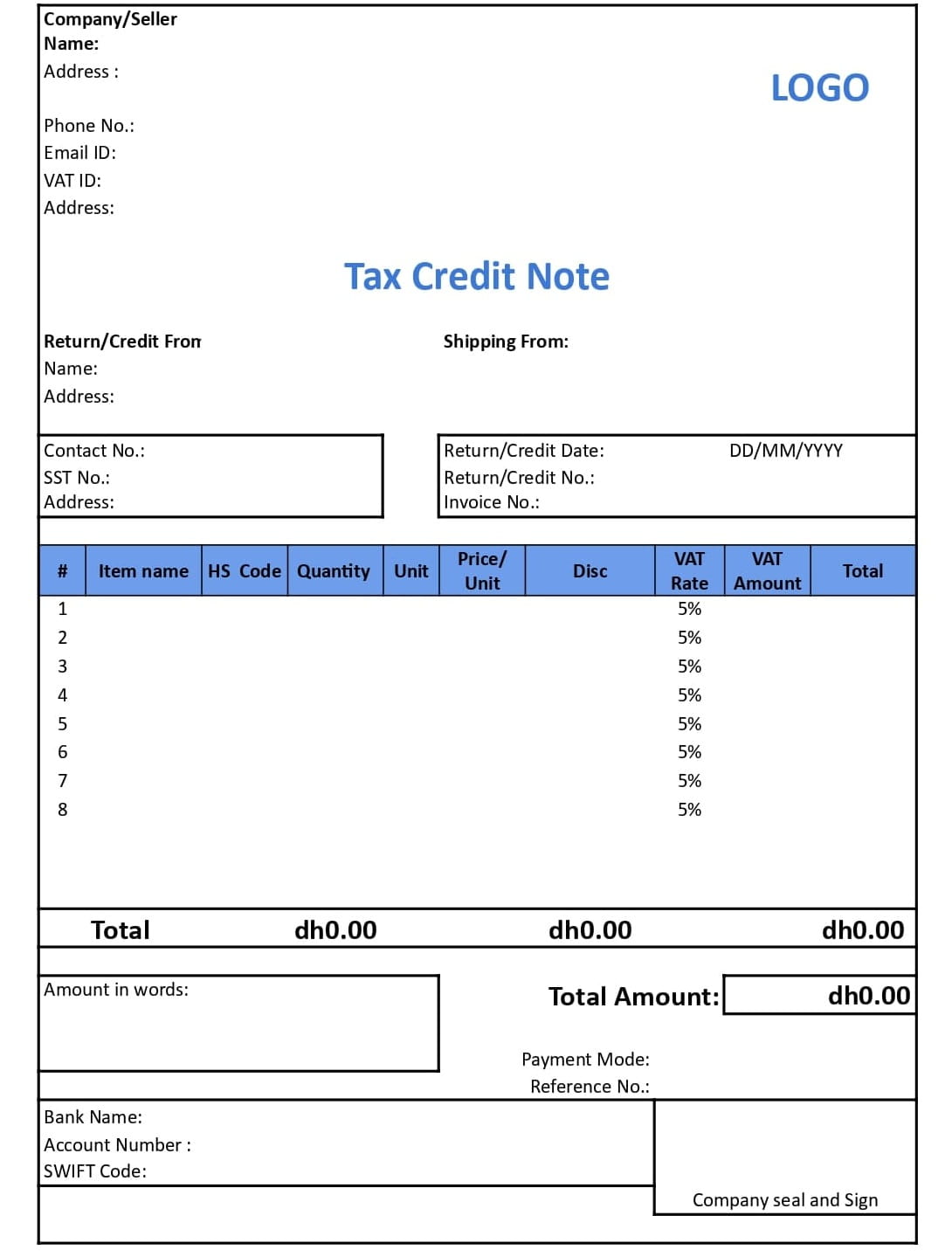
    Here’s a sample tax credit note from the UAE, fully aligned with VAT regulations.

    credit note format

    Benefits of Tax Credit Notes under UAE VAT

    Below are the benefits of tax credit notes under UAE VAT:

    1. Reduction in VAT Liability for Suppliers

    Tax Credit Notes allow suppliers to correct previously issued invoices by reducing the VAT amount owed to the Federal Tax Authority (FTA). These adjustments might arise due to product returns, post-sale discounts, or invoice errors. This correction ensures businesses don’t overpay VAT.

    2. Input Tax Adjustment Benefit for VAT-Registered Recipients

    If the recipient is also VAT-registered, the Tax Credit Note enables them to decrease their claimed input tax, aligning with the corrected taxable amount.

    3. Improved Cash Flow

    By avoiding overpayment of VAT, businesses can retain funds that would otherwise be held until refunds are processed or adjustments confirmed—enhancing liquidity.

    4. Enhanced Accuracy and Error Reduction

    Tax Credit Notes serve as a clean and systematic way to amend billing errors, such as overcharges or wrong VAT calculations, without generating new invoices or complicated manual adjustments.

    5. Regulatory Compliance and Audit Readiness

    Using Tax Credit Notes in alignment with FTA rules ensures proper documentation and reduces the risk of penalties during audits.

    6. Customer Trust & Satisfaction

    For returns or price adjustments, Tax Credit Notes provide transparency and fairness, reinforcing trust between businesses and their customers.

    7. Supports Electronic Record-Keeping & E-Invoicing

    Electronic Tax Credit Notes are encouraged, when issued via approved digital systems, they’re secure, tamper-evident, and seamlessly integrated into accounting workflows.

    8. Simplifies Complex Transactions

    Under Cabinet Decision No. 81 of 2023, businesses can combine tax invoices and credit notes within a single document labelled “Tax Invoice/Tax Credit Note,” reducing administrative burden without compromising clarity.

    How Shuraa Tax Ensures Compliance with Credit Notes and UAE Tax Credit Notes

    A credit note, whether a simple adjustment tool or a formal UAE Tax Credit Note under VAT is far more than just an invoice note issued against errors or returns. It safeguards accurate financial records, ensures VAT compliance, and maintains transparency in every business transaction. Whether you’re issuing a credit note invoice, reconciling a credit note against invoice, or referring to a credit invoice example, precision and timely action are non-negotiable under UAE law.

    With the Federal Tax Authority’s updated 14-day rule and evolving VAT framework, businesses can no longer rely on manual checks or outdated processes. Non-compliance, even if unintentional, can trigger penalties and disrupt cash flow. That’s why proactive measures, like automating credit note workflows, training finance teams, and auditing VAT processes, are critical.

    Shuraa Tax can help you navigate these requirements with ease. From ensuring every Tax Credit Note under VAT meets FTA standards to streamlining your accounting systems for error-free reporting, their experts make compliance seamless. Whether you need guidance on issuing a credit note invoice, structuring a credit note against invoice, or understanding a detailed credit invoice example, Shuraa Tax offers the clarity and precision your business deserves.

    Get expert VAT support today:
    Call: +(971) 44081900
    WhatsApp: +(971) 508912062
    Email: info@shuraatax.com

    By treating credit notes as a compliance asset not just a correction tool you’ll protect your business, improve liquidity, and build lasting trust with both customers and regulators.

    FAQs

    1. What is a Tax Credit Note under UAE VAT?

    A Tax Credit Note is a document issued by a supplier to adjust or reduce the value of a previously issued tax invoice. It is typically used when goods are returned, services are cancelled, discounts are applied after invoicing, or errors are found in the original invoice. The note ensures VAT adjustments are correctly reflected in both supplier and buyer records.

    2. When can a Tax Credit Note be issued in the UAE?

    As per Federal Tax Authority (FTA) regulations, a Tax Credit Note must be issued within 14 days from the date the supplier becomes aware of the adjustment requirement. This ensures VAT records remain accurate and compliant with UAE law.

    3. What details must a valid UAE Tax Credit Note contain?

    A valid Tax Credit Note must include:

    • Supplier’s name, address, and Tax Registration Number (TRN).
    • Recipient’s details and TRN (if VAT registered).
    • Title “Tax Credit Note.”
    • Date of issue.
    • Reason for issuing the note.
    • Original invoice value, corrected amount, and VAT adjustment.
    • Reference to the original supply or invoice.

    4. What are the benefits of issuing a Tax Credit Note?

    Tax Credit Notes ensure:

    • Reduction in VAT liability for suppliers.
    • Correct input tax adjustment for buyers.
    • Improved cash flow by avoiding VAT overpayment.
    • Error-free records for audits and compliance.
    • Transparency and stronger customer trust.

    5. What happens if a Tax Credit Note is not issued correctly or on time?

    Failure to issue a Tax Credit Note within the 14-day deadline, or providing incomplete details, may result in FTA penalties, incorrect VAT reporting, and potential disputes with customers. Businesses should upgrade their accounting systems and train finance teams to avoid such risks.