Author: Afroz

  • Why do you need accounting and bookkeeping services in Dubai?

    Why do you need accounting and bookkeeping services in Dubai?

    Accounting and bookkeeping services in Dubai are the need of the hour! The implementation of VAT in the UAE has not only affected the tax calculation but also changed the way UAE companies operate and do business. Be it accounting services for small business in Dubai, or bookkeeping services for a multinational company – outsourced accounting services UAE can provide the best for you company!

    But if you are still thinking whether you need to outsource accounting and bookkeeping services in Dubai, here are some reasons that will help you decide.

    File UAE VAT returns

    Companies registered by the FTA for VAT in Dubai or anywhere across UAE need to file tax / VAT returns every interval. These intervals may be maintained on monthly or quarterly basis depending on the nature of the business.

    Follow FTA compliances

    Taxable entities must adhere the FTA compliances while doing business in the UAE. Businesses that appoint UAE bookkeeping and accounting firms or even tax consultants are for sure updated to incorporate the new VAT laws. Bookkeeping and accounting firms ensure that FTA compliances are updated in your operations, sales, accounting methods, business procedures and expense management systems.

    Reduced Costs & Limit Errors

    Accounting and bookkeeping services in Dubai – UAE can seem like an additional cost. However, outsourcing accounting services can help you reduce costs & limit errors. Accounting in UAE is a tedious task! If you do a mistake you will have to face the penalty, but a professional accountant will know how to lessen costs without any blunders. Professional accountants can limit human error, have complete knowledge about payments and tax obligation, due dates, etc.

    Focus on your core business

    Taxation in the UAE requires fulltime attention and monitoring. Outsourcing accounting and bookkeeping services in Dubai – UAE will enable you to focus on your core business. While you strategize, market, fund, sale and focus on your daily operational, an accounting and bookkeeping firm can handle the taxation aspects of your business.

    Thus, to ensure that your company has implied the FTA compliances in all realms and properly maintained the accounts contact Shuraa Tax Consultants.

    Shuraa Tax Consultants are the best in accounting and bookkeeping services in Dubai and across UAE. We are a Dubai accounting company offering bookkeeping services in UAE to help you manage your finances, assist you with VAT registration, raise VAT compliant invoices, create business reports, generate VAT returns and other bookkeeping services.

    For further details of accounting and bookkeeping services in Dubai book a free consultation with our expert tax consultants in Dubai or simply call on +971508912062. You can also email us your query at info@shuraatax.com and we will call you back to solve all your doubts.

  • Your questions related to VAT filing answered

    Your questions related to VAT filing answered

    How to file VAT returns in the UAE?

    Companies that are registered with the FTA, need to file their return using the Federal Tax Authority portal and their online services. VAT e-filing will be active on the portal of Federal Tax Authority www.tax.gov.ae. But, the best and easiest to do this is through appointing a tax consultant or taking guidance from tax advisories.

    When to file VAT returns to avoid penalties?

    The interval to file a tax return is likely to be 3 months for most of the companies, that can be calculated as 4 times a year. Nevertheless, there are also some companies that need to file VAT in the UAE on monthly basis.

    What are the penalties for not filing VAT return in the UAE?

    The procedures to file a VAT return in the UAE is quite simple and can be done with the help of a Tax Advisory firm. After the VAT implementation has been done by a company. Regular bookkeeping procedures and tax filing routine must be followed to avoid any penalties.

    Any delay is filing the tax return can attract penalties such as 1,000 AED for the first time and 2,000 AED in case of repetition within 24 months.

    Why is it crucial to file VAT returns?

    Filing VAT return in the UAE is a recognized process to report the financial proceeding of a company. VAT is paid every interval and must be accurate to the substantial records, ledgers, and the financial statements of the company. The main purpose of filing a return is to show the summary of the value added tax to the authorities. It stands as evidence that VAT obligations are thoroughly followed by the company.

    Get in touch with Shuraa Tax Consultants to file your first tax return.

    Shuraa Tax Consultants can help you with Tax Consultation, Tax Registration, VAT filing and everything related to VAT in the UAE. To know more about the VAT / Tax in the UAE or to get a free consultation email us at info@shuraatax.com and we will call you back to answer your questions.

  • Do you need a VAT Certificate to do business in Dubai?

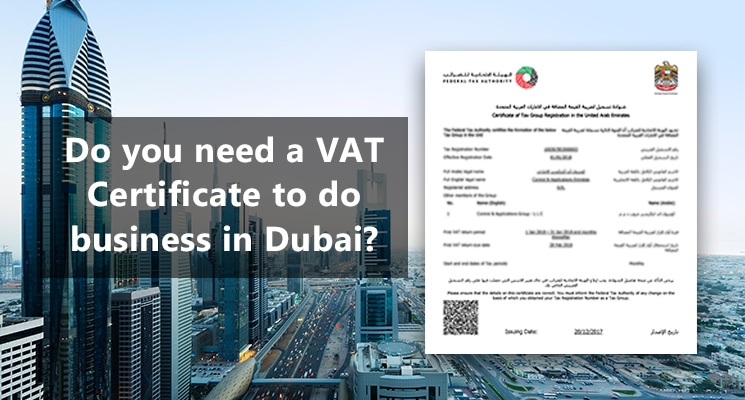
    Do you need a VAT Certificate to do business in Dubai?

    Businesses and companies in Dubai as well as across the UAE have been introduced to value-added-tax for some time now. Coping with the changes, commercial entities have adopted various ways to tackle taxation within the organization. One such change that businesses have instigated is to verify the VAT certificate of their suppliers and dealers.

    But is VAT certificate a mandatory?

    To substantiate your business and commercial activities you would need to apply for a VAT certificate. However, to do business in the UAE, you do not need to get the VAT certificate from your suppliers and dealers.

    Businesses can just get the TRN Number / Tax Registration Number to verify their suppliers and dealers. The UAE VAT Registration Number or TRN number can be crosschecked on the official website of Federal Tax Authority (FTA). Thus, there is no need of directly checking the VAT certificate and the TRN number is sufficient.

    The Federal Tax Authority has also offered provisional Tax Registration Number of companies who submitted their UAE VAT registration applications after the deadline. The FTA did this to allow such companies to conduct business and comply with their tax obligations. Nevertheless, companies need to complete their UAE VAT Registration procedures and submit the FTA all required documents.

    The FTA also supports the UAE businesses to fulfill with tax regulations and to certify that their operations are not disordered. The provisional UAE Tax Registration Number enables commercial transactions and validates the legal status of the taxable entities. However, obtaining a validated UAE VAT certificate is only possible after completing the procedures.

    Therefore, whether you need to get your final UAE Tax Registration Number; get your VAT Certificate or manage VAT in the UAE – Shuraa Tax Consultants can help you with your every tax-related needs in UAE.

    To know more about the taxation system or to get a free consultation, contact  Shuraa Tax Consultant today! You can email us at info@shuraatax.com or follow us this section for VAT-related updates.

  • 10 things you need to know about the new UAE tax law 2018

    10 things you need to know about the new UAE tax law 2018

    The legal framework in the United Arab Emirates has been imminent and divergent, to bring about progressive changes and development in the country. Aiming similar outcomes for the region, the new UAE tax law was introduced recently on 1st January 2018.

    According to the new tax law in Dubai – UAE, Value Added Tax (VAT in UAE) is applicable to various categories of businesses and services. All the commercial activities are now subjected to the payment of five percent (5% VAT) value-added tax VAT in Dubai, UAE.

    NEW TAX LAW IN BRIEF

    The Federal Decree Law No. (8) Of 2017 Value Added Tax stated by the Ministry of Finance (MoF) summaries the tax possibilities within the country; the VAT rate, the responsibilities that will be carried out by the collection of these taxes for the growth of the country; the taxes that will be applied to the supply chain. The new UAE tax law also defines the UAE tax registration and deregistration, as well as the mandatory threshold for tax registration, tax group, registration exceptions, tax registration for government bodies as well as voluntary registration. The Article 85 of the UAE VAT Law, showcases the effective date of this Decree – as 1 January 2018.

    This new UAE tax law environment in the country has also brought about a series of confusion and uncertainties. Moreover, businesses and commercial entities are also having a hard time understanding the new tax law in Dubai and all other parts of the UAE.As consumers, traders and end-users across the UAE need to familiarize themselves with a value-added tax (VAT) system and to be able to identify their role as taxpayers, we at Shuraa Tax Consultants offer you suitable help in this regard.

    NEVERTHELESS, HERE ARE THE 10 THINGS THAT YOU MUST KNOW ABOUT THE NEW UAE VAT TAX LAW:

    1. The VAT law in UAE is based on the VAT guidelines agreed in the Unified GCC Agreement for Value Added Tax (VAT) published in the Official Gazette on 21 April 2017. However, specifications on the implementation of VAT in UAE incorporated in Federal Tax Authority FTA regulations.
    2. Businesses operating across UAE need to adhere to the changes in the cost structure, compliances as well as organizational structure as well as file tax returns on Monthly and Quarterly basis due to the VAT implementation in UAE and comply with the UAE VAT requirements and updates at all times.
    3. The mandatory threshold to register for VAT in UAE is Dh375,000 and the voluntary threshold to register for VAT is Dh187,500. Business in the process of establishment/company formation in UAE needs to get their VAT registration under the new UAE VAT law within 30 days of establishing the company/business, while older companies had to register before 31 December 2017 to avoid penalties.
    4. Companies in UAE must obtain Tax Registration Number from the Federal Tax Authority to pay VAT. The Tax Registration Number also called for TRN number or tax identification number which is required to print all the invoices and bills of the company. The UAE TRN Number is also used while filing tax returns and dealing with the FTA.
    5. Companies and business entities in the UAE must follow a four-processes 1) Obtain VAT registration from the FTA 2) Charge VAT in UAE on taxable goods or services; 3) Reclaim any UAE VAT they have paid on business-related goods or services; 4) keep a range of commercial and business records for FTA’s evaluation.
    6. As of now, FTA has stated that exemption on VAT is on basic education, healthcare, residential real estate, local transport and zero-rate on some sector. The VAT exemption or zero-rating in these commercial sectors are currently a huge saver for VAT payers in UAE. However, except VAT exemption or zero-rated supplies all other goods and services in the UAE, even if supplied by the governmental bodies and governing authorities are chargeable to VAT.
    7. VAT penalties are outlined by the Federal Tax Authority and can be applied to 1) companies and businesses failing to register for VAT in UAE; 2) companies and businesses, who do not submit a tax return or make a payment within the determined period; 3) companies and businesses, who do not maintain  the records as per the VAT guidelines of the tax legislation; 4) any kind of tax evasions, deliberate act or omission was done intentionally to violate the provisions the FTA will impose VAT penalties.
    8. As per the new UAE Tax Law, the credit of input VAT is not allowable on the expenses incurred for producing exempted supplies. Moreover, input tax cannot be claimed if it is incurred in respect of specific expenses such as obtaining a vehicle for rent or lease for personal use, entertainment expenses, etc. For e.g. employee entertainment as per Article (53) of federal Decree-Law No (8) of 2017 on Value Added Tax.
    9. In case of a UAE nonresident, the new UAE Tax law who makes supplies of goods and services in the country requires registration in accordance with the provisions of the Decree-Law. The Federal Tax Authority shall register him with effect from the date on which he or she started making supplies in the UAE. It could be an earlier date if agreed by the FTA and the non-resident entity.
    10. All the UAE companies and businesses within the country – whether registered for VAT or not, must retain their financial records. These financial records include Balance Sheet, Profit and Loss reports, fixed assets reports, payroll sheet, reports on inventory, stock level reports and accounting records (including payments, receipts, purchases, sales, revenues and expenses).

    Concludingly, it is also important to know that almost all commercial individuals or companies require to change their financial management practices as well as core operations to follow the procedures levied by the legislation in terms of accounting books and records. Also, the technology of accounting practices and human resources such as chartered accountants, tax advisers and UAE tax consultants are a must!

    The most easy and quick solution to maintain all sorts of communication and understand guidelines provided by the Federal Tax Authority is to get in touch with SHURAA TAX CONSULTANTS.

    SHURAA TAX CONSULTANTS support you with each and every requirement for UAE VAT & Dubai Taxation Services. Speak to our Tax consultants to understand the taxation system in UAE. Call us on +971508912062 or visit www.shuraatax.com.